




The printers in this family keep two supplies, and most owners only ever shop for one of them. The toner cartridge gets the orders; the imaging drum quietly forms every page in the background — and when it wears out, fresh toner cannot rescue the output. HP built exactly one drum for these machines: the 32A, part CF232A, rated at roughly 23,000 pages and shared by 12 printers across two toner platforms. This store sells that one drum at six depths, and those six offers are the cards below. Five further listings sell the identical single drum under printer-model names — names that call it a toner cartridge, which it is not. Every price on this page is a sale price; the product pages do their arithmetic from list.
Start with the distinction this whole page hangs on: the CF232A is a drum, not a toner cartridge. It carries no toner, and it runs on a far longer clock — about 23,000 rated pages against the 1,200 to 3,500 pages of the toner cartridges it partners. There is no tier decision to make: HP issued one drum for these printers, and the store sells that one drum. The only choice is depth. The ten-pack leads as flagship — 230,000 pooled rated pages at 0.059¢ a page — while the single at $28.10 is the yardstick every pack is measured against. You need one when the supplies status page shows the drum nearing its end, or when output goes pale across the whole page while the toner gauge still shows life — the two supplies fail differently, and only one of them is cured by a new cartridge. HP’s own drum, for scale, costs $122.99: $94.89 more than the compatible single, for the same rating.
The ten-drum carton — depth is the only decision this family asks
Stack ten drums in a single carton and the order carries 230,000 rated pages of imaging life — enough to see a small fleet through toner change after toner change without a drum order in between. The carton is $136.33: $13.63 a drum against $28.10 bought one at a time, and $144.67 kept against ten singles at $281.00. Set it against HP’s own shelf and the contrast sharpens — one genuine CF232A costs $122.99, so this ten-drum carton runs $13.34 more than a single HP drum and delivers ten. Beside the flagship sits the shelf’s oddity: the same single drum, sold five more times under names that misdescribe it. It is also the shelf’s simplest value story: one drum specification, bought ten at a time, at less than half the single’s per-unit cost — $13.63 against $28.10 — with no tier, rating or compatibility question anywhere in the arithmetic.
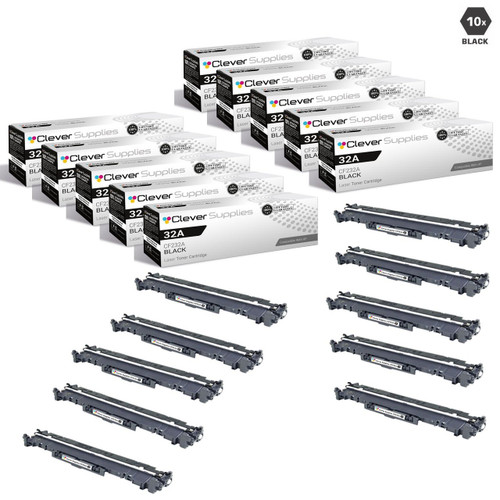
Built for central stock: hold the cartons where supplies are managed, and send a drum out when a site’s output fades evenly or its status page calls for one. A drum change on this platform is a rare, planned event — the rating runs to roughly 23,000 pages — so depth here is about never being caught without a unit, not about feeding a hungry machine.
Shop the 32A 10-Pack →One product gets one card on this page, and the card follows the listing that calls the drum a drum. The five name-doors are written up here and in the closing note — described, never linked.
One drum at five more depths — the CF232A ladder
Below the flagship, the ladder steps down through five, four, three and two drums to the single. One rung is a small catalog mystery: the four-pack exists only inside a newer listing that names the drum a “Toner Cartridge 4 Black” and introduces it as one — while its own questions and closing paragraphs describe the drum correctly, in its own words: “The drum holds no powder.” The card below follows the product, not the name. Every other rung wears its drum name honestly. The ladder’s per-unit prices fall in a clean staircase — $28.10, $20.07, $17.38, $16.05, $15.24 and $13.63 at the flagship — because each box divides the same drum by a larger count.
THE CF232A LADDER — SHALLOWER DEPTHS
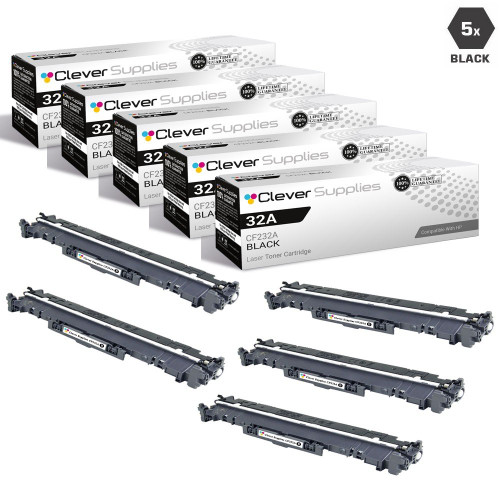
Five drums pool 115,000 rated pages at $15.24 a unit — the natural stock for a handful of printers on one site. Five singles at sale come to $140.50, so the box keeps $64.30, and its rate sits a whisker above the flagship’s.
Shop the 32A 5-Pack →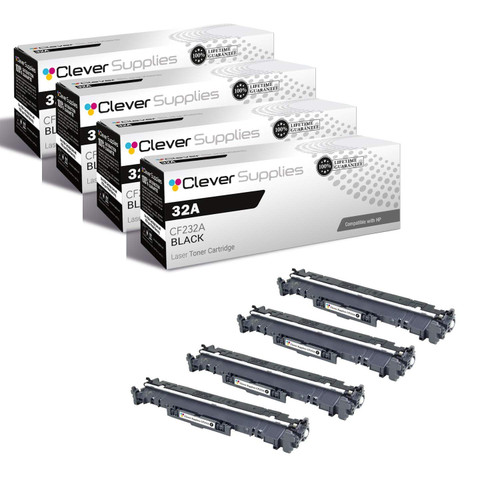
The family’s only four-pack, and its most confused page: the name and introduction sell a toner cartridge, while the questions and closing text sell the drum that is actually in the box. The drum is real — 92,000 pooled rated pages at $16.05 a unit; four singles total $112.40, so the pack keeps $48.22.
Shop the 32A 4-Pack →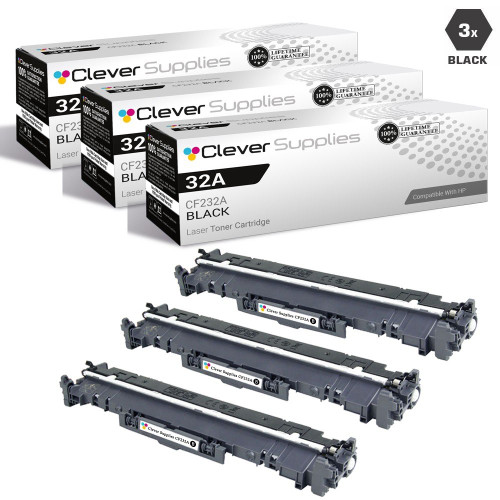
Three drums pool 69,000 rated pages — one fitted, two shelved — at $17.38 a unit. Each unit’s cost is computed here from the $52.15 actually charged, not the $59.97 list its page works from. Three singles total $84.30; the pack keeps $32.15.
Shop the 32A 3-Pack →
The pair pools 46,000 rated pages — one drum working, one waiting for a change that may be years away. Two singles come to $56.20; the pair keeps $16.07, at $20.07 a drum.
Shop the 32A 2-Pack →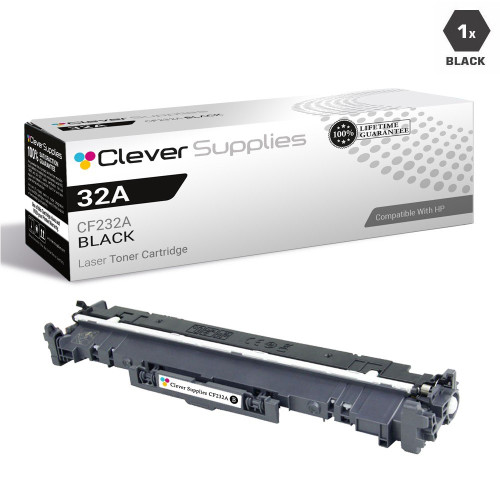
The yardstick of the shelf: every badge above is measured against this drum. Its own closing text prices it at “$32.32” — the list figure; the price actually charged is the $28.10 shown here. One drum, honestly named, rated for ~23,000 pages.
Shop the 32A Single Drum →The whole shelf on one table — plus HP’s own price
One row here is not like the others. HP still sells this drum itself, so the genuine article takes a row: $122.99, in stock at HP’s US store when read, rated the same ~23,000 pages as every compatible unit on the table. Read its rate — 0.535¢ a page — against the flagship’s 0.059¢, and the shape of this shelf explains itself.
| Configuration | Price | Rated pages | Cost / page | Printer fit |
|---|---|---|---|---|
| 32A 10-Pack — the flagship | $136.33 | 10 drums · ~230,000 pages | 0.059¢ pooled | All 12 models |
| 32A 5-Pack | $76.20 | 5 drums · ~115,000 pages | 0.066¢ pooled | All 12 models |
| 32A 4-Pack | $64.18 | 4 drums · ~92,000 pages | 0.070¢ pooled | All 12 models |
| 32A 3-Pack | $52.15 | 3 drums · ~69,000 pages | 0.076¢ pooled | All 12 models |
| 32A 2-Pack | $40.13 | 2 drums · ~46,000 pages | 0.087¢ pooled | All 12 models |
| 32A Single | $28.10 | 1 drum · ~23,000 pages | 0.122¢ | All 12 models |
| Genuine HP 32A (CF232A) | $122.99 | 1 drum · ~23,000 pages | 0.535¢ | All 12 models |
The ladder’s lesson runs one way: every added drum lowers the per-page rate, because the single carries the shelf’s worst rate and each pack spreads the same drum thinner. There are no tiers to game and no ratings to argue over — HP’s one figure, ~23,000 pages, divides every price on the table.
A note on the rating every row shares: HP declares the ~23,000 pages under ISO/IEC 19752, with its own footnote that actual yield varies considerably with the content of the pages printed. The listings repeat the figure exactly — none adds a page — and the pooled totals in the table are plain multiples of it: two drums, 46,000; ten drums, 230,000. Each rate divides the configuration’s sale price by that rating, so the table compares prices on a single, manufacturer-stated basis rather than on any seller’s estimate.
Twelve printers, two toner families, one drum
HP rates the CF232A for 12 printers, and the 12 divide into two camps that share nothing but the drum. The larger camp prints on the 30A and 30X toners: the LaserJet Pro M203d, M203dn and M203dw; the MFP M227d, M227fdn, M227fdw and M227sdn; and the Ultra MFP M230fdw and M230sdn. The smaller camp — the LaserJet Pro M118dw and the MFP M148dw and M148fdw — runs the 94A and 94X toners instead; that shelf has its own buying guide. Same drum, two toner families: an owner moving between camps changes cartridges, never drums.
You would not assemble that roster from the product pages. The ten ladder listings name five printers between them — a series shorthand along the lines of “LaserJet Pro M203, M203DW; LaserJet Pro MFP M227, M227FDN, M227FDW” — which skips the M203d, M203dn, M227d, M227sdn and both Ultra models, and never mentions the M118dw or either M148 at all. The four-pack’s closing text names nine, the fullest on the shelf, and still omits the entire second camp. The roster above is HP’s, and it is complete at 12.
The category tree hides the drum from half its owners. No family category exists for the CF232A — the listings hang on model and series pages only — and the filing splits two ways: the ladder sits under M203 and M227 buckets, the four-pack under the nine M203-to-M230 model pages, and no drum listing is filed under the M118dw, M148dw or M148fdw categories at all. Browse your M148’s category and you will find its toners, but not the drum HP rates for it. The links above lead to each model’s primary category regardless.
Finding your own camp takes one glance: the model name on the machine’s front panel decides it. M203, M227 and Ultra M230 owners shop the 30A/30X toner shelf; M118dw and M148 owners shop the 94A/94X shelf. The drum ignores the boundary entirely — the same CF232A box serves a warehouse M227fdw and a desk-side M118dw — which is precisely why the missing M118/M148 filing matters: the camp an owner belongs to for toner is invisible on the drum’s own pages.
For all that, the fit text never overreaches: no listing names a printer outside HP’s 12, and none carries a warning against a model HP includes. On fit, this family’s fault is omission, not invention.
Toner fills the page; the drum forms it — two supplies on two clocks
Inside these printers the two supplies divide the labor. The toner cartridge carries the powder. The drum — a light-sensitive cylinder — takes the page image from the laser and lays that powder onto the paper. It holds no toner of its own: open HP’s box for the genuine article and the contents line reads “Imaging drum; Recycling guide.” When output fades evenly from edge to edge, or streaks in a pattern that repeats down the sheet, while the toner gauge still shows life, the drum is the suspect — and the printer can tell you which clock ran out, because it tracks toner level and drum life separately and reports both on its supplies status page.
The clocks run at very different speeds. A toner cartridge on this platform is rated between ~1,200 and ~3,500 pages, depending on camp and tier. The drum is rated ~23,000. So one drum partners roughly fourteen standard 30A cartridges — or six to seven 30X cartridges — in an M203 or M227 machine, and roughly nineteen 94A or eight 94X cartridges in an M118 or M148 machine, before its own turn comes. That arithmetic is why the drum is so easy to forget: it outlasts cartridge after cartridge, quietly, until the day the status page names it.
Fitting its replacement is a one-unit swap: the spent drum lifts out, the new drum seats in its place, and the printer begins tracking the new unit’s life from that moment — each machine meters the drum actually fitted in it, which is why a drum cannot be shared or rotated between printers to spread the wear. Nothing is filled, and no toner changes hands in the exchange at all.
Each compatible drum here carries a current-generation smart chip — the ten ladder listings say so in their introductions — and that chip is what lets the printer meter the drum’s remaining life and report it beside the toner gauge. Nothing is transplanted from the spent drum; the new unit arrives chipped and is recognized the moment it is fitted. That is the store’s position for the firmware these machines run today; no seller can honestly underwrite firmware HP has not written yet. One listing’s text — the four-pack’s — makes no chip statement at all; the silence is recorded in the closing note.
The terms, stated once and stated the same on all 11 pages
This family’s paperwork is the tidy kind. Every one of the 11 listings states the same terms — a one-year warranty and one year of free returns, running per unit inside the packs — and no page carries a “Lifetime” line to contradict them. It is the one part of this family’s paperwork that needs no correction anywhere on this page. The tiles below print the operative set.
Choosing a depth by the machines you feed
With one specification and no tiers, the pick is purely how many machines you run and how much central stock you like to hold:
Questions from M203, M227, M118 and M148 owners
No — and the distinction is this family’s whole subject. The 32A (CF232A) is an imaging drum: a light-sensitive cylinder that forms the page image and transfers toner onto the paper. It contains no toner; HP’s box for the genuine article lists an imaging drum and a recycling guide, nothing else. Your printer needs both supplies — toner cartridges for powder, this drum for imaging — and they wear out on different clocks, roughly 1,200 to 3,500 pages for a toner cartridge against ~23,000 for the drum. Several listings on this shelf blur exactly that line in their names; the part code does not. If the code on the unit reads CF232A, it is the drum. On many LaserJet platforms the drum rides inside the toner cartridge and is renewed with it; on these 12 models HP split the two supplies apart, and that split is what the listings’ names keep tripping over.
It depends on which of the two camps your printer sits in. The M203, M227 and Ultra M230 machines pair the drum with the 30A (CF230A, ~1,600 pages) or the high-yield 30X (CF230X, ~3,500 pages). The M118dw, M148dw and M148fdw pair it with the 94A (CF294A, ~1,200 pages) or the 94X (CF294X, ~2,800 pages). The drum itself is identical either way — one CF232A serves all 12 printers — but the toners are not interchangeable between camps, so order toner by your printer’s camp and the drum by the code alone.
Because two listing generations meet on this shelf and the naming slipped in both. Five listings built around printer-model names are titled and SKU’d “Toner Cartridges” while their own descriptions sell the drum — and their introductions print codes like “CF2M203” that exist in no HP catalog. The four-pack’s listing is named “Toner Cartridge 4 Black”, its introduction praising toner performance before its questions correct course: “The drum holds no powder.” Buy by the part code — CF232A is the drum, whichever name the page wears.
On rating, about 23,000 pages’ worth: roughly fourteen standard 30A cartridges in an M203 or M227 machine, six or seven 30X cartridges, roughly nineteen 94A cartridges in an M118 or M148 machine, or eight 94X. Real counts move with coverage, but the shape holds — the drum is a many-cartridge part. Each printer tracks the fitted drum’s life itself and reports it on the supplies status page, separately from the toner gauge, so the machine announces the drum’s turn well before output suffers.
Yes — the equivalence underneath one garbled paragraph on this shelf is real. Canon sells the same drum as its Drum 051 (2170C001AA), likewise rated at 23,000 pages, for its own machines on this platform. What the four-pack’s page gets wrong is the route: it first calls the CF232A “the same cartridge Canon sells as Canon Cartridge 051 and 051H” — but those two Canon codes are toner cartridges, and only the sentence’s final clause lands on the drum. Same drum, wrong first draft.
The pages do their sums from the list price; this guide uses the price at checkout. The single’s closing text says “Priced at $32.32” while the till charges $28.10. The five-pack’s page works from $87.63 against $76.20 charged; the ten-pack’s from $156.78 against $136.33. Every derived figure on those pages inherits the higher basis — per-unit costs included. Every figure here is computed from the sale price.
Price and disclosure note: Prices here are the sale prices the six carded listings showed when this guide was read against the store on November 18, 2026 — if a product page disagrees when you visit, that page governs. The descriptions themselves quote list prices throughout: $32.32 for the single, $46.15 for the two-pack, $59.97 for the three-pack, $73.81 for the four-pack, $87.63 for the five-pack and $156.78 for the ten-pack. Badge savings are sale against sale: the two-pack at $40.13 against $56.20, the three-pack at $52.15 against $84.30, the four-pack at $64.18 against $112.40, the five-pack at $76.20 against $140.50, the ten-pack at $136.33 against $281.00. Yields are HP’s: ~23,000 pages per drum under ISO/IEC 19752, and the pooled totals are plain multiples of that figure. The genuine CF232A stood at $122.99, in stock, at HP’s US store on the same date. Fit follows HP’s published 12: M203d, M203dn, M203dw, M227d, M227fdn, M227fdw, M227sdn, Ultra MFP M230fdw, Ultra MFP M230sdn, M118dw, M148dw and M148fdw. HP’s sheet also carries an “Ultra M206” series line; no distinct US model stands behind it, so it is not counted above. What the catalog itself gets wrong follows.
(1) Five listings are named and SKU’d as “Toner Cartridges” while selling the imaging drum — the mislabel sits on the very distinction this family exists to teach; their descriptions sell the drum correctly. (2) The four-pack listing is named “Toner Cartridge 4 Black”, and its introduction repeatedly calls the CF232A a toner cartridge and praises its print output; its questions and closing text describe the drum correctly. (3) That listing’s Canon cross-reference first equates the drum with Canon’s 051 and 051H toner cartridges, correcting itself to Canon Drum 051 only at the end, and links into the two Canon toner listings. (4) The five model-named listings’ introductions print part codes that do not exist — “CF2M203”, “CF2M203DW”, “CF2M227”, “CF2M227FDN”, “CF2M227FDW” — as the genuine part being replaced. (5) Every listing’s closing text quotes its list price as the price while checkout charges the lower sale figure, and all derived numbers inherit the basis. (6) Fit under-naming in all 11 listings: the M118dw, M148dw and M148fdw platform is named in none of them; the ladder names 5 of the 12 models HP rates, the four-pack names 9. (7) No family category exists for this drum; the ladder and the four-pack file into disjoint category sets, and no drum listing is filed under the M118dw or M148 categories, where a browsing owner would look. (8) The M203d category sits under the store’s color LaserJet branch though the line is monochrome, and duplicate buckets shadow M203dw, M227fdn and M227fdw — one set stamping the print-only M203dw as an “MFP”. (9) A broken “<p> />” fragment opens each of the ten ladder-generation descriptions. (10) Weight fields read 2 for the single and the ten-pack alike, and 3 for the four-pack — flat figures that cannot describe both ends of the ladder. (11) Stock figures are one echo: six storefronts read the same pool of 230, and the pack figures are that pool divided by pack size; this guide makes no per-listing stock claims. (12) The ladder’s texts name only the CF230A/CF230X toner pairing, silent on the CF294A/CF294X pairing the M118/M148 camp uses — the same omission as the missing models. The four-pack’s text, alone on the shelf, makes no chip statement; the chip paragraph above follows the other ten listings and the store’s position. The negative results belong on the record as well: every listing states HP’s ~23,000-page rating without adding a page; no listing names a printer outside HP’s 12; no tier was invented, because HP issued one drum and the store sells one drum; wherever the text turns to the drum’s function it describes it accurately; no production text leaks into any description; and every listing carries an image.
The buyable shelf rides on six cards — one for each depth of the single drum HP made. Five more listings sell the same single drum under printer-model names and are handled in prose, never offered. The terms underneath are the ones all 11 listings agree on: a one-year warranty, a year of free returns, a support desk staffed weekdays between 9 AM and 5 PM Central, and dispatch from warehouses in Illinois, Pennsylvania, Georgia and California.