




Some printer platforms hand you a shelf of choices; this one hands you a ladder to audit. HP’s big departmental LaserJets — the 8100 and 8150 families, and the Mopier 320 — were built around a single cartridge, the C4182X, and HP never issued a second size: no standard-yield 82A exists, and none ever did. This store stocks that cartridge in three box counts. Beside them sits a second ladder wearing a code HP never printed — 82XJ, “Maximum Yield” — rated at 26,000 pages by the listings alone. Below, both ladders are priced at sale, every rate is worked out in the open, and each figure carries the name of whoever stands behind it: HP, or the shelf.
Start with what HP did, because it is unusually simple. For the LaserJet 8100 and 8150 platform HP published one cartridge — the 82X, code C4182X, rated at 20,000 pages — and no other. There is no standard-capacity version to step up from; the high-yield cartridge is the entire line. The store’s shelf then splits into two ladders. The documented ladder sells the C4182X as a single, a two-pack and a three-pack. The claimed ladder sells a C4182XJ “Maximum Yield” cartridge as a single and a three-pack: a code that appears in no HP document, carrying a 26,000-page rating no HP source supports, priced $30.59 above the X cartridge it sits beside. Both ladders fit the same printers. What separates them is paperwork — one set of numbers can be traced back to HP, and the other stops at the listing. This guide cards all five buyable boxes, flags the claimed figures wherever they are used, and leaves the tracing to you.
The deepest box in the family — and the claim it stands on
Seventy-eight thousand claimed pages is the largest single order this family offers, and on the listings’ own arithmetic it is also the cheapest page here: 0.625¢ per claimed page, against 0.660¢ for the best documented rate. Three XJ singles at sale total $519.99; the box is $487.83. The card below is the flagship because depth and rate both peak in it. But this flagship’s headline figure belongs to the shelf, not to HP, and the panel beside the card sets out exactly how far the XJ label can be trusted — read it before the rate persuades you.
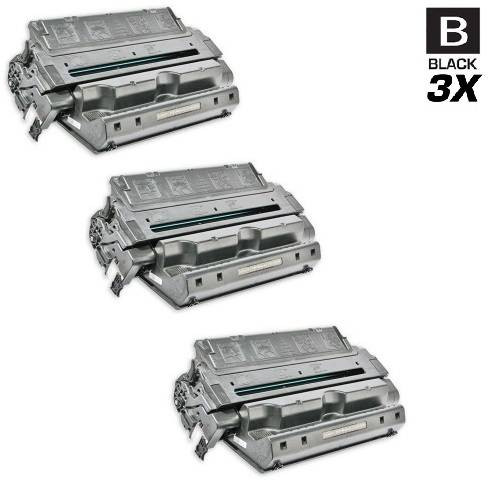
A box of this size belongs in a print room that measures toner by the quarter, or with a small fleet of 8100s and 8150s drawing from one shelf. What it asks of the buyer is a judgment, not a leap: the fit is the platform’s own, the price is the shelf’s best claimed rate, and the 26,000-page figure underwriting that rate is the listings’ claim — weighed in the panel beside this card and again in the yields section below.
Shop the 82XJ 3-Pack →None of this makes the box a bad buy; it makes it a buy whose central number you cannot check against the manufacturer. This guide therefore computes every XJ rate on the claim and says so each time. If the claim holds in your machines, this is the cheapest page in the family. If it does not, the documented ladder below is priced just as openly.
The documented ladder, plus the claimed ladder’s single rung
Four boxes remain. Three of them carry HP’s code and HP’s rating: the X three-pack at 0.660¢ a page, the X two-pack at 0.673¢ and the X single at 0.714¢, with the packs priced $32.17 and $16.09 under the same counts bought one by one. The fourth is the XJ single — the claimed ladder’s entry point, and the listing whose fit answer causes the trouble taken apart in the questions below.
One more listing belongs in this section without earning a card. The X three-pack exists twice on this shelf; the second copy wears a “Premium Quality” name at the identical price, and the panel under the grid quotes what that copy says about itself.
THE REMAINING BOXES
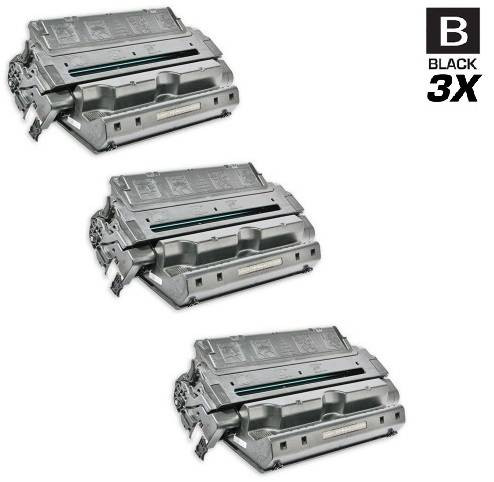
The deepest box whose every number traces to HP. Three C4182X cartridges pool 60,000 rated pages — the rating HP published, repeated without drift by the listing’s features and answers alike. For a buyer who wants depth without the flagship’s asterisk, this is the shelf’s conservative summit: $91.78 less than the XJ box, at a rate 0.035¢ above the claimed best.
Shop the 82X 3-Pack →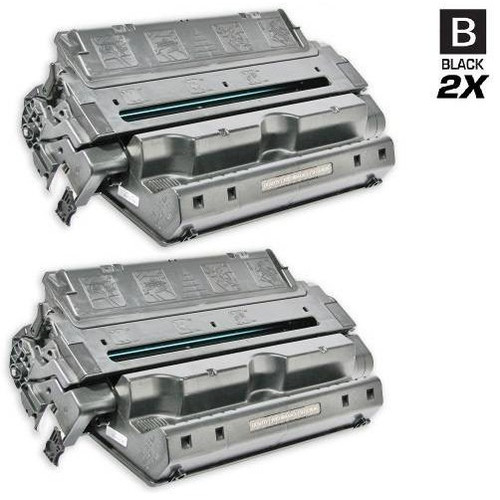
The middle rung: one cartridge in the printer, one in reserve, and 40,000 rated pages between this order and the next one. Two singles bought apart come to $285.48, so the pair keeps $16.09. On a platform whose cartridge already lasts 20,000 pages, a two-pack is a long interval between orders by any office’s arithmetic.
Shop the 82X 2-Pack →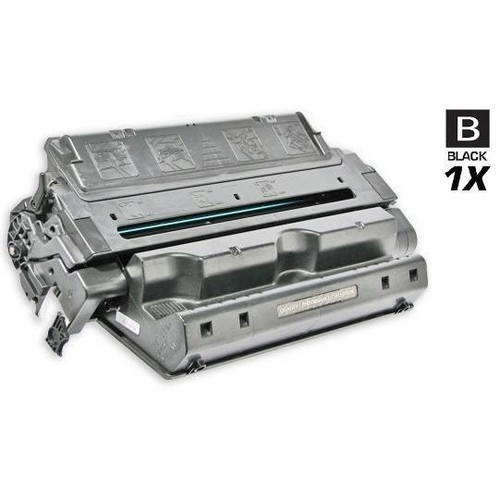
The claimed ladder, one rung high. Its per-page figure, computed on the claim, undercuts even the X three-pack — which is exactly why the claim matters. This listing’s fit answer also tells buyers to match a “C4182XJ” stamp on the cartridge they remove; no genuine cartridge bears that stamp, and the first question below takes the point apart.
Shop the 82XJ Single →
The reference point for the whole shelf: HP’s cartridge, HP’s rating, the highest per-page rate here and the smallest sum to lay out. It is also the listing the catalog weighs strangely — its record carries a weight of 10 against 2 for the three-cartridge boxes, a clerical quirk the closing note itemizes.
Shop the 82X Single →So there is nothing to deliberate: the plain listing holds the card above, and this copy is recorded here — described, quoted, and not linked.
Two ladders, one table — sale prices, claims labeled
No genuine row stands at the head of this table, for the same reason no genuine price appears anywhere in this guide: the C4182X is long discontinued, HP’s US store keeps no page for it with a readable price, and a figure lifted from a reseller would be that reseller’s number, not HP’s. What remains is the shelf itself — five boxes, each row labeled with the source of its page rating:
| Configuration | Price (sale) | Rated pages | Cost / page | Printer fit |
|---|---|---|---|---|
| 82XJ 3-Pack — the flagship | $487.83 | 3 cartridges · ~78,000 claimed pages | 0.625¢ per claimed page | All 10 machines |
| 82X 3-Pack | $396.05 | 3 cartridges · ~60,000 pages | 0.660¢ | All 10 machines |
| 82X 2-Pack | $269.39 | 2 cartridges · ~40,000 pages | 0.673¢ | All 10 machines |
| 82XJ Single | $173.33 | 1 cartridge · 26,000 claimed pages | 0.667¢ per claimed page | All 10 machines |
| 82X Single | $142.74 | 1 cartridge · 20,000 pages | 0.714¢ | All 10 machines |
Read down the cost column and the family’s oddity surfaces: the claimed ladder’s single rung, at 0.667¢ per claimed page, sits below the documented ladder’s three-pack. That inversion is the XJ question in miniature. The 26,000-page claim, if it holds in your machines, rearranges the shelf’s economics in the XJ’s favor; if an XJ cartridge in practice lasts the X’s 20,000 pages, the same single’s rate becomes 0.867¢ — the dearest page here. The table cannot settle which outcome you will get. It can only make sure you see the bet before you place it.
Ten machines take this cartridge; the listings name none of them
HP’s documentation — its safety data sheets and the 8100/8150 service manual — assigns the C4182X to ten machines: the LaserJet 8100, 8100n, 8100dn, 8100mfp, 8150, 8150n, 8150dn, 8150hn and 8150mfp, and the Mopier 320. Nine of the ten have their own category pages in this store, linked from their names above; the Mopier 320 has none, and appears nowhere in the store at all — no listing names it, and nothing is filed under it. In the catalog the family itself sits under the HP C4182X category.
Against that roster, the listings’ own fit statements are strikingly thin. Every description in the family says the same single line — “Compatible with: HP LaserJet 8100 and 8150 printer series” — and stops there. The line is accurate as far as it goes: nothing in any description claims a printer outside the platform, which earns the family a clean mark in the closing note. But an owner of an 8150hn or an 8100mfp reading a product page will find their exact model nowhere on it; the roster above is assembled from HP’s documents, not from the shelf.
Identifying your cartridge is a ten-second job. The unit that comes out of an 8100 or 8150 is stamped C4182X — or, on HP’s channel packaging, C4182X-XC. Either stamp matches the X ladder directly and the XJ ladder by platform. What the stamp will never read is C4182XJ: HP never produced a cartridge under that code, whatever the XJ single’s fit answer advises. If your removed cartridge seems to say otherwise, read it again under better light — it says C4182X.
One rating HP published, one rating the shelf asserts
HP rated the C4182X at 20,000 pages, and the basis matters for a cartridge of this vintage: the figure is an approximate yield at 5 percent page coverage, the measure HP used across its supplies line before the ISO/IEC 19752 declared-yield footnote became standard on later cartridges. Five percent coverage is a page of ordinary office text — a memo, a letter, an invoice — so the rating describes this platform’s natural diet of high-volume plain-text work.
The X listings honor that figure exactly: 20,000 in the features, 20,000 in the answers, no drift anywhere in the tier. The XJ listings are equally consistent with each other — 26,000 everywhere — but their consistency is internal only. No HP chart, matrix, catalog or safety document carries the number, because no HP document carries the cartridge. Every XJ rate in this guide is therefore computed on 26,000 and labeled “per claimed page” each time it appears; the label is the difference between a measurement and an assertion.
In practical terms, even the documented cartridge is a long-haul supply: 20,000 pages is forty reams of paper through one unit. Coverage remains the swing factor — dense graphics and heavy bold spend any rating faster than plain text — but the comparison between boxes stays honest because both ladders are divided by their stated ratings the same way, with the claimed one flagged.
The drum question the listings never raise
Search all six descriptions in this family for the word “drum” and you will find it zero times. The listings are silent on the subject — not wrong, just silent — so the fact comes from HP’s own service documentation instead: the C4182X is an all-in-one print cartridge. Toner supply, the OPC imaging drum and the waste toner chamber live in a single sealed unit, and the 8100/8150 engine treats that unit as its only consumable. There is no separate drum part for this platform, under this code or any other, so no second purchase waits behind the prices above: a cartridge change renews the drum surface along with the toner, every time.
The cartridges arrive chipped with the current generation of recognition chip fitted as standard, so installation is the whole procedure: seat the unit, close the cover, and the printer registers it and reports its toner level. There is nothing to transplant from the cartridge you removed — no chip to pry off, no reset ritual. The boundary of that assurance is the honest one: it covers these printers as their firmware stands today, and no seller can truthfully underwrite firmware HP has not written yet.
Terms that read the same on all six pages
One quiet virtue of this family’s catalog copy deserves naming: the terms never wobble. All six listings state a one-year warranty and one year of free returns, in the same words, with no contradictory boilerplate lurking in a spec strip. The terms below are those terms.
Which rung, for which print room
The choice in this family is really two choices: which ladder you trust, and how deep along it you buy:
Questions from LaserJet 8100 and 8150 owners
You pulled the right one — and the instruction you were given cannot be followed, because no cartridge printed with that code exists. HP manufactured this platform’s cartridge as the C4182X only; its safety documents add a -XC packaging variant, and that is the full extent of the genuine code family. The “C4182XJ” stamp appears solely in the store’s XJ listings, whose fit answer advises matching “the full code, including the J.” Treat that answer as catalog fiction: a removed cartridge reading C4182X is the correct, expected result, and it is the cartridge every box on this page is built to replace.
No. HP’s charts list this platform’s cartridge line with a single entry — the high-capacity 82X — and period catalogs carry the same one line. Unlike most LaserJet families, this one never had a smaller standard cartridge to step up from; the 20,000-page X was the whole offering from the start. Any “82A” you meet elsewhere is not an HP product.
That is the listings’ figure, and it is labeled in this guide as a claim: HP publishes no rating for the XJ because HP never issued the cartridge. What can be verified is the surrounding arithmetic — the XJ single costs $30.59 more than the X single at sale, so the claim needs to deliver its extra 6,000 pages for the premium to pay for itself. Were an XJ cartridge to last the X’s documented 20,000 pages instead, its rate would be 0.867¢ a page, the highest here. Your own coverage and your own machines decide where between those poles a given cartridge lands.
Because there is no genuine HP price to put in it. The C4182X is long discontinued, and HP’s US store maintains no product page for it showing a price or an availability state. Genuine stock does surface at resellers, but their prices are theirs; printing one as “HP’s price” would misstate the comparison. The table therefore prices the five compatible boxes against each other, which is the comparison open to a buyer today.
No. On this platform the drum is not a separate part: HP’s service documentation treats the print cartridge as the machine’s single consumable, with the toner supply, the OPC imaging drum and the waste chamber combined in the one unit. It is worth knowing that the product pages never tell you this — the word “drum” appears in none of the six descriptions — but the engineering fact stands regardless of the listings’ silence.
Because their price answers quote the list price, in every case. The X single’s page calls $164.15 the price; checkout charges $142.74. The same pattern runs through the family — $309.80 quoted against $269.39 charged for the two-pack, $561.00 against $487.83 for the XJ three-pack — and the sale figure appears nowhere in any description’s prose. Every price in this guide is the sale figure, and the closing note below sets the two sets of numbers side by side.
Price and disclosure note: Prices above are sale prices, read from the carded listings on November 18, 2026; if a product page shows a different figure today, the product page governs. Sale is the basis throughout because sale is what checkout charges. The descriptions instead answer price questions with list — $164.15 (X single), $309.80 (X two-pack), $455.46 (X three-pack, both copies), $199.33 (XJ single), $561.00 (XJ three-pack) — and no description anywhere quotes its sale figure. Badges compare like with like, sale against sale: two X singles at $285.48 against the two-pack’s $269.39; three at $428.22 against $396.05; three XJ singles at $519.99 against the XJ three-pack’s $487.83. No genuine price is printed, because HP’s US store publishes none for this discontinued cartridge, and no third-party figure is substituted. Yields divide two ways, labeled each time: 20,000 pages for the X tier — HP’s published approximate yield at 5 percent coverage, from the period before ISO/IEC 19752 footnotes — and 26,000 pages for the XJ tier, a figure carried by the listings alone. Fit follows HP’s documentation: LaserJet 8100, 8100n, 8100dn, 8100mfp, 8150, 8150n, 8150dn, 8150hn, 8150mfp and Mopier 320. What the catalog itself gets wrong follows, item by item.
(1) An invented tier wearing a genuine identity: “C4182XJ / 82XJ / Maximum Yield” appears in no HP document — HP’s record holds C4182X and the -XC packaging variant only — and the XJ single’s fit answer instructs buyers to find “C4182XJ” printed on the cartridge they remove, a stamp no genuine cartridge carries; the first question above addresses it in full. (2) List-price arithmetic in all six descriptions: every price answer quotes list as the price (figures in the paragraph above), and the duplicate’s summary repeats its list figure a second time; sale appears in no description. (3) Markup debris at the head of every description: each of the six opens with banner boilerplate containing a broken “<p> />” fragment ahead of the second banner image — harmless to read, but it is stray code sitting in customer-facing copy. (4) A family-wide inventory zero: all six listings record an inventory level of 0 while presenting themselves as available — one identical figure repeated across the shelf, recorded here as it stands. (5) A weight field that inverts the shelf: the single X cartridge is recorded at a weight of 10, every other listing — three-cartridge boxes included — at 2. (6) Fit under-naming in all six descriptions: fit is given only as “HP LaserJet 8100 and 8150 printer series,” no roster model is named anywhere, and the Mopier 320 — a documented member of HP’s roster — is named nowhere in the store and has no category page. (7) The duplicated three-pack: two listings on one price block, with the “Premium Quality” copy conceding in its own text that code, rating and fit are identical; the card above follows the plain listing. (8) The series page above the family is broken in the live store: the monochrome LaserJet series page answers with a server error and is not linked from this page. The defect classes searched for and not found are recorded as well: no warranty contradiction — all six listings state the same one-year warranty and one-year free returns, with no “Lifetime” line anywhere; no yield drift within either tier; no fit over-claim — no description names a printer outside the platform; no leaked production or prompt text; no color-tree misfiling — every listing sits in the monochrome tree under the same twelve categories; and no false drum claim, the listings’ failing on that subject being silence rather than error.
The buyable shelf is carried by five cards, one per distinct product; the three-pack’s second listing is handled in prose, quoted where a reader can judge it and never presented as a separate offer. Above the cards stand the terms the listings themselves state — one year of warranty, one year of free returns, weekday support between 9 AM and 5 PM Central, and shipping from warehouses in Illinois, Pennsylvania, Georgia and California.