




Six LaserJet Pro M402 printers and three MFP M426 multifunctions — nine workgroup machines in all — run on a single cartridge family, which HP builds in two sizes: the 26A (CF226A, ~3,100 pages) and the high-yield 26X (CF226X, ~9,000). The standard tier is stocked deep in this store, six pack sizes of it; the high-yield tier is stocked exactly one listing deep — a 2-pack — and no 26X single exists at any price. All seven listings are compatibles, and all seven carry a markdown as this page is written, so the arithmetic below starts from what checkout actually charges — the sale price — rather than the list price the product pages divide by. The family’s arithmetic turns on a single comparison: the high-yield pair costs $3.90 more than the standard pair and holds nearly three times its pages, which is how the shelf’s cheapest page — 0.25¢ — ends up inside the box that fronts this page.
Own one of the nine M402 or M426 models and the standard cartridges it runs on are set out below: six pack sizes of the standard-yield 26A, running from a $28.24 single up to a ten-cartridge box, and exactly one high-yield offer — the 26X, sold as a 2-pack at $44.30, there being no 26X single on this shelf. No genuine HP cartridge is listed beside the compatibles. The pair fronts the page because this family’s value sits in the tier step rather than the pack step: at 0.25¢ a page it undercuts even the deepest standard-yield carton, and it costs just $3.90 more than the standard-yield pair while holding some 18,000 rated pages against 6,200. Below: all seven offers side by side, the full-size cartridge a new machine arrives with, the nine machines named, and a chip section that reports one shared parts sentence — because that is the whole of what the listings say on the subject.
Six standard boxes, one high-yield pair
Seven listings sort unevenly, and the unevenness is the story of this shelf. The standard tier climbs the usual staircase — single, pair, and boxes of three, four, five and ten — with its page rate easing from 0.91¢ down to 0.44¢ as the cartons grow. The high-yield tier takes a single step: two 9,000-page cartridges at $44.30. That one step outruns the entire staircase, because 0.25¢ a page beats the standard ladder’s bottom rung by a wide margin, and the pair’s outlay is smaller than every standard box except the 2-pack and the single. An office that prints steadily lands on the pair almost by default; the standard ladder remains for lighter volume, for budgets set per order rather than per page, and for supply drawers that turn over slowly.

Against HP’s own counter the contrast is stark: the genuine 26X sells at $298.99, so two genuine cartridges come to $597.98 — $553.68 more than this pair. And unlike families where a yield gap offsets a price gap, there is none to weigh here: HP rates its cartridge at about 9,000 pages, and the compatibles on this shelf state the same 9,000 in their own listings.
Shop the 26X 2-Pack →ALSO ON THE SHELF — THE STANDARD LADDER IN FULL
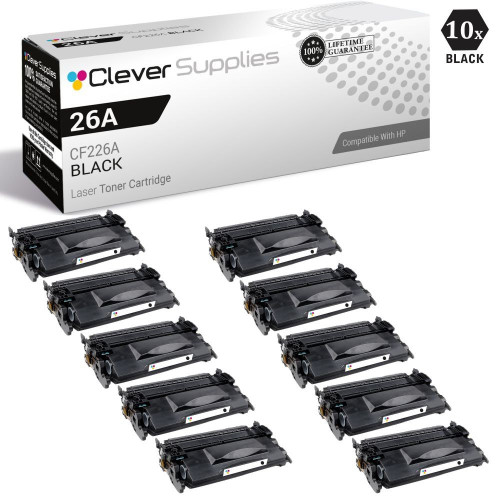
The standard tier’s deepest box: ten cartridges at $13.77 apiece, the rate the ladder bottoms out at — for offices that reorder by the quarter.
Shop the 26A 10-Pack →
Five cartridges at $15.37 apiece — the mid-depth box for an office that would rather hold five than ten.
Shop the 26A 5-Pack →
Four cartridges at $16.18 apiece — the standard ladder’s middle box, deep enough to carry an office past a reorder cycle.
Shop the 26A 4-Pack →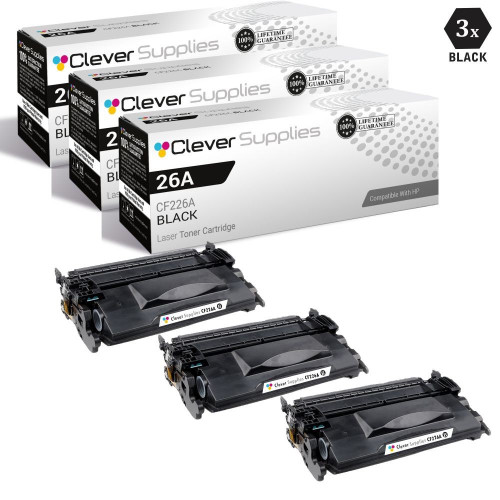
Three cartridges at $17.52 apiece — a working unit, a spare on the shelf, and one behind the spare.
Shop the 26A 3-Pack →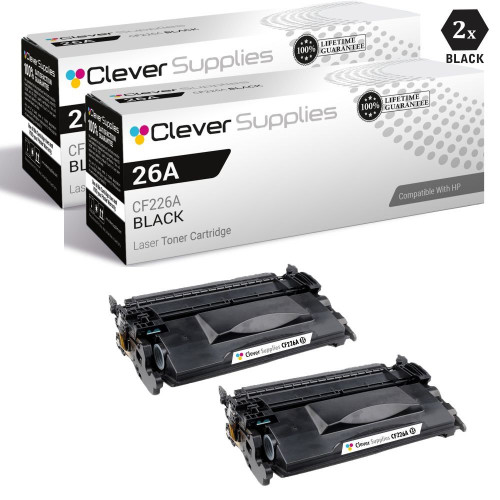
The standard pair at $20.20 a cartridge — and the comparison this page keeps returning to: the high-yield pair above costs $3.90 more and holds nearly three times the pages.
Shop the 26A 2-Pack →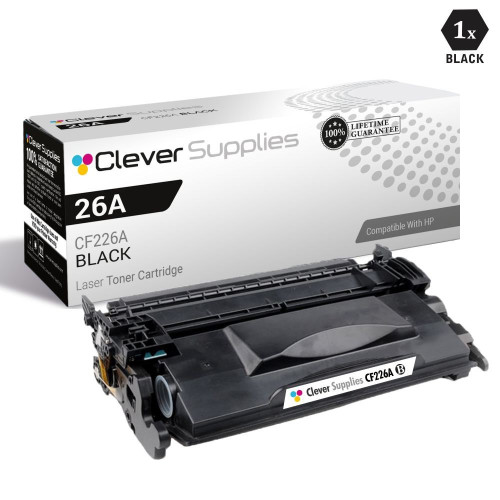
The cartridge on its own — the family’s starting point, and the restock for owners who order only when the machine stops. HP asks $173.99 for the genuine article at the same 3,100-page rating.
Shop the 26A Single →Read as one slope, the standard ladder descends 0.91¢, 0.65¢, 0.57¢, 0.52¢, 0.50¢, 0.44¢ — each larger box shaving a little more off the page. The tier step shaves off more in a single move: the two 2-packs sit $3.90 apart, $40.40 against $44.30, and that $3.90 buys 11,800 additional rated pages. Counted in bulk, those same ten standard cartridges total $282.40 when ordered singly across ten orders, against $137.67 in one box — while two high-yield pairs, $88.60 in total, hold some 36,000 rated pages, more than the standard 10-pack’s 31,000.
One naming wrinkle deserves a plain statement. Two listings on this shelf — the 26A 4-pack and the 26X 2-pack — carry both cartridge codes in their product names, and the codes are not two names for one cartridge: the 26A is a ~3,100-page fill and the 26X a ~9,000-page fill of the same cartridge family. What settles each listing’s contents is its SKU and its description, and by those the 4-pack holds 26A cartridges and the pair holds 26X cartridges. This page cards each listing under the tier its SKU assigns, and every figure printed for it is worked from that tier’s rating.
All of it is figured at sale prices. The markdown takes roughly thirteen percent off list across the seven listings, and it holds as this page is written; the product pages, by contrast, still divide by list, so their per-page readings run higher than the ones printed here. What matters at the till is the sale figure, and that is the figure used throughout.
Seven offers at sale prices — the table
The ratings in the table are HP’s own for the two cartridges, stated on the basis HP prints for the family: approximate average yields under ISO/IEC 19752, with actual output shifting according to how much of each printed page is covered. A pack’s page total is its cartridges’ ratings added together, and the per-page column divides each sale price by the pages it buys — pack rows are marked blended because the rate averages every unit in the box. The high-yield row’s saving column carries no figure, deliberately: with no 26X single sold, there is no singles baseline for it to save against.
| Offer | Fits | Sale price | Rated yield per cartridge | Cost per page | Saving vs singles |
|---|---|---|---|---|---|
| 26X 2-Pack — the flagship | All 9 models | $44.30 | Up to ~9,000 pages each | 0.25¢ blended | No 26X single is sold |
| 26A 10-Pack | All 9 models | $137.67 | Up to ~3,100 pages each | 0.44¢ blended | SAVE $144.73 |
| 26A 5-Pack | All 9 models | $76.87 | Up to ~3,100 pages each | 0.50¢ blended | SAVE $64.33 |
| 26A 4-Pack | All 9 models | $64.71 | Up to ~3,100 pages each | 0.52¢ blended | SAVE $48.25 |
| 26A 3-Pack | All 9 models | $52.56 | Up to ~3,100 pages each | 0.57¢ blended | SAVE $32.16 |
| 26A 2-Pack | All 9 models | $40.40 | Up to ~3,100 pages each | 0.65¢ blended | SAVE $16.08 |
| 26A Single | All 9 models | $28.24 | Up to ~3,100 pages | 0.91¢ | Bought one at a time |
Two comparisons do the table’s talking. First, the pairs: $40.40 buys 6,200 standard-yield pages and $44.30 buys 18,000 high-yield pages — the family’s whole argument in a single line. Second, the depth of the standard ladder’s own discount: the 10-pack’s $137.67 set against $282.40 for the same ten cartridges ordered one by one. A buyer whose volume justifies neither a bulk box nor the tier step is still served — the single at $28.24 is this family’s starting point — but the arithmetic keeps pointing two ways at once: up a pack size, or across to the high-yield pair.
The cartridge in the box is a full one
Workgroup printers often arrive with a shortened starter cartridge, filled to a lower line than the replacement on the shelf. This line is an exception. On its printer page for the series, HP lists the box contents with a preinstalled 26A rated at about 3,100 pages — the full standard rating, identical to the figure a replacement 26A carries — and HP’s specification for the cartridge itself gives the same 3,100 pages as its starter yield. Nothing about the first cartridge is a sample size.
The consequence is breathing room rather than a deadline. The first reorder arrives a full cartridge’s life into the machine’s service — roughly 3,100 pages of ordinary work — which is time enough to learn what the office actually prints in a month and to choose between the standard ladder and the high-yield pair on evidence. Owners who already know their volume can skip the experiment: the tier decision is the same on day one as it will be at the first reorder.
Nine machines take both cartridges
HP’s cartridge datasheets state fit at series level — the LaserJet Pro M402 series and the LaserJet Pro MFP M426 series — and HP’s user guides resolve those two series into nine models. Every one of the nine accepts both the 26A and the 26X, so inside this line there is no fit line to draw and no model fenced off from the high-yield tier; the only choice the roster leaves open is yield.
The printers: LaserJet Pro M402n, LaserJet Pro M402d, LaserJet Pro M402dn, LaserJet Pro M402dne, LaserJet Pro M402dw and LaserJet Pro M402m. Two of HP’s roster models — the M402dne and the M402m — have no category page in this store; they are named here because HP lists them, and both cartridges fit them exactly as they fit the rest.
The multifunctions: LaserJet Pro MFP M426dw, LaserJet Pro MFP M426fdn and LaserJet Pro MFP M426fdw.
One caution, because the near namesakes cause real mis-orders: the M403 printers and the MFP M427 multifunctions share these machines’ user guides, but HP’s supplies tables assign them a different cartridge — the CF228 — and they take no part in this roster. So check one of two things before ordering: the badge on the machine, or the CF226 code on the cartridge you are taking out. Either one leads to the same seven listings.
Chips: one parts sentence, and two listings that say nothing
Search the seven listings for the word chip and it surfaces in five of them, once each, always inside the same sentence about construction: the units are manufactured 100% brand new, with all new parts — OPC drums, wiper blades, “a smart chip” and other internal parts among them. The two newest listings — the 26A 4-pack and the 26X 2-pack — never use the word at all. Nothing anywhere on the shelf goes further: no listing discusses firmware, and a chip named as one component among several is a statement about what a cartridge is built from, not a promise about how a printer will treat it.
HP’s side of the record offers nothing to set against that sentence, in either direction: on the printer and cartridge pages checked for this family, HP prints no dynamic-security language for the M402 and M426 machines — no warning to relay, and no basis for upgrading a parts list into a recognition guarantee. What the listings stand behind is the remedy: a 1-year warranty and free returns for the same twelve months, with pack cover running unit by unit, so the last cartridge out of a 10-pack is protected from the day it is fitted. A cartridge that fails — or one a machine will not accept — goes back under that cover, and support answers on weekdays, 9 AM to 5 PM Central, while the return is arranged. The family’s chip position, firmware by firmware, is followed on the store’s HP monochrome toner chip compatibility page, alongside the rest of the monochrome range.
What stands behind the seven listings
Five checks before the reorder
Questions this family raises
Not from this shelf. The plain high-yield cartridge is stocked here only as the 26X 2-pack — two CF226X cartridges in one box at $44.30 — and no single 26X listing, compatible or genuine, exists in this store. The pair is therefore the high-yield tier’s entry point as well as its whole range: $22.15 a cartridge, some 18,000 rated pages in the box, and at 0.25¢ a page the cheapest printing this family offers. A buyer who needs exactly one cartridge buys the 26A single instead, and gives up the yield step.
No. The resemblance is genuine — HP publishes shared user guides for the M402 and M403, and for the M426 and M427 — but its supplies tables draw the line firmly: the 26A and 26X are marked for the M402 and M426 models only, while the M403 printers and M427 multifunctions take a different cartridge, the CF228, sold as the 28A and 28X. Nothing on this page fits those machines.
No — this line is one of the exceptions. HP’s box contents for the M402dn list a preinstalled 26A at about 3,100 pages, the cartridge’s full rating, and HP’s specification for the CF226A gives the same 3,100 pages as its starter yield. The first reorder therefore arrives a full cartridge’s life into the machine’s service, which is time enough to learn a month’s volume before choosing between the standard ladder and the high-yield pair.
They start from different prices. This guide divides by the sale price — what checkout charges today, $28.24 for the standard single — and arrives at 0.91¢ a page. The product pages divide by list instead: that same cartridge’s text works from $32.48. Both are honest arithmetic at different starting prices; while the markdown lasts, the sale-based figures describe what a buyer actually pays, and if it ends, the product pages’ figures take over again, because the product page’s own price is always the final word.
Send it back. Every one of the seven offers is covered for a year — warranty and free returns alike — and in the packs the cover attaches cartridge by cartridge, so the final unit out of a 10-pack is protected from the day it goes into the machine, not the day the box arrived. Help is available weekdays, 9 to 5 Central Time, while the return is arranged. Keep the packaging until the cartridge has earned its place — a return ships more safely inside it.