




Renewing the whole printer: order the four-color set at $199.66. It is not the cheapest route on paper — its contents total less bought one at a time, and the sums are set out further down rather than smoothed over — but it is the only complete restock on the shelf, and the only carton that contains a black or a magenta cartridge. Cyan or yellow spent on its own: order that color’s single at $42.96. Black or magenta spent: no single can be ordered for either, because both listings are switched off, so the set is again the only route. Every price quoted on this page is the sale price from the product’s own listing; the listings themselves reason from list prices, and their figures are left out of the buying math entirely. One more absence to plan around: when the imaging drum wears out it is replaced separately, as part C9704A, and the store cannot sell you one today either — the drum section below covers it.
The set leads because nothing else completes the printer
Ordinarily a flagship set justifies itself with a saving, printed beside its price. Here the arithmetic points the other way, so this card wears no badge. The four cartridges inside add up to $182.01 at the sale prices used across this page; the set is stickered $199.66, which is $17.65 above that total. Nor is the cheaper route genuinely open: two of the four singles behind the $182.01 cannot be bought at all. Measured against what a buyer can actually assemble — cyan and yellow as singles, $85.92 together — the set’s $113.74 premium is the price of the black and magenta cartridges it carries, plus the convenience of one order. Completeness, not a discount, is what the flagship sells.
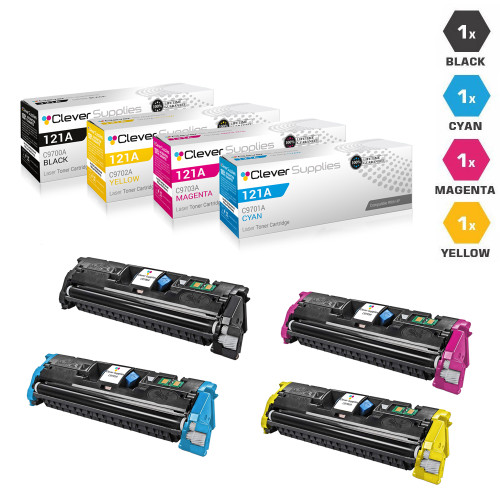
The carton holds the family in HP’s sequence: C9700A black, C9701A cyan, C9702A yellow, C9703A magenta. Fitting any of them is the exchange these printers were designed around — spent cartridge out, fresh cartridge in — because each unit leaves the supplier with its current chip generation already seated; nothing is salvaged from the cartridge being discarded. One limit of the box deserves naming here rather than later: a set change renews toner only. On this platform the imaging drum is a separate part with a life of its own, covered in its own section below, and no toner purchase postpones the day it falls due.
Two colors still sell on their own
Cyan and yellow are the family’s only self-service singles, and they are perfect twins on the numbers: $42.96 apiece, about 4,000 rated pages apiece, 1.074¢ a page apiece — together the cheapest buyable printing this family offers. Magenta would complete the grid, but its single is one of the dark listings, so the third color reaches a buyer only inside the set. While ordering, keep HP’s sequence in view: against the codes C9701A, C9702A and C9703A the colors run cyan, yellow, magenta, so yellow answers to the 2-code and magenta to the 3-code, no matter what sequence a listing’s title recites them in.
THE BUYABLE SINGLES — ONE BAY AT A TIME
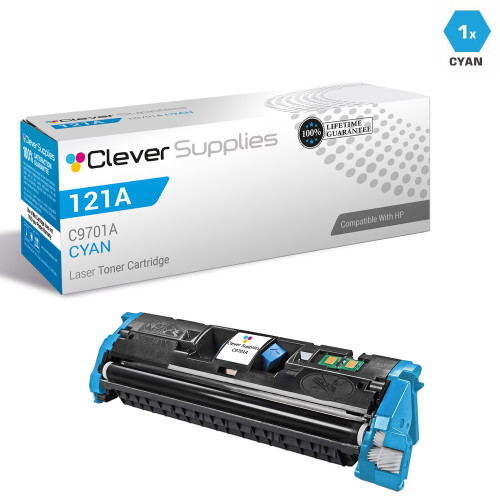
Sky tones turn chalky and greens lose their depth as this bay fades. The cyan single restores it alone, at the joint-lowest per-page rate any buyer can currently pay in this family.
Shop the 121A Cyan →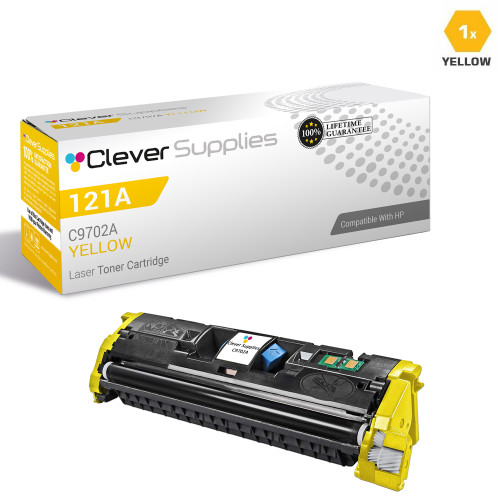
Warm colors cool and highlights go dull when yellow gives out — often well before any warning appears. Check the spent cartridge’s label as it comes out: C9702A is the code it should carry.
Shop the 121A Yellow →Three buyable boxes, one way of pricing them
Each row divides the sale price on the product’s own page by its rated pages; the set’s rate is marked pooled because its pages are spread over four bays. Two rows are absent deliberately — the black and magenta singles — and the notes under the table carry their figures as a record instead. Ordered by buyable rate, cheapest at the top:
| Configuration | Sale price | Rated pages | Cost per page | Printer fit |
|---|---|---|---|---|
| 121A Cyan Single | $42.96 | 1 cartridge · ~4,000 pages | 1.074¢ | All 8 models |
| 121A Yellow Single | $42.96 | 1 cartridge · ~4,000 pages | 1.074¢ | All 8 models |
| 121A 4-Color Set — the flagship | $199.66 | 4 cartridges · ~17,000 pages | 1.174¢ pooled | All 8 models |
The missing rows frame the whole shelf. The black single’s dark listing priced it at $38.00 — at 0.760¢ a page it would have been the cheapest printing in the family; the magenta single’s priced it at $58.09, or 1.452¢. Magenta is also the family’s pricing irregularity: at the identical 4,000-page rating it is stickered well above its two siblings at both price levels, and its sale figure alone exceeds their list figure. None of that can be acted on today — neither listing takes an order — but it explains the set’s arithmetic above: measured against the two colors that can be bought, $85.92 together, the set’s extra $113.74 is what black and magenta cost when they can only be had inside a box.
For scale, the three colors together account for about 3.60¢ of a full-color page at the coverage the ratings assume; everyday office pages lay down far less color than that basis supposes, so read the figure as a ceiling implied by the ratings, not as a meter reading. One genuine comparison does survive for the black: HP’s own US store still carries a page for C9700A, priced at $93.99 — and shows the cartridge out of stock there. For the three colors, HP’s store carries no page at all, so no genuine figure exists to set beside them.
Eight printers — and a fence at the 2550
HP’s published compatibility gives this row to two related series. From the earlier line, the Color LaserJet 1500, 1500L and 1500Lxi; from the later one, the 2500, 2500L, 2500Lse, 2500n and 2500tn. Each of the eight accepts all four cartridges and shares the same separate imaging drum, and the store gathers the family under its HP 121A category.
The fence matters because every listing in this store steps over it. Their fit lines claim the Color LaserJet 2550 series and the 2820, 2830 and 2840 all-in-ones as well. HP assigns those machines to a different row — the 122A, codes Q3960A through Q3963A — and publishes no C970x fit for them. Fairness requires the nuance: the two rows share the same basic cartridge form, the 2550 platform having succeeded the 2500 on the same engine family, so the claim is not a physical absurdity. But the families carry different smart chips, and HP’s published compatibility is the standard this store’s guides follow. The practical rule costs nothing to apply: the code printed on the cartridge you pull out decides. A 2550 or 2820 owner needs the 122A row, not anything carded on this page.
The same descriptions err in the opposite direction elsewhere. The magenta listing’s fit lines, and the duplicate black’s, drop the entire 2500 series — half the genuine roster — and run the 1500 model numbers together without spaces, even though their own question-and-answer text names the 1500 and 2500 series correctly. Category filing, at least, covers all eight models for nearly every listing. HP’s roster is the one printed above, and this page goes by it.
Two ratings on an old-fashioned basis
HP declares about 5,000 pages for the black cartridge and about 4,000 for each color, and both figures rest on five percent average page coverage — the yardstick of these cartridges’ era, from before ISO/IEC 19798 standardized how yields are measured. It is declared once, here, because every calculation on this page depends on it. Five percent coverage means a page carrying little more than text: a document with color accents may carry a cartridge well past its rating, while a full-color brochure will drain one in a fraction of the span. In this family the three sources a buyer might consult all tell the same story — the spec fields on the listings, the listings’ own text and HP’s documents agree on both ratings for every code — and the math above runs on those declared figures exactly as printed.
A complete renewal pools about 17,000 rated pages: the black’s 5,000 plus 12,000 divided among the three colors. Pooling is a way of sizing an order, not a promise about any one bay: no cartridge can lend its pages to another, and black — drawn on by every sheet — empties on a schedule the colors know nothing about. Judge a restock by the pooled figure; judge a single bay by its own rating.
A drum of its own — and chips that arrive fitted
Most platforms in this part of the catalog seal toner and imaging drum into a single cartridge. This one does not. The 1500 and 2500 engine keeps its drum in a separate unit, part C9704A, which all eight roster models share. HP rates that drum at 20,000 pages when printing black only and 5,000 pages when printing color, with an average life of 6,000 to 8,000 pages in mixed use — so its replacement falls due on a timetable of its own, independent of any single cartridge, and background fading across every color at once is its symptom rather than a toner’s. The store lists the drum twice; both listings are switched off, so a C9704A cannot be ordered from this store today. The part is named here, unlinked, so an owner planning ahead knows both the number and the situation.
The toner cartridges, by contrast, ask nothing of the buyer on the chip side. Each leaves the supplier with its current chip generation already in place — the standing practice across this store’s compatible range, and one with an unblemished record behind it: no chip failure has ever been reported back on a cartridge sold this way. Drop the cartridge in and the machine recognizes it, toner gauge and all; the spent unit surrenders nothing. Two boundaries belong beside that assurance. It speaks for cartridges as shipped today and for the record accumulated so far. And it cannot reach forward: firmware HP may issue someday lies beyond any seller’s honest promise, this store’s included.
Warranty, returns and support
One set of terms covers all three products carded on this page — the set and the two singles alike — so the terms are gathered once, here.
Deciding by bay — and by drum
Questions from 1500 and 2500 series owners
Not today. Both singles sit in the catalog — C9700A black priced at $38.00, C9703A magenta at $58.09 — but their listings are turned off: hidden from the storefront, impossible to order, their addresses returning “Not Found”. For now, a black or magenta cartridge reaches a buyer only as part of the four-color set. That would change the day either listing is turned back on; neither has been.
On HP’s published compatibility, no. HP assigns the 2550 series and the 2820, 2830 and 2840 all-in-ones to the 122A row — Q3960A black, Q3961A cyan, Q3962A yellow, Q3963A magenta — and lists no 121A code for them. The two families share the same basic cartridge form, but their smart chips differ, and this guide follows HP. Some listings in this store claim those machines for the 121A anyway; the safe check is the code on the cartridge coming out of your printer.
Because the sticker says so. Added up at sale prices the four singles come to $182.01, and the set is $199.66. Bundles normally reward the buyer for taking everything at once; this one charges for it instead, and this page declines to call that a saving — no savings badge sits on the set, because none was earned. The comparison is academic anyway: two of the four singles cannot be bought, so what the premium actually purchases is the black and magenta cartridges themselves, plus one order instead of four.
There is, and today you cannot. The imaging drum is its own part, C9704A, shared by all eight printers on the roster; HP rates it at 20,000 pages printing black only and 5,000 printing color, averaging 6,000 to 8,000 pages in mixed use. The store carries two listings for it and both are switched off, their pages answering “Not Found” — so the drum is named here for planning, with no link and no card.
C9702A is the yellow; C9703A is the magenta. HP numbers the family in color order — black, cyan, yellow, magenta across C9700A to C9703A — so the second code always carries yellow and the third magenta. When a title recites the codes in some other order, go by the label on the cartridge you are replacing.
A colors-only stock-up box: six cartridges spread across the three color codes, with no black, priced at $158.77. Its own text never states the per-color split outright, and the listing is switched off in any case, so it is recorded here rather than carded. Were it orderable, its pooled rate would be the family’s lowest — but a dark listing sells nothing.
A year of each, counted from delivery: the warranty runs twelve months, and returns stay free for the same twelve months, under the terms set out on each product’s own page. Help is staffed on weekdays between 9 AM and 5 PM Central, and parcels ship from the Illinois, Pennsylvania, Georgia and California warehouses.
Price and disclosure note: Prices here are the sale figures shown on each product’s own page, checked again on November 18, 2026 while this guide was prepared; if a figure changes later, the product page is the one to trust. Sale is used on purpose, list is not: in their own text the listings reason from list prices — $229.61 for the set, $53.20 for the black single, $49.40 each for cyan and yellow, $81.33 for magenta, $222.28 for the six-color set — amounts higher than anything checkout asks on the listings that can be checked out at all, with their per-page claims derived from those amounts. No savings badge appears on this page, and the reason is arithmetic rather than modesty: the family’s only set is priced above the total of its contents, leaving no saving for a badge to report. The yield figures are HP’s declared ones — roughly 5,000 pages for black, 4,000 per color, at five percent average coverage from the pre-standard era — and in this family the listings’ fields and prose repeat them without deviation; totals that span several cartridges are labeled pooled wherever they appear. One genuine figure is quoted, in the table notes above: HP’s US store still carries a page for the black cartridge alone, prices it there, and shows it out of stock; no genuine price exists for any color. Compatibility follows HP’s published roster: 1500, 1500L, 1500Lxi, 2500, 2500L, 2500Lse, 2500n and 2500tn. Then comes the catalog’s own disorder, item by item.
First, the dark listings: the family’s black and magenta singles are invisible and unavailable, their storefront pages returning “Not Found” while their descriptions go on quoting prices for products nobody can order; the duplicate black and the six-color set are switched off as well, so four of the family’s seven listings are dark, and black and magenta can be bought only inside the set. Second, fit is over-claimed everywhere: every toner description claims the Color LaserJet 2550 series and the 2820, 2830 and 2840 all-in-ones, machines HP assigns to the 122A family; this page follows HP and does not repeat the claim. Third, the same catalog under-names where it matters: the magenta listing’s and the duplicate black’s fit lines omit the entire 2500 series and mash the 1500 model numbers together without spaces, contradicting their own question-and-answer text. Fourth, money is argued at list throughout, as noted above. Fifth, magenta is priced away from its siblings — $81.33 list and $58.09 at sale against $49.40 and $42.96 for cyan and yellow at the identical 4,000-page rating — its sale figure alone sitting above its siblings’ list figure. Sixth, the duplicate black listing cannot decide what it sells: its name says compatible replacement, its condition field says OEM/Original, its stock code ends in -BLACK-OEM, and its text alternates original-cartridge language with an answer calling it a compatible replacement; the same stock is counted on both black listings, and a boilerplate line praising magenta toner sits inside this black cartridge’s text. Seventh, every description’s spec block reads “Warranty: Lifetime” while the same pages’ own answers state a one-year warranty and one-year free returns; the one-year terms are the operative ones, and they are the terms this page prints. Eighth, the six-color set never states its contents per color, and it is the one family listing not filed under the HP 121A family category. Ninth, the drum listings: both are invisible, one truncates HP’s drum rating to a flat 5,000 pages — the color endpoint alone — and repeats the compatible-versus-original labeling contradiction. Tenth, all seven descriptions open with a stray “/>” fragment. Recorded as not defects: no production or prompt text leaks into any description in the family, and no toner text claims the drum is built into the cartridge — the shared boilerplate correctly counts five printing supplies for this platform, four cartridges plus the separate drum.
Three cards are what remain orderable of this family, and each is shown exactly once; everything else — two darkened singles, a duplicated black, a colors-only set, a drum that cannot be bought — is dealt with in prose rather than presented as choice. HP’s roster bounds the page: eight models, two series, nothing beyond. The ratings are HP’s declared figures, neither inflated nor trimmed. Chips are presented with their limit attached: the current generation ships fitted, the record to date is clean, and unwritten firmware is warranted against by nobody, this page included. Underneath it all sit the terms printed on the family’s own product pages — a year of warranty, a year of free returns, weekday support from 9 AM to 5 PM Central, and dispatch from warehouses in Illinois, Pennsylvania, Georgia and California.