




ML-5010ND
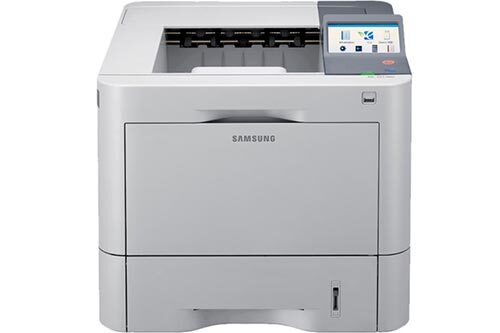
Some department printers earn their place by never making the office wait, and the ML-5010ND is built for exactly that job: it pairs the faster 5010 engine with Ethernet sharing and automatic two-sided printing, so a whole department queues work to one machine. It feeds on Samsung's MLT-D307 family, a range that runs from standard yield up through ultra-high, and the cartridge this page stocks is the extra-high-yield MLT-D307E. The standard MLT-D307S, the high-yield MLT-D307L and the ultra-high MLT-D307U all belong to the same family the printer accepts; our shelf concentrates on the E cartridge because a shared departmental machine burns through the smaller ones quickly.
Think about who notices a toner swap on a printer like this. On a personal desktop machine, one person loses two minutes. On the ML-5010ND, the invoice run, the month-end reports and everyone's everyday pages all funnel through the same slot, so an empty cartridge is a small outage with an audience. That is the practical argument for the largest yield in the family and for keeping a sealed spare in the supply cabinet: fewer interruptions, fewer emergency orders, and a machine whose running costs stay predictable month after month.
Toner Cartridges for ML-5010ND
| Cartridge | Color | Page Yield |
|---|---|---|
| MLT-D307E — Extra High Yield Toner Cartridge, single | Black | See product page |
| MLT-D307E — Extra High Yield Toner Cartridge, 3 Pack | Black | See product page |
| MLT-D307E — Extra High Yield Toner Cartridge, 5 Pack | Black | See product page |
Every listing above is the same extra-high-yield cartridge; the only difference is how many you take at once. The 3 Pack and 5 Pack exist for offices that would rather reorder a few times a year than a few times a quarter.
Which cartridge should you buy?
The ML-5010ND accepts the whole MLT-D307 ladder, so the honest question is which rung matches your volume. The standard and high-yield cartridges suit a machine that prints a few hundred pages a week. A departmental printer with heavy daily output belongs on the MLT-D307E or the ultra-high tier: each swap is rarer, the cost per page drops, and the printer spends its time printing instead of waiting on supplies. If your machine's counter climbs fast, buy the E in a multi-pack and treat toner like paper — a stocked consumable, not a recurring errand. Lighter users can stay with the single and reorder as needed.
Chip, toner and everyday use
Two consumables share the work inside this printer, and confusing them wastes money. The toner cartridge carries the powder; the separate MLT-R307 imaging unit carries the drum that puts it on the page. Powder empties with printing, while the drum wears with rotations and time, so expect several toner swaps for every imaging unit. When pages fade evenly, suspect toner; when the same defect repeats down every page despite a fresh cartridge, suspect the drum. A gentle side-to-side rock of the cartridge redistributes settled toner and can carry a job to the finish, and a cool, dry shelf keeps a sealed spare healthy far longer than a hot storeroom does.
Frequently Asked Questions
Does the ML-5010ND use a separate imaging unit, or is the drum inside the cartridge?
It is separate. The MLT-R307 imaging unit lives alongside the toner cartridge and is replaced on its own much longer cycle. That is why a printer can demand an imaging unit while its toner is still fresh, and why replacing toner alone never cures a repeating drum defect.
Can this printer run the smaller MLT-D307 cartridges, or only the E?
The family fits across the range: MLT-D307S, MLT-D307L, MLT-D307E and MLT-D307U are all cartridges for this platform. This page stocks the extra-high-yield E because departmental volume is what the ND configuration is bought for, but the code family is what matters — match the D307 part of the code and the yield letter is your choice.
How do I check how much life is left in the imaging unit?
Use the printer's supplies status, on the panel or in its web interface, rather than guessing from print quality. The MLT-R307 reports separately from toner, and its remaining life is a rotation-based estimate. Order its replacement when the reported life runs low, not when a toner warning appears.
Why do you keep saying to order by code instead of by printer name?
Because this corner of the ML line is a naming trap: the 5010, 5012, 5015 and 5017 machines sit side by side with near-identical names and do not all share supplies the way their badges suggest. The cartridge code printed on your old cartridge cannot be misread the way a model name can. Read the code, match the code, and the cartridge that arrives is the one that fits.
More printers that use the same cartridges
The MLT-D307 family also feeds a row of related departmental machines. If you run any of these alongside your ML-5010ND, the same cartridge shelf covers them: ML-4510, ML-4510ND, ML-4512, ML-4512ND, ML-5010, ML-5012, ML-5012ND, ML-5015, ML-5015ND, ML-5017, ML-5017ND and the Samsung-MLTD307 cartridge family page.