




Most LaserJet families ask you to pick a box size. This one asks you to pick a size of cartridge first: HP built the P2015 and M2727 workgroup platform around two genuine cartridges, the 3,000-page 53A and the 7,000-page 53X, and still sells both from its own store today. The compatible shelf below offers six ways to buy them — and carries a few wrinkles worth knowing first: the biggest box is listed twice, three newer introductions claim these cartridges fit a neighboring printer family they cannot serve, and one single wears a printer’s name while claiming the other tier’s contents. Every figure here is the sale price.
Decide the tier before the count. The step from the standard cartridge to the high-yield one is unusually cheap here: a 53X single costs $5.77 more than a 53A single and carries 4,000 extra rated pages, so most buyers should start on the X side and then choose how deep to stock — four cartridges at 0.322¢ a page, two at 0.379¢, one at 0.494¢. The A tier remains the low-outlay route, topping out at a three-pack. The four-pack exists as two listings on one price and one stock figure; the plainer one holds the flagship card, its twin dealt with in prose beside it. The newer listings — the two-pack, the model-named single and that twin among them — open with an introduction claiming fit for the LaserJet P2035 and P2055 families, which take a different cartridge entirely; the fit section corrects that claim in full. And unlike the discontinued families elsewhere in this catalog, HP still sells both genuine cartridges, at $152.99 and $278.99.
Four high-yield cartridges in one box — the shelf’s lowest cost per page
Pool four 7,000-page cartridges and the arithmetic turns decisively: 28,000 rated pages for $90.05 is 0.322¢ a page, against 0.494¢ for the same cartridge bought singly, and four singles at sale total $138.28 — the box undercuts them by $48.23. Against the genuine article the gap widens: HP’s store charges $278.99 for one 53X, $188.94 more than this entire four-cartridge box. Beside it sits the same four-pack’s second storefront — one product wearing two pages.

This is the box for a workgroup printer that earns its keep — a shared P2015dn on a busy corridor, an M2727 handling a small office’s fax and copy load alongside its printing. At 7,000 rated pages per cartridge, four units can carry a department through a year or more of ordinary volume, each swap renewing the whole print unit.
Shop the 53X 4-Pack →Nothing about the second page makes its box better or worse; it is the same box. The card above follows the listing filed with the rest of the family, and this twin is recorded here — described, not linked.
The other five ways to buy
The X tier steps down through a two-pack at 0.379¢ a page to the single at 0.494¢, and the A tier offers its own single and three-pack at 0.960¢ and 0.603¢. The two-pack’s page opens with the borrowed introduction described above — the box is right, the first paragraph is not. And the last card, the single named for the P2015dn, is priced and stocked exactly as the standard single while its own answers claim the high-yield build inside; its card states both halves.
THE REMAINING BOXES

The middle rung of the X ladder: one cartridge in service, one on the shelf, 14,000 pooled rated pages in reserve. Two singles bought apart total $69.14, so the pair holds on to $16.08. One warning rides with this card: its page’s introduction names the LaserJet P2035 and P2055 families as suitable homes for this cartridge. They are not — the fit section below corrects the claim — while its own questions and answers cover the correct machines.
Shop the 53X 2-Pack →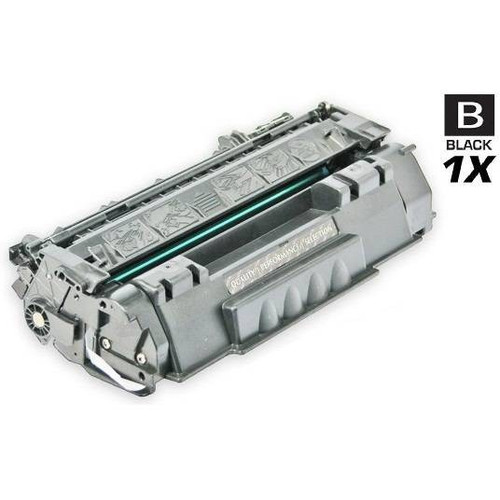
The comparison that decides most purchases in this family: for $5.77 more than the standard single below, this cartridge more than doubles the rated life, from 3,000 pages to 7,000. Its page carries one blemish — a features list ending in a “Warranty: Lifetime” line its own answers contradict; the terms section explains which wording governs.
Shop the 53X Single →
The deepest the standard tier goes. Three singles at sale come to $86.40, so the pack trims $32.15, and each cartridge inside works out to $18.08 — less than the $20.80 per-cartridge figure its own page quotes from the list price. For scale against the genuine shelf: one genuine 53A at HP’s store costs $152.99, $98.74 more than this whole three-cartridge box.
Shop the 53A 3-Pack →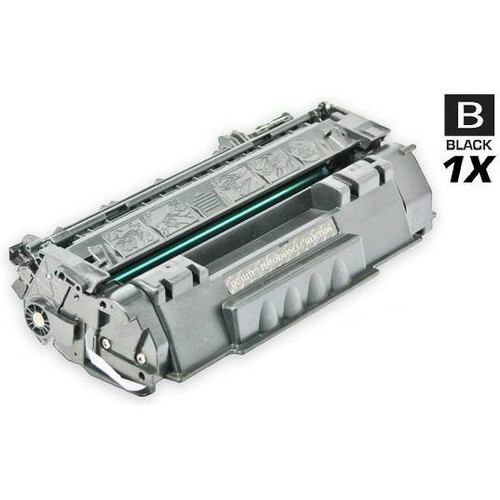
The shelf’s smallest commitment and the yardstick its badges are measured against: one standard cartridge, 3,000 rated pages, the lowest sum on the page and the highest per-page rate. It suits a lightly used machine, a printer kept as a spare, or a first order placed to judge print quality before stocking deeper.
Shop the 53A Single →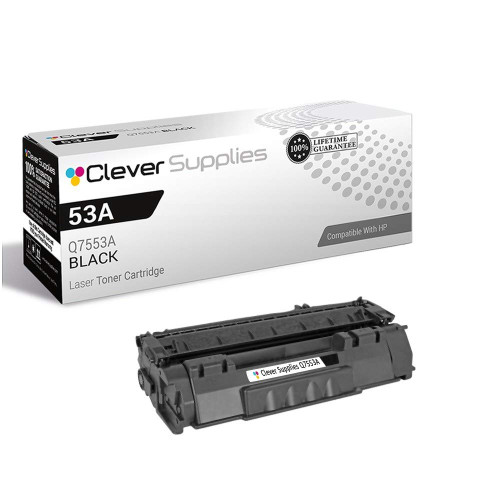
Read this card with both eyes open. The listing is named for the P2015dn and carries both of the family’s part numbers. Its price is the standard single’s price to the cent, and it reads the standard single’s stock figure of 26 — yet its own identity answer states plainly that the box holds the high-yield build, rated at 7,000 pages. If that answer is accurate, this is the cheapest rated page among the singles; if the price block is the truer signal, it is a standard cartridge wearing an ambitious answer. The catalog offers no way to settle the question from outside, so the claim is printed labeled as a claim — and the standard single above remains the unambiguous buy at this price. Its introduction also repeats the wrong-platform sentence corrected below.
Shop the 53 P2015dn Single →The plain three-pack holds the card above; this copy is noted here and not linked.
Every configuration on one table — genuine rows included
This family can do something the discontinued ones cannot: show the genuine article’s current price. HP’s US store lists both cartridges in stock today, so two genuine rows lead the table. One compatible row is flagged: the model-named single’s page count rests on its own answers, not its price block.
| Configuration | Price | Rated pages | Cost / page | Printer fit |
|---|---|---|---|---|
| Genuine HP 53A (Q7553A) — HP US store, in stock | $152.99 | 1 cartridge · 3,000 pages | 5.100¢ | All 10 models |
| Genuine HP 53X (Q7553X) — HP US store, in stock | $278.99 | 1 cartridge · 7,000 pages | 3.986¢ | All 10 models |
| 53X 4-Pack — the flagship | $90.05 | 4 cartridges · ~28,000 pages | 0.322¢ pooled | All 10 models |
| 53X 2-Pack | $53.06 | 2 cartridges · ~14,000 pages | 0.379¢ pooled | All 10 models |
| P2015dn-Named Single — contents as claimed by its own answers | $28.80 | 1 cartridge · 7,000 claimed pages | 0.411¢ per claimed page | All 10 models |
| 53X Single | $34.57 | 1 cartridge · 7,000 pages | 0.494¢ | All 10 models |
| 53A 3-Pack | $54.25 | 3 cartridges · ~9,000 pages | 0.603¢ pooled | All 10 models |
| 53A Single | $28.80 | 1 cartridge · 3,000 pages | 0.960¢ | All 10 models |
Two comparisons do the real work on this table. Vertically, the genuine rows show what one original cartridge costs today — and the flagship box of four compatibles undercuts a single genuine 53X by $188.94. Horizontally, the compatible rows show the tier step plainly: at the single level, moving from A to X costs $5.77 and cuts the per-page rate almost in half.
Ten printers take these cartridges — one neighboring family does not
HP’s documentation assigns the Q7553A and Q7553X to ten machines: the P2014, P2014n, P2015, P2015d, P2015n, P2015dn and P2015x, plus the multifunction M2727, M2727nf and M2727nfs. Both tiers fit every one of the ten. In this store’s catalog the family is gathered under the HP Q7553A category.
One correction matters more than anything else in this section. The introductions of the family’s newer listings — the two-pack, the model-named single and the second four-pack among them — state that these cartridges are designed for the LaserJet P2035, P2035DN, P2055, P2055D, P2055DN and P2055X. That is false. Those printers run on another cartridge family entirely — the P2035/P2055 line is a compact platform of its own, and no Q7553 cartridge belongs in it. Ordering a box from this page for one of those six models buys a cartridge that physically will not go in. The sentence reached these listings as copied boilerplate from a different family’s page; the listings’ own questions and answers, on the very same pages, talk about the P2015 and M2727 hardware correctly the whole way through. Only the introduction is wrong.
The older listings err in the opposite, harmless direction: their fit line names six of the ten models and trails off into an “etc.”, leaving the P2014n, P2015n, P2015x, M2727 and M2727nfs unnamed. The roster above is the complete one, taken from HP’s user guides and yield reports; if your model appears there, every card on this page fits it.
Identifying the cartridge in your machine takes seconds: the unit that slides out of a P2015 or an M2727 is marked Q7553A or Q7553X, the standard and high-yield builds of the same cartridge. Either marking matches the cards here tier for tier; any other code belongs to a different platform, whatever a stray introduction may claim.
Two ratings, both traceable to HP’s own test reports
Yield claims are where toner catalogs usually wander, so it is worth saying plainly that this family does not. HP publishes declared yields for both cartridges under ISO/IEC 19752 — 3,000 pages for the Q7553A, 7,000 for the Q7553X — drawn from its own test reports on the P2014 and P2015. The listings’ prose repeats those figures exactly, tier for tier, including the pooled pack totals. Every per-page figure in this guide is simply a sale price divided by HP’s rating and multiplied across the cartridges sealed in the box.
In working terms, the high-yield cartridge’s 7,000 pages amount to roughly fourteen reams of paper; the standard cartridge’s 3,000 to about six. Real output still moves with coverage — dense pages spend a rating faster than plain office text — but both tiers were measured on the same standard.
One listing stands apart from this tidy picture, already flagged on its card: the model-named single claims the 7,000-page build at the standard cartridge’s price. Its rating is carried here as a claimed figure, not a confirmed one.
One unit does both jobs — in HP’s words, not the listings’
Whether this platform hides a separate drum is a question the product pages never raise: across all eleven descriptions in the family, the word “drum” appears not once. The answer comes from HP instead. Its yield reports describe the cartridge type itself as “all in one,” and its store copy calls the Q7553A “the reliable, all-in-one HP LaserJet cartridge” — toner supply and imaging drum combined in a single sealed unit, replaced together at every swap. No drum exists for the P2015 or M2727 under a separate code, so the card prices above are the platform’s entire consumable cost.
Fitting a cartridge is correspondingly simple. Each unit arrives with the latest-generation chip already fitted — the current, trouble-free chipped supply this store carries across its compatible range — so installation is the whole procedure: slide the cartridge in, close the cover, and the printer recognizes it and reports its toner level. There is no chip to move across from the spent unit. The promise reaches as far as the firmware these printers run today; firmware nobody has written yet is beyond any seller’s honest guarantee.
The terms that govern — one year, whatever two features lists say
What follows is what each listing promises in its own questions and answers: twelve months of warranty cover and twelve months of free returns. One inconsistency has to be flagged rather than smoothed over: the features lists of the 53X single and the flagship four-pack each end with a “Warranty: Lifetime” line, while those same pages’ answers state the one-year terms — as do the A and newer listings, which carry no such line at all. This guide prints the one-year terms; the closing note records the contradiction.
Matching the box to the printer’s workload
Pick the tier by how much the machine prints, then the count by how often you want to reorder:
Questions from P2015 and M2727 owners
It will not — and this is the correction this guide most needs to make. Your P2055dn belongs to the P2035/P2055 line: different hardware, different cartridge, and neither Q7553 build goes into it. The suggestion comes from the introduction the newer listings in this family share, a block of copied text; scroll further down those same product pages and their questions and answers describe the P2015 and M2727 range, which is where these cartridges actually belong. For a P2035, or a P2055 of any suffix, look to that platform’s own cartridge instead.
Its own identity answer states that the box holds the high-yield build, rated at 7,000 pages. Everything else points the other way: its price is the standard single’s price to the cent, and it reads the standard single’s stock figure of 26, one pool serving two different claimed contents. The catalog gives a buyer no way to resolve that contradiction from outside, which is why this guide carries the rating as a claimed figure — 0.411¢ per claimed page — rather than a confirmed one. The standard 53A single at the identical price is the listing whose contents are exactly what its name says.
Because the same product was listed twice. The two pages share one price and one stock figure of 62, but were filed separately: the listing carded here sits with the rest of the family in the catalog, while the second hangs under the color LaserJet tree, never appears in the family category, and opens with the wrong-platform introduction corrected in the fit section. There is one four-pack product, not two offers — the second page is examined in prose beside the flagship card.
Believe the answers. The “Lifetime” line sits at the end of the features lists on the 53X single and the flagship four-pack, and on both pages the questions and answers give the operative terms: twelve months of warranty, twelve months of free returns. The standard and newer listings state the same terms with no Lifetime line anywhere.
No. On this platform the drum is not a separate part: HP’s yield reports describe the cartridge type as “all in one,” and its store copy calls it “the reliable, all-in-one HP LaserJet cartridge,” with toner and imaging drum combined in the one unit. A cartridge change is therefore the complete service. The product pages never tell you this — the word “drum” appears in none of the family’s descriptions.
Because their figures start from the list price, not from the amount charged at the register, so they come out higher than this guide’s. Ask a listing what one cartridge inside its pack works out to, or what a page costs, and the answer is divided out of the list figure every time: the three-pack’s “$20.80 per cartridge” comes from its $62.39 list price, not from the $54.25 actually charged, at which each cartridge costs $18.08. The sale figure appears nowhere in any description. Everything here is priced at sale.
Price and disclosure note: Every price on this page is a sale price, taken from the carded listings on November 18, 2026; where a product page shows a different figure today, the product page is the one that governs. Sale is used throughout because sale is what a buyer actually pays. The descriptions work from list instead — $33.12 (standard single, and the model-named single at the same price block), $62.39 (standard three-pack, both copies), $39.76 (high-yield single), $61.02 (high-yield two-pack), $103.56 (high-yield four-pack, both listings) — and the sale figure is quoted in no description at all. Badges are struck sale against sale, like against like: two high-yield singles at $69.14 against the two-pack’s $53.06; three standard singles at $86.40 against the three-pack’s $54.25; four high-yield singles at $138.28 against the four-pack’s $90.05. The genuine prices are HP’s own US store figures, read the same day with both cartridges shown in stock: $152.99 for the Q7553A and $278.99 for the Q7553X. Yields are HP’s declared ratings under ISO/IEC 19752 — 3,000 pages for the standard cartridge, 7,000 for the high-yield — except the model-named single’s, which is its own claim and is labeled as such wherever used. Fit follows HP’s published roster: LaserJet P2014, P2014n, P2015, P2015d, P2015n, P2015dn, P2015x, M2727, M2727nf, M2727nfs. The catalog’s own errors follow, one by one.
(1) A fit claim pointed at the wrong platform: the shared boilerplate introduction of the family’s newer listings — the two-pack, the model-named single and the second four-pack among them — presents these cartridges as designed for the LaserJet P2035, P2035DN, P2055, P2055D, P2055DN and P2055X. Those printers run a different cartridge on a platform of their own, and the sentence contradicts the same listings’ own answers, which are P2015- and M2727-correct throughout; the fit section corrects it in full. It is this family’s only fit over-claim. (2) List-price arithmetic in all eleven descriptions, derived figures included: the standard three-pack’s “$20.80” per cartridge is the list basis against $18.08 at sale; the high-yield single’s “roughly 0.57 cents” per page is list (0.568¢) against 0.494¢ at sale; both four-pack listings quote “$25.89” per unit from list against $22.51 at sale; the model-named single’s “roughly 0.47 cents” is list against 0.411¢ at sale. (3) Warranty boilerplate at war with itself: the features lists of the high-yield single and the flagship four-pack end with “Warranty: Lifetime,” while those pages’ own answers state a one-year warranty and one year of free returns; no other listing carries the line, and the one-year terms are the terms this guide prints. (4) A link that does not lead where its text promises: in the About paragraphs of the standard single, the standard three-pack and the flagship four-pack, a link labeled as the high-yield 53X (Q7553X) single cartridge leads not to the high-yield single carded here but to a different listing that is not part of this guide’s shelf. (5) A split identity: the model-named single’s answers claim the high-yield build at 7,000 pages, yet the listing sits on the standard single’s exact price block and reads the standard pool’s stock figure of 26 — one price and one pool serving two different claimed contents. (6) The duplicated four-pack: two listings kept as separate pages sharing one price block and one stock pool, both reading an inventory of 62 — with different texts and filings; the card above follows the listing filed with the family. (7) Markup debris in the seven older-template descriptions: each carries a broken “<p> />” fragment in its boilerplate. (8) A filing split: the newer listings are absent from the family category and hang in the color LaserJet branch of the tree; the main group’s filing also carries the P2015dn under two separate categories with two slightly different names. (9) Fit under-naming in the older listings, the mirror image of item (1): their fit line names six models and an “etc.” against HP’s ten, leaving the P2014n, P2015n, P2015x, M2727 and M2727nfs unnamed. (10) Weight fields that invert the shelf: the high-yield single is recorded at 4, the flagship four-pack at 2 and the second four-pack at 3 — the two identical-count boxes disagree, and the single outweighs both. (11) Stock figures that repeat across storefronts: 26 is read by three listings, and 8, 62 and 125 are each read by two. (12) A mislabeled cross-reference: the standard single’s About paragraph calls the model-named single “the 53A (Q7553A) three-pack”; that listing is a single cartridge. (13) The series page above the family is broken in the live store: the monochrome LaserJet series page answers with a server error, and it is not linked from this page. What was searched for and not found is recorded too: no invented tier — both cartridges sold here are HP’s own designs at HP’s own ratings; no yield drift within either tier; no leaked production or prompt text; no false drum claim, the listings’ failing there being silence rather than error; and no fit over-claim in the older listings, which name no printer outside the platform.
The buyable shelf is carried by six cards, one per distinct product; two further listings — the standard three-pack’s “Premium Quality” copy and the four-pack’s second storefront — are handled in prose, never presented as separate offers. Beneath them sit the terms the listings state for themselves — a year’s warranty, a year of free returns, weekday support from 9 AM to 5 PM Central, and dispatch from warehouses in Illinois, Pennsylvania, Georgia and California.