




The LaserJet 2300 was built for a shared office corridor, and HP kept its supplies simple: the printer’s own manual names a single cartridge, the Q2610A, rated 6,000 pages. Yet a shopper browsing this family meets three codes, not one. Two of them — a 10X and a 10XX — appear in no HP code list, no HP manual and no HP rating, and both are switched off besides, so neither can actually be ordered. What can be ordered is the genuine-code cartridge in five pack counts, and that is the shelf this guide prices. Every figure below is a sale price, the amount the register charges; the descriptions’ own arithmetic runs on list, and the closing note separates the two.
Start with what can actually be bought. The buyable shelf is one cartridge in five counts — one, two, three, four or five Q2610A cartridges to a box — and the five-pack is where the arithmetic peaks: $158.90 for roughly 30,000 rated pages, 0.530¢ a page, $64.30 saved against five singles. Smaller counts trade a little of that rate for a smaller outlay, and each of the four packs undercuts its own count of singles, so all four carry honest savings. Then there is what cannot be bought. The shelf also shows a 10X and a 10XX tier, rated by the store at 10,000 and 13,000 pages; HP never issued either code, and every one of those listings is switched off. The cheaper-looking numbers in this family belong to cartridges that do not exist in HP’s catalogue and cannot be ordered from this one. No genuine HP price is quoted anywhere on the page, because HP’s US store returns no product data for this long-discontinued cartridge — there is nothing honest to set beside the compatible shelf.
The five-pack: where the ladder actually tops out
Workgroup printers earn their keep by volume, and volume is what the largest buyable box prices best. Five singles at sale come to $223.20. The five-pack is $158.90 — a $64.30 difference, sale measured against sale — and its pooled 30,000 rated pages work out to 0.530¢ each, the cheapest page that can genuinely be ordered in this family. Anything that looks cheaper per page on this shelf is attached to a listing that is switched off; the panel beside the card lays those out in full, because a buyer comparing numbers deserves to know which numbers correspond to a cartridge that can ship.
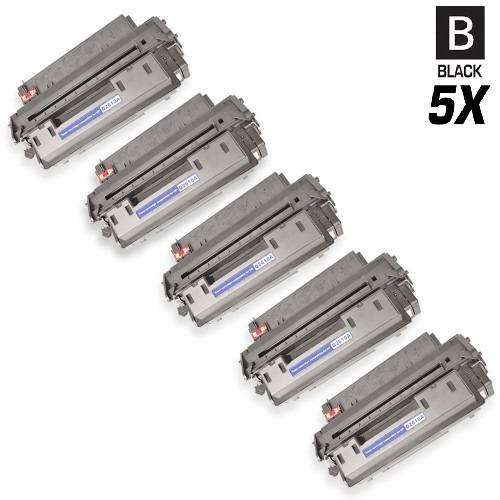
A five-pack suits a 2300 that anchors a department: the cartridges are individually sealed, drawn down one at a time, and the pooled rate assumes only that a busy workgroup machine will eventually use them — a safe assumption for hardware that has already outlasted its maker’s support window. Lighter printers are served by the counts below; nothing about the cartridge itself changes as the box shrinks.
Shop the 10A 5-Pack →None of this makes the buyable shelf worse; it makes the comparison treacherous. The 10,000- and 13,000-page figures are the store’s numbers for codes HP never issued, so this guide does its arithmetic on HP’s 6,000 and treats the two dark tiers as what they are: labels without a product behind them that a buyer can actually take home.
Four counts beneath the flagship
Below the five-pack the boxes hold four, three, two and one cartridge, and the cartridge is the constant: same Q2610A, same 6,000-page rating at 5% coverage, same combined toner-and-drum build. Only the rate moves. Each pack beats buying its own number of singles at sale — by $48.22, $32.15 and $16.07 respectively — and each badge on the cards below is that comparison, sale against sale. The single stands without a badge: it is the yardstick the other four are measured against. It also carries the family’s lone entry in the sales ledger — exactly one recorded sale — which says more about how quietly this old platform sells than about any ranking.
One count is listed twice. The four-pack also appears under a “Premium Quality” name at the identical $130.34, with identical fields and the same stock figure. Read closely, the twin’s own text gives the game away: it defines the phrase as nothing more than the name of a line of cartridges, promises the same backing as the rest of the range, and says the pack is presented “without dressing the product up”. No specification, rating or term separates the two listings, so the plain four-pack holds the card and the twin is recorded here in words.
THE REMAINING COUNTS

Four complete renewals at 0.543¢ a page — a rate within a whisker of the flagship’s, for a department that would rather not hold the fifth box. Four singles would cost $178.56; the pack saves $48.22 of it. This count is also the one wearing the “Premium Quality” label covered above — the card here belongs to the plain listing, not the twin.
Shop the 10A 4-Pack →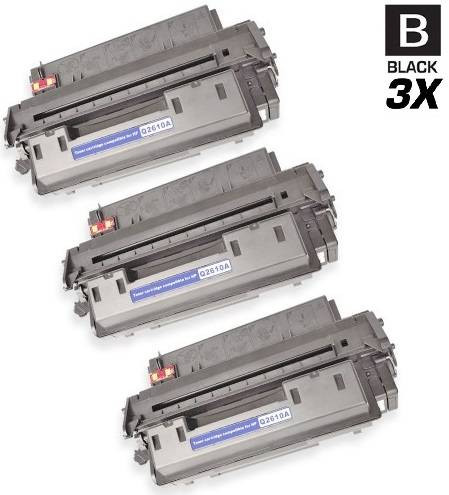
The middle of the ladder: roughly 18,000 pooled rated pages at 0.565¢ a page. Three singles come to $133.92, so the pack hands back $32.15. Every unit is rated identically, and each swap brings a fresh drum surface with it, so output holds steady from the first box to the third.
Shop the 10A 3-Pack →
One cartridge in the machine, one on the shelf: about 12,000 pooled rated pages at 0.610¢ a page. Two singles total $89.28, making the pair $16.07 cheaper than buying the spare separately — the smallest of the four pack savings, and the easiest to justify.
Shop the 10A 2-Pack →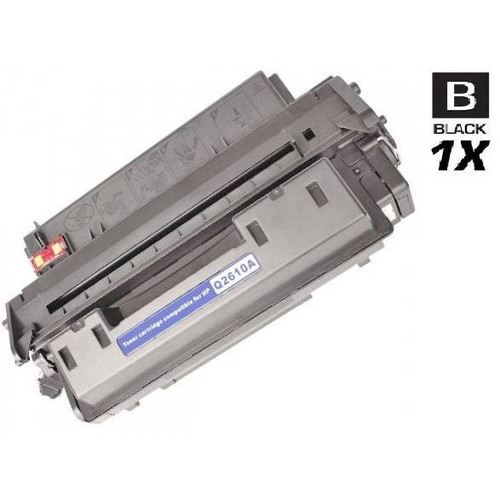
The reference price for the whole family: a single Q2610A at $44.64, 6,000 rated pages, the highest per-page rate here at 0.744¢ and the least money committed. Every badge above is this figure multiplied out and beaten. It is also, for the record, the one listing in the family with a recorded sale against it.
Shop the 10A Single →The buyable shelf on one price basis
Five rows, because five configurations can actually be ordered. Prices are sale; pages are rated at HP’s 6,000 per cartridge, with pack rows marked pooled since the pages are split across sealed units. There is no genuine row: HP’s US store returns no data for the Q2610A, so no original-equipment figure can honestly be set beside these:
| Configuration | Price (sale) | Rated pages | Cost per page | Printer fit |
|---|---|---|---|---|
| 10A 5-Pack — the flagship | $158.90 | 5 cartridges · ~30,000 pages | 0.530¢ pooled | All 6 models |
| 10A 4-Pack | $130.34 | 4 cartridges · ~24,000 pages | 0.543¢ pooled | All 6 models |
| 10A 3-Pack | $101.77 | 3 cartridges · ~18,000 pages | 0.565¢ pooled | All 6 models |
| 10A 2-Pack | $73.21 | 2 cartridges · ~12,000 pages | 0.610¢ pooled | All 6 models |
| 10A Single | $44.64 | 1 cartridge · 6,000 pages | 0.744¢ | All 6 models |
Two honest observations follow from the table. First, the spread is narrow: barely two-tenths of a cent per page separates the flagship from the single, so choosing among the counts is about cash committed, not about hunting down a bargain tier. Second, the cheapest arithmetic in the family is not in the table at all: at their store-stated ratings the switched-off X listings would work out to 0.361¢ and 0.343¢ a page — numbers attached to codes HP never issued and listings nobody can order. They are excluded from the table for exactly that reason, and recorded in the panel beside the flagship instead.
Six printers, one cartridge, no exceptions in either direction
HP’s compatibility for the Q2610A covers the LaserJet 2300 family in full: the 2300, 2300d, 2300dn, 2300dtn, 2300L and 2300n. Every card on this page fits every one of the six; there is no per-model split to watch for, and no neighboring platform borrows this cartridge. The family’s home in the catalog is the HP Q2610A category, named for the genuine code. To its credit, the catalog gets the printers right: the compatibility line in every description names exactly these six — the invention in this family is confined to cartridge codes. One blemish stands: the About section of each product page lists only five of the six and leaves out the 2300n, although the same page’s opening line names it. The 2300n takes this cartridge; HP’s roster says so, and the omission is in the About lists, not in the hardware.
Identifying the cartridge is a one-glance job: the code stamped on the unit you remove reads Q2610A, or the short name 10A — the same cartridge under its box name. If it reads either, the cards above are its replacements. One warning belongs here: a listing in this family advises buyers to look for a “Q2610X” stamp instead. No genuine cartridge carries that marking, because HP never produced the code; a buyer who follows that advice will search their cartridge in vain.
Where the page counts come from — and where two of them don’t
The 6,000-page figure has a clean pedigree. HP rated the Q2610A at 6,000 pages at 5% coverage, the standard measure of the era before ISO/IEC 19752 declared yields; the printer’s own manual calls it simply “the 6,000-page cartridge”. The listings agree with their maker: spec fields say 6,000, prose says 6,000. (Their spec boilerplate does invoke the ISO standard while their own answers state the 5% coverage basis — a labeling untidiness that changes nothing, since the number is the same under either description.) Every per-page cost on this page divides a sale price by that figure.
The 10,000 and 13,000 figures have no pedigree at all. They are attached to codes that appear in no HP document — not the code list, not the manual, not any rating HP published — and the listings that carry them cannot be ordered in any case. This guide therefore prints them only as the store’s claims about its own invented tiers, never as ratings a buyer can plan around, and never as a reason to prefer a listing that is switched off.
The drum question answers itself on this platform
There is no separate drum unit in a LaserJet 2300’s life. The Q2610A builds the imaging drum into the cartridge shell, and HP offers no drum under any other code for these printers. The listings state this, and for once the statement needs no correction: it matches HP’s design. Practically, it means a cartridge change is the whole maintenance event — toner and drum surface renewed together — and it is why worn-drum symptoms on a 2300, repeating marks or a gray wash, point at the cartridge rather than at a service part.
Each cartridge ships with the current chip generation fitted — the supply standard across the store’s compatible range, and one with an unblemished record behind it: no cartridge supplied this way has come back with a recognition complaint. Installation is a drop-in: the printer reads the cartridge, the level gauge reports, and nothing has to be carried over from the empty unit. The limit of that promise is the honest one — it speaks for these printers and their firmware as they stand today, not for firmware that has not been written yet.
The backing behind every card
All five listings share the same terms, set out once here. One caution first: the descriptions carry a “Warranty: Lifetime” line in their specification blocks, while their own terms answers give the warranty and the free returns a one-year span each. The one-year terms are the operative ones — they are what the product pages’ answers commit to — and they are the terms printed here.
Matching the count to the corridor
Questions from LaserJet 2300 owners
No. HP’s cartridge list for the 2300 contains the Q2610A and a dual pack, the Q2610D — nothing with an X. HP’s own manual for the printer names the Q2610A as its cartridge and calls it the 6,000-page cartridge. The 10X and 10XX listings on this shelf are the store’s own codes, rated by the store, and both are switched off, so neither can be ordered regardless.
You are not. The stamp does not exist: HP never manufactured a Q2610X, so no genuine cartridge is marked with it. The code on a genuine unit reads Q2610A, or 10A in short form. Match either of those and the cartridges on this page are the replacements; the advice to hunt for an X stamp is an error in that listing, recorded in the note at the foot of this page.
Not from HP’s own store. The Q2610A was discontinued years ago, and HP’s US store no longer carries any product information for it — the page came back empty on both checks made while this guide was prepared, with neither a price nor an availability statement to read. That is why no genuine price appears anywhere here: there is no figure that could be quoted honestly. The compatible shelf above is what remains on sale.
The one-year terms. Every description in this family carries a “Lifetime” line in its specification boilerplate, and every one of the same pages states in its terms answers a warranty of one year and free returns for one year. Boilerplate is not a commitment; the stated terms are. This guide prints the one-year warranty and one-year free returns throughout, and the contradiction is recorded below.
It fits. HP’s roster for the Q2610A includes the 2300n alongside the other five 2300 models, and the compatibility line at the head of each product page names it. The omission is confined to the About lists further down those pages, which name five models instead of six. The cartridge is the same for all six.
Because they are computed from a different figure. Every price answer in the descriptions — contents, per-cartridge, per-page — is built on the list price, while the register charges the sale price, which the descriptions never mention. The single’s own per-page answer, for instance, comes out at about 0.86 cents on list; on the sale price the register actually charges, it is 0.744¢. This guide works from sale throughout; the list figures are set out, marked as the descriptions’, in the closing note.
Price and disclosure note: Prices here are sale prices throughout, taken from the carded listings on November 18, 2026, when this guide was put together; the product page prevails if a figure has changed since. Sale is the basis because sale is what a buyer is actually charged. The descriptions work from list instead: $51.34 (single), $84.19 (two-pack), $117.04 (three-pack), $149.89 (four-pack, both copies), $182.74 (five-pack) — and the two switched-off X listings from list as well, $50.55 for the invented single and $247.62 for its three-pack. Nowhere does a description mention the sale figure. Badges compare sale with sale: $89.28 for two singles against the two-pack’s $73.21; $133.92 for three against $101.77; $178.56 for four against $130.34; $223.20 for five against $158.90. Yield provenance: 6,000 pages for the Q2610A at 5% coverage — the pre-ISO basis on which HP published the figure in its code list and the 2300 manual, repeated unchanged in the listings’ fields and text. The 10,000- and 13,000-page numbers belong to the store alone and ride on codes HP never issued. No original-equipment price appears, because HP’s US store holds no product data for the Q2610A and the cartridge was discontinued many years ago. Fit is per HP’s published list: LaserJet 2300, 2300d, 2300dn, 2300dtn, 2300L, 2300n. What follows is the catalog’s own untidiness, itemized.
First, two invented step-up tiers presented as HP’s own: no Q2610X or Q2610XX exists in HP’s code list or the 2300 manual, yet the listings’ prose introduces them as HP’s (“The Q2610X is the HP 10X”), rates them at 10,000 and 13,000 pages with no HP source, and the X single’s identity answer instructs buyers to find a “Q2610X” stamp on their installed cartridge — a stamp no genuine cartridge carries. Second, none of it can be bought: the X single and X three-pack are hidden and unavailable, the XX single is unavailable, and the dark X single’s $36.11 undercuts the genuine single’s $44.64 while claiming two-thirds more pages — an inverted ladder in the dark. Third, the invented three-pack is priced far above its contents: $176.87 against three of its own singles at $108.33. Fourth, arithmetic done on list, as set out above: not one prose price in the family is the price charged, and every per-unit and per-page answer is worked out from the list figure — the single’s page cost reads about 0.86 cents in its description against 0.744¢ at the sale price the register charges. Fifth, warranty boilerplate at war with itself: every description’s specification block claims a lifetime warranty while the same page’s terms answers state one year of warranty and one year of free returns; the one-year terms are the operative ones and are what this guide prints. Sixth, the premium distinction without a difference: the four-pack appears twice at one price, with one set of fields and one stock figure, the second copy wearing a “Premium Quality” name its own text concedes is merely a line name carrying the same backing as the rest of the range. Seventh, the About fit lists: each carded listing’s About section names five of HP’s six models and omits the LaserJet 2300n, although the same description’s opening compatibility line names all six. Eighth, stock figures that repeat: 53 is read by four listings across the family, 17 by two, and 12 by both copies of the four-pack — single pools surfacing under several listings at once. Ninth, the platform’s series category page returns a server error in the live store; it is not linked here. For completeness, what was looked for and not found: no description carries leaked production or prompt text; the drum statements are accurate, the imaging drum being built into the cartridge exactly as the listings describe; no printer is claimed that HP did not make, and no phantom category exists — the model tree matches HP’s six exactly; the genuine tier’s yield is one figure in the fields, the text and HP’s publications alike; and no category name is a garbled concatenation.
The buyable shelf rests on the five cards above, one card per product. The duplicate four-pack and the two invented tiers are dealt with in prose — the place where an explanation, rather than a price tag, does the work. HP’s roster bounds everything claimed here: six printers, a single genuine cartridge in a single size, five counts of it on sale; the invented codes surface only in the flagship’s side panel and in the itemized record above, never as things a reader can buy. Underneath sit the family’s own stated terms: one year of warranty, one year of free returns, support on weekdays from 9 AM to 5 PM Central, and shipping out of Illinois, Pennsylvania, Georgia and California.