




Search this store for a cartridge for a Lexmark T520 and you will come back empty-handed — not because the cartridge is missing, but because it is hiding under another company’s badges. The 12A6835, Lexmark’s Return Program high-yield cartridge for the T520 generation of workgroup printers, is sold here exclusively under the IBM InfoPrint 1120 and 1125 names, IBM’s rebadges of the same engines. No product title, no category filing, no fit answer anywhere in the family names a single Lexmark printer. Lexmark’s own compatibility table names ten: the T520 and T522 lines and the X520-series multifunctions, every one of them taking this same cartridge with no tier line drawn anywhere. This guide puts the Lexmark roster back on the record, prices the three boxes the store actually sells at checkout prices, and explains the one other cartridge a buyer weighing this shelf should know exists.
Own a T520, T522, X520 or X522 in any of its variants and this is your cartridge, whatever badge the product pages wear: the 12A6835 fits all ten models on Lexmark’s roster, with no high-yield fence and no model left on the wrong side of a tier line. The box to start from is the 2-pack at $188.99 — about forty thousand rated pages at 0.47¢ each. The 4-pack below it lowers the rate to 0.45¢; the single at $102.53 keeps the first commitment smallest. Two structural facts matter before the cards. First, the stocked code is the platform’s Return Program high-yield; its Regular twin, the 12A6735, is stocked on a separate shelf of this store at the same 20,000-page rating, and a later section separates the two. Second, the cartridge carries its own drum — there is no second imaging part to budget for on this platform, and the printer-side items that do wear out are service parts, covered further down.
The whole shelf: three boxes under borrowed badges
Six listings carry this cartridge, and they reduce to three offers. Each pack size appears twice — once named for the IBM InfoPrint 1125 and once for the 1120 — at prices identical to the cent, so the cards below show the 1125-named set, whose records are the tidier of the two, and show each box exactly once. The pair opens as flagship; the four and the single sit in the grid beneath it. Where a SAVE badge appears, it is a single subtraction done at the prices on this page: the cost of the pack’s cartridges bought one by one at the single’s sale price, less the pack’s own sale price. The badges on the product pages are computed from list prices instead and read larger; the closing note reconciles the two sets of figures.
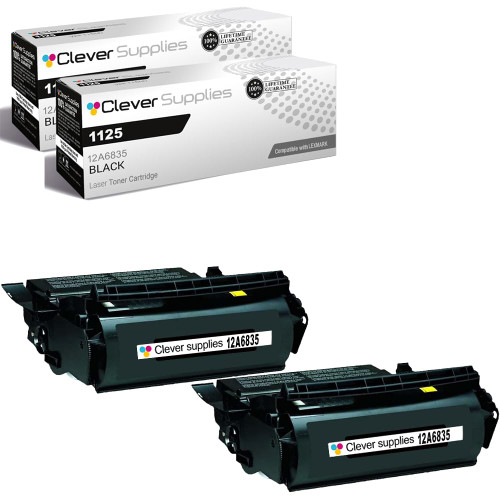
On a platform whose cartridge is rated at twenty thousand pages, running dry is a rare event — but it always lands mid-job, and the second cartridge in this box is what turns it into a two-minute swap instead of a rush order. Two singles bought separately come to $205.06, so the pair starts $16.07 ahead before a page is printed. Stepping up to the 4-pack shaves a further two hundredths of a cent off each page; that is worth gathering on a busy machine and barely worth noticing on a quiet one. What the pair really buys is an interval: on a departmental T522 printing a few thousand pages a month, one box can carry the office most of a year.
Shop the 12A6835 2 Pack →THE OTHER TWO BOXES
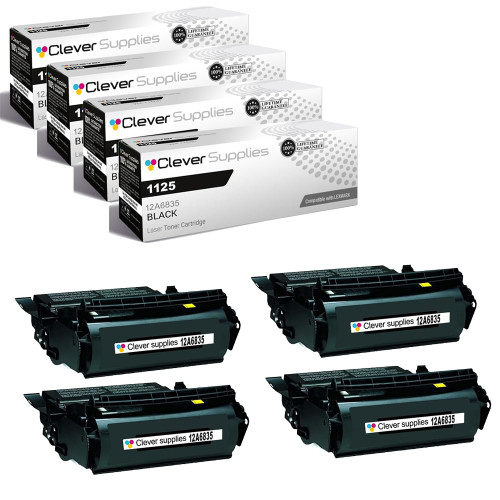
The shelf’s largest box and its cheapest page — on the order of eighty thousand rated pages before the next order is due. The same four cartridges bought one at a time would add up to $410.12.
Shop the 12A6835 4 Pack →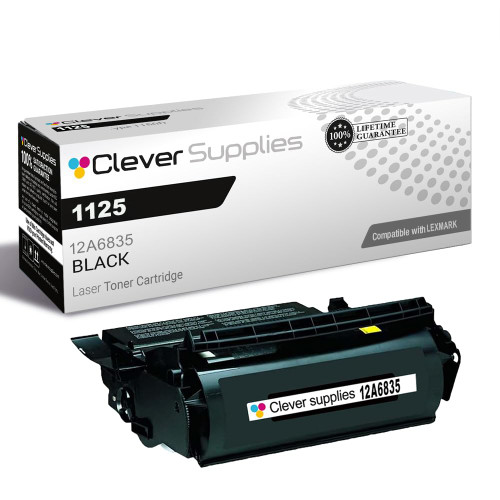
The smallest outlay on the shelf and the dearest page on it — the right box for a lightly used machine, or for a first order while the pack arithmetic is still unproven. The full 20,000-page rating arrives either way.
Shop the 12A6835 Single →Fit does not vary between the three cards — the same cartridge is inside each — so the choice between them is purely how far ahead to buy. The table prices that choice; the section after it restores the roster the cards assume.
The price of a page, box by box
Each rate below is the box’s sale price divided across the rated pages of the cartridges inside it. A single stocked code means a single tier, so the rows differ only in how many cartridges change hands at once; the fit column is identical down the table because the cartridge — and the ten printers it serves — never changes with the size of the box.
| Offer | Sale price | Rated pages per box | Per-page cost | Fits |
|---|---|---|---|---|
| 12A6835 4 Pack | $361.90 | 4 cartridges · ~80,000 pages | 0.45¢ | All 10 models — T520, T522, X520, X522 lines |
| 12A6835 2 Pack — the flagship | $188.99 | 2 cartridges · ~40,000 pages | 0.47¢ | All 10 models — T520, T522, X520, X522 lines |
| 12A6835 Single | $102.53 | 1 cartridge · ~20,000 pages | 0.51¢ | All 10 models — T520, T522, X520, X522 lines |
Six hundredths of a cent separate the bottom row from the top, and the first step — single to pair — collects four of them, leaving two for the step from two cartridges to four. Per cartridge the arithmetic runs $102.53 alone, $94.50 in a pair and $90.48 in a four. Nothing here punishes a small order; the spread simply pays a modest dividend for buying the way a busy office prints, in depth.
Fit: ten Lexmark printers the store never names
Lexmark’s North America supplies compatibility table assigns the 12A6835 to ten models, and every one of them has a category page in this store. Under the Lexmark T Series: the T520, T520d, T520dn and T520n, and the T522, T522dn and T522n. Under the Lexmark X Series: the X520, X522 and X522s. One cartridge covers the platform entire — Lexmark draws no yield fence on this generation, so no model in the ten is offered a lesser cartridge or refused this one.
Nowhere in the store is that roster stated. The six listings are titled for the IBM InfoPrint 1120 and 1125 — IBM’s rebadges of the T520 and T522 engines — and they are filed under the 1120 and 1125 categories and no others: not one of the ten Lexmark categories above holds a single one of these products. The printer link block on each product page repeats the same two IBM names, the shared introductory paragraph repeats them, and the fit answers inside the listings present the pair as the whole family. A T520dn owner who browses to that printer’s category page in this store finds no cartridge waiting there at all.
The direction of the error deserves its own sentence, because it is the opposite of the one guides in this series usually have to correct. Nothing on this shelf claims a printer Lexmark denies — the cartridge genuinely fits both IBM machines, since they are the T520 and T522 engines under IBM badges. What the shelf does is omit: ten documented models go unnamed on every surface a buyer can read. Understatement misleads more quietly than overstatement, but it misleads all the same — it tells the platform’s Lexmark-badged majority that their cartridge does not exist here.
So the rule for ordering is simple. If your machine wears any of the ten Lexmark badges above, the cards on this page are your shelf, and the IBM name on the listing you land on is a naming artifact, not a restriction. If it wears an InfoPrint 1120 or 1125 badge, the same cards are yours — those machines are this platform, and the store’s titles were written for you in the first place.
20,000 pages under the ISO standard — and the rungs around it
The yield needs no adjudication here. Lexmark’s supply page for the 12A6835 gives an average cartridge yield of up to 20,000 standard pages, declared in accordance with ISO/IEC 19752, and its compatibility table marks the figure with the same ISO footnote. The store’s texts agree: the singles state 20,000 pages and the packs multiply it honestly into totals of 40,000 and 80,000. One point is worth pausing on — this platform dates from 2001, and some cartridges of its era carry ratings expressed only as averages at five percent coverage, with no standard behind them. This is not one of those: Lexmark declares this cartridge’s yield under the ISO standard on its own current pages, so the 20,000 can be set beside modern ratings on equal terms, and every rate in this guide is built on it.
Around the stocked code, Lexmark’s ladder for the platform runs two programs. In the Return Program: a standard cartridge, the 12A6830, rated about 7,500 pages; the stocked high-yield 12A6835; and a label-applications variant, the 12A6839, at the same 20,000-page rating with a different fuser wiper for label stock. In the Regular program, sold outright: the 12A6730 at about 7,500 pages and the 12A6735 at about 20,000 — the Regular twin of the code carded above. Of the five, this store stocks two: the 12A6835 on this shelf, and the 12A6735 on a shelf of its own under the T520 name. The standard rung is stocked in neither program, and the label variant is not stocked at all.
The cartridge coming out of the printer settles which shelf is yours. A 12A6835 label is this page exactly. A 12A6735 label names the Regular twin — the same rating across the same ten printers, sold outright rather than under the return arrangement — and it is stocked separately, under its own listings; this guide names it so the two 20,000-page codes are not mistaken for one product, and prices neither it nor its packs. A 12A6830 or 12A6730 label names the unstocked standard rung, and the cartridge above is the step up from either, at well over two and a half times the rating.
A genuine price that no longer exists
Most shelves in this series are measured against what Lexmark charges for the genuine cartridge. Here there is nothing current to measure against. Lexmark’s supply page for the 12A6835 survives with its specifications intact, but it carries no United States checkout price — the cartridge has been discontinued for years. The Texas DIR schedule, Lexmark’s official US price list and the source of the genuine figures in several neighboring guides, contains no row for this family’s part numbers in either program. The only Lexmark-published price research could find anywhere is a 2003 figure from a legal filing — over two decades old, quoted in a document that was never a price list — and a number like that describes the market of 2003, not this one. It is not printed here as a price, and no savings-against-genuine claim is built on it.
What remains is the shelf’s own arithmetic, and it is respectable. Spread over blocks of ten thousand pages, toner from this shelf costs about $51 bought singly, about $47 in 2-packs and about $45 in 4-packs. An office printing ten thousand pages a month spends roughly $615 a year on singles against roughly $543 on fours — a difference near $72 a year, earned entirely by box size on a platform that asks for almost nothing else. The next section takes up the one maintenance story this generation of printer has.
A caution for cross-checkers: the product pages work their savings and per-page figures from list prices rather than charged prices. The single’s text starts from its $117.91 list figure and arrives at about 0.59¢ a page; start from the $102.53 actually charged and the rate is the 0.51¢ used throughout this guide. One of the family’s savings claims fails even against its own list prices — the closing note shows the subtraction.
One unit does the imaging: drum and toner together
There is no imaging unit to time against the toner on this platform. The photoconductor drum is built into the underside of the print cartridge itself — Lexmark’s User’s Reference for these printers warns owners never to touch it there — so each cartridge change installs a fresh drum along with the toner, and the cartridge’s 20,000-page rating already contains the drum’s working life. No separate unit is sold for these models, by this store or as a Lexmark supply, and none needs budgeting.
The parts that do wear live on the printer’s side of the line: a charge roll, a transfer roll, the fuser assembly and a periodic maintenance kit all appear in the platform’s documentation as service items. They are technician parts rather than consumables, this store lists none of them, and their practical meaning for an owner is narrow — when a T520-generation machine eventually needs attention, it will be the printer asking for service, not a supply running out. What the printers shipped with, this guide does not state: the platform’s setup guide shows a cartridge in the box but no retrieved Lexmark source gives that cartridge’s part number or rating, so no starter figure is printed rather than inferred.
Chips: the listings say nothing; the platform’s history says plenty
On this shelf, the subject simply never comes up. None of the six descriptions carries a chip claim of any kind — no smart-chip boilerplate of the sort the modern Lexmark families recite, no chip entry in any specification, and no statement about firmware in either direction. The listings are silent, and the silence is reported here as found rather than filled in on their behalf.
The platform underneath the silence is, historically, the most chip-litigated in Lexmark’s line. The genuine Return Program cartridges for this generation carry an authentication chip, and the chip on the T520-era Prebate cartridge became the subject of the Static Control litigation — a case that reached the Supreme Court — over whether Lexmark could use it to control what happened to a cartridge after its first sale. Lexmark’s documented position in the platform’s own User’s Reference is the era’s standard one: supplies from other makers are not recommended, and refilling a cartridge without authorization voids that cartridge’s warranty. No firmware-blocking regime is described in the platform’s documentation, and none is claimed here. The store’s standing position for its compatible range applies as it does across the catalog — its supplier builds cartridges around the current-generation chip, they install plug-and-play, and nothing is transplanted from the spent cartridge — and the limit this series always states applies too: no promise is made about firmware that does not yet exist.
The cover behind each box
Which box, for which office
Questions from T520 and T522 owners
Ten Lexmark models, per Lexmark’s North America supplies compatibility table: the T520, T520d, T520dn and T520n; the T522, T522dn and T522n; and the multifunctions X520, X522 and X522s. The same cartridge also serves the IBM InfoPrint 1120 and 1125, which are this platform’s engines under IBM badges — the only two machines the store’s own pages name. No model on the roster is fenced out of this cartridge, and no cartridge on the platform’s ladder fits a model this one does not.
Yes. The InfoPrint 1120 and 1125 are rebadges of the T520 and T522 engines, and Lexmark’s compatibility table documents the 12A6835 for the full ten-model Lexmark roster, your T520 included. The listings’ silence about the Lexmark models is a filing and naming gap in the store’s catalog — the products are not filed under any Lexmark model category, and their texts enumerate only the IBM pair — not a restriction on the cartridge. Nothing in the family claims a fit Lexmark denies; the omission runs the other way.
In Lexmark’s catalog, yes: a standard rung rated at about 7,500 pages exists in both programs — the 12A6830 in the Return Program and the 12A6730 sold outright. In this store, neither is stocked in any pack size, so the 20,000-page cartridge on this page is the only capacity on offer. Given the ratings, that is rarely a hardship: the stocked cartridge delivers well over two and a half standard cartridges’ worth of pages in a single unit, and capacity on this platform is otherwise increased only by holding more of the same box.
The program, not the performance. Both are the platform’s high-yield cartridge, rated at about 20,000 pages under ISO/IEC 19752 and documented for the same ten models. The 12A6835 is the Return Program version, sold under Lexmark’s single-use arrangement in which the empty goes back; the 12A6735 is the Regular version, sold outright. This store stocks both — the 12A6835 on this shelf, the 12A6735 separately under the T520 name — and neither family’s listings mention the other, which is why the distinction is drawn here.
The drum is part of the cartridge. On this platform the photoconductor drum sits on the underside of the print cartridge — Lexmark’s User’s Reference warns against touching it there — so a cartridge change renews the imaging surface along with the toner, and no part of the drum’s life sits outside the cartridge’s rating or price. The platform’s remaining wear items — charge roll, transfer roll, fuser, maintenance kit — are printer-side service parts, not supplies, and this store does not list them.
Because the two computations start from different prices. The listings reckon from list prices; this guide reckons from the sale prices checkout charges. Take the 2-pack: its page sets the $217.34 list price against two list singles at $235.82 and reports an $18.48 saving, $108.67 a cartridge and about 0.54¢ a page. On sale prices — $188.99 against $205.06 — the saving is $16.07, the cartridge costs $94.50 and the rate is 0.47¢. The 4-pack’s page adds a second fault: the saving it prints does not survive its own list prices, as the note below demonstrates.
Price and disclosure note: Every price in this guide is a sale price, read from the relevant product’s storefront page against its listing title on November 17, 2026 and confirmed live once more in the run-up to publication. Each listing also displays a higher list price; should a sale price lapse, the figure on the product page governs. SAVE badges follow one convention on this page — a pack’s sale price measured against buying its cartridges singly at the sale price, $205.06 for two singles and $410.12 for four — giving $16.07 on the 2-pack and $48.22 on the 4-pack. No genuine Lexmark price appears anywhere in this guide, and the absence is evidenced rather than assumed: Lexmark’s supply page for the cartridge carries specifications but no United States checkout price, the Texas DIR schedule contains no row for any of this family’s part numbers, and the sole Lexmark-published figure research located — a 2003 price inside a legal filing — is a historical document, not a price of record, and is not used. On yield, the sources converge: the listings’ texts state 20,000 pages and multiply it correctly into pack totals, and Lexmark declares the same figure in accordance with ISO/IEC 19752. Fit follows Lexmark’s North America supplies compatibility table. Measured against that record, the store’s surfaces depart in one direction only. First and largest, fit by omission: the listings are named for the IBM InfoPrint 1120 and 1125, filed under those two categories alone, linked to those two categories alone in their printer blocks, and their shared introduction and fit answers enumerate the IBM pair as the whole family — while the ten Lexmark models Lexmark documents appear on no surface, although all ten categories exist in the store and stand empty of this cartridge. Nothing in the family overstates a fit; everything in it understates one. Second, price basis: the listings compute their savings and per-page figures from list prices. The single is presented at about 0.59¢ a page from its $117.91 list price, against 0.51¢ on the $102.53 charged. The 2-pack advertises an $18.48 saving with cartridges at $108.67 and a rate near 0.54¢, against $16.07 saved, $94.50 per cartridge and 0.47¢ on sale prices. The 4-pack advertises cartridges at $104.05 and a rate near 0.52¢, against $90.48 and 0.45¢. Third, one of those list-basis figures is wrong on its own terms: the 4-pack’s texts claim a saving of $55.47 against four singles, where four list singles total $471.64 and the pack’s list price is $416.19 — a difference of $55.45. Every other list-basis figure in the family was tested and checks out; the basis, not the arithmetic, is the general fault, and this is the single exception to that.
Each unique product appears exactly once among the cards: one code in its three pack configurations. The family’s remaining three listings repeat those same configurations under the InfoPrint 1120 name at unchanged prices; they are not carded or linked, the contents being the identical 12A6835 throughout. The carded set is the 1125-named one, chosen because its stock-keeping codes are uniform, where the 1120 set’s are case-inconsistent and its 2-pack’s code misspells its pack word as “2Balck”. Beyond the stocked code, the platform’s ladder holds the standard pair 12A6830 and 12A6730 and the label variant 12A6839, none stocked in any configuration, and the Regular twin 12A6735, which is stocked on its own shelf under the T520 name and is named here without being carded or priced, the two programs’ shelves being separate. Two record gaps in the listings themselves are logged for completeness: no listing in the family carries a specification field of any kind — no part-number, yield or condition field — so every specification in the store’s presentation of this family lives in prose alone; and the introduction shared by all six listings headlines the cartridge as the 1120 cartridge even on the three listings named for the 1125. No ships-with figure for any model on this platform could be retrieved from a Lexmark source, so none is printed. On chips, the listings are entirely silent — the topic arises in none of the six descriptions — and the platform’s documented chip history and the store’s position are given in the relevant section above. No wording anywhere in the family describes a product as “genuine” or “authentic”. The protection attaching to each offer is the protection its listing itself promises: warranty cover for a year against defects in materials and workmanship, with returns free across the same year.