




Lexmark built two high-yield cartridges for the T520 generation, both rated at 20,000 pages, and what separates them is not output — it is ownership. The 12A6835 goes out under the Return Program, priced on the promise that the empty comes back. The cartridge covered here, the 12A6735, is the Regular version of that same cartridge: bought outright, kept, and owed to nobody. Clever Supplies sells the two from different shelves, and this guide deals only with the outright one — three boxes, a single, a 2-pack and a 4-pack, all listed under the T520 name. On fit, this family asks for no corrections: Lexmark documents the cartridge for ten printers, and every page the store publishes repeats those ten accurately. The gaps sit elsewhere. Nothing in the listings mentions that a Return Program twin exists, that Lexmark also made a smaller cartridge for these printers in both of its programs, or what separates the two 20,000-page codes from each other. The pages that follow put prices on the three boxes — at the figures charged at checkout, not list — and set that missing structure down in full.
Ten printers take this cartridge — T520, T520d, T520dn, T520n, T522, T522dn, T522n, X520, X522 and X522s — and if yours is among them, begin with the 2-pack: $279.05 buys about forty thousand rated pages at 0.70¢ apiece, arranged as one cartridge working and one waiting. Print in real volume and the 4-pack pulls the page cost down to 0.68¢; the $147.56 single asks the least money up front. Two things are worth holding onto while you compare the boxes. The first is the program carried in the code: 12A6735 is the Regular cartridge, purchased outright, and its Return Program twin sits elsewhere in this store under a guide of its own — same rating, same ten printers, different terms of sale. The second is mechanical: on this platform the imaging drum is built into the cartridge, so toner is the only consumable there is; the parts that eventually wear are the printer’s own service components, dealt with further down.
The outright shelf, all three boxes of it
There is no long catalog to work through here. The 12A6735 appears in the store exactly three times — once per pack size, each listing named for the T520 — with no duplicate listings muddying the choice, so the cards below are not a selection from the shelf; they are the shelf. The 2-pack leads, and the 4-pack and single sit beneath it. Badges marked SAVE are worked out on one basis everywhere in this guide: take what the cartridges inside would cost as singles at the sale prices shown here, subtract the pack’s sale price, and the remainder is the saving. Product pages run the same comparison off list prices instead, which makes their badges read bigger; the note closing this guide puts the two sets of arithmetic next to each other.
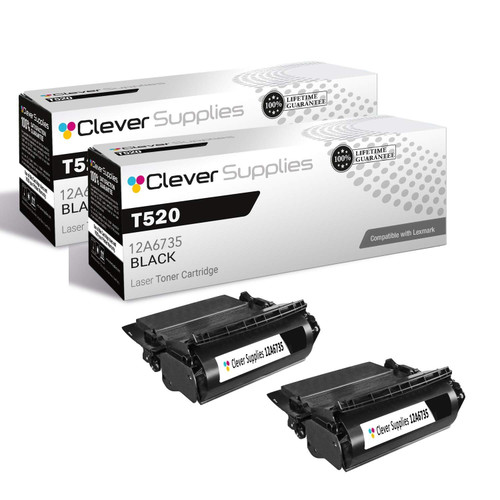
A cartridge rated at twenty thousand pages changes how an office thinks about spares: it runs for months, and the risk is not running out often but forgetting to reorder until the week it happens. The second cartridge in the box takes that week off the table. Two singles would cost $295.12 bought apart, so the pair begins $16.07 in front; moving to four cartridges trims another 0.02¢ from each page — a gain that matters at heavy volume and fades to a footnote where one cartridge already covers a season.
Shop the 12A6735 2 Pack →THE OTHER TWO BOXES
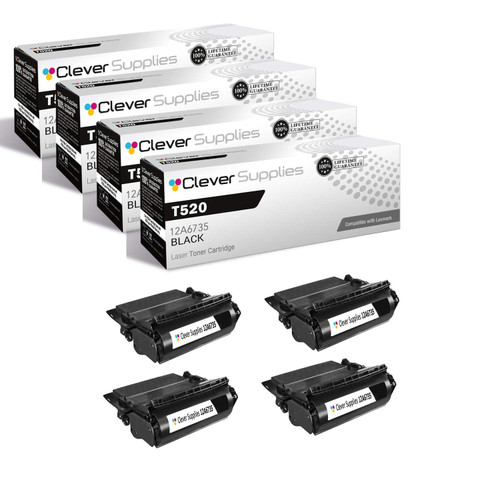
The biggest box here, and the cheapest way to buy the page: close to eighty thousand rated pages before anyone has to think about reordering. Purchased one by one, the same four cartridges come to $590.24.
Shop the 12A6735 4 Pack →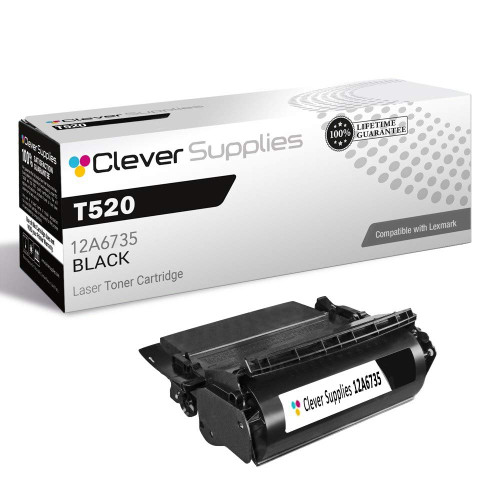
The lowest rung of commitment — least spent, most paid per page. Sensible for a machine that prints occasionally, or a first order before the pack maths has earned trust; the cartridge itself is the full retail unit, rated the same 20,000 pages.
Shop the 12A6735 Single →Nothing about fit separates the three cards — the cartridge inside is the same — so the only decision is how much of it to hold. That decision is priced in the next section.
What a page costs in each box
Each figure below comes from a single division: the box’s sale price spread over the rated pages of everything inside it. With one code and one cartridge size on the shelf, the table can only rank pack sizes — and the fit column cannot change from row to row, because boxing the cartridge singly or in fours does not alter the ten printers it serves.
| Offer | Sale price | Rated pages per box | Per-page cost | Fits |
|---|---|---|---|---|
| 12A6735 4 Pack | $542.02 | 4 cartridges · ~80,000 pages | 0.68¢ | All 10 models — T520, T522, X520, X522 lines |
| 12A6735 2 Pack — the flagship | $279.05 | 2 cartridges · ~40,000 pages | 0.70¢ | All 10 models — T520, T522, X520, X522 lines |
| 12A6735 Single | $147.56 | 1 cartridge · ~20,000 pages | 0.74¢ | All 10 models — T520, T522, X520, X522 lines |
Top to bottom the whole spread is 0.06¢. Most of it is won in the first step, from one cartridge to two; the step after that, two to four, adds only 0.02¢. Split the packs down and a cartridge costs $139.53 from a pair or $135.51 from a four, against $147.56 bought alone. Gaps that small make no choice a bad one — they just tilt the arithmetic toward whichever box matches how far ahead an office likes to buy.
Fit: the full ten-model roster, right on every surface
Lexmark’s documentation assigns the 12A6735 to ten models. In the Lexmark T Series: the T520, T520d, T520dn and T520n, and the T522, T522dn and T522n. In the Lexmark X Series: the X520, X522 and X522s. Every name above links to that model’s own category page here, and all ten categories are live. Nor is there a tier line to trip over: Lexmark gave the platform a single high-yield cartridge in each program, documented both for the identical ten printers, and fenced none of them away from this one.
Most families in this series hand the guide a roster error to untangle — a surface that claims too much, or one that claims too little. This one hands over none, and the point deserves emphasis. Browse the listings by category and the ten models are there. Open the Compatible Printers block on a product page and the same ten are linked. The packs’ introductory fit paragraph counts them out; the compatibility answers in the listings, single and packs together, repeat them. Hold any of it against Lexmark’s compatibility table and it matches, in both directions — the tidiest fit record this platform has.
The contrast with the platform’s other shelf in this store is sharp. The Return Program twin is sold under IBM InfoPrint names and filed under not one of the ten Lexmark categories; this shelf is named for the T520 and filed under all ten. A T520 owner who starts from their model’s category page lands on these listings directly — the very route that never reaches the twin. Neither shelf’s listings mention the badges the other wears, and the ten primary categories linked above are the ones this guide works from.
Filing details worth recording, though none moves the fit picture: the products also sit under a few variant categories belonging to these same machines — an SBE version of the T520, MFP versions of the X520 and X522s — while a separate Optra branch of the tree keeps further duplicate categories for the same models, none of them holding these products. Cross-references elsewhere in the trade pin Dell and IBM badges onto the same engines; Lexmark’s table speaks only for its own ten, and the ten are what this guide relies on.
The 20,000-page rating, agreed everywhere — and the family around it
Begin with the rating, because nobody disputes it. In their prose the listings give the cartridge 20,000 pages and scale the packs from there — 40,000 for two cartridges, 80,000 for four — and that prose is the only place the figure lives in the store, since the family carries no specification fields at all. Lexmark’s record backs the number twice: the supplies table on its X520 MFP page lists the code at 20,000 pages among the platform’s Regular supplies, and the North America compatibility table attaches to the figure its footnote declaring the yield in accordance with ISO/IEC 19752. One listing describes the rating as based on standard five percent text coverage — Lexmark’s own stated basis for the platform’s yields, and no obstacle to the ISO declaration standing beside it. All the arithmetic in this guide rests on the 20,000.
The code itself carries the structure around the stocked cartridge. Lexmark’s ladder for the platform holds five codes in two programs, and on this platform the digits announce the program: 12A68xx is Return Program, 12A67xx is Regular. At the standard rung, around 7,500 pages, sit the 12A6830 and its Regular counterpart the 12A6730. At the high-yield rung, around 20,000 pages, the 12A6835 pairs with the 12A6735 carded above. A fifth code, the 12A6839, adapts the Return Program high-yield cartridge for label work. This store stocks two of the five: this cartridge, and the Return Program twin shelved separately. The standard rung appears in neither program, and the label variant appears nowhere.
Which shelf is yours is decided by the cartridge that comes out of the printer. A 12A6735 label is this page, exactly. A 12A6835 label belongs to the Return Program twin — identical rating, identical ten printers, but sold on return terms rather than outright — which the store sells from its own shelf; the two guides point at each other, and neither puts the other’s products on its cards. A 12A6730 or 12A6830 label is the smaller standard cartridge, stocked in neither program here; the cartridge above outrates it by well over two and a half to one.
The genuine cartridge has no current price
Elsewhere in this series the compatible shelf is measured against what Lexmark charges for the genuine article. Here the measurement cannot be made, and rather than dress the page with an unofficial number, the guide records why. The cartridge was discontinued long ago: Lexmark’s platform page marks the product no longer for sale, and its supplies table — this code included — is printed without a checkout price. The Texas DIR schedule, the official Lexmark US price list published on lexmark.com that supplies genuine figures for several families nearby, has no entry at all for this family’s part numbers. With no current Lexmark price of record in existence for the 12A6735, none appears here, and no claim of savings against a genuine price is made anywhere in the guide.
That leaves the shelf’s own numbers, which stand up on their own. Reckoned per ten thousand pages, toner bought here runs to about $74 as singles, $70 in 2-packs and $68 in 4-packs. Sustain ten thousand pages a month for a year and the same printing costs roughly $885 bought one cartridge at a time against roughly $813 bought four at a time — about $72 a year decided by nothing but box size, on a machine that demands little else. Depth of pack is the single lever the family gives a buyer, and the table above puts numbers on it instead of adjectives.
One warning for anyone cross-checking the product pages: their figures are built from list prices, not from what checkout charges. The single’s text takes its $169.69 list price and lands near 0.85¢ a page; divide the $147.56 actually paid and the result is the 0.74¢ this guide uses throughout. The closing note runs the same audit over the other two listings.
The drum is inside the cartridge — there is no second consumable
For once, the toner budget is the whole consumables budget. Imaging on this platform happens inside the print cartridge: the photoconductor drum is one of its components, and Lexmark’s User’s Reference for these machines warns against touching the drum on the cartridge’s underside. The drum’s working life is therefore already inside the cartridge’s 20,000-page rating and inside its price; print quality starts over with every swap, and no separate imaging unit exists for a buyer to purchase, shelve or schedule against the toner.
Beyond cartridges, what the printer eventually wants is workshop hardware rather than supplies: the charge roll, transfer roll, fuser assembly and maintenance kit fill the later chapters of Lexmark’s reference as parts for a technician, none of them items ordered alongside toner and none of them sold in this store. They earn their mention for a single reason — so the owner of a high-mileage T520 understands that its next big need is a service visit, not a different cartridge. The starter question gets the same restraint: the platform’s Setup Guide shows a print cartridge arriving in the box, yet no Lexmark source found for this guide gives that cartridge a part number or a yield, so no starter figure appears here in place of a guess.
Chips: claimed on the packs, absent from the single
Whether this family claims a chip depends on which listing you read. The two packs open with a shared boilerplate introduction that describes units built entirely new and names a smart chip among the OPC drums and wiper blades. The single has no boilerplate — a keyword header, then straight into its questions — so its introduction claims no chip, and beyond that the family is quiet: firmware is not mentioned anywhere, hopefully or warningly. The disagreement between listings is reported as it stands; this guide does not smooth it over.
Behind the claims sits a platform with a chip history of its own, and it is documented rather than rumored. Remanufacturing literature records that Lexmark’s genuine Return Program cartridges for this generation carry an authentication chip fitted with a disabling function that enforces the single-use license, while genuine Regular cartridges — the program this code belongs to — carry a chip whose disabling function is switched off; in its day, the platform’s Return Program chip was litigated in well-known proceedings. Lexmark’s position, stated in the User’s Reference, is that cartridges from other makers are not recommended and that refilling without authorization voids the cartridge’s warranty; the platform’s guides contain no firmware-blocking statement, and this page invents none. What can be said for the store’s own range reaches this shelf as it reaches the catalog at large: the supplier builds its cartridges around the latest-generation chip, they go in plug-and-play, and nothing has to be carried over from the cartridge being replaced. The boundary this series never crosses applies here as well — firmware that does not exist yet is promised against by no one.
The cover standing behind every box
Matching the box to the office
Questions from T520 and T522 owners
Ten of them: T520, T520d, T520dn and T520n; T522, T522dn and T522n; and the X520, X522 and X522s multifunctions. The list is Lexmark’s — its North America compatibility table and the supplies table on the X520 MFP page agree on the same ten — and the store matches it on every surface: look at the category filing, the printer link blocks, the introductory paragraphs or the compatibility answers in the listings and the identical ten names come back, neither padded nor cut. A single cartridge covers the platform, so no model and no pack size carries a fit exception.
Terms of sale — nothing about performance. Yield and fit coincide: about 20,000 pages declared under ISO/IEC 19752, across the same ten printers. The 12A6735 is the Regular cartridge, sold outright. The 12A6835 is the Return Program twin, sold under Lexmark’s single-use arrangement, under which the empty goes back. The platform’s numbering spells the split out: 12A67xx codes are Regular, 12A68xx codes are Return Program. This store keeps both, on separate shelves behind separate guides; the listings on this shelf never mention the twin or the distinction, which is why it is set out here.
Lexmark made one; this store does not stock it. Under the high-yield rung sits a standard rung at roughly 7,500 pages, in both programs — the 12A6730 sold outright and the 12A6830 under the Return Program — alongside a label-applications variant of the Return Program high-yield cartridge, the 12A6839. Not one of the three is listed here in any pack size. Two listings on this shelf allude to “smaller standard-fill cartridges” without giving their codes; the codes are the ones in this answer, and a buyer set on them will not find them in this store — its offer for the platform is the high-yield cartridge above.
The drum travels with the cartridge. The 12A6735 is an all-in-one unit and the photoconductor drum is among its components — Lexmark’s reference for these printers warns owners off touching the drum on the cartridge’s underside — so no imaging life is left outside the 20,000-page rating or the price, and there is no second unit to buy or to schedule. The printer-side hardware — charge roll, transfer roll, fuser assembly, maintenance kit — belongs to technicians rather than to the supplies cupboard; it is not stocked here, and the section above records it so that a high-mileage machine’s eventual service need is not a surprise.
Some print cartridge — the platform’s Setup Guide shows one coming out of the box and being fitted during setup — but no Lexmark source gathered for this guide names that cartridge’s part number or yield, so this page prints no starter figure instead of inventing one. What is certain is that everything carded above is the full-rated retail high-yield cartridge: whatever the machine arrived with, its first replacement from this shelf is the complete 20,000-page unit.
The two sets of numbers start from different prices. The listings work from list prices; this guide works from the sale prices a buyer is actually charged. Take the 2-pack: its page sets two list singles ($339.38) against the pack’s $320.91 list price and reports $18.47 saved, $160.46 a cartridge and about 0.80¢ a page. On sale prices — $279.05 for the pair against $295.12 for two singles — the same box saves $16.07, works out to $139.53 a cartridge and runs at 0.70¢. The single and the 4-pack show the same list-price habit across their questions and About sections; the note after this section goes through each of them.
Price and disclosure note: Every price in this guide is a sale price, taken from the relevant product’s storefront page, checked against that page’s listing title on November 17, 2026, and confirmed live again while the guide was being prepared. Listings also carry a higher list price; if a sale price lapses, the figure on the product page is the one that governs. SAVE amounts obey one convention throughout the page — a pack’s sale price set against buying its cartridges one at a time at sale prices ($295.12 for two singles, $590.24 for four) — which produces $16.07 on the 2-pack and $48.22 on the 4-pack. That no genuine Lexmark price appears anywhere here is a deliberate, evidenced omission: Lexmark’s platform page marks the product as no longer for sale and prints no checkout price for the code, the Texas DIR schedule dated July 25, 2024 holds no entry for any of this family’s part numbers, and no other current Lexmark price of record for the cartridge could be found. On yield there is nothing to adjudicate: the listings’ prose and Lexmark’s ISO/IEC 19752 declaration converge on approximately 20,000 pages — prose being the store’s only record, since the family carries no specification fields. Fit rests on Lexmark’s North America compatibility table, backed by the supplies table on its X520 MFP page. Measured against that record, the store’s fit information deviates not at all: categories, link blocks, prose and question-and-answer text name the ten documented models uniformly, the sole additions being duplicate categories for machines already counted in the roster. The departures on record are about money and about omission. Money first: the listings build their savings and per-page figures on list prices. The single is shown at about 0.85¢ a page from its $169.69 list price, against 0.74¢ on the $147.56 charged. The 2-pack advertises $18.47 saved, cartridges at $160.46 and a rate near 0.80¢, against $16.07 saved, $139.53 per cartridge and 0.70¢ on sale prices. The 4-pack advertises $55.44 saved, cartridges at $155.83 and a rate near 0.78¢, against $48.22 saved, $135.51 per cartridge and 0.68¢ on sale prices. Second, credit where it is owed: the listings’ arithmetic survives testing instance by instance — the 4-pack’s $55.44 is exactly four list singles ($678.76) minus the pack’s list price ($623.32) — a care with sums that a comparable figure on certain other shelves in this series does not match; the fault is the price basis, not the addition. Third, omission: no listing discloses that the stocked code is the Regular cartridge sold outright (the term “Return Program” occurs zero times family-wide), names the Return Program twin stocked on its own shelf, or identifies any sibling code in Lexmark’s ladder — three facts about how this platform is supplied that a reader of the product pages alone would never meet.
Among the cards, each distinct product appears once and once only: a single code in its three pack configurations, and the family holds no duplicate listings that would need excluding. Past the stocked code, Lexmark’s ladder for the platform contains the standard pair 12A6730 and 12A6830, the label variant 12A6839 and the Return Program twin 12A6835; of those only the twin is stocked, shelved separately under IBM names, and it is referred to here for context — never carded, linked or priced. The cartridge is all-in-one; the platform’s printer-side parts (charge roll, transfer roll, fuser assembly, maintenance kit) are service parts rather than consumables, and none is for sale here. Ships-with evidence reaches as far as the platform’s Setup Guide and no further: a cartridge is shown in the box, no Lexmark source retrieved states its part number or yield, and none is asserted. Three blemishes are logged for completeness. Each listing’s stored Compatible Printers block links the T520 twice at its head, shows one variant model name as plain unlinked text, and ends on a link into a malformed nested category along a duplicate branch of the tree — present on all three listings and without consequence for fit, since the roster the block names is the right one. The listings are likewise filed under four variant or duplicate categories beyond the roster, every one of them a category for a machine already in it. And the boilerplate divides the family: the two packs carry the shared introduction — fit paragraph, warranty language and chip claim together — while the single carries none of it and opens on a keyword header instead, though its question-and-answer body still states the warranty and returns terms in full. On chips, the packs claim a smart chip inside that shared boilerplate, the single claims nothing, and firmware is mentioned nowhere in the family; the store’s position on the subject is set out in the relevant section above, on the store’s own authority. No wording in the family calls a product “genuine” or “authentic”. The protection attached to each offer is the protection its listing promises: a year of warranty cover against defects in materials and workmanship, with returns free across the first year.