




Most cartridge families ask a buyer to weigh price against endurance and pick a side. This one refuses to cooperate. HP made two black cartridges for the LaserJet 4345 and M4345 multifunction printers — the standard 45A, code Q5945A, and the maximum-yield 45X, code Q5945X — identical in fit, differing only in how much toner the shell carries. On this store’s shelf the larger cartridge is also the less expensive one: $49.16 against $53.78, with the longer rating attached. Two complications ride along with that easy answer, and both are handled in the open further down: the standard cartridge’s page rating is stated one way by the store and another by HP, and the same hardware is offered elsewhere in this catalog under nine printer-model names, with the paperwork of the two tiers crossed. Neither complication changes which cartridge a buyer should take. Both change how carefully its figures deserve to be read.
Order the 45X. It costs less than the standard cartridge, it is rated for more pages, and it fits exactly the same printers — there is no axis on which the standard fill wins the comparison, so the flagship below is the default for nearly every department running these machines. The 45A is carded underneath it for the buyers who have a reason outside arithmetic: a stores shelf already standardized on the standard cartridge, or a procedure that names the Q5945A code. Every figure on this page is a sale figure taken off the product’s own page. The listings themselves do their sums from higher list prices; those sums are quoted only inside the disclosure at the foot of the page, where they are identified as the listings’, not used as this guide’s.
The bigger fill is the smaller bill
Set the two singles side by side and the usual tier logic inverts. The maximum-yield cartridge is stickered $4.62 under the standard one, and on the store’s own ratings it carries 4,000 more pages — so it wins the outright price, wins the per-page rate, and wins the interval between swaps, all at once. No savings badge is pinned to its card, because badges in this catalog report a pack priced below its contents, and this family has no packs; a single cartridge cannot undercut itself. What the X offers is not a discount. It is a shelf that happens to price the better cartridge lower, stated here as a fact rather than dressed as a promotion. Alongside the flagship stands the family’s other peculiarity: nine further listings that sell this platform’s cartridge under the names of the printers themselves. They are accounted for in the panel beside the card, in prose, because their own paperwork disqualifies them from one.
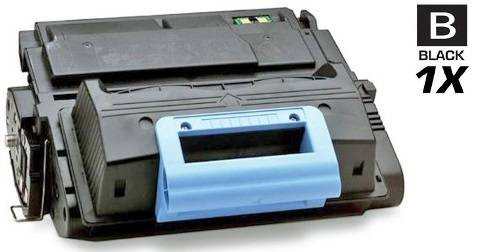
On a multifunction machine the cartridge feeds every job the device performs, not just the print queue, so the longest interval between swaps is worth more here than it would be on a single-function printer. The X stretches that interval furthest on any reading of the ratings — and because the drum rides inside the same shell, each swap closes out the machine’s whole consumable account at once. Nothing else on this platform runs on a separate clock.
Shop the 45X →A buyer who starts from a model page meets a cartridge whose stated life belongs to the standard fill and whose cost belongs to the maximum-yield one, and has no way to tell from that page which physical cartridge would arrive. This guide therefore cards the two code-named listings whose fields, prose and price describe a single coherent product, and leaves the nine to the disclosure below, where their inventory echoes are recorded as well. If you arrived here from one of those model-named pages, the two cards on this page are the same purchase with its paperwork in order.
The standard cartridge, for buyers who want the standard cartridge
The 45A remains a legitimate purchase for a narrow set of reasons: a department that stocks one cartridge code and qualifies its supplies by that code, or a shelf already holding standard fills that a new cartridge should match. What it is not, on this shelf, is the economical choice — at $53.78 it costs more than the X before it prints a page, and its per-page rate is higher on every basis the yields section examines. The A is listed twice in this catalog. The card below shows the listing this guide cards, which carries the words “Premium Quality” in its name; a second, plainer listing offers the identical cartridge at the identical price with identical fields, and is named in the disclosure rather than carded — one product earns one card. Nothing in this guide’s recommendation rests on the premium wording. The listing’s own text promotes that label as a choice about output density and evenness for client-facing work, while its fit answer concedes the single checkable point: the premium line changes nothing about which printers the cartridge serves. Between the carded listing and its plain twin, no figure in the store’s data — price, rating, fields, stock — separates them, and the disclosure records the label exactly on those terms. The plain twin’s stock code even mislabels the tier it belongs to, styling the standard cartridge “High-Yield” when the family’s high-yield member is the X; that defect is recorded in the disclosure as well.
THE STANDARD FILL — ONE CARTRIDGE
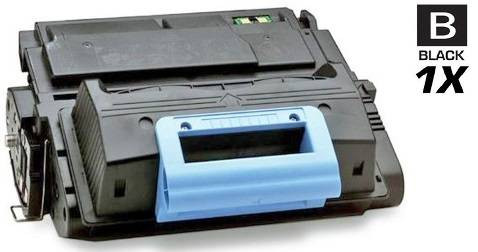
The family’s standard fill, sold under a “Premium Quality” name this guide repeats but does not lean on. Its rating is the disputed one: the store states 20,000 pages in field and prose alike, HP states 18,000, and the yields section below shows the working for both.
Shop the 45A →Two cartridges, and one rating stated two ways
Each row divides a sale price by a stated page rating. The standard cartridge appears twice — once on the rating its own listings publish, once on the rating HP publishes — because the two disagree, and a buyer deserves both denominators rather than a silent choice between them. The maximum-yield row needs no such doubling; its rating is the same in every source:
| Cartridge | Sale price | Rated pages | Cost per page | Fits |
|---|---|---|---|---|
| 45X Single — the flagship | $49.16 | 1 cartridge · ~24,000 pages | 0.205¢ | All 8 configurations |
| 45A Single — at the store’s rating | $53.78 | 1 cartridge · ~20,000 pages | 0.269¢ | All 8 configurations |
| 45A Single — at HP’s rating | $53.78 | 1 cartridge · ~18,000 pages | 0.299¢ | All 8 configurations |
Read the first two rows together and the inversion is complete: the cartridge with more pages costs fewer dollars, so its rate wins by both doors at once — 0.205¢ against 0.269¢ on the store’s figures. The third row exists because the second row’s denominator is contested. HP rates the standard cartridge at 18,000 pages, not 20,000, and recomputing on HP’s figure moves the A’s rate to 0.299¢ — worse, but not decision-changing: the X leads by a wide margin under either accounting, which is precisely why this guide can afford to print both.
One column is missing by necessity: genuine HP pricing. HP’s US store lists neither code, so no manufacturer figure exists to set against the store’s, and this guide does not invent one.
Two series, eight configurations, one cartridge fit
HP’s published compatibility assigns both cartridges to the same two multifunction series. From the first, the LaserJet 4345, 4345x, 4345xm and 4345xs; from the second, the LaserJet M4345, M4345x, M4345xm and M4345xs. Each configuration also appears in mfp-badged forms, and those take the same cartridge — the badge spells out the multifunction role the whole platform already has. Both tiers serve the entire roster without exception: a 45A and a 45X are interchangeable at the printer, and the choice between them is purely about fill and price. The store files the family under its HP Q5945A category, a name taken from the standard tier although the maximum-yield listing sits under it too; that naming is recorded in the disclosure. The category tree is generous about the platform in general — sixteen model categories for a two-series family, every configuration and every mfp-badged variant keeping a shelf of its own.
On fit, this family’s listings behave better than most in the catalog: their compatibility lines name exactly the machines HP names, and no listing here reaches for a printer outside the two series. Where their own answers fall short is the opposite direction — narrower than the truth — and that is a disclosure item rather than a fit risk. The check that settles any individual machine remains the spent cartridge itself: if the code coming out reads Q5945A or Q5945X, either card on this page is its replacement; if it reads anything else, this is the wrong family.
One rating everyone signs, and one they do not
Both tiers are rated under ISO/IEC 19752, the standardized test method the listings’ own footnotes cite — so unlike the older families elsewhere in this catalog, these figures were at least produced under a common yardstick, and dense departmental work will still pull real life below them. The maximum-yield rating needs no arbitration at all: 24,000 pages in the listing’s spec field, 24,000 in its prose, 24,000 in HP’s published data. The standard rating is where the sources part company. The store states 20,000 pages for the Q5945A — in the structured spec field, not merely in marketing prose — while HP’s own product page for the same cartridge states 18,000. This store’s standing practice for compatible cartridges is to compute on the wholesaler’s figure, so the math on this page runs on 20,000 and prices the A at 0.269¢ a page; HP’s figure is printed beside it wherever it matters, recomputing to 0.299¢, and 20,000 is never presented here as HP’s number.
The tier gap itself changes size with the basis chosen. On the store’s figures the X carries 24,000 pages against the A’s 20,000 — a fifth more, 4,000 extra pages, a ratio of 1.20. On HP’s figures the same comparison runs 24,000 against 18,000, a ratio of 1.33. Either way the direction is identical, and it arrives attached to the lower price: the X is not a premium charged for longevity but a longer-lived cartridge that happens to cost less, which is why the recommendation on this page does not depend on which rating basis a reader trusts. A department whose machines spend their days copying dense files will land below either rating on either tier — the standardized test page is a yardstick, not a forecast — but it will land below them in the same proportion, and the comparison survives.
The drum rides inside — there is nothing else to replace
Buyers cross-shopping this catalog will meet platforms where the imaging drum is a second part with a second price and a second schedule. This is not one of them. The Q5945 shell unites toner and imaging drum in a single unit, HP sells no separate drum for these printers — no drum code, no drum rating, nothing else wearing out on its own timetable — and the listings’ statements to that effect were checked rather than assumed, and hold. A cartridge change is therefore the whole maintenance event: toner renewed, drum renewed, done. When output fades on this platform, the cartridge is the first and only consumable suspect.
The electronic side is equally undemanding. Units ship with the newest chip generation the supplier fits — the standing practice across this store’s compatible range, and one with a clean record behind it: no chip complaint has come back on a cartridge supplied this way. Seat the cartridge and the machine takes it, toner gauge reporting; nothing is salvaged from the old unit, and no chip changes hands. The assurance has edges, and they are printed beside it: it covers cartridges as supplied today and the record to date, and it cannot reach firmware that HP has not yet written.
The terms underneath both cards
Whichever of the two carded cartridges a buyer takes, the same terms travel with it; they are collected here rather than repeated under each card.
Settling the two-card question
Questions from 4345 and M4345 departments
Because that is how the shelf is priced. The store offers no explanation for the inversion, and this guide will not manufacture one — what can be verified is the fact itself: the 45X is listed at $49.16, the 45A at $53.78, and the X carries the longer rating on any basis. A buyer does not need the reason to act on the arithmetic. Should the prices ever right themselves, the per-page comparison in the table above is the tool for re-deciding; at today’s figures the decision makes itself.
Either. The 45A and 45X share one fit across the whole roster — the LaserJet 4345, 4345x, 4345xm and 4345xs, the M4345, M4345x, M4345xm and M4345xs, and their mfp-badged forms. The tiers differ only in fill: the standard cartridge and its maximum-yield sibling seat in the same bay, so the choice is made on price and pages, never on compatibility. If the cartridge coming out of your machine reads Q5945A or Q5945X, you are in the right family.
The store says so twice over — 20,000 pages in the Q5945A’s structured spec field and again in its prose. HP’s own product page for the cartridge says 18,000, on the same ISO/IEC 19752 basis. This store’s standing rule for compatible cartridges is to compute on the wholesaler’s figure, so this page’s math uses 20,000 and prices the A at 0.269¢ a page — while printing HP’s figure alongside, which recomputes to 0.299¢. The 20,000 is the store’s rating, and it is never dressed up here as HP’s.
Nothing that the store’s data can demonstrate. The carded 45A listing carries those words in its name, and its own text presents the premium line as a matter of output density and evenness — while its fit answer concedes that the premium line changes nothing about which printers the cartridge serves. A second, plain listing offers the same cartridge at the same price, with the same spec fields, the same rating and the same stock behind it. This guide cards the premium-named listing, records the label without endorsing it, and does not claim to know what, if anything, differs inside the box.
They do not. HP built this platform with toner and drum sealed into the single Q5945 cartridge, and sells no drum part for it — no code, no rating, nothing to schedule. Each swap therefore renews both at once, and fading output on a 4345 or M4345 points at the cartridge, not at a second consumable behind it.
Twelve months of each, running from the day the cartridge is delivered: a year of warranty cover and a year in which returns cost nothing, on the terms each product page prints. Questions go to staff on weekdays, 9 AM to 5 PM Central, and orders are dispatched from warehouses in Illinois, Pennsylvania, Georgia and California.
Price and disclosure note: Every price printed above is the sale figure showing on the carded product’s own page when this guide was prepared, on November 18, 2026; if a price has moved since, the product page governs. Sale is the basis throughout, because sale is what checkout charges. The listings’ own prose works from list instead — $61.85 for the standard cartridge, $56.53 for the maximum-yield — and derives its per-page claims from those amounts: the X’s per-page answer works out near 0.236¢ at list against 0.205¢ at sale, the A’s text calls its rate roughly a third of a cent at list (0.309¢) against 0.269¢ at sale, and the plain duplicate A builds an annual budget on list — $247.40 a year at four cartridges, $742.20 at twelve — overstating a year’s supply by $32.28 and $96.84 respectively against sale prices. The yield figures are ISO/IEC 19752 ratings: about 24,000 pages for the 45X, on which the listings’ fields, their prose and HP agree exactly; and for the 45A a split — 20,000 pages in the listings’ spec fields and prose, 18,000 on HP’s own product page. Following this store’s standing yield-source rule, the math here runs on the wholesaler’s 20,000, with the HP-basis rate of 0.299¢ stated so a reader can recompute. No genuine figure is printed for either code, because HP’s US store keeps no page for the Q5945A or the Q5945X; nothing has been estimated to stand in for one. Fit follows HP’s published roster: LaserJet 4345, 4345x, 4345xm, 4345xs, M4345, M4345x, M4345xm and M4345xs, with their mfp-badged forms. Then the catalog’s own untidiness, taken in order.
First, the premium label: the carded A listing is named “Premium Quality” and its text markets that line on output density and evenness, yet its price, spec fields, yield rating and stock are identical to the plain duplicate listing’s, and its own fit answer concedes the premium line changes nothing about fit. No store data substantiates a physical difference, and this page records the label without adjudicating it. Second, the duplicate itself: a plain Q5945A listing duplicates the carded one in every particular, and its stock code reads “Q5945A-High-Yield” — a misnomer, since HP classifies the A as its standard-capacity cartridge and the family’s high-yield member is the X. Third, the nine model-named listings: each is fielded as the standard cartridge with a 20,000-page rating, in field and prose, yet priced at the maximum-yield cartridge’s money, so their text pairs the X’s list figure with the A’s rating and lands near 0.246¢ a page — a rate true of no cartridge this store sells; their inventories echo the two code-named pools, the X’s count of 424 standing behind the six M4345-named listings and the A pool behind the three 4345-named ones. Fourth, that A pool is counted repeatedly: the same inventory figure of 5 stands behind the A listings, one pool presented as though it were several. Fifth, the family category is named “HP Q5945A”, for the standard tier, while holding the maximum-yield listing under the same banner. Sixth, the carded listings’ own answers under-name the roster their boilerplate states completely: the X’s fit answer names only the LaserJet 4345 and the 4345mfp, and the A’s fit answer describes the family without ever naming the M4345 badge. Minor artifacts: the code-named descriptions open with a stray markup fragment, and the model-named listings’ weight fields read 2 against the code-named listings’ 8. Not defects, and recorded as such: no description in this family leaks production or prompt text; the drum-inside-the-cartridge statements were verified against the platform’s design and are accurate; warranty language holds at one year in every listing, with no lifetime promise anywhere in the family.
The buyable shelf, in the end, is two cartridges, each carded once; the duplicate and the nine model-named listings stay in prose, where their crossed paperwork can be explained instead of merely displayed. HP’s roster bounds everything: two series, eight configurations, one fit at two fill levels. Ratings are printed with their bases attached — the X’s agreed by every source, the A’s split between the store’s figure and HP’s, with the math run on the store’s and the alternative stated. The chip assurance is printed with its boundary: today’s cartridge ships with the current generation fitted and the record so far is unblemished, and no seller can honestly underwrite firmware that does not yet exist. Beneath all of it sit the terms on the family’s own product pages — a year of warranty, a year of free returns, weekday support from 9 AM to 5 PM Central, and dispatch from Illinois, Pennsylvania, Georgia and California.