




The P1000 machines are the smallest printers HP ever sold under the LaserJet name — personal hardware, one desk, one user — and the supply list is as small as the printers: a single standard cartridge, the CB435A, rated 1,500 pages and offered here in boxes of one, two, three, five and ten. Around that plain shelf, though, the catalog grows a second tier HP never made: a 35X whose own listing concedes its rating is the listing’s invention, on a page that is switched off besides, so it cannot be bought even by accident. This guide prices the five counts that can be ordered, sets HP’s own $104.99 genuine cartridge beside them, and keeps the invented tier in the explanation rather than the shopping.
Buy a count, not a tier, because only one tier exists. HP cataloged the CB435A alone — no high-yield sibling stands in any HP list, whatever the shelf implies — so all five buyable boxes hold the same cartridge and the only decision is how many to keep on hand. The ten-pack runs cheapest per page at 0.572¢ and saves $144.69 against ten singles bought one at a time. The five-pack is the count this family’s buyers actually reorder: seven recorded sales, more than any other configuration, at 0.679¢ a page. The genuine alternative carries an unusual twist — HP still sells the original cartridge itself, at $104.99, which is $19.18 more than the compatible ten-pack that holds ten. As for the 35X, it is a store-invented code on a switched-off listing, rated 2,300 pages by a figure its own page attributes to itself. It is dealt with in the panel beside the flagship, and nowhere as an offer.
Ten cartridges deep: the ten-pack
A ten-pack is a wager that a small printer will keep earning its desk space, and the arithmetic rewards the wager. Ten singles at the sale price come to $230.50; the box is $85.81; the $144.69 between those figures is the largest saving anywhere in this family. Spread over the box’s pooled 15,000 rated pages, the cost lands at 0.572¢ a page — the single’s 1.537¢ rate divided by nearly three. Who the wager suits, and where its limits sit, is set out on the card; the panel beside it handles the tier that pretends to beat these numbers.

Ten sealed units is a deep stock for a personal printer: at 1,500 rated pages apiece it can represent years of output for a light user, which is exactly the point for an office running several P1000 machines, or a single machine whose owner wants toner settled once and forgotten. Each unit waits in its sealed packaging until its turn, and every change renews the drum along with the toner, the drum being built into the cartridge on this platform.
Shop the 35A 10-Pack →An invented tier would matter less if it could not mislead, but this one instructs buyers to identify their cartridge by a stamp that does not exist. The position taken here is plain: HP’s 1,500-page rating is the only yield in the family with a source behind it, and the 35X belongs in this panel and in the closing note — described, never sold.
The four counts under the flagship
Under the ten-pack, the same cartridge comes four more ways, and the ladder behaves the way ladders should: each step down costs a little more per page and commits a little less cash — 0.679¢ for the five-pack, 0.822¢ for the three-pack, 1.001¢ for the two-pack, 1.537¢ for the single — and every pack undercuts its own number of singles, by $64.30, $32.15 and $16.07 on the way down. The five-pack earns a sentence of its own: it is the configuration this family’s buyers actually choose, with seven recorded sales against two for the single and two for the three-pack. Nothing about the cartridge changes between boxes — same code, same 1,500-page rating, same all-in-one build.
One count appears on the shelf twice. Alongside the standard five-pack stands a second five-pack wearing a “Premium Quality” name at the identical $50.95, with identical fields and the same stock figure of 33 — one pool of stock counted under two listings. Read closely, the twin’s own text settles what the name adds: it explains that the phrase is merely a line name, and that its price is “precisely the same price as the standard 5-pack” — quoting, in that sentence, the list figure rather than the $50.95 both packs actually sell for. No rating, specification or term separates the two, so the card goes to the standard listing, and the twin gets words instead of a card.
THE REMAINING COUNTS

The count buyers reorder: seven recorded sales make it the most-chosen box in the family. Five singles would cost $115.25, so the pack returns $64.30, and its pooled 7,500 rated pages run at 0.679¢ each — near enough to the flagship’s rate that only genuinely heavy use justifies the ten-pack’s extra depth. This is also the count wearing the “Premium Quality” twin described above; the card belongs to the standard listing.
Shop the 35A 5-Pack →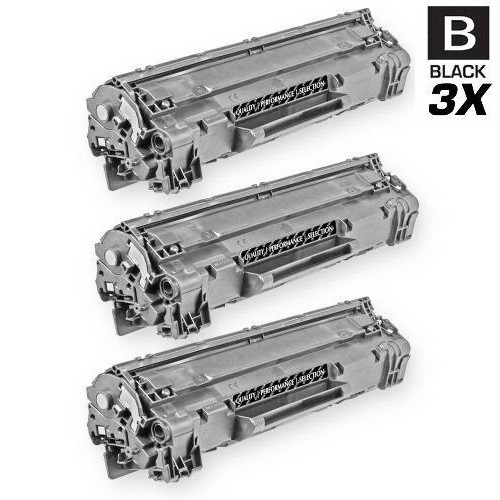
A year or more of toner for a typical personal machine in one modest box: roughly 4,500 pooled rated pages at 0.822¢ a page. Three singles total $69.15, so the pack saves $32.15 — and because each unit carries its own drum surface, the third cartridge prints as cleanly as the first.
Shop the 35A 3-Pack →
One cartridge working, one waiting in the drawer: about 3,000 pooled rated pages at a shade over a cent a page — 1.001¢, roughly a third below the single’s rate. Two singles come to $46.10, so the pair undercuts buying the spare on its own later by $16.07.
Shop the 35A 2-Pack →
The yardstick for the whole shelf: one CB435A at $23.05, rated 1,500 pages, carrying the highest per-page figure here at 1.537¢ and the smallest sum committed. Every badge above is arithmetic measured against this price. It holds two recorded sales of its own — buyers with one quiet printer and no appetite for stock.
Shop the 35A Single →Every buyable option on one price basis
Six rows this time: the five compatible counts, plus the genuine cartridge HP still sells — included because, for once, an original-equipment price exists to set beside the compatibles. All prices are sale; pages are HP’s 1,500 per cartridge, pooled across the sealed units on pack rows:
| Configuration | Price (sale) | Rated pages | Cost per page | Printer fit |
|---|---|---|---|---|
| 35A 10-Pack — the flagship | $85.81 | 10 cartridges · ~15,000 pages | 0.572¢ pooled | All 9 models |
| 35A 5-Pack | $50.95 | 5 cartridges · ~7,500 pages | 0.679¢ pooled | All 9 models |
| 35A 3-Pack | $37.00 | 3 cartridges · ~4,500 pages | 0.822¢ pooled | All 9 models |
| 35A 2-Pack | $30.03 | 2 cartridges · ~3,000 pages | 1.001¢ pooled | All 9 models |
| 35A Single | $23.05 | 1 cartridge · 1,500 pages | 1.537¢ | All 9 models |
| Genuine HP CB435A Single | $104.99 | 1 cartridge · 1,500 pages | 6.999¢ | All 9 models |
Read the last row against the first. One genuine cartridge from HP, at $104.99, delivers 1,500 rated pages; the flagship delivers ten cartridges and ten times the pages for $19.18 less. That does not make the genuine cartridge a poor product — it is HP’s own, with HP’s backing — but on arithmetic alone it is the dearest page on this page by a factor of twelve. Among the compatibles the spread from single to ten-pack is under a cent a page, so the real choice is how much toner to hold, not which bargain tier to hunt down: there is no second tier, whatever the switched-off 35X listing implies.
Nine small LaserJets share this one cartridge
HP built the P1000 series as regional and feature variants on a single engine, and the CB435A serves the whole set: the P1002, P1002W, P1003, P1004, P1005, P1006, P1007, P1008 and P1009. Any card above fits any model on that list — there is no split by suffix or region to navigate. In the catalog, the family lives at the HP CB435A category, named for the genuine code.
The catalog’s one fit blemish runs in the unusual direction: the listings understate. The compatibility line in every description names eight of the nine printers and leaves out the P1007 — yet the store files these same products under a P1007 category of their own, and the three-pack’s own fit answer names the P1007 among the machines it serves. HP’s roster includes the model and the cartridge fits it; the omission lives only in the shared prose. Owners of a P1007 can buy from any card above with confidence.
Telling the cartridge apart takes seconds: the unit coming out of the printer is stamped CB435A, or carries the short name 35A, and either marking points at every card here. What no genuine unit is stamped is CB435X. The invented tier’s identity answer sends buyers hunting for exactly that marking — and a buyer who trusts it will conclude, wrongly, that the cartridge in their hand is something other than what it is.
One yield figure, agreed by everyone entitled to one
Ask HP, ask the spec fields, ask the descriptions: the answer is 1,500 pages each time. HP rates the CB435A at approximately 1,500 pages under ISO/IEC 19752, the declared-yield standard for monochrome LaserJet cartridges, and the store’s listings repeat the figure in their fields and their prose without deviation. Every cost-per-page number in this guide is a sale price divided by that 1,500, multiplied out across the sealed units inside each pack.
The family’s only other number is the 35X’s 2,300 — and it arrives carrying its own disclaimer. The listing that prints it concedes, in its yield answer, that the figure holds “per this listing’s own rating”. Translated plainly: the store rated a cartridge of its own invention, under a code HP never issued. The number is recorded in this guide as a claim about a listing, never as a rating a buyer can budget around.
Drum, chip and the rest of the hardware story
HP describes the CB435A as a redesigned all-in-one cartridge, and the design is exactly that: toner supply and imaging drum in a single shell, renewed together at every change. The listings say the drum is built in — “the drum lives inside the cartridge on this platform” — and on this point the listings and the manufacturer agree in substance word for word. No drum unit exists for any P1000 model under another code, to price, stock or replace; the cartridge price on this page is the whole consumable cost, which keeps the running-cost arithmetic complete.
On recognition, the cartridges arrive with the current chip generation already fitted — the standing standard across the store’s compatible range, backed by a plain record: chip recognition has never been a problem with this supply. Fitting is mechanical. Seat the cartridge, close the cover, and the printer reports it and its level; nothing is transplanted from the spent unit. The honest boundary of that assurance is the usual one — it covers the printers and firmware in their current state, not releases that do not exist yet.
The terms standing behind the cards
One set of terms covers all five listings — and, a small mercy in this catalog, the family’s pages state them consistently: the warranty and returns language matches from listing to listing, free of the contradictions that mark some neighboring families. The operative terms are these:
Choosing a count for a personal printer
Questions from P1000 owners
No. HP’s catalog for the P1000 platform contains the CB435A alone, described by HP itself as standard capacity and standard size. The CB435X code appears in no HP list or store; the one listing here that uses it rates the cartridge by, in its own words, “this listing’s own rating”, and the listing is disabled besides, so it could not be ordered in any case.
It is the right one. No genuine cartridge is stamped CB435X, because HP never manufactured that code; the stamp advice comes from the invented tier’s own product page and describes a marking that does not exist. A genuine unit reads CB435A, or 35A in short form — and either marking is matched by every card on this page.
Yes — unusually for a platform of this age, HP’s US store still lists the CB435A, at $104.99 and in stock when this guide was prepared. Set that beside the compatible shelf before deciding: one genuine cartridge costs $19.18 more than the compatible ten-pack, which holds ten cartridges. Buyers who want HP’s own product can have it; buyers who want pages will find them cheaper above.
It fits. HP’s roster for this cartridge covers the full P1000 family, P1007 included, and the store itself files these products under a P1007 category — one listing’s fit answer even names the model outright. The omission sits in the compatibility prose the descriptions share, which lists eight models instead of nine. The cartridge itself is indifferent to which list it appears on.
Their arithmetic is built on the list price. Every price answer in the descriptions — what a pack costs, what a cartridge works out to, what a page costs — divides or multiplies the list figure, and the sale price the register actually charges appears nowhere in their text. The five-pack’s duplicate even defends its identical pricing by quoting the list figure, while both five-packs sell at $50.95. This guide prices everything at sale; the list figures are set out in the note below, marked as the descriptions’ own.
No. The CB435A is an all-in-one design — HP’s own description says so — with the imaging drum built into the cartridge shell. Each cartridge change renews the drum surface along with the toner, and no drum unit exists for the P1000 platform under any other code. When print quality fades on one of these machines, the cartridge is the service part.
Price and disclosure note: Every price in this guide is a sale price, read from the carded listings on November 18, 2026; if a product page disagrees today, the product page governs. Sale is used because sale is the amount actually charged at the register. The descriptions instead compute from list: $26.51 (single), $34.53 (two-pack), $42.55 (three-pack), $58.59 (five-pack, both copies), $98.68 (ten-pack) — and the switched-off 35X listing shares the single’s list block. The sale figure appears in no description at all. Badge arithmetic is sale against sale: $46.10 for two singles against the two-pack’s $30.03; $69.15 for three against $37.00; $115.25 for five against $50.95; $230.50 for ten against $85.81. The genuine figure is HP’s own: $104.99 for one CB435A at HP’s US store, in stock at the time of checking, which works out to 6.999¢ a page at HP’s rating. Yield provenance: 1,500 pages per cartridge, HP’s published figure under ISO/IEC 19752, repeated unchanged in the listings’ fields and prose; the 2,300-page figure belongs to the store’s invented tier and is conceded by its own listing to be that listing’s own rating. Fit follows HP’s published list: LaserJet P1002, P1002W, P1003, P1004, P1005, P1006, P1007, P1008, P1009. The catalog’s own untidiness follows, item by item.
First, an invented tier wearing HP’s naming: no CB435X exists in HP’s catalog, yet a listing presents the code as HP’s own (“HP 35X”), rates it 2,300 pages with no HP source, and instructs buyers in its identity answer to find the cartridge “stamped CB435X” — a stamp no genuine cartridge carries; the listing is switched off, so the phantom cannot even be bought by mistake. Second, list-based arithmetic, as detailed above: every prose price in the family is the list figure, not the price charged, and the duplicate five-pack’s defense of its identical pricing quotes the $58.59 list figure as “the price” while both copies sell at $50.95. Third, the premium distinction without a difference: the five-pack is listed twice — same price, same fields, same stock figure — with the second copy carrying a “Premium Quality” name that its own text concedes amounts to a line name and nothing more. Fourth, stock figures that repeat: 175 is read by three listings across the family and 33 by both copies of the five-pack — the same pools showing up under multiple listings. Fifth, a boilerplate misnomer: two listings describe the platform in their machine boilerplate as “HP inkjet printers”, though every machine on the roster is a LaserJet. Sixth, each description opens with a stray “/>” fragment left over from its markup. Seventh, weight fields that invert the shelf: the single cartridge is recorded as weighing 3 units and every pack, the ten-pack included, as 2 — against HP’s genuine package weight of about 1.76 lb for one cartridge. Eighth, the fit prose omission: every description’s compatibility line names eight of HP’s nine models and leaves out the P1007, which the store’s own category tree and one listing’s fit answer both include. Ninth, the series category page for the platform answers with a server error in the live store and is not linked from this page. Also recorded, for completeness, are the defect classes looked for and absent: no description contains leaked production or prompt text; no “Lifetime” warranty boilerplate appears — the one-year warranty and returns terms are stated consistently and are the terms this guide prints; no listing claims a printer HP never made, and the category tree contains no phantom or garbled entry — it matches HP’s nine models exactly; the drum statements are accurate; and the genuine tier’s yield stands at a single figure across fields, prose and HP’s publications.
Five cards carry the buyable shelf, one for each product. The duplicate five-pack and the invented tier are dealt with in prose — described where a reader can weigh them, never dressed as offers. HP’s roster bounds everything claimed here: nine printers, one genuine cartridge in one size, five counts of it for sale, and one original cartridge still sold by HP itself at a price this guide prints beside them. Beneath them sit the terms the family itself states: a one-year warranty, a year of free returns, weekday support between 9 AM and 5 PM Central, and dispatch from warehouses in Illinois, Pennsylvania, Georgia and California.