




This is the standard-capacity cartridge of Oki’s Type 9 family, and for three of the printers on this platform it is not the smaller option — it is the only option there is. The B4100, B4200 and B4250 take no other cartridge. The store sells it in six box sizes under twenty-six listings, and this guide lines the six boxes up at the prices checkout actually charges.
Buy the 42103001 2-Pack at $28.24 if your printer takes this cartridge at all: $14.12 a cartridge against $22.16 singly, and one spare always sealed. Owners of the B4300 family should read the choice section first — their machines also take the 6,000-page 42102901, which roughly halves the cost per page. Owners of the B4100, B4200 and B4250 have no such choice to make: this cartridge, in one of the six boxes below, is the whole shelf.
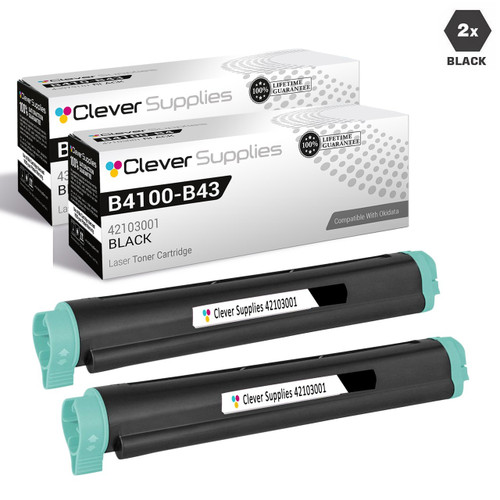
The pair earns its place at the top of this shelf the same way it does on every monochrome shelf: a printer that runs dry mid-job is a stopped office, and this is the cheapest box that keeps a sealed spare behind the working cartridge. Read its listing with care, though — the listing’s own arithmetic is done at the base price of $32.48, $16.24 a cartridge, against $50.96 of singles. Checkout charges $28.24. At that figure the cartridge costs $14.12, two singles cost $44.32, and the real saving is $16.08. The box sits $20.76 under the $49 free-shipping line; the routes over the line are set out in the shipping section below.
Buy the 42103001 2-Pack →Seven LED printers, two very different situations
Oki’s consumables list divides this platform into two groups, and which group your printer sits in decides whether this guide is a choice or a certainty. The first group — the B4100, B4200 and B4250 — was built around this cartridge alone. Oki never made a high-capacity version for those three machines, no compatible maker can conjure one, and any listing anywhere that promises an extended-yield cartridge for a B4100 is describing a product that does not exist. If one of those models sits on your desk, the only decision on this page is box size.
The second group — the B4300, B4300N, B4350 and B4350N — accepts this cartridge and its 6,000-page sibling with equal readiness. Plenty of those machines are still running on the standard cartridge simply because it is the one they were first fed, or the one a previous order happened to bring. For those owners the honest comparison is set out further down, and it does not flatter the cartridge this guide is about.
Two further variants appear in the store’s own catalogue: dedicated postings exist for the B4300NPS and B4350NPS, the PostScript versions of the network models. They are the same printing engines with a different interpreter board, and the store lists this cartridge for them under their own names; those postings are among the twenty-six listings counted on this page, though the six carded boxes below are the code- and family-named ones. And a word the listings themselves blur: every machine named here prints with an LED array, not a laser. The word “laser” in product titles is shelving language, not a description of the hardware.
One code, three names — and the bigger cartridge next door
Oki’s American catalogue calls this family Type 9, and calls this cartridge the standard-capacity member of it. The same family name appears on Oki Data’s own safety documentation, which covers both Type 9 toner part numbers in a single sheet. Retailers and compatible makers often write the family as Type C9 instead — same cartridges, same printers, a different label tradition. In Europe the cartridge was ordered as 01103402. None of those names changes what arrives: a black toner cartridge rated at 2,500 pages, built to sit on the Type 9 image drum.
| Part number | What Oki calls it | Rated yield | Sold as |
|---|---|---|---|
| 42103001 | Type 9 Toner Cartridge (standard capacity) | 2,500 pages | Single · 2-pack · 3-pack · 5-pack · 6-pack · 10-pack |
| 42102901 | Type 9 Toner Cartridge (high capacity) | 6,000 pages | B4300 family only — see the sibling guide |
| 42102801 | Type 9 Image Drum | About 25,000 pages | Separate unit — not a toner, and not interchangeable with one |
The middle row is the one that causes the returns. A B4300 owner searching by family name alone can land on either cartridge, and both genuinely fit — the mistake only shows up months later, in pages per dollar. A B4100 owner who orders the high-capacity code has a worse problem: it does not fit at all. The full treatment of the bigger cartridge, its five boxes and its own shelf arithmetic, lives in the Best Okidata 42102901 Toner Cartridges guide; its flagship box is the 42102901 2-Pack at $35.75. Everything below this section is about the standard cartridge only.
The honest arithmetic: 2,500 pages, and what each one costs
Oki rates this cartridge at 2,500 pages, and the basis printed alongside the rating is a 5% page density on continuous printing — the traditional toner measure, stated in the footnote of Oki’s own consumables list rather than as an ISO/IEC 19752 figure. The printers’ user guides repeat the same 2,500 pages on the same basis. Five percent coverage is a page of ordinary office text; a month of invoices and correspondence lands near it, while dense reports, forms with heavy blocks and graphics run through a cartridge sooner. Treat 2,500 as the rating the price is divided by, not a promise about any particular stack of paper.
One refreshing detail: on this cartridge the aftermarket agrees with the manufacturer. The largest compatible seller rates its own 42103001 at the same 2,500 pages Oki publishes. That agreement is worth noticing precisely because it fails on the sibling cartridge, where a 7,000-page figure circulates against Oki’s 6,000. Here there is no inflated number to unpick — every price in this guide divides by the same 2,500.
For the B4300 family, the comparison that matters is cost per rated page. A single 42103001 at $22.16 works out near 0.89¢ a page; a single 42102901 at $25.91 works out near 0.43¢. In pairs it is 0.56¢ against 0.30¢. The standard cartridge is not a little dearer per page — it is roughly twice as dear, every page, for as long as the machine runs. Its honest case on a B4300 is narrow and real: $3.75 less leaves the account today, which suits a printer being run down toward retirement, a machine that prints a few pages a month, or a spare unit kept for overflow. Any B4300-family printer doing steady work should be fed the high-capacity cartridge, and this guide will not pretend otherwise. For the B4100, B4200 and B4250 there is no comparison to run — the arithmetic that matters for them is the box ladder below.
The whole shelf: six boxes behind twenty-six listings
Twenty-six listings sell this one cartridge: a code-named set, a Clever Supplies family named for the B4100, and a row of postings named printer by printer. They resolve to six distinct boxes. The cards below are the six — the 2-Pack leads the page as the featured box, so the grid carries the other five. Where several postings sell the same box, the carded one is the family’s own; the rest are the same cartridges under model names, and they are counted once, here and in the stock figures.
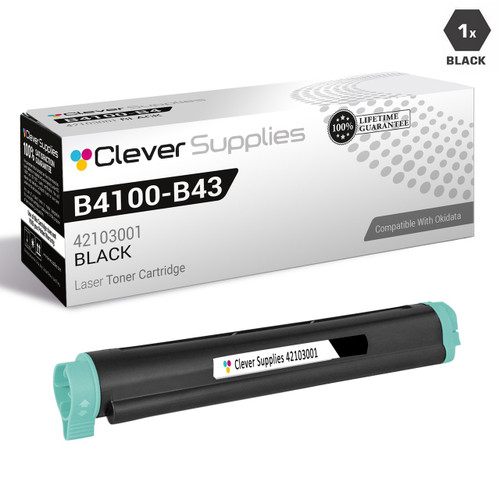
The unit every pack below is built from, and the right order when a printer needs exactly one cartridge — a machine being sold on, a spare being tested, a first compatible trial. Its listing does its sums at the base price of $25.48; checkout charges $22.16, and every comparison on this page uses the charged figure.
Buy the 42103001 Single →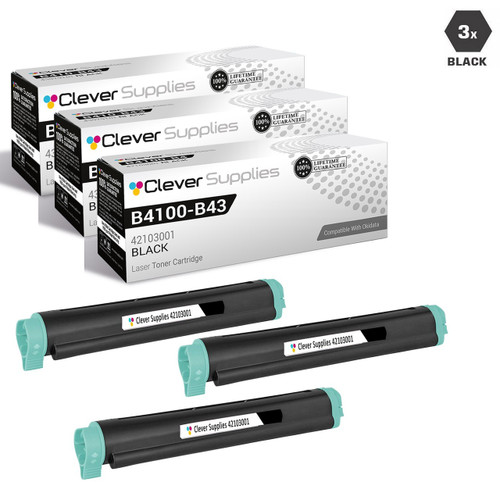
The middle rung for a single-printer office: one cartridge working, two sealed behind it, and the per-page cost already down near half the single’s. Three cartridges is also a sensible span between orders for a B4100 that prints daily but not heavily — stock enough to forget about, not so much that it ages on the shelf.
Buy the 42103001 3-Pack →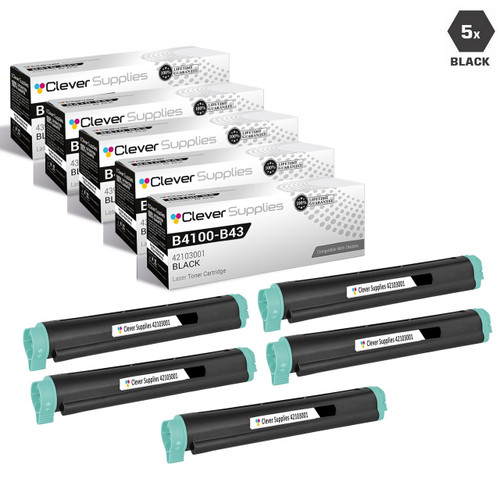
Five cartridges is half a drum’s worth of toner — the drum section below explains the rhythm — and at $46.48 the box stops just short of free shipping. Any small addition to the basket carries it over the line; on its own it is the one pack on this shelf where the shipping charge deserves a second look before checkout.
Buy the 42103001 5-Pack →
The unusual rung of this ladder — most toner shelves step from five to ten, and this one pauses at six. It is also the first box that clears $49 unaided, which makes it the natural order for a B4200 or B4250 that works hard: six cartridges, no shipping charge, and a per-page cost already within sight of the bulk box.
Buy the 42103001 6-Pack →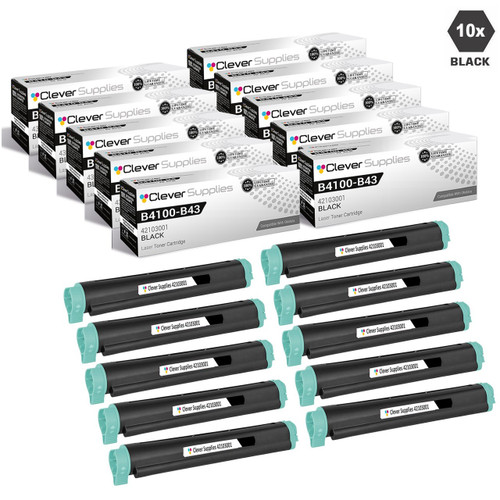
The bulk end, sized with a neatness the smaller boxes cannot claim: ten standard cartridges at their rated yield add up to almost exactly the rated life of the drum they print through. A site running several of these printers from one cupboard can plan toner and drum together — one of these boxes per drum, and the drum conversation starts when the box runs out.
Buy the 42103001 10-Pack →The six boxes, priced one by one
| Box | Price charged | Per cartridge | Cost per rated page | Counted stock |
|---|---|---|---|---|
| Single · 2,500 rated pages | $22.16 | $22.16 | About 0.89¢ | 27 |
| 2-Pack · 5,000 rated pages | $28.24 | $14.12 | About 0.56¢ | 13 |
| 3-Pack · 7,500 rated pages | $34.32 | $11.44 | About 0.46¢ | 9 |
| 5-Pack · 12,500 rated pages | $46.48 | $9.30 | About 0.37¢ | 5 |
| 6-Pack · 15,000 rated pages | $52.56 | $8.76 | About 0.35¢ | 4 |
| 10-Pack · 25,000 rated pages | $76.87 | $7.69 | About 0.31¢ | 2 |
Every figure in this table is recomputed from the price checkout charges. The listings themselves do their arithmetic one tier up, at base prices — a $25.48 single, a $32.48 pair, a $53.45 five-pack — so the savings they quote are not the savings on offer. The real ladder is steeper than the listed one: moving from singles to the 10-Pack cuts the price of a cartridge by nearly two-thirds, from $22.16 to $7.69, and the saving against ten singles bought one at a time is $144.73.
One pool of 27 cartridges, and the $49 line
The stock column is not six separate piles. The store counted 27 single cartridges at the November reading, and the pack counts are that same shelf divided: 13 pairs, 9 threes, 5 fives, 4 sixes and 2 tens are exactly what 27 cartridges make when each box is assembled from the pool, with the remainders the division leaves behind. The model-named postings draw on it too — a B4200-named single and the code-named single show the same 27 because they are the same stock wearing different titles. When the pool moves, every box on this page moves with it.
Shipping turns on the store’s $49 free line. The 6-Pack at $52.56 is the cheapest box that crosses it alone, and the 10-Pack crosses it with room to spare. The 5-Pack stops $2.52 short, close enough that almost any addition settles it. Below that, pairs combine well: a 2-Pack with a single comes to $50.40, a 3-Pack with a single to $56.48, and two 2-Packs to the same $56.48. A lone single or pair ordered by itself carries the shipping charge, which is worth weighing against the pair’s saving before ordering small.
Living with the platform: ten toners to a drum
Underneath every cartridge on this page sits the same second consumable: the 42102801 Type 9 image drum, a separate unit that the toner cartridge mounts onto and the printer keeps when the toner runs out. Oki rates the drum at about 25,000 pages. Divided by this cartridge’s 2,500-page rating, one drum carries roughly ten standard cartridges end to end — a slower rhythm than the high-capacity shelf, where the same drum is spent in about four. That is the planning gift of the 10-Pack above: one bulk box and one drum begin and end together.
The printer announces the drum’s old age itself, with a CHANGE DRUM warning at roughly 90% of its life — on this cartridge’s rhythm, somewhere around the ninth cartridge. A drum change is a user job, not a service call: the new unit goes in on the same mounts, and the drum counter is then reset by hand, through the Status Monitor on the B4200 and B4250 or the operator panel’s maintenance menu on the B4300 family. Skip the reset and the warning outlives the drum it was complaining about. The drum’s surface is light-sensitive, so the swap is done in one motion, out of bright light, without leaving the unit sitting exposed.
This store does not sell the 42102801 drum, so it is explained here rather than carded: when the warning arrives, the drum is a purchase to plan alongside the toner, not instead of it. What the store does stand behind is the toner itself — the terms are in the band below, and they apply to every box on this shelf alike.
Fitting a cartridge on a two-piece platform
A toner change here is a smaller job than on a one-piece platform, because only half the assembly comes out. The spent cartridge lifts off the image drum it has been riding on; the drum stays in the printer, and the new cartridge seats onto the same drum in its place. That separation is the platform’s whole economy — the expensive, long-lived part is bought once in ten cartridges, and the part replaced each time carries toner only. It is also why the number check matters at the counter: the cartridge in your hand should read 42103001, and the unit staying in the machine is the drum, which no toner box replaces.
Two habits carry over from the listings’ own guidance and are worth keeping. When print begins to fade or come down the page unevenly, a gentle side-to-side rock of the cartridge redistributes the toner inside and usually restores an even page for the remainder of its life — fading is a distribution problem before it is an empty one. And when a new cartridge goes in, keep the spent one in its replacement’s box for the first few days: if anything about the new unit’s first pages looks wrong, the old cartridge is the evidence that shows what changed.
Reading the twenty-six listings: three names for one cartridge
The twenty-six postings fall into three families, and telling them apart explains most of the confusion around this cartridge. The first family is named for the code itself — the 42103001 postings, which carry the single, the 5-Pack and the 6-Pack. The second is the store’s own B4100-named family, which carries the single and the 2, 3, 5 and 10-packs; those are the boxes carded in this guide, because a family shelf is best represented by its own fullest line. The third family is named printer by printer — a B4100 single, a B4200 single, a B4250 5-Pack, and so on through the NPS variants — so that a search by model name lands on a page that answers in the model’s own terms.
What matters is what the three families agree on. Every single, under every name, is counted at 27 in stock and priced at $22.16; every 5-Pack is counted at 5 and priced at $46.48. The postings are one cartridge photographed and described from several doors, not several grades of cartridge. There is no premium version of the 42103001 hiding under a printer’s name, and no cut-rate one either. Buy from whichever door you arrived at — or from the six carded boxes above, which gather the full ladder in one place.
Which box, when: matching the order to the machine
For a B4100 in light home or small-office service — a few hundred pages a month — the featured 2-Pack is the natural standing order: the spare is already in the drawer when the working cartridge fades, and at that pace the pair spans the better part of a year. A single is the right order only when the machine itself is temporary. For a B4200 or B4250 printing daily, step up: the 5-Pack halves the ordering rhythm, and the 6-Pack does the same while removing the shipping charge from the calculation entirely. The 3-Pack sits between those cases, for a printer busy in bursts — term-time, tax season, a project — where three cartridges cover the surge and the quiet months need nothing.
Where several of these printers share a supplies cupboard, the 10-Pack is the planning unit: one box per drum cycle, split freely among machines, since every cartridge in it is identical and individually sealed. And for the B4300 family the matching runs the other way — the box to match is usually not on this page at all. Those owners should size their order from the sibling shelf, where the same money buys roughly twice the pages, and treat this guide’s cartridge as the deliberate exception: the small fill for a machine being run down, kept spare, or printed from rarely.
What backs every box on this shelf
Each carded cartridge is a Clever Supplies compatible made for the seven printers above. The terms that travel with it: a one-year warranty, one-year returns, weekday support between 9 AM and 5 PM CST, and dispatch from four warehouses — Illinois, Pennsylvania, Georgia and California. Orders over $49 ship free; here that means the 6-Pack qualifies by itself, and the smaller boxes cross the line in the combinations set out above.
Questions buyers ask about this family
Is there a high-capacity cartridge for the B4100, B4200 or B4250?
No. Oki’s consumables list names exactly one toner for those three printers, the 42103001 at 2,500 pages, and no standard of evidence turns up an extended-yield alternative — the high-capacity 42102901 belongs to the B4300 family’s rows of the same list and does not fit the smaller machines. A listing that offers a B4100 owner a bigger cartridge is offering a return shipment. Box size is the only lever those printers have, and it is a good one: the 10-Pack brings the cartridge down to $7.69.
The cartridge in my B4300 reads 42103001. Should the replacement match it?
It can, and the printer will run exactly as it does today — both cartridges belong in that bay. But unless the machine is near the end of its working life, matching is the expensive habit: the 42102901 carries 6,000 rated pages at about 0.43¢ a page in single form, against about 0.89¢ for the cartridge you are holding. The standard cartridge is the right replacement for a lightly used or short-lived machine; a working B4300 earns its keep on the bigger fill.
Is the 42103001 the same thing as a Type 9 cartridge?
Yes — Type 9 is Oki’s American family name for this platform’s consumables, and the 42103001 is its standard-capacity toner. The high-capacity 42102901 and the 42102801 image drum carry the same family name, which is why the part number, not the family name, is the thing to order by. Retailers who write Type C9 mean the same family. If the number on the cartridge coming out of your printer reads 42103001, the boxes on this page are its replacements.
Why does the listing show $25.48 when checkout charges $22.16?
Because the listings’ text was written against the base price and never rewritten for the sale. The single’s copy reckons at $25.48, the pair’s at $32.48, the five-pack’s at $53.45 — while the register takes $22.16, $28.24 and $46.48. The charged prices are the lower ones, and they are the only figures this guide calculates with, including every SAVE badge: each badge is the difference between a pack’s charged price and the same cartridges bought singly at the charged single price.
How many of these cartridges does one drum last through?
About ten, at rated yields: the 42102801 drum is rated near 25,000 pages and this cartridge at 2,500. The printer shows a CHANGE DRUM warning at roughly 90% of the drum’s life, around the ninth cartridge, and after the drum is changed its counter has to be reset by hand — through the Status Monitor on the smaller machines or the panel maintenance menu on the B4300 family — or the warning keeps reporting on a drum that is no longer fitted. This store does not stock the drum; it is named here so the warning is not a surprise.
Can a multi-pack be split between two printers?
Yes. Every cartridge in every box is identical and individually sealed, so a 10-Pack can supply a B4100 and a B4250 in any proportion, and a partly used box keeps its remaining cartridges fresh for the next machine that calls. There is nothing to sort and nothing matched to a particular printer — the cartridge either is a 42103001 or it is not, and every unit in the box is.
How long can a sealed spare sit before it is fitted?
Kept sealed, flat, and in a cool dry place out of direct sunlight, a toner cartridge waits patiently — toner is a dry powder, not a liquid ink, and it does not dry out. That is what makes the spare-behind-the-working-cartridge pattern sound on this shelf: the second cartridge of a pair, or the back half of a 10-Pack, can sit for the months its turn takes to arrive. Open a cartridge only on the day it goes in, and keep the one it replaces until the new unit has printed cleanly for a few days.
Does this cartridge carry a page-counting chip?
There is no evidence that it does, and this guide makes no chip claim for it. On this platform the printer watches toner level by sensor, and the counter that owners actually meet is the drum’s — the one reset by hand at a drum change, as the question above describes. What decides a compatible cartridge’s behavior here is its fill and its fit, and on both counts the listings’ own terms apply: a one-year warranty and one-year returns stand behind every box on the shelf.
How this guide was put together: yields are Oki’s, stated at 5% coverage with no ISO standard cited for the family, so none is claimed here. No genuine Oki price is quoted, because the cartridge is discontinued and no current authoritative price could be verified. The sibling cartridge 42102901 is linked where the two cartridges share a printer bay, and nowhere else; the drum 42102801 is named for identification only and is neither sold nor linked here. Stock figures are the November 2026 counts and follow the shared-pool pattern set out above.