




Two neighboring LaserJet lines anchor this family — the compact P2035 machines and the faster P2055 series — and HP feeds both from a single cartridge design drawn at two depths: the 05A (CE505A), rated at about 2,300 pages, and the 05X (CE505X), rated at about 6,500. This store lists the pair in fourteen configurations once its two home-grown “Jumbo” lines are counted, and those sit further down in blocks that say plainly what they are. One fit rule governs the whole page, and it admits no exceptions: the 05X runs only in the P2055 line. The P2035 and P2035n take the 05A and nothing else — HP never offered those machines a high-yield cartridge, and the store’s own high-yield listing prints the same warning in its features. Every price below is the sale figure the register actually charges, and every rate is worked from HP’s declared yields — 2,300 and 6,500 pages — not from the larger number a few of the newer listings carry in their descriptive text, which the closing note takes up in full.
Begin with the machine, because on this platform the machine decides. A LaserJet P2035 or P2035n accepts only the standard cartridge, so its shelf is the 05A ladder below, five boxes deep, plus the first of the two variant blocks. A P2055, P2055d, P2055dn or P2055x accepts everything on this page, and for those machines the box this guide leads with is the 05X 2-pack at $46.95 — two high-yield cartridges, roughly 13,000 rated pages, 0.36¢ a page. Every offer carded here is a Clever Supplies compatible; the store carries no genuine HP stock for this family, so where HP’s prices turn up they are labeled as HP’s and serve only as a yardstick. Two further lines wear the word Jumbo. Neither code is HP’s and neither rating is HP’s, and both are carded under labels that say so — with arithmetic showing that even on their own claimed yields, they cost more per page than the genuine tiers they imitate.
Fourteen boxes, two genuine depths
The family’s twenty-one listings resolve into fourteen distinct configurations: the standard cartridge in five pack sizes, the high-yield in three, and three boxes apiece for the store’s two Jumbo lines, which follow in their own labeled blocks. One further listing repeats the standard 3-pack’s numbers to the cent and is accounted for in the closing note rather than carded twice. Prices are sale prices throughout. A SAVE badge, where one appears, is nothing more exotic than subtraction within a tier: what the pack’s cartridges would cost bought one at a time, less the pack’s price. The flagship leads, then the rest of the high-yield line, then the standard ladder from the single to the 6-pack.
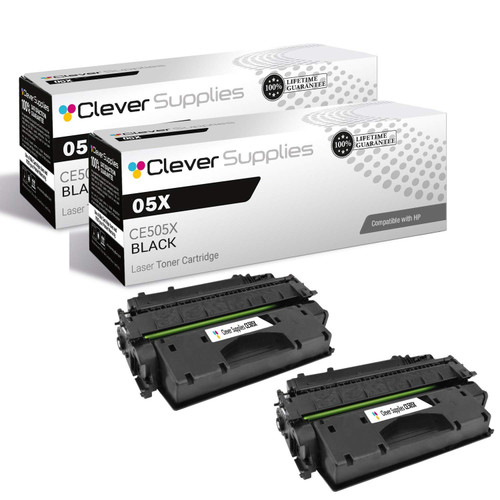
HP prices one genuine CE505X at $251.99 in its US store. This box holds two high-yield cartridges — the rated output of two genuine singles, roughly 13,000 pages — for $46.95, less than a fifth of what HP charges for one. For a P2055 that prints every working day, the pair is the natural unit: one cartridge in service, one waiting sealed, and no order placed in a hurry the morning the low-toner warning appears.
Shop the 05X 2-Pack →THE REST OF THE HIGH-YIELD LINE — P2055, P2055D, P2055DN AND P2055X ONLY
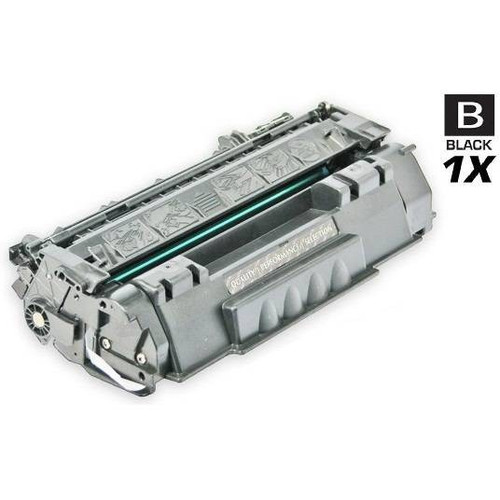
The high-yield cartridge on its own. HP’s genuine CE505X stands at $251.99, so this single undercuts its counterpart by $220.47 at the same 6,500-page rating — and its own listing is the one that prints the fence in its features: not compatible with the P2035 or P2035n.
Shop the 05X Single →
Cartridges at $19.46 apiece — the cheapest page among the genuine tiers on this shelf. Four of these cost $174.16 less than a single genuine CE505X bought from HP.
Shop the 05X 4-Pack →THE STANDARD LINE — FIVE BOXES, AND THE ONLY TIER A P2035 CAN TAKE
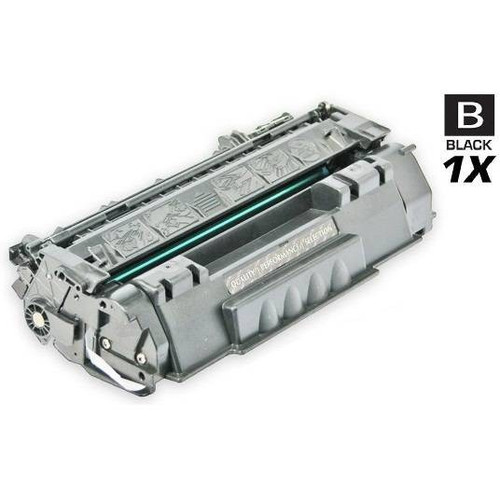
The cartridge both printer lines are born with, and the only tier a P2035 can take. HP asks $138.99 for the genuine CE505A; this single runs $112.70 under that figure at the same 2,300-page rating.
Shop the 05A Single →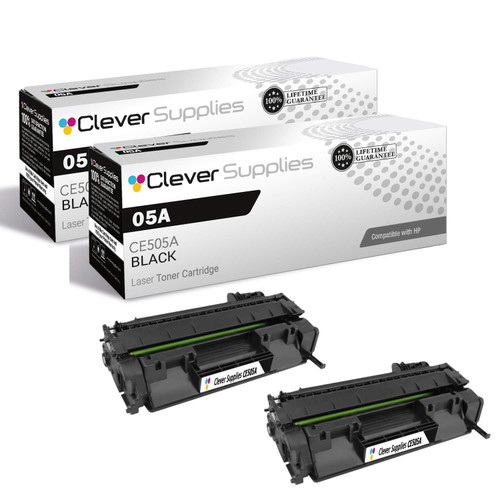
Cartridges at $18.25 apiece. HP sells this configuration itself, as the CE505D, at $246.99 — this pair undercuts the genuine twin pack by $210.50.
Shop the 05A 2-Pack →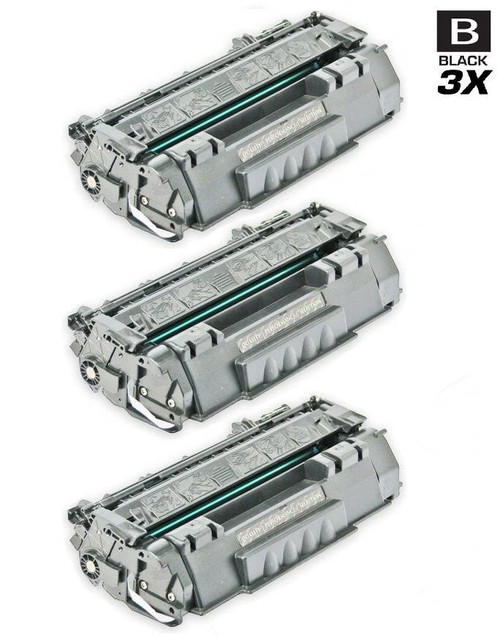
Cartridges at $15.57 apiece — a working quarter of standard pages for a lightly shared P2035. It is priced within a quarter of this guide’s flagship pair, which buys a P2055 owner nearly twice the pages instead.
Shop the 05A 3-Pack →
Cartridges at $14.23 apiece. The standard ladder’s middle depth: near ten thousand pages in a single carton, for an office that has settled on the A and reorders by the season.
Shop the 05A 4-Pack →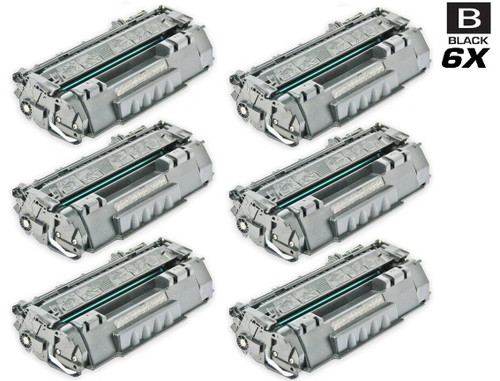
The standard tier’s floor, at $12.89 a cartridge — 13,800 rated pages, 800 more than the flagship pair carries, reached with six shallow fills instead of two deep ones, at 0.56¢ against 0.36¢ a page.
Shop the 05A 6-Pack →The first Jumbo line: “CE505AJ”, a code HP never issued
Three boxes carry a third code — CE505AJ, sold as “Jumbo Yield” and rated by the store at 3,500 pages a cartridge. HP’s catalog knows no such article: its genuine range for this platform stops at the CE505A, the CE505X and the CE505D twin pack. The AJ is the store’s own deeper fill of the standard cartridge, and unlike the second Jumbo line below, this one is at least consistent about itself on two of its three listings, where the name, the yield field and the descriptive text all say 3,500. Taken at that claimed figure, its pages land between the two genuine ladders — 0.53¢ to 0.87¢ — never undercutting the high-yield tier whose ground it stands on. No SAVE badge is printed on this block: the comparison that matters runs across tiers, and the table further down makes it.
The middle card needs a caution of its own. The AJ 2-pack’s Jumbo identity appears nowhere a shopper can read it: its name and text are the plain standard 2-pack’s, rating the cartridges at 2,300 pages, and only its SKU and its yield field — which says 3,500 — identify it as the variant. It is carded in this block on those two witnesses and on its price, $44.99, which stands $8.50 above the standard pair, so that a buyer comparing the two 2-pack pages side by side can see they are not the same box wearing two prices.
THE STORE’S FIRST VARIANT — A STORE-CLAIMED 3,500 PAGES, FITTING ALL SIX MODELS
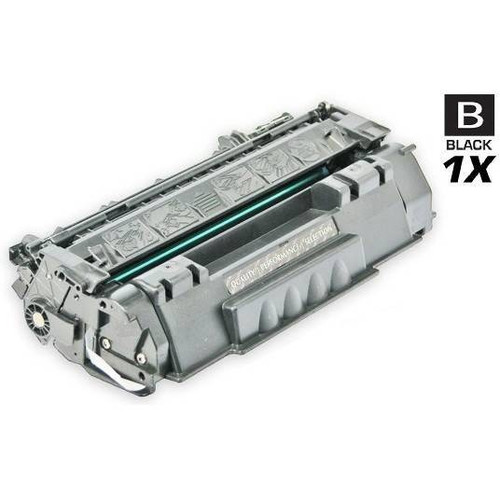
The variant wearing its name openly: “Jumbo Yield” stands in this listing’s title, and its field and text agree at 3,500 pages. Even at the claim it prints a dearer page — 0.87¢ — than the standard 6-pack’s 0.56¢; the premium buys a longer interval between swaps, nothing more.
Shop the 05AJ Single →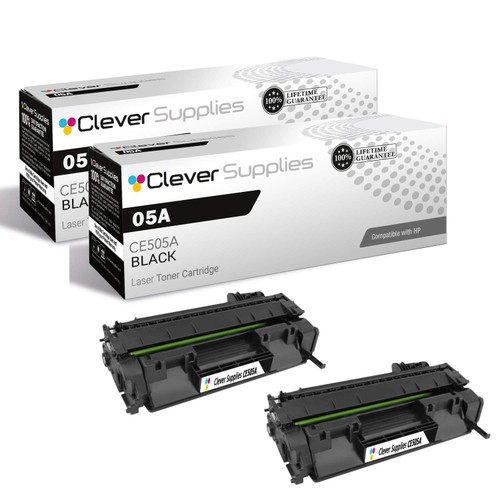
Cartridges at $22.50 apiece — carded here on its SKU and yield field, as the caution above explains, since its own page presents it as an ordinary standard pair. At its field’s claimed rating the pair works out to 0.64¢ a page; at the 2,300-page rating its own text prints, 0.98¢. Either way, the flagship pair above is cheaper per page and unambiguous about what it is.
Shop the 05AJ 2-Pack →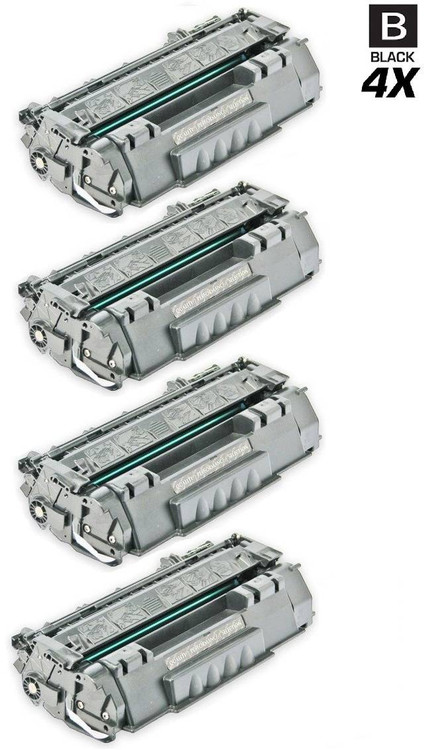
Cartridges at $18.47 apiece — the variant’s best rate, and still a dearer page than every high-yield box on the shelf. Its own listing muddles the identity further, calling the contents standard CE505A cartridges in one answer while rating them 3,500 pages in the next; the closing note records the tangle.
Shop the 05AJ 4-Pack →The second Jumbo line: an 8,000-page claim that lives only in a data field
The second Jumbo line reaches further and discloses less. Its three boxes are built on the high-yield cartridge, and the word Jumbo appears only inside their SKUs; the yield field claims 8,000 pages a cartridge, a figure no sentence in their names or text will vouch for — the text is the regular high-yield template, complete with that template’s own inflated 6,900-page figure, which the closing note deals with. Grant the field its 8,000 anyway, and the line still loses at every size: 0.44¢ to 0.59¢ a page against the genuine high-yield packs’ 0.30¢ to 0.36¢. The sharpest comparison is the single: $46.89 buys one Jumbo X cartridge claiming 8,000 pages, while six cents more buys the flagship pair carrying 13,000 honestly rated pages. No SAVE badge is printed on this block either, and the fence applies to it in full — these are P2055-line cartridges, and no P2035 takes one.
THE STORE’S SECOND VARIANT — A FIELD-ONLY CLAIM, P2055 LINE ONLY
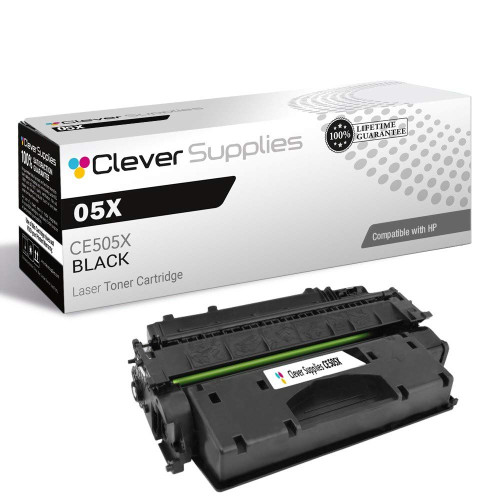
Six cents under the flagship pair’s price — for a single cartridge, on a rating no sentence on its page will vouch for. The regular high-yield single above costs $15.37 less and states its 6,500 pages in the open.
Shop the Jumbo 05X Single →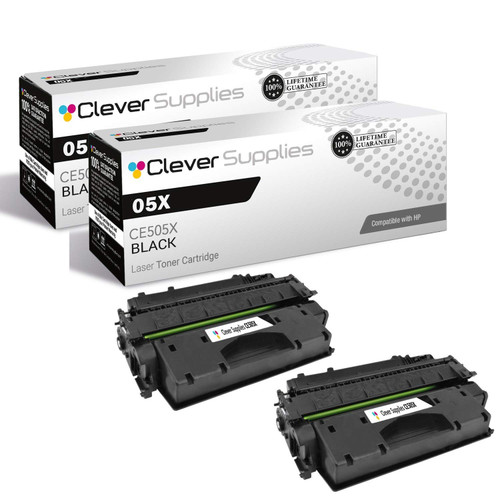
Cartridges at $38.86 apiece. Even at the field’s claim, its page — 0.49¢ — costs more than the regular high-yield single’s 0.48¢: a pair outsold by a single, on the variant’s own numbers.
Shop the Jumbo 05X 2-Pack →
The variant’s deepest box and its best rate — and 0.44¢ still loses to the regular high-yield 4-pack’s 0.30¢, a box that costs $61.51 less.
Shop the Jumbo 05X 4-Pack →The full shelf on one scale
Every row divides the box’s price by the pages it is rated to print — 2,300 a cartridge for the standard tier, 6,500 for the high-yield, and for the variant rows the store’s claimed figures, marked as claims in the row itself. The fit column is where this family parts company with most: it does not read the same all the way down, because the entire high-yield side of the shelf is closed to the P2035 machines.
| Pack | Sale price | Pages the box is rated for | Per-page rate | Fits |
|---|---|---|---|---|
| 05X 4-Pack | $77.83 | 4 cartridges · ~26,000 pages | 0.30¢ | P2055 line only |
| 05X 2-Pack — the flagship | $46.95 | 2 cartridges · ~13,000 pages | 0.36¢ | P2055 line only |
| Jumbo 05X 4-Pack (store variant) | $139.34 | 4 cartridges · ~32,000 pages at the field’s claimed rating | 0.44¢ | P2055 line only |
| 05X Single | $31.52 | 1 cartridge · ~6,500 pages | 0.48¢ | P2055 line only |
| Jumbo 05X 2-Pack (store variant) | $77.71 | 2 cartridges · ~16,000 pages at the field’s claimed rating | 0.49¢ | P2055 line only |
| 05AJ 4-Pack (store variant) | $73.89 | 4 cartridges · ~14,000 pages at the store’s claimed rating | 0.53¢ | All 6 models |
| 05A 6-Pack | $77.32 | 6 cartridges · ~13,800 pages | 0.56¢ | All 6 models |
| Jumbo 05X Single (store variant) | $46.89 | 1 cartridge · ~8,000 pages at the field’s claimed rating | 0.59¢ | P2055 line only |
| 05A 4-Pack | $56.91 | 4 cartridges · ~9,200 pages | 0.62¢ | All 6 models |
| 05AJ 2-Pack (store variant) | $44.99 | 2 cartridges · ~7,000 pages at the store’s claimed rating | 0.64¢ | All 6 models |
| 05A 3-Pack | $46.70 | 3 cartridges · ~6,900 pages | 0.68¢ | All 6 models |
| 05A 2-Pack | $36.49 | 2 cartridges · ~4,600 pages | 0.79¢ | All 6 models |
| 05AJ Single (store variant) | $30.53 | 1 cartridge · ~3,500 pages at the store’s claimed rating | 0.87¢ | All 6 models |
| 05A Single | $26.29 | 1 cartridge · ~2,300 pages | 1.14¢ | All 6 models |
Read this table by its fit column before its rates. Everything a P2035 can use sits in the lower half — the standard ladder and the first Jumbo line — because HP built that machine around the shallow cartridge alone. The top of the table belongs to the P2055 line, and its order carries the lesson: the genuine high-yield packs take the first two places, and both Jumbo lines, granted every page they claim, still cannot catch them. What the variants sell is time between cartridge changes. On this shelf, that is all they sell.
Fit: one fence, drawn by HP itself
The store keeps a category for each of the six US models in this platform: the LaserJet P2035 and P2035n; and the P2055, P2055d, P2055dn and P2055x — and the family’s own shelf is gathered under HP CE505A. Which cartridges each machine may take is not open to interpretation. HP’s page for the P2035 names a single replacement cartridge — the 2,300-page CE505A. Its P2055 series datasheet names two: the CE505A and the 6,500-page CE505X. So the standard cartridge, and the store’s AJ variant built upon it, run in all six machines; the high-yield cartridge, and the Jumbo X line built upon it, run in the four P2055 models and nowhere else. The CE505X does not fit the P2035 or the P2035n.
The store does not always keep its own fence. The standard single’s comparison answer says of the two tiers that “both fit the same slot” — true of the slot, false of the P2035, which was never given a high-yield option. And a paragraph shared by the newer listings introduces both tiers over a roster that includes the P2035, blurring the same line from the other side. Credit where it is due: every high-yield listing’s own fit list is drawn correctly, P2055 models only, and the high-yield single’s feature list states the exclusion in so many words. This guide follows HP, and the listings’ careful pages, rather than their careless ones.
Owners reading HP’s global compatibility charts will meet further names — P2033, P2036, P2037, P2053, P2054, P2056, P2057 and their suffixed kin. Those are HP’s regional designations for machines sold outside the United States, not errors and not additional US models; the six categories above are the US roster, and it is against that roster that this guide judges fit.
Yields: the fields agree with HP — one text disagrees with both
On the genuine tiers there is nothing to arbitrate. HP’s ISO/IEC 19752 declaration for the CE505A gives 2,300 standard pages; its US product pages give the CE505X at about 6,500; and the store’s own yield fields print those same two figures on every genuine-tier listing in the family. Every rate in this guide is therefore a division by 2,300 or by 6,500, and every pack total is plain multiplication of the same numbers.
One text breaks the agreement. The newer high-yield listings describe their cartridge in prose as “rated at 6,900 pages” — 400 pages, a little over six percent, beyond the figure carried in their own yield field and beyond HP’s declaration. The pack pools swell with it: 13,800 pages claimed for a pair, 27,600 for four. That number is used nowhere in this guide’s arithmetic; it is recorded in the closing note as what it is, a prose inflation, and a buyer comparing this page against a product page should know which of the two figures the divisions here trust, and why.
HP’s shelf stands opposite, quoted from HP’s US store and labeled as HP’s wherever it appears: the genuine CE505A at $138.99, which is 6.04¢ a page at its rating; the genuine CE505X at $251.99, or 3.88¢; and a genuine twin pack for the standard tier, the CE505D, at $246.99. HP also catalogs a high-yield twin pack, the CE505XD — but no HP US price for it could be retrieved for this guide, so none is printed, and comparisons for the high-yield packs above run against genuine singles instead, saying so where they do. Set against HP’s figures, the compatible high-yield single saves $220.47 against one genuine CE505X, and the compatible standard pair saves $210.50 against the genuine CE505D.
One caution covers every product page in the family: the listings work out their cost-per-page sums at list prices, while the register charges the lower sale prices carded here. The standard single’s text computes at $30.23 where checkout takes $26.29; the flagship’s own page introduces the pair at $53.99 where checkout takes $46.95. Any per-page figure quoted on a product page in this family deserves to be re-divided at the sale price before it is believed — which is all this guide has done.
One supply to stock — and a full one in the box
There is no drum unit to budget alongside these cartridges. HP’s yield declaration describes the CE505A, in terms, as “all in one”, and its product copy says the design folds the toner and imaging drum into one supply — so the drum’s wear is counted inside the cartridge’s rating, and every change fits a fresh imaging surface together with the fresh toner. The store’s own answers say the same. A buyer cross-shopping platforms that split toner and drum into two part numbers will find no second number here, from this store or from HP.
What arrives inside the printer is this platform’s quiet virtue. HP’s P2055 datasheet lists among the box contents a preinstalled CE505A whose stated yield is the complete standard figure — an average of 2,300 pages — and the P2035’s box list likewise names a preinstalled cartridge, with no reduced rating published for it anywhere. HP calls the in-box unit introductory; on this platform, introductory describes its position in the box, not its fill. No machine in either line ships with a high-yield cartridge, so the tier decision arrives with the first replacement order — by which time the owner holds a full standard cartridge’s worth of evidence about how fast the machine drinks.
Chips: a platform from before the argument
Search all twenty-one listings in this family for any mention of a chip, a firmware version or dynamic security, and the search comes back empty. The explanation is the calendar. These printers were designed in 2008 and 2009, years before HP’s dynamic-security program existed, and HP’s own pages for these cartridges carry no dynamic-security notice of the kind its current-generation pages print — because there is no cartridge-blocking mechanism on this platform for such a notice to describe.
What can be stated is the store’s standing position for its compatible range, the same position this guide prints for every family it covers. The cartridges arrive with a current-generation chip already fitted by the supplier; fitting one is a straight exchange, plug-and-play, with no chip to lift from the spent cartridge and move across. The one promise never made — here as everywhere — concerns firmware that does not yet exist. What stands behind the cartridges themselves is set out next.
What stands behind each box
Which box, for which machine
Answers for the P2035 and P2055 owner
No — and this is the family’s one hard rule. HP offers the P2035 and P2035n a single replacement cartridge, the CE505A; the high-yield CE505X was never made for them, and the store’s own high-yield single prints the exclusion in its feature list. A P2035 owner’s shelf is the standard ladder and the AJ variant block above. The 05X belongs to the P2055, P2055d, P2055dn and P2055x.
6,500 — the figure in the listing’s own yield field, and in HP’s declaration for the CE505X. The 6,900 appears only in the newer listings’ descriptive text, where it also inflates the pack pools built on it. Every rate in this guide divides by 6,500, and the discrepancy is recorded in the closing note rather than smoothed over.
It is not an HP article. The AJ is this store’s own deeper fill of the standard cartridge, rated by the store at 3,500 pages, and it fits all six models on the roster. It is carded in its own labeled block above. At its claimed rating its pages cost more than the high-yield tier’s, so it earns its place only where a longer interval between swaps is worth a premium — and it is no use at all as a way around the P2035’s fence, since the fence was never about depth of fill but about which cartridges HP built the machine to accept.
Also the store’s own line — and a quieter one: the word Jumbo appears only in those listings’ SKUs, and the 8,000-page figure only in a data field, while their text is the regular high-yield template. Even granted the 8,000 in full, the flagship 05X 2-pack carries more honestly rated pages for six cents more than the Jumbo single costs. The fence applies to these boxes in full: P2055 line only.
No. The cartridge is an all-in-one supply — toner and imaging drum in a single housing, in HP’s own description — so the drum’s life is counted inside the cartridge’s rating and renews with every change. There is no drum part number for this platform, here or at HP.
A full standard one. HP’s datasheets list a preinstalled CE505A rated at the complete 2,300-page figure — the platform publishes no reduced starter yield — and no machine in either line ships with the high-yield cartridge. The tier choice therefore arrives with the first replacement, informed by how long that first full cartridge lasted: a year of service makes the standard tier’s case; a quarter makes the high-yield’s, P2055 permitting.
Price and disclosure note: Every price in this guide is the sale figure the register charges, drawn from the store’s live catalog on November 17, 2026 and confirmed against each listing’s own storefront page, with the page title matched against the catalog record. A higher list price stands behind each sale price; should a promotion lapse, the product page’s own figure is the one that governs. SAVE badges are sale-basis subtraction inside a tier — a pack measured against its own cartridges bought one by one, at sale prices. Standard tier: the 2-pack’s $16.09 badge is the gap between its $36.49 price and $52.58 of singles; the 3-pack’s $32.17 against $78.87; the 4-pack’s $48.25 against $105.16; the 6-pack’s $80.42 against $157.74. High-yield tier: $16.09 against $63.04 of singles for the 2-pack, and $48.25 against $126.08 for the 4-pack. The two variant blocks carry no badges by design. HP’s figures are HP’s, verified the same day from the offer data carried on its US store product pages, and labeled as HP’s at each appearance: the CE505A at $138.99, the CE505X at $251.99 and the genuine CE505D twin pack at $246.99. A genuine CE505XD twin pack exists in HP’s catalog, but no HP US price could be retrieved for it, so none is printed here and no comparison leans on it. Yields: every rate divides by HP’s declared figures — about 2,300 pages for the CE505A and about 6,500 for the CE505X, each under ISO/IEC 19752, and each also the figure in the listings’ own yield fields; a pack’s page count is the sum of the cartridges inside it, and a per-page rate is the pack’s price divided by that sum. The variant blocks’ figures are the store’s claims — 3,500 pages for the AJ line, and 8,000 for the Jumbo X line, the second of those found only in a data field — and are flagged as claims wherever this guide uses them. Fit follows HP’s published compatibility for the platform: the CE505X, and the variant built on it, fit the P2055 line only. Set against that record, the store’s own pages depart from it in the following respects.
First, prose yield inflation on the newer high-yield listings: their text rates the CE505X at 6,900 pages a cartridge, with pools of 13,800 and 27,600 built on it, against 6,500 in their own yield fields and in HP’s declaration; the inflated figure is used nowhere in this guide. Second, list-price arithmetic throughout the family: descriptions compute their per-page figures at list prices the customer does not pay — the standard single “at $30.23” where the register charges $26.29, the flagship introduced “at $53.99” where it charges $46.95, and the same habit across both tiers and both variant lines; every figure here is recomputed from sale prices. Third, fence contradictions: the standard single’s comparison answer claims the two tiers “both fit the same slot” in a context that includes the P2035, and a paragraph shared by the newer listings presents both tiers over a roster naming the P2035 — while the high-yield listings’ own fit lists are drawn correctly. Fourth, an identity tangle on the AJ 4-pack, whose answers call its contents standard CE505A cartridges while rating them at the AJ’s 3,500 pages, beneath a description header that garbles both codes at once. Fifth, the older listings open with HP’s own marketing text, including passages praising “deep color” and “smooth color distribution” on cartridges that print only black. Sixth, filing: all ten newer listings sit under the store’s COLOR LASERJET SERIES — a color parent for a monochrome family — and none is filed in the family’s own category, where the eleven older listings sit. Seventh, a model that does not exist: the newer rosters print “P2035DN” throughout, a name HP never sold — its network model is the P2035n, which carries no duplex unit — and the store keeps a category under the invented name. Eighth, the older listings share a boilerplate fit line that leads with HP’s regional series names, repeats one of them, and omits the suffixed US models the roster above is built from. Ninth, the duplicate: one further standard 3-pack repeats the carded 3-pack’s list price, sale price and stock to the unit, under a “Premium Quality” name its own answers concede describes how the cartridges are made and inspected, not a different product; it is not carded. Tenth, misdirected labels in the family’s uncarded check-printing listings, whose only use of that designation sits in closing cross-link anchors that pin it onto regular listings carded above — an anchor naming a high-yield MICR two-pack delivers the ordinary flagship pair — so a buyer following those anchors in search of check toner arrives at plain toner instead.
Fourteen cards stand above: five standard configurations, three high-yield, and six across the store’s two variant lines, each variant carded in a block that names it as the store’s own. Six further listings in this family are check-printing (MICR) products — one wearing the fact in its name, five carrying it only in their SKUs while repeating the regular listings’ names and prices — and under this guide program’s standing rule, none of the six is carded, linked or offered here; they are counted in this note and nowhere else. On chips, the section above records a family-wide silence across all twenty-one descriptions, on a platform designed before cartridge blocking existed, and gives the supplier position as the store’s own, with its standing boundary: nothing is promised about firmware still to come. The in-box figure comes from HP’s P2055 series datasheet. Each offer carries the cover printed on its own listing — one year of warranty, one year of free returns, weekday support hours of 9 AM to 5 PM Central, and stock held across Illinois, Pennsylvania, Georgia and California.