




Brother’s Innobella platform climbs three yield steps on a single cartridge shape, and LC79 is the top step — the Super High-yield tier, marketed as the LC79 XXL Series, and made for exactly four ledger-size printers. Its black is rated up to 2,400 pages and each color up to 1,200, the longest ratings anywhere on the platform. Six compatible offers follow, costed per page, with the tier underneath measured fairly beside them — because on these four machines the two tiers compete head to head.
Four wide-format MFC printers — and only those four — can use what sits on this shelf: six Clever Supplies compatibles, each carrying a new compatible chip, with no genuine LC79 stocked beside them. Heading the page is the Set of 4 at $29.94, which refills every slot at once at the longest ratings Brother publishes for this platform. Behind it, the Set of 10 at $68.85 holds four blacks in reserve against two of each color, and stands as the one offer here priced beyond the $49 free-shipping mark by itself. Singles at $8.99 wait for whichever slot empties first. What follows deals with the questions peculiar to a top tier: why only four printers qualify, how the set prices can match the tier below while the ratings run far longer, what the printer actually shipped with, and what has become of Brother’s own LC79 shelf.
The full-machine box first, then the reserve box, then the singles
Fit separates none of these six — each serves the same four printers — so the order below follows the depth of stock each purchase leaves in the drawer. The complete refill leads, the reserve box follows for owners who would rather reorder rarely, and the four singles close the ladder for the one slot that ran dry ahead of the others.
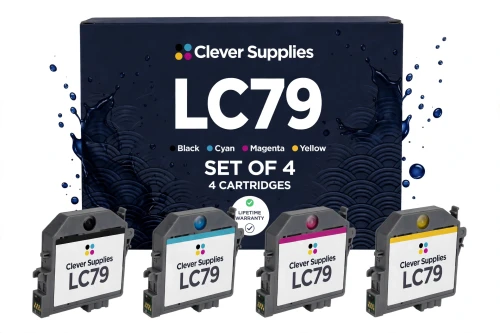
Brother’s own prices put the same refill in another league: $47.49 for the genuine black, $27.49 to $28.99 for the colors — $131.46 across the four slots. Nor could that refill actually be bought from Brother when the figures were gathered: Brother’s data flags the genuine black and yellow as discontinued, and the cyan and magenta, current products though they are, were showing out of stock. Here, the renewal costs $29.94. Alone it falls short of the $49 free-shipping line — the ten-cartridge box further down is the offer that passes that mark by itself.
Shop the LC79 Set of 4 →THE REST OF THE LADDER — THE RESERVE BOX, THEN THE FOUR SINGLES
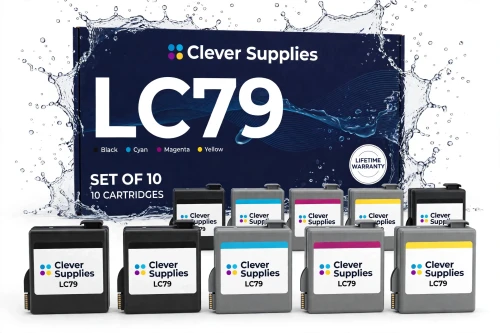
The drawer-stocking option: ten cartridges working out to $6.89 each, the cheapest unit price on the page and the cheapest page rate as well. Four of the ten are black, matching how these wide machines actually spend ink — documents first. And at $68.85 the box qualifies for free shipping with nothing else added to the order.
Shop the LC79 Set of 10 →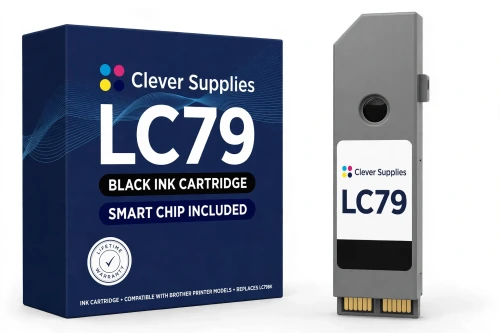
The longest-rated cartridge on the platform: four times the pages of the high-yield black beneath it, for seventy-five cents more than that tier’s single costs. Brother’s genuine version: $47.49 at list, and flagged discontinued in Brother’s own data.
Shop LC79BK Black →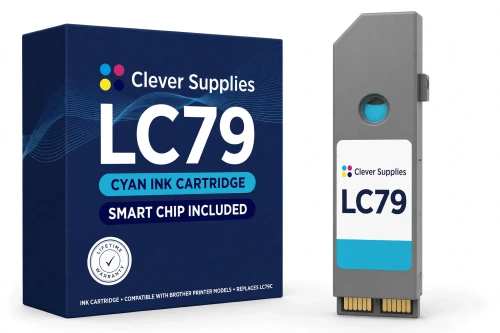
Double the rating of the high-yield cyan beneath it, dropped into the same slot. Brother’s genuine LC79C lists at $27.49 and stood out of stock at Brother when these figures were read.
Shop LC79 Cyan →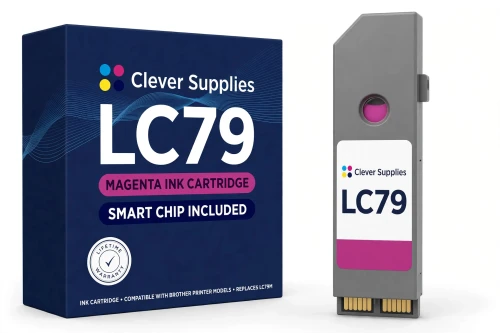
Magenta carries the color load on charts, covers and wide-format proofs; here it is rated to 1,200 pages before it asks for a change. The genuine cartridge at Brother is $28.99, out of stock there when checked.
Shop LC79 Magenta →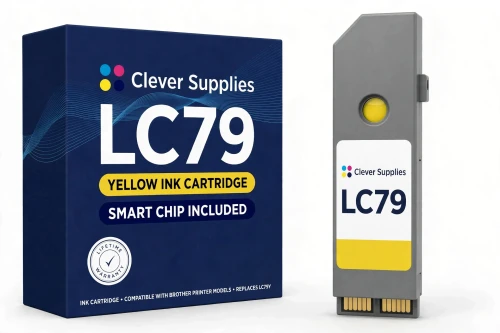
Yellow is the slot owners forget until the output washes pale; a 1,200-page rating makes keeping a spare an easy habit. Brother lists the genuine yellow at $27.49 and flags it discontinued in its own data.
Shop LC79 Yellow →Singles earn their place under the boxes because no two slots run dry together. Four weeks of invoices can empty the black with the colors barely touched; a week of color proofs reverses the picture. A single swaps the one cartridge that is finished and leaves the part-used rest undisturbed. The boxes are cheaper ink, page for page — the single is cheaper housekeeping, because it never asks you to pay again for ink already sitting in the machine.
Everything above carries one condition: four printers qualify, and no fifth model does. Owners of the compact letter-size MFCs will find nothing here that fits — their machines top out one tier lower — and the tier section below sets out exactly where that boundary falls.
Six offers, two ratings — the table
Behind every yield on this page stands a single sentence from Brother, repeated word for word on all four LC79 cartridge pages: “‡Approximate page yield in accordance with ISO/IEC 24711.” The ratings that sentence supports are assigned per cartridge — the black at up to 2,400 pages, each color at up to 1,200 — and the set listings will not combine them into a box rating: “We do not merge the four ratings into one set total”, as the Set of 4 puts it. So where the set rows below show a cost per page, division did the work — the Set of 4’s price over the 6,000 rated pages in that box, the Set of 10’s over the 16,800 in its box — and each such figure is labeled blended.
| Offer | Fits | Price | Rating per cartridge | Cost per page | Against the singles |
|---|---|---|---|---|---|
| LC79 Set of 4 BK C M Y — the flagship | All four printers | $29.94 | Black up to 2,400 · colors up to 1,200 | 0.50¢ blended | SAVE $6.02 |
| LC79 Set of 10 BCMY | All four printers | $68.85 | 4 black up to 2,400 · 6 colors up to 1,200 | 0.41¢ blended | SAVE $21.05 · ships free alone |
| LC79BK black single | All four printers | $8.99 | Up to 2,400 pages | 0.37¢ | The document slot |
| LC79C cyan single | All four printers | $8.99 | Up to 1,200 pages | 0.75¢ | One slot, one cartridge |
| LC79M magenta single | All four printers | $8.99 | Up to 1,200 pages | 0.75¢ | The color-work slot |
| LC79Y yellow single | All four printers | $8.99 | Up to 1,200 pages | 0.75¢ | One slot at a time |
Read across and the pattern is plain: a black page costs 0.37¢ from a single, a color page 0.75¢, and both rates fall as the box grows — $7.49 a cartridge inside the Set of 4, $6.89 inside the Set of 10, blended rates settling at 0.50¢ and 0.41¢. The cartridges are the same cartridges in every row; a bigger box simply spreads their price across more rated pages before the drawer has to open again.
Three tiers on one cartridge shape — this is the top step, and the narrowest
Brother builds this cartridge shape in three yield steps. At the bottom, LC71 wears the Standard-yield label and a 300-page rating. In the middle, LC75 is the High-yield step, its rating a flat 600 pages in every slot. The top step is this page’s LC79, Super High-yield — the tier Brother markets on the wide models as the “LC79 XXL Series”, a name its own printer pages use for three of the four models here — where the black carries a 2,400-page rating and each color a 1,200-page one. The shell and the slots never change; what changes from step to step is how far a cartridge travels before it is spent.
Which steps a printer may climb, though, depends on its class. The seven compact models on the platform take LC71 and LC75 and stop there — no LC79 was ever made for them. The four ledger-size models start one step higher: Brother never listed the standard cartridge for them at all, so their ladder runs LC75 then LC79, and the two coexist slot by slot — a super high-yield black can sit beside high-yield colors, or the reverse, and the mixture can change again at the next swap. LC79 is therefore at once the platform’s longest-running tier and its most restricted: the ceiling on four printers, and absent from the fit lists of the other seven.
The middle tier has a shelf of its own in this store and a guide of its own as well — our Best Brother LC75 Ink Cartridges guide — and setting its prices beside this page’s produces the platform’s strangest comparison. An LC75 single costs $8.24, seventy-five cents less than an LC79 single, yet its flat 600-page rating puts its page at 1.37¢, where this tier’s black page costs 0.37¢ and its color pages 0.75¢. LC75’s Set of 10 comes to $67.35, a blended 1.12¢. Its Set of 4, though, is tagged at exactly $29.94 — dollar for dollar the flagship’s price — while holding 2,400 rated pages where the box above holds 6,000: blended 1.25¢ on that side, 0.50¢ on this one. Oddest of all, the per-cartridge price inside the LC79 Set of 4 is $7.49, undercutting the $8.24 charged for a lone LC75 cartridge.
Taken at set level, then, the contest on these four printers is lopsided, and honesty requires saying so: an owner who restocks by the box pays no premium for the longest ratings. The middle tier’s remaining advantages are different in kind. It alone spans all eleven platform printers, so one shelf can feed a compact MFC and a ledger machine side by side; and its single, at $8.24 against $8.99, suits the light user for whom 600 pages already covers a season. As for LC71, it never enters the discussion on the wide four: Brother never offered it to them, and this store does not stock it in any case.
What came in the box: starters from the tier below
Ask what ink these four printers started life with and the answer is: not this tier. Brother’s pages for the four models carry no starter statement scoped to LC79 at all — the only in-box footnotes found on them are written against the tier below — so no starter yield for LC79 is quoted anywhere on this page. The starters these machines shipped with were LC75-series cartridges.
For two of the four, Brother states the arrangement outright. The MFC-J5910DW and MFC-J6710DW pages both carry the note: “Actual yield of starter cartridge will be approx. 65% of replacement LC75 cartridge series, due to ink system initialization process.” Read the percentage against what it actually measures — a replacement LC75 cartridge, the 600-page high-yield unit. It describes the starters those two printers came with, and it must not be carried over to LC79 yields. The MFC-J6510DW and MFC-J6910DW pages offer no readable in-box statement at all; rather than lend them a figure from a neighboring model, this guide prints none for them.
So the first LC79 an owner buys is also the first top-tier cartridge the machine has ever held: a full retail unit at the full published rating — the black good for up to 2,400 pages, each color for up to 1,200.
Chipped for an electronic reader — and candid about where that ends
The specification block tells the same story on all six listings: “New compatible chip”. Why a chip matters here is spelled out in the magenta listing’s own words — “the printers read their cartridges electronically, so every cartridge here carries a new compatible chip”. These machines interrogate the cartridge electronically before they print from it; fail that interrogation and the cartridge may as well be absent. That is the whole reason no chipless version exists on this shelf.
The listings are equally explicit about the claim’s edge. Firmware moves, and a chip that read yesterday can be refused after an update; the printed response is a short routine — out with the cartridge, a check that the chip contact is clean and unmarked, a firm reseat, a restart — and beyond the routine, no sweeping assurance. The black cartridge’s text: “Recognition is not something we can promise in every firmware state”. The Set of 4’s: “We do not claim recognition under every possible firmware state”. When the routine fails, the texts point to the warranty process and stop there.
Unusually, the texts also name the exact words a failed read puts on the screen. ‘Cannot Detect’ shows up in all six descriptions — the Set of 10 raises it twice — presented each time as the familiar aftermath of a firmware update and answered with the routine above. Around the claim sits Brother’s own published position, held since March 2025, that its firmware updates do not block third-party cartridges. Sum the page’s position up and it is this: a new chip in every cartridge, the failure message named in advance with a routine for it, the warranty behind that — and recognition across every firmware state promised by nobody.
Four printers, all of them ledger-size
On each of Brother’s four LC79 cartridge pages, the “For use with:” line reads the same, and it is short: four MFC models. Every offer above fits all four of them, in every slot. A model missing from the line is a model this tier was never built for.
The four: MFC-J5910DW, MFC-J6510DW, MFC-J6710DW and MFC-J6910DW. Each of the four is a wide-format machine whose other tier is the high-yield LC75 below; the standard tier was never offered on any of them.
The store files the six exactly where Brother’s line points: inside all four model categories, and together under the family’s code category, the Brother LC79 category. Start from the printer model or start from the spent cartridge’s code — the destination is the same six listings either way.
What stands behind each listing
Five checks before ordering from a four-printer shelf
Questions the top tier draws
No. The compact seven on this platform — models like the MFC-J430W and MFC-J825DW — accept the standard LC71 and high-yield LC75 tiers and nothing above them; Brother never made an LC79 cartridge for them. Your ceiling is LC75, rated at a flat 600 pages a cartridge. Everything on this page is built for the four ledger-size models only.
Because the two shelves simply price their four-boxes alike — $29.94 on both — while the ratings inside differ sharply: the LC79 box holds a black rated to 2,400 pages and colors rated to 1,200, which is 6,000 rated pages across the box, costed by division at a blended 0.50¢, where the LC75 box’s four 600-page cartridges give it 2,400 rated pages and a blended 1.25¢. Per cartridge the contrast sharpens further: priced per cartridge at $7.49 inside the LC79 Set of 4, against $8.24 for one LC75 cartridge bought singly. On the four printers that accept both tiers, the longer-running box is not the expensive option.
The Set of 10 is the cheaper ink by every measure: $6.89 a cartridge against $7.49, and a blended 0.41¢ a page against 0.50¢, across 16,800 rated pages in the box. It is also the only offer here that ships free on its own, at $68.85. The Set of 4’s case is cash flow and turnover: $29.94 now rather than $68.85, and four cartridges cycled through sooner. Heavy document printing argues for the ten-box; occasional use argues for the four.
It describes Brother’s own shelf, not this one. In Brother’s data the genuine LC79BK and LC79Y carry discontinued flags; the genuine LC79C and LC79M remain current products but stood out of stock at Brother when these pages were gathered — so at that moment Brother was directly selling none of the four genuine cartridges. The six listings on this page are Clever Supplies compatibles, a separate line that remains available, and a discontinued genuine cartridge changes nothing about what your machine accepts.
Yes — on the four ledger models the two tiers share the same slots, and the choice is made per slot at every change. Brother’s own in-box note for the MFC-J5910DW and MFC-J6710DW describes LC75-series starters at roughly 65% of a replacement LC75, so most owners meet the top tier at their first full refill. Nothing needs converting: pull the spent starter, seat the LC79, and the machine reads it by its chip.
Run the routine in the order the listings print it. Out comes the cartridge; the chip contact gets checked for dirt and fingerprints; the cartridge goes back in, seated firmly; the printer restarts. In the listings’ framing, that message is the familiar failure that can trail a firmware update, and one of those four steps closes most cases. What is assured is a new compatible chip in every cartridge — a successful read under every firmware state is assured by neither the listings nor this page. If the message survives the routine, the listing’s warranty is where the cartridge goes next.