




Lexmark’s T650, T652 and T654 workgroup lasers — and the T656dne multifunction built on the same engine — draw on one black toner family with three rungs: a standard cartridge rated near 7,000 pages, a high-yield cartridge at roughly 25,000, and an extra-high-yield cartridge at roughly 36,000. This store stocks all three rungs, and stocks them under their Return Program codes only. Nine distinct offers result — each part number sold as a single cartridge, a 2-pack and a 4-pack — although the storefront shows fifty-four listings for them, the high-yield tier having been re-listed under printer after printer. What makes this family unlike most is that its price ladder runs backwards. The standard and high-yield cartridges carry identical prices to the cent at every pack size, although one is rated at more than three and a half times the other’s pages; and the longest-running cartridge of the three is the cheapest to buy. The one fence around that bargain is fit: the extra-high-yield T654X11A belongs to the T654 models alone, while the two lower tiers run across the whole platform. This page prices all nine offers, draws the fit line where Lexmark’s own maintenance guide draws it, and says plainly where the X listings’ printer lists claim more than Lexmark allows.
Start, again, with the badge on the printer — but here it decides between two bargains rather than three prices. Owners of the T654 line, including the T656 and T656dne, can buy the flagship below: the T654X 2-pack at $225.88, seventy-two thousand rated pages at 0.31¢ each, with the 4-pack trimming the rate to 0.30¢. Everyone else — every T650 and T652 model — tops out at the high-yield tier, where the T650H 2-pack at $279.05 is the working buy and the 4-pack reaches 0.54¢ a page. Between the two lower tiers there is no choice to make at all: the standard T650A and the high-yield T650H are priced identically at every pack size, so the standard cartridge’s 7,000 pages never beat the high-yield’s 25,000 at the same money. Against Lexmark’s own list prices — $297.26 for a genuine standard single, $882.36 for a genuine extra-high-yield — the compatibles on this page run from about half the genuine figure down to about a seventh of it.
Nine offers: three tiers, three pack sizes, one inverted ladder
Nine cards follow, and together they are the platform’s whole shelf in this store — no configuration the store sells is missing, and none is shown twice. The forty-five listings beyond these nine are repetitions, nearly all of them high-yield cartridges filed under one printer name or another; a configuration does not become a second product by being listed again. A savings badge is shown wherever a pack undercuts the same cartridges bought singly at this page’s sale prices — here, that is all six multi-packs. And on every card the fit line comes from Lexmark’s maintenance guide for the platform, not from the broader claim made by the X listings’ printer blocks; the fit section further down addresses that disagreement head-on.

Measure it against the genuine article and the offer’s shape comes into focus. One genuine T654X cartridge carries a Lexmark US list price of $882.36; this box holds two of the compatible equivalent — seventy-two thousand rated pages in total — for roughly a quarter of that single-cartridge figure. The listing’s own text, to its credit, draws the tier’s fit line accurately, naming the models it serves. What a buyer must not lose sight of is the fence itself: the cartridge belongs to the T654 line, and it will not run in any T650 or T652 model.
Shop the T654X 2 Pack →THE REMAINING OFFERS
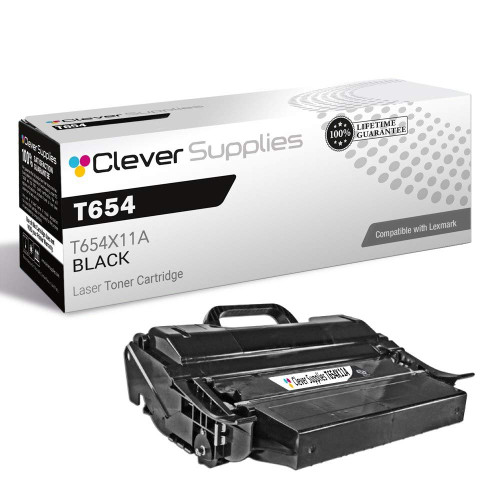
The inverted ladder in a single card: the longest-running cartridge on the shelf is also its cheapest single, undercutting both lower tiers by $26.58. Against Lexmark’s $882.36 list price for the genuine cartridge, it runs at about a seventh of the genuine figure.
Shop the T654X Single →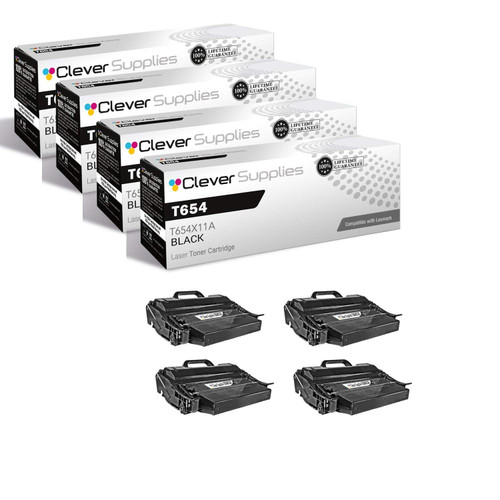
Nothing on the shelf holds more pages: a hundred and forty-four thousand of them, at the family’s lowest per-page rate. Bought as singles the same four cartridges come to $483.92. A busy shared T654 can run a whole season on one of these boxes before anyone thinks about reordering.
Shop the T654X 4 Pack →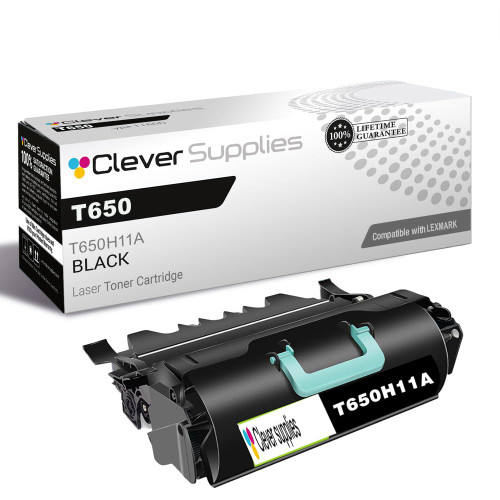
The platform-wide workhorse bought one at a time — and the card the whole platform can use. It carries the identical sticker to the standard single further down while returning more than three and a half times its rated pages, which is why this tier, not that one, anchors the shelf.
Shop the T650H Single →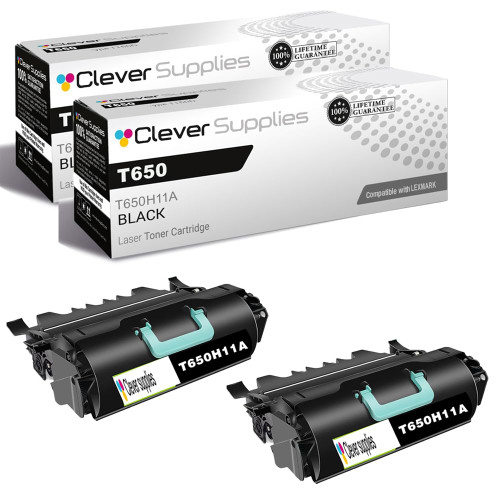
The lead buy for every printer the flagship cannot serve — all ten T650 and T652 models and the TS channel variants. Fifty thousand pages of the tier that fits the whole platform, at the shelf’s standard pack saving.
Shop the T650H 2 Pack →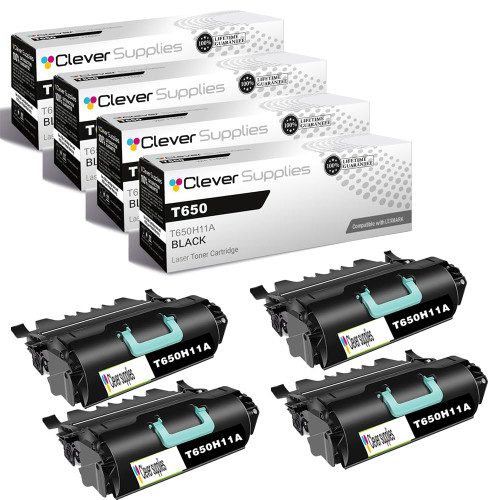
A hundred thousand rated pages of universal fit — the deepest box that serves the whole platform, and the floor rate for every model outside the T654 line. Four singles would cost $590.24.
Shop the T650H 4 Pack →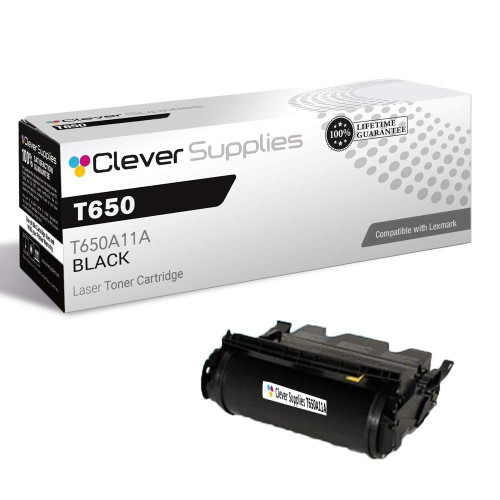
Carded because the shelf is not complete without it — and carded with the verdict attached. At the identical $147.56, the T650H single above returns 25,000 rated pages against this cartridge’s 7,000; there is no figure on this page on which the standard single wins.
Shop the T650A Single →
The pack saving is real — $16.07 against two standard singles — but it is measured against the wrong baseline: the T650H 2-pack beside it costs the same $279.05 and holds fifty thousand rated pages against this box’s fourteen thousand.
Shop the T650A 2 Pack →
Twenty-eight thousand pages at the standard tier’s floor rate — and still the weakest deep box on the shelf, because the same $542.02 buys the T650H 4-pack’s hundred thousand pages. The standard tier’s case does not improve with pack size; it disappears at the same speed.
Shop the T650A 4 Pack →With that, the shelf is complete — nine offers, each shown once. Two patterns in its arithmetic are worth remembering through the sections that follow. The saving for buying in packs barely moves from tier to tier: roughly $16 on a 2-pack, roughly $48 on a 4-pack. And although the sticker prices run backwards — the cartridge that lasts longest costs least — the per-page prices never do: bigger yields and bigger boxes only ever push the cost of a page downward.
The ladder in nine rows
Each offer gets its own row, and no two rows hide the same configuration — this store sells every tier under a single code, so nothing needs collapsing. A row’s per-page figure is its sale price divided by the total rated yield of the cartridges inside it, computed on numbers that the listings and Lexmark publish in agreement. Read the fit column before the price columns: it is the only one that can strike a row off your list.
| Offer | Sale price | Pages in the box, rated | Cost per page | Fits these printers |
|---|---|---|---|---|
| T654X 2 Pack — the flagship (T654X11A) | $225.88 | 2 cartridges · ~72,000 pages | 0.31¢ | T654, T654n/dn/dtn, T656, T656dne (6 models) |
| T654X Single (T654X11A) | $120.98 | 1 cartridge · ~36,000 pages | 0.34¢ | T654, T654n/dn/dtn, T656, T656dne (6 models) |
| T654X 4 Pack (T654X11A) | $435.69 | 4 cartridges · ~144,000 pages | 0.30¢ | T654, T654n/dn/dtn, T656, T656dne (6 models) |
| T650H Single (T650H11A) | $147.56 | 1 cartridge · ~25,000 pages | 0.59¢ | All 16 platform models |
| T650H 2 Pack (T650H11A) | $279.05 | 2 cartridges · ~50,000 pages | 0.56¢ | All 16 platform models |
| T650H 4 Pack (T650H11A) | $542.02 | 4 cartridges · ~100,000 pages | 0.54¢ | All 16 platform models |
| T650A Single (T650A11A) | $147.56 | 1 cartridge · ~7,000 pages | 2.11¢ | All 16 platform models |
| T650A 2 Pack (T650A11A) | $279.05 | 2 cartridges · ~14,000 pages | 1.99¢ | All 16 platform models |
| T650A 4 Pack (T650A11A) | $542.02 | 4 cartridges · ~28,000 pages | 1.94¢ | All 16 platform models |
Two features reward a second look. The middle and bottom blocks carry identical prices row for row — $147.56, $279.05, $542.02 — while the pages column multiplies by more than three and a half between them; the step from a standard single to a high-yield single costs nothing at all and cuts the page cost from 2.11¢ to 0.59¢, the only free upgrade on the shelf. And the top block breaks the pattern buyers expect: the extra-high-yield rows are the cheapest in both money columns, fenced only by the fit column beside them.
Ten thousand pages, priced three ways
Put the three rates against a fixed block of work — ten thousand pages, a fair quarter for a workgroup machine — and the spread is wide. At single-cartridge rates that block costs about $211 in standard cartridges, about $59 in high-yield and about $34 in extra-high-yield; buying by the 4-pack trims the same block to roughly $194, $54 and $30. The per-page ladder, unlike the sticker ladder, has no inversions in it: yield steps and pack steps alike only ever cheapen the next page. Which makes one habit on this platform pure waste — reordering standard singles for a T650 or T652, at high-yield prices, when switching to the high-yield cartridge costs nothing at all.
One caution governs every genuine comparison on this page. No checkout price for these codes could be obtained from Lexmark’s US store, so the genuine numbers quoted are the company’s published US list prices — MSRP figures from its official price list — and they should be read as list prices, never as street prices. On that footing: a genuine standard cartridge lists at $297.26 beside this shelf’s $147.56; a genuine high-yield at $827.60 beside the same $147.56; a genuine extra-high-yield at $882.36 beside $120.98. Lexmark’s Regular-code versions of the two upper tiers list higher again — $885.60 and $940.36 — though the store sells neither. Expressed as shares of the genuine list figure, the compatible single costs about a half at the standard tier, about a sixth at high yield and about a seventh at extra high yield.
Anyone cross-checking these figures against the product pages should know which prices each side uses. The listings’ FAQ answers do their savings and per-page arithmetic on list prices — the high-yield single’s text arrives at roughly 0.68¢ a page, where the $147.56 sale price gives 0.59¢ — whereas this guide reckons throughout on the sale price a buyer is actually charged at checkout. The note at the foot of the page states that basis again.
Three yield figures, agreed by every source
Most families in this series arrive with a yield argument to settle; this one arrives with none. Every listing’s structured yield field carries the same three numbers — 7,000 pages for the standard tier, 25,000 for the high-yield, 36,000 for the extra-high-yield — the descriptions that quote a figure quote the field’s figure, and Lexmark’s own product pages declare identical ratings under ISO/IEC 19752, its US price list going so far as to name the codes “(7K)”, “(25K)” and “(36K)”. All of the arithmetic on this page rests on those three numbers, and no rival set of figures lurks in a data field to unsettle it. A caution does belong here: page counts belonging to other Lexmark high-yield families circulate online attached to cartridges of this shape. For the T650H11A the record is unanimous — field, text and manufacturer page alike say 25,000 — and 25,000 is the figure this guide uses.
The code structure is simpler here than on most Lexmark shelves, because only one of Lexmark’s two lines is stocked. Each tier exists in two Lexmark lines: as a Return Program cartridge — the codes sold on this page, priced lower on the condition that the spent cartridge goes back to Lexmark — and as a Regular twin: T650A21A, T650H21A and T654X21A. The store stocks none of the Regular codes, in any pack, and none of Lexmark’s label-application variants (T650H04A, T654X04A) either; if the cartridge coming out of a printer carries one of those codes, its stocked equivalent on this page is the Return Program code of the same tier and rating. The yields and the fit do not change between the twins.
How much printing a new machine’s first cartridge delivers is, on the available record, an open question — and this guide leaves it open rather than filling it with a guess. Lexmark sources consulted for this page publish no starter-cartridge yield for the T650, T652 or T654 models, so no such figure appears here. The ratings above belong to the retail cartridges, and they govern planning once the first replacement is due.
The platform’s other consumable — or rather, its absence — comes last. These print cartridges are all-in-one units: the photoconductor drum is built into the cartridge itself, which the listings’ own text reflects in its list of new internal parts. Lexmark’s ordering documentation for the platform covers print cartridges and maintenance-side parts — a fuser, charge rolls, pick rollers — and carries no photoconductor or imaging-unit part number at all, so there is no separate drum for this store to stock and none is carded or linked here. Toner is the platform’s only cartridge decision.
Which tier fits which printer
Drawn from the user’s and maintenance guides for the T650 family, Lexmark’s platform roster is the Lexmark T Series in three printer lines: the T650, T650n, T650dn and T650dtn; the T652, T652n, T652dn and T652dtn; and the T654, T654n, T654dn and T654dtn — joined by the platform’s multifunction sibling, the T656dne, for which this store also keeps a base T656 category, and by the channel variants TS654dn and TS656dne. All sixteen models have category pages in this store, linked above.
The standard and high-yield cartridges fit all sixteen. No footnote in Lexmark’s maintenance guide restricts either row of its cartridge table, so the two lower tiers are the platform’s common denominator — the cartridges a mixed fleet can standardize on. The extra-high-yield cartridge fits six: the T654, T654n, T654dn and T654dtn, and the T656 and T656dne built on the T654 engine. In Lexmark’s cartridge table the tier carries a footnote — “Available for the T654 models” — and the X listings are filed in full agreement with it, under those six categories and no others. The T654X11A does not fit any T650 or T652 model, nor the TS654dn or TS656dne. Beyond the store’s catalog, Lexmark also markets the 36,000-page cartridge for its X654, X656 and X658 multifunction line under the twin code X654X11A; none of those machines has a category or a listing in this store, so they stand here in prose and nothing on this page is sold for them.
One disagreement has to be aired before this section closes, because it sits on the product pages themselves. The Compatible Printers link block attached to each X listing was built for the whole platform, not for the tier: it links the T650 and T652 categories, and the TS channel variants, that Lexmark excludes from the X cartridge’s fit. Yet the text on those same listings names the fit accurately — the six models above — and the listings sit under exactly those six categories, so an X product page argues with itself, its block against its text and its filing. The standard tier’s pages drift in a smaller way: fourteen models in their text, sixteen in their blocks, fourteen in their filing. Wherever the surfaces conflict, the fit lines on this page’s cards follow Lexmark’s maintenance guide. The stakes are concrete: a T650 owner who believes an X listing’s block ends up holding a cartridge their printer cannot run — so the correction is printed here, where that owner will actually read it.
As elsewhere in this series, the cartridge itself settles any remaining doubt. One coming out of any of the sixteen printers should be marked T650A11A, T650H11A or T654X11A — or bear the Regular twin of one of those codes — and matching that code against the model’s tier line above leads straight back to the correct rows of the table.
Chips and firmware: little to report, reported straight
Some platforms in this series need a long chip discussion; this one needs a short one. No listing on the shelf carries a chip specification field. The standard and extra-high-yield descriptions mention a smart chip a single time, as one item in a list of new internal parts, and the high-yield descriptions say nothing about chips whatsoever. No cartridge here is marketed with any assurance about firmware behavior, one way or the other.
On Lexmark’s side, the record is its Return Program note: the genuine Return Program cartridge is designed to automatically update the memory in the printer, in Lexmark’s words, to protect against the introduction of counterfeit and unauthorized third-party cartridges. That note is the extent of the documented position found for this platform — a statement about how the genuine cartridge is designed, not a description of any blocking regime in these printers — and it is reproduced here as found. Behind the compatible cartridges stands the store’s own cover, detailed in the next section: twelve months of warranty, and returns that cost nothing for the first year.
The cover written into every listing
Start from the badge on the printer
Questions from the T65x supply shelf
The platform in this store runs to sixteen models — the T650, T650n, T650dn and T650dtn; the T652, T652n, T652dn and T652dtn; the T654, T654n, T654dn and T654dtn; the T656 and T656dne; and the TS654dn and TS656dne channel variants. Which of them a given cartridge serves is a tier question. All sixteen take the standard T650A and the high-yield T650H. Only six take the extra-high-yield T654X: the T654 set plus the T656 and T656dne. The lines are drawn by the cartridge table in Lexmark’s maintenance guide for the platform.
No. In Lexmark’s maintenance guide the extra-high-yield cartridge is marked as available for the T654 models, and its tier includes no T650 or T652 model. The printer lists on the X product pages do link the T650 and T652 categories — that block was built once for the entire platform — but the same pages describe the fit correctly in their text, they are filed under the six T654-line categories alone, and the manufacturer’s guide is decisive: on a T650 or T652 the ladder stops at the high-yield T650H, sold as a single, a 2-pack or a 4-pack.
Because that is how the shelf is priced — identically, to the cent, in list and sale price alike, at all three pack sizes: $147.56, $279.05 and $542.02. No figure favors the standard cartridge at those prices: the T650H is rated at about 25,000 pages against the T650A’s 7,000, so at equal money the high-yield cartridge returns more than three and a half times the pages. This guide cards the standard tier because the shelf is not complete without it, and says plainly that the high-yield tier is the buy.
No. On this platform the photoconductor drum is built into the print cartridge — an all-in-one unit — and Lexmark’s ordering documentation for the T650 family lists print cartridges and maintenance parts such as the fuser and charge rolls, with no photoconductor or imaging-unit part number at all. This store stocks no drum for the platform because there is no drum to stock; when a cartridge is spent, the drum inside it is spent with it, and the replacement cartridge renews both.
One tier, two of Lexmark’s sales lines. The T650H11A belongs to the Return Program — the range priced on the condition that spent cartridges are sent back to Lexmark — while the T650H21A is the Regular version of the same cartridge. Rating and fit match exactly, at about 25,000 pages and the full sixteen models; at Lexmark list the Regular twin is even the dearer of the two, $885.60 against $827.60. Only the Return Program codes are stocked in this store — the pattern repeats at the standard tier (T650A11A / T650A21A) and the extra-high-yield tier (T654X11A / T654X21A).
An honest answer is that the sources behind this guide do not give one. Lexmark material consulted for this page publishes no starter-cartridge yield for the T650, T652 or T654 models, so this guide prints none rather than estimating. Planning can safely begin at the first replacement: from that point the retail ladder above — 7,000 pages at the standard tier, 25,000 at high yield, 36,000 at extra high yield — applies to every model on the platform.