




Departmental Lexmark machines — the MS725, MS82x printers and their MX721, MX722, MX822 and MX826 multifunction counterparts — share a single black Unison toner system, and this store’s shelf for it looks far larger than it is. Seventy-eight listings resolve, once the same configuration listed under printer after printer is counted only once, into six distinct products: three yield tiers, each under one Return Program part number, in a pack grid with holes in it. The high-yield 581H (58D1H00) comes as a single, a 2-pack and a 4-pack; the extra-high 581X (58D1X00) stops at a 2-pack; the ultra-high 581U (58D1U00) is sold as a single and nothing else — six boxes stocked out of the nine the grid could hold. Two disciplines govern the buying decision here. The first is fit, which narrows as the yield climbs: the H tier serves all seventeen models the store lists for the platform, the X tier serves fourteen, and the U tier serves twelve. The second is an unusual price shape: the longest cartridge on the shelf is a lone single that costs less than either lower tier’s multi-packs, which is why this guide leads with it rather than with a pack. Every figure that follows is drawn from the listings’ own data and from Lexmark’s ordering tables, and where the product pages overstate fit — they do, in one specific place — this page says so and follows Lexmark instead.
Work out which of the three audiences your printer belongs to before looking at a single price. If it is one of the twelve models that accept the ultra tier — the MS725DVN, the MS823, MS825 and MS826 printers, the MX722 pair, and the MX822 and MX826 multifunctions — the buying decision is close to settled: the 581U single at $429.13 delivers roughly 55,000 rated pages at 0.78¢ each, and no other box on the shelf beats that rate. If your machine is an MX721, the ladder stops one rung lower, at the 581X, whose 2-pack works out to 1.07¢ a page. If it is an MS821 or MS822, only the 581H fits at all, and the H 2-pack at $530.34 — the platform-wide alternative carded below the flagship — is the sensible depth for a machine that prints daily, with the 4-pack trimming the rate to 1.74¢. No genuine Lexmark price is quoted anywhere in this guide, for a simple reason: none could be retrieved from a sanctioned source, so the case for these cartridges is made on per-page arithmetic alone.
Six offers: three tiers, an incomplete pack grid
What is carded below is the entire distinct shelf — all six configurations, each shown a single time with its own photograph and its own product link. The other seventy-two listings are the same six boxes wearing different printer names, and repeating one here would dress a duplicate up as a choice. Badges marked SAVE appear only on the three multi-packs, and each measures that pack against the identical cartridges purchased as singles at the sale prices quoted on this page. Fit statements on the cards come from Lexmark’s user-guide ordering tables; they are deliberately narrower, on the two upper tiers, than the printer blocks attached to the listings themselves, for reasons the fit section lays out in full.

Most shelves in this guide series are led by a 2-pack of the highest tier; this one cannot be, because the ultra tier is stocked as a single only. It earns the lead position on the numbers regardless. A departmental machine that accepts it gets roughly fifty-five thousand pages from one cartridge change — fewer interventions, one box on the shelf, and the family’s floor rate without any pack commitment. Two boundaries travel with it and are printed wherever this guide mentions the tier: it fits twelve of the platform’s seventeen models, not all of them, and there is no larger U box to graduate to when volume grows. For the five models outside its line, the H 2-pack carded directly below is the alternative this guide recommends.
Shop the 581U Single →THE REMAINING OFFERS
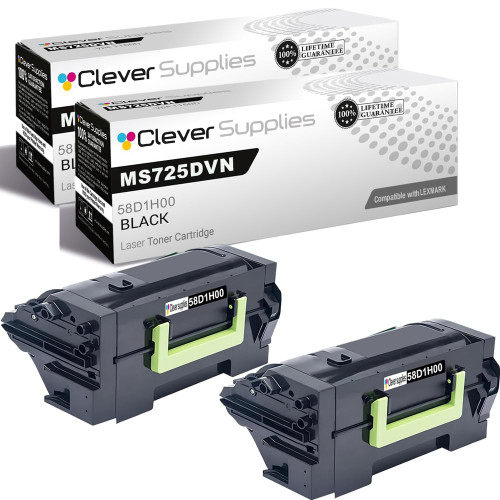
The platform-wide alternative to the flagship: thirty thousand pages of the one tier every model accepts, including the MS821, MS822 and MX721 machines the upper tiers exclude. Two singles bought separately would come to $546.42.
Shop the 581H 2 Pack →
The deepest box the X tier offers — there is no X 4-pack — and the ceiling for MX721 owners, whose machines take this tier but not the U above it. Seventy thousand pages at the tier’s best rate.
Shop the 581X 2 Pack →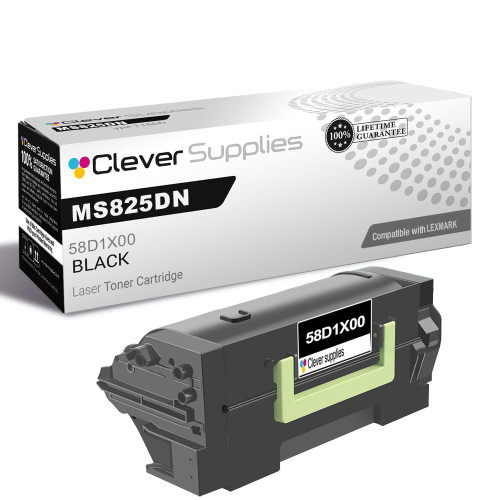
The middle tier bought one cartridge at a time: thirty-five thousand pages, and a rate within two hundredths of a cent of the 2-pack’s. For a single MX721 or a lighter-duty MS823, the pack premium buys depth rather than savings.
Shop the 581X Single →
The family’s only 4-pack, and the stocking choice for a mixed fleet standardized on the universal tier — sixty thousand pages any of the seventeen models can draw on. Four singles would total $1,092.84.
Shop the 581H 4 Pack →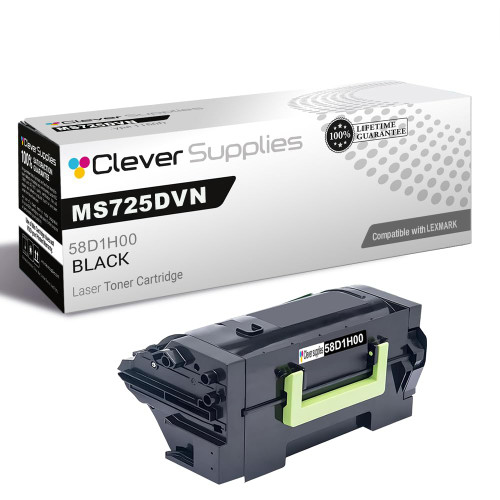
The entry point and the universal spare: the lowest sticker on the shelf and the highest cost per page, which is the usual trade at the bottom of a yield ladder. For an MS821 or MS822 it is also, with its two packs, the entire available range.
Shop the 581H Single →Two features of this small shelf deserve emphasis before the detail sections. The pack grid genuinely ends where the cards end — there is no U 2-pack or X 4-pack hiding elsewhere in the catalog — and the per-page column contains no traps: every move to a higher tier, and every move to a larger pack within a tier, makes the next page cheaper. The only decision that can go wrong here is a fit decision, and it can only go wrong by buying above your model’s line.
The whole shelf in six rows
Six distinct products make a short table, and nothing in it needs merging or interpretation: one row per box, with the per-page figure worked out from the sale price and the combined rated yield of the cartridges inside. The fit column is placed last on purpose — read it first anyway, because it is the column that decides which of the other columns are available to your printer at all.
| Offer | Sale price | Pages per box, rated | Per-page cost | Fits |
|---|---|---|---|---|
| 581U Single — the flagship (58D1U00) | $429.13 | 1 cartridge · ~55,000 pages | 0.78¢ | 12 models — MS725DVN, MS823, MS825, MS826, MX722, MX822, MX826 lines |
| 581X 2 Pack (58D1X00) | $746.46 | 2 cartridges · ~70,000 pages | 1.07¢ | 14 models — the H roster minus MS821DN, MS821N, MS822DE |
| 581X Single (58D1X00) | $381.27 | 1 cartridge · ~35,000 pages | 1.09¢ | 14 models — the H roster minus MS821DN, MS821N, MS822DE |
| 581H 4 Pack (58D1H00) | $1,044.60 | 4 cartridges · ~60,000 pages | 1.74¢ | All 17 platform models |
| 581H 2 Pack (58D1H00) | $530.34 | 2 cartridges · ~30,000 pages | 1.77¢ | All 17 platform models |
| 581H Single (58D1H00) | $273.21 | 1 cartridge · ~15,000 pages | 1.82¢ | All 17 platform models |
Sorted by rate, the table makes the family’s oddity impossible to miss: the cheapest row is a single cartridge, sitting above every pack. The U single also beats the packs on total pages per dollar spent in a second sense — its $429.13 buys more rated pages than the $746.46 X 2-pack’s cartridges deliver one at a time, and nearly as many as the $1,044.60 H 4-pack holds in total. Where the U tier is closed to a printer, the ordering reverts to the familiar shape: within the H tier the 4-pack is the floor rate, and the X tier’s two boxes sit between the H rates and the U’s.
What a page costs, with no genuine figure to lean on
Guides in this series usually set the compatible rates beside Lexmark’s own prices at this point. This one does not, and the omission is deliberate: Lexmark’s US store returned no checkout price for any of the three stocked codes, and the official Lexmark US price list that prices other families in this series carries no toner rows for this platform at all. Rather than borrow a number from a reseller, this guide leaves the genuine column empty and lets the internal arithmetic carry the argument — which, on this shelf, it comfortably does.
Price a standard block of work — ten thousand pages — at each box’s rate and the spread runs from about $182 bought as H singles down through about $174 at the H 4-pack rate and about $109 as an X single, to roughly $78 on the U cartridge. Put differently, a departmental machine that can take the ultra tier prints its next fifty-five thousand pages for less money in toner than an H-only machine spends on thirty thousand. The tier steps are worth far more than the pack steps: moving from H to X nearly halves the page cost, moving from X to U cuts it by more than a quarter again, while the deepest pack discount inside any tier is worth only a few hundredths of a cent.
A warning about cross-checking: the product pages do their own sums, and they do them on the higher list prices rather than the sale prices charged at checkout. The H single’s text, for example, arrives at about 2.09¢ a page by dividing its $314.19 list price; the sale price of $273.21 gives the 1.82¢ used here. The U listing’s overview even quotes its $493.50 list price as the cartridge’s price, where buyers pay $429.13. Every figure in this guide is sale-price arithmetic, and the closing note documents the difference.
Yields, codes, and the platform’s other consumable
The yield record for this family is clean, with one gap that honesty requires naming. The structured yield field on every listing gives the same ladder — 15,000 pages for the H tier, 35,000 for the X, 55,000 for the U — and Lexmark’s own publications match it rung for rung, each figure declared under ISO/IEC 19752; Lexmark’s product table for the platform adds the unstocked standard rung at 7,500 pages beneath them. The gap is in prose: H and X descriptions state their ratings in their text, but no U-tier description anywhere prints its 55,000 figure — the number rests on the field and on Lexmark, and this guide is the first page in the store to state it in a sentence. It is stated here on that basis, and the arithmetic built on it uses no other source.
On codes, the shelf is simpler than most Lexmark families: one code per tier, and one sales line only. All three stocked part numbers — 58D1H00, 58D1X00, 58D1U00 — are Return Program cartridges, Lexmark’s line priced on the understanding that the spent cartridge goes back to Lexmark. The Regular counterparts (58D0HA0, 58D0XA0, 58D0UA0) and the Corporate Return Program variants exist in Lexmark’s tables but are not stocked here in any pack size, and neither is the standard-yield 581 (58D1000) beneath the H tier. So a cartridge coming out of one of these printers may well carry a code this page does not sell; its stocked equivalent is the Return Program code of the same tier, subject to the fit lines in the next section.
The cartridge a machine leaves the factory with resists the usual inference, too. Lexmark’s literature for the MX721 line puts an up-to-11,000-page Return Program cartridge in the box — a starter rating that falls between the standard and high-yield retail rungs rather than matching either — so on this platform the first cartridge’s life cannot be read off the retail ladder. For the MS printers, no Lexmark-published starter table turned up during this guide’s research, so no starter number is given for them.
Finally, plan for the second consumable. Toner is only half of this platform’s supply picture: imaging is handled by a standalone unit housed in the printer, Lexmark’s 58D0Z00, which Lexmark rates at up to 150,000 pages on the basis it uses for imaging units, and none of the cartridges above carries a drum inside it. That unit is not sold here — Lexmark’s US price list puts it at a $117.76 list price, quoted in that capacity for a part bought elsewhere — so it appears in this guide purely so it can be budgeted for: it wears on a far longer cycle than toner, and no toner order will cover it when its turn comes.
Fit, tier by tier: seventeen models, three lines
The store’s roster for the platform, matching the ordering tables in Lexmark’s user guides, runs to seventeen models across two series. In the Lexmark MS Series: the MS725DVN, MS821DN, MS821N, MS822DE, MS823DN, MS823N, MS825DN and MS826DE. In the Lexmark MX Series: the MX721ADE, MX721ADHE, MX722ADE, MX722ADHE, MX822ADE, MX822ADTE, MX822ADXE, MX826ADE and MX826ADXE. Every one of the seventeen has a category page here, linked above. One further machine, the MX725adve, appears in Lexmark’s own tables for this toner system but has no category and no listing in this store, so it is named in prose only; the larger XM multifunctions that share some of these manuals take a different cartridge family entirely and are not fits for anything on this page.
The 581H fits all seventeen. No restriction footnote attaches to the standard or high-yield rows in any of Lexmark’s three ordering tables for the platform, which makes the H tier the common cartridge — the one a mixed fleet can hold as a universal spare. The 581X fits fourteen: the whole roster except the MS821DN, MS821N and MS822DE; Lexmark’s printer-side table attaches the line as a footnote limiting the extra-high cartridge to the MS725, MS823, MS825 and MS826 models among the MS printers. The 581X does not fit the MS821 or MS822 models. The 581U fits twelve: the X tier’s fourteen minus the MX721ADE and MX721ADHE, the multifunction-side footnote limiting the ultra cartridge to the MX722 and MX725 among that branch of the family. The 581U does not fit the MS821 or MS822 models, and does not fit the MX721 models either.
Against that record, one surface of the store disagrees with itself, and buyers deserve to have it pointed out. Each listing’s own description names its tier’s models correctly — seventeen, fourteen and twelve respectively, verified across the whole shelf — and the listings are filed under exactly those model categories. But the Compatible Printers link block attached to every listing is a single platform-wide block naming all seventeen models. On every X listing, that block links the three MS821/MS822 categories the tier cannot serve, overstating its fit by three models; on every U listing it links those three plus both MX721 categories, overstating by five. This guide follows Lexmark’s tables, the listings’ prose and their filing — three surfaces against the block’s one — and the fit statements on the cards above are drawn accordingly. The practical stake is not abstract: an MS821 owner who orders from an X or U listing on the strength of that block receives a cartridge their printer, on Lexmark’s own record, cannot run.
The quickest check of all is still the cartridge in the machine. Pull it and the label should show 58D1000, 58D1H00, 58D1X00 or 58D1U00 — or the Regular counterpart of one of those codes. Set its tier against your model’s line above and the correct table rows identify themselves.
Chips and firmware: nothing claimed, one warning noted
On chips, this shelf says nothing at all: no listing carries a chip field, and no description ventures a claim about recognition or firmware, favorable or otherwise. Rather than fill that silence with assurances, this guide leaves it exactly as it finds it — the only protection offered for these cartridges is the warranty and returns cover detailed in the next section.
What Lexmark itself documents, in the platform’s user guides, is a caution aimed at all non-Lexmark supplies: they can affect how the printer performs, how reliable it stays and how long it and its imaging components last, and harm traced to them falls outside the printer warranty. No stronger mechanism is documented for this family — nothing resembling the dynamic-security systems some other brands describe — so the caution is reported here in substance, unsoftened and unextended.
The cover written into every listing
Matching the box to the badge
Questions from the departmental supply shelf
Seventeen models in this store — eight MS printers from the MS725DVN through the MS826DE and nine MX multifunctions from the MX721ADE through the MX826ADXE — but the answer splits by tier. The 581H serves all seventeen. The 581X serves fourteen, excluding the MS821DN, MS821N and MS822DE. The 581U serves twelve, excluding those three and the MX721ADE and MX721ADHE as well. The lines are Lexmark’s, from the ordering tables in its user guides for the platform; the MX725adve also appears in those tables but has no page in this store.
For the MS821DN, MS821N and MS822DE, neither — Lexmark’s tables admit only the standard and high-yield cartridges to those models, so the 581H is the whole range there. For the MX721ADE and MX721ADHE, the 581X works and the 581U does not. Be careful with the printer lists on the product pages: the link block attached to every X and U listing names all seventeen models, including the ones its tier cannot serve, even though the same pages’ description text and category filing state the restrictions correctly. This guide follows the text, the filing and Lexmark.
Because the ultra tier has no 2-pack — the 581U is stocked as a single only, one of three gaps in the family’s nine-cell pack grid, alongside the missing X 4-pack. The single earns the lead on its figures anyway: at $429.13 it is cheaper to buy than the X tier’s 2-pack ($746.46) and the H tier’s 4-pack ($1,044.60), and at roughly 55,000 rated pages and 0.78¢ a page it is simultaneously the longest cartridge and the cheapest page on the shelf. Its one condition is fit: twelve of the seventeen models, listed in the fit section.
In Lexmark’s catalog, both: a standard 581 (58D1000, about 7,500 pages) sits beneath the H tier, and each stocked tier has a Regular counterpart — 58D0HA0, 58D0XA0 and 58D0UA0 — alongside Corporate Return Program variants. In this store, neither: every stocked code is a Return Program code, in the six configurations carded above, and no other 58D code appears in any listing. A spent cartridge carrying a Regular code is replaced here by the Return Program code of the same tier and rating.
No. On this platform the imaging unit is a separate, printer-side consumable — Lexmark’s 58D0Z00, rated by Lexmark at up to 150,000 pages on the imaging-unit basis it uses for that part — and the toner cartridges contain no drum. This store does not stock the unit for this platform, so it is named here for planning only; Lexmark’s US price list carries it at a $117.76 list price. When the unit reaches the end of its schedule it is sourced and replaced separately from any toner order.
For the MX721 line, Lexmark’s literature answers directly: a Return Program cartridge rated at up to 11,000 pages, which sits above the retail standard rung and below the 581H — one more reason the ladder cannot be used to guess a starter figure. For the MS printers, this guide’s research found no Lexmark-published equivalent, so no number is offered for them. Once that first cartridge is spent, planning runs on the retail ratings — 15,000, 35,000 and 55,000 pages by tier, inside each model’s fit line.