




One part number, one tier, nine printers — and, for once in this series, a store record that agrees with the manufacturer almost everywhere it can be checked. The 1382625 is Lexmark’s Regular high-yield black cartridge for the Optra S workgroup line, the late-1990s platform Lexmark built as machine type 4059, and this store sells it as a single, a 2-pack and a 4-pack, each listed exactly once under its cartridge name. The listings rate it at about 17,500 pages; Lexmark rated the genuine cartridge at 17,600, so the store’s figure is the cautious one, and every price in this guide is worked from the store’s rating. The fit record needs no untangling either: the same nine models appear in Lexmark’s compatibility table, in the listings’ fit paragraphs and in the store’s category filing. What remains to decide is only how many cartridges to hold at once — and this guide prices that decision at the prices actually charged.
If your printer is one of the nine Optra S models — S 1250, S 1255, S 1620, S 1625, S 1650, S 1855, S 2420, S 2450 or S 2455 — this is your cartridge, and the flagship 2-pack at $208.69, roughly 35,000 rated pages at 0.60¢ each, is where this guide starts. The 4-pack below trims the rate to 0.57¢ for offices that would rather hold four cartridges than reorder; the single keeps the outlay smallest. Two boundaries are worth knowing before the cards. The Optra Se 3455, a close relative from the same generation, takes a different cartridge family entirely and is not served here. And there is no cheaper rung on this shelf: Lexmark’s standard-yield cartridge for the platform exists in its catalog but is stocked in no form, so depth is bought by the pack, not by the tier.
The whole shelf: three boxes, one code
The three cards below are not a selection — they are the family entire. A single part number is sold in three pack sizes, each configuration listed once, so no deduplication stands between the shelf and an honest price. The flagship leads; the other two boxes follow in the grid. SAVE badges sit on the multi-packs only, and each is reckoned identically: what the pack’s cartridges would cost one by one at the sale prices printed here, minus the pack’s own sale price. The product pages figure their savings from list prices instead — a different starting point, worked through in the closing note.
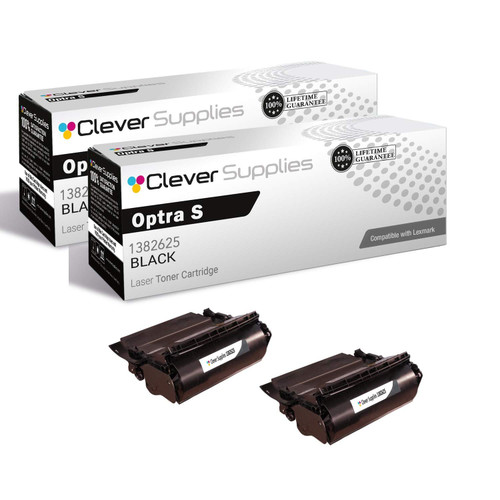
The pair leads because going deeper buys so little: the 4-pack below shaves roughly two hundredths of a cent from each page and asks for close to twice the money up front to do it. Bought as two singles, the same cartridges would cost $224.76. For an office running two of these printers the pack splits without waste — one cartridge per machine — and for a single-printer office it is the familiar arrangement: one cartridge in the machine, one in reserve against the day the first runs dry.
Shop the 1382625 2 Pack →THE OTHER TWO BOXES
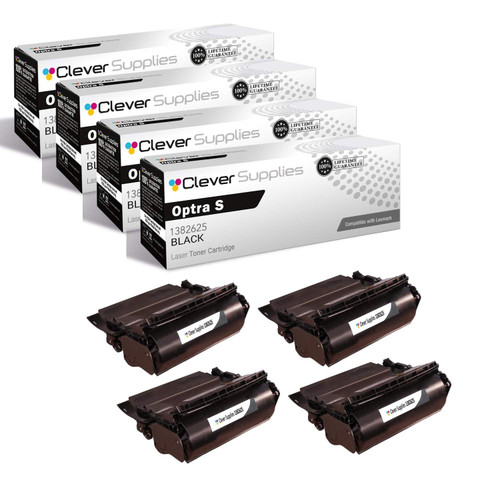
The shelf’s cheapest page inside its largest commitment — about 70,000 rated pages, enough to carry a hard-worked Optra S through years of steady printing. Four singles bought separately would total $449.52.
Shop the 1382625 4 Pack →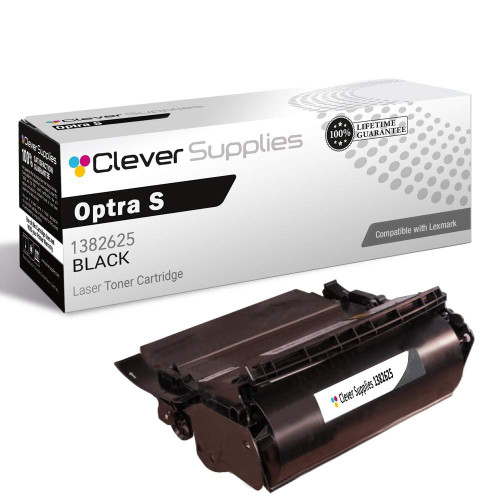
The smallest outlay on the shelf and its most expensive page — the box for a lightly used survivor of a printer, or a first cartridge before packs have earned their commitment. Even alone it carries the full high-yield rating.
Shop the 1382625 Single →Every card above serves the same nine models, so pack size is the only decision this shelf puts to a buyer. The table that follows puts a per-page price on each of the three.
Three boxes, priced by the page
Each rate divides a box’s sale price by the combined rated yield of the cartridges inside it, at the store’s 17,500-page rating. With one code on the shelf there is no tier step for the table to price; the ranking runs purely by pack size, and the last column repeats on every row because the fit line is the same nine models throughout.
| Offer | Sale price | Rated pages per box | Per-page cost | Fits |
|---|---|---|---|---|
| 1382625 4 Pack | $401.30 | 4 cartridges · ~70,000 pages | 0.57¢ | 9 models — the Optra S line |
| 1382625 2 Pack — the flagship | $208.69 | 2 cartridges · ~35,000 pages | 0.60¢ | 9 models — the Optra S line |
| 1382625 Single | $112.38 | 1 cartridge · ~17,500 pages | 0.64¢ | 9 models — the Optra S line |
The spread across the whole shelf is seven hundredths of a cent — the single at 0.64¢ against the 4-pack at 0.57¢ — and the flagship sits about two hundredths above the bottom rate. Counted per cartridge, the packs hold theirs at $104.35 inside a pair and $100.33 inside a four, against $112.38 bought singly. With the rates this close, the real grounds for choosing are cash committed today and changeovers avoided over the years these printers still have in them; no row of the table is a bad buy for any of the nine models it serves.
Fit: nine models, one cartridge, no argument
Lexmark designed the Optra S line around a single cartridge, and its North America supplies compatibility table names the same nine models for it: the Optra S 1250, Optra S 1255, Optra S 1620, Optra S 1625, Optra S 1650, Optra S 1855, Optra S 2420, Optra S 2450 and Optra S 2455 — all under the Lexmark Optra Series, on the platform Lexmark numbered machine type 4059. Every name above links to its own category page on this store, and the products are filed under all nine. The store’s fit paragraphs and printer link blocks name exactly the same nine — no model added, none dropped. In a series where fit is so often the argument, this family has none.
One relative does need separating out, because it shares the generation and part of the name. The Optra Se 3455 does not take this cartridge. It runs on its own smart-cartridge family — Lexmark’s 12A0725, 12A0825 and 12A0829 supplies — a different cartridge system entirely, and no surface on these product pages claims otherwise. An Se 3455 owner who orders from this page would be buying against Lexmark’s record; the exclusion is stated here so that mistake is not made.
One smaller gap sits inside the listings’ own answers. Their question-and-answer fit replies enumerate seven of the nine models, passing over the S 1255, S 1625 and S 2455 — even though the same pages’ fit paragraphs name all nine and the products are filed under those three models’ categories. The answers’ claim that one cartridge serves the whole line is true; the list attached to it is short. This guide follows the complete roster, as printed on every card above.
The rating: 17,500 here, 17,600 in Lexmark’s table
Every surface in the store tells the same yield story. All three listings carry 17,500 pages in their yield field, repeat it in their text, and multiply it straight into their pack totals — 35,000 pages across a 2-pack, 70,000 across a 4-pack. Lexmark’s own compatibility table rates the same cartridge at 17,600 pages. The difference is a hundred pages, about half of one percent, and it runs in the direction buyers rarely get: the store’s number is the lower one. Every rate in this guide is worked on the store’s 17,500, so the per-page figures here are, if anything, a touch pessimistic.
Both figures also carry a dating note. They are ratings at approximately five percent page coverage from the 1990s — the basis Lexmark printed in its table’s own footnote — and they predate the ISO/IEC 19752 yield standard that modern cartridges are measured against. They are comparable to each other, and to the 7,500-page rating of the platform’s standard cartridge on the same basis; they should not be set directly against a modern ISO-rated yield as if the yardsticks were the same.
Lexmark’s ladder for the Optra S — and the one rung stocked
Lexmark sold this platform’s toner in two yields, each in two programs. The standard rung, rated at about 7,500 pages, is the 1382620 sold outright and the 1382920 in the Return Program. The high-yield rung, rated at 17,600 pages in Lexmark’s table, is the stocked 1382625 — the Regular cartridge — and its Return Program twin, the 1382925. A fifth code, the 1382929, is a special-media variant of the Return Program cartridge with a built-in label fuser cleaner, made for label work rather than as a yield tier. Of the five, this shelf stocks exactly one: the Regular high-yield, in the three pack sizes carded above. Neither standard code has a listing in any configuration.
The twin deserves a sentence of its own, because a spent cartridge may carry its number. The 1382925 is the same high-yield cartridge under Lexmark’s Return Program — same platform, same rating in Lexmark’s table — and this store sells it as a shelf of its own, separate from this one. The code stocked here is the Regular twin, sold outright: the single-use, return-to-Lexmark license language Lexmark attaches to its Return Program cartridges belongs to that program and does not attach to the 1382625 or to the compatibles on this page, which are sold under this store’s own terms either way.
The label on the cartridge you are replacing settles which card is yours. A label reading 1382625 is this shelf exactly. A label reading 1382925 names the twin on its own shelf. A label reading either standard code means the machine has been running 7,500-page cartridges; the stocked cartridge is the step up from there, at about 2.3 times the rating, and it fits the same nine printers.
What a genuine cartridge costs: no figure exists to quote
There is no genuine price to set against this shelf, and this guide will not invent one. The 1382625 left Lexmark’s catalog long ago; its US store offers no checkout price for the part, and the official US price list Lexmark publishes — the Texas DIR list on lexmark.com, the document that supplied genuine figures for other families in this series — contains no entry for any of this platform’s part numbers. Numbers lifted from marketplace listings or old catalogs would not be Lexmark’s price in any sense a buyer could rely on, so none is quoted: no genuine price, no genuine per-page rate, no claim of savings against genuine, here or anywhere else in the guide.
What can be priced honestly is the shelf against itself. Ten thousand pages cost about $64 when the cartridges are bought singly, about $60 at the 2-pack’s rate and about $57 at the 4-pack’s. Stretch the comparison across a 4-pack’s whole rated life and the gap widens into real money: 70,000 pages bought one cartridge at a time come to $449.52, against $401.30 for the four-pack box. Pack against single, at today’s checkout prices — that is the comparison this family supports, and the guide makes no other.
One unit to change — and a service call every 250,000 pages
The Optra S cartridge is an all-in-one unit: the drum that forms the image rides inside the cartridge itself, alongside the toner. There is no separate photoconductor kit or imaging unit for this platform — Lexmark’s compatibility table leaves that row empty for the Optra S — so no second consumable ever has to be budgeted, stocked or timed against the toner. When a cartridge is spent, the unit that comes out is the unit that goes in, and print quality resets with it.
The platform’s only other scheduled event is a service one. At 250,000 pages the printer calls for a maintenance kit — fuser, transfer roller, charge roller and pickup rollers, fitted by a technician. It is not a shelf item, this store does not sell it, and no part number or price for it is quoted here because none could be verified; it is named only so the interval is on the record. At this cartridge’s rating, that service call sits roughly fourteen cartridges away.
A platform from before the chip era
The Optra S predates the regime modern buyers have learned to ask about. Lexmark’s 1998 user’s guide for this platform knows no cartridge chip and no firmware lock, and the word firmware appears nowhere in any of the three listings. The one chip anywhere in the 4059 family belongs to the Se 3455’s separate smart-cartridge system — not to this cartridge or this platform’s nine models. There is no lock for a cartridge to defeat and no update that can switch one off.
For completeness, the listings’ shared boilerplate does name a smart chip among the cartridge’s all-new parts; that sentence is generic text carried across the store’s catalog, and it is recorded in the closing note as found. What travels with these cartridges in practice is simpler: they are built with the latest-generation components from a supplier whose chipped products have a trouble-free record, they install and print without any chip transfer from the old cartridge, and — the honest limit, stated on every guide in this series — no promise is made here about firmware that does not yet exist. On a platform this age, that limit is theoretical: the machines predate firmware cartridge locks entirely.
What backs each cartridge
Match the box to the machine and the month
Answers for the Optra S owner
Nine models, per Lexmark: the Optra S 1250, S 1255, S 1620, S 1625, S 1650, S 1855, S 2420, S 2450 and S 2455 — the whole Optra S line, machine type 4059. Lexmark’s North America compatibility table names those nine for this cartridge, the listings’ fit paragraphs name the same nine, and the products are filed under all nine models’ categories in this store. One caution: the fit answers inside the product pages’ questions enumerate only seven of the nine, leaving out the S 1255, S 1625 and S 2455. Those three take this cartridge on Lexmark’s record and on the listings’ own fit paragraphs; the shorter list is an omission in the answers, not a restriction on the cartridge.
No. The Se 3455 shares the Optra S generation and paper path, but its supplies are a separate smart-cartridge family — Lexmark’s 12A0725, 12A0825 and 12A0829 cartridges — and the 1382625 is not documented for it in any Lexmark source. No page in this store claims the fit either: the listings’ fit text names the nine Optra S models and stops there. If your machine’s badge reads Se 3455, this page’s shelf is not your supply, whatever the family resemblance suggests.
Program, not performance. Both are Lexmark’s high-yield cartridge for the same nine Optra S models, each rated at 17,600 pages in Lexmark’s table. The 1382625 is the Regular cartridge, sold outright. The 1382925 is its Return Program twin, sold on Lexmark’s single-use, return-the-empty terms. This store stocks both, as two separate shelves: the Regular code is the one carded on this page, and the twin has listings of its own. A spent 1382925 can be replaced from either shelf, since the cartridges serve the same printers at the same rating.
In Lexmark’s catalog, yes: a standard rung rated at about 7,500 pages, sold as the 1382620 outright and as the 1382920 in the Return Program, fitting the same nine models. In this store, no — neither code has a listing in any pack size. The high-yield cartridge carded here is the only one of this platform’s codes with a listing in this store at all, which is why the choice on this page runs by pack size rather than by tier.
The store’s figure is simply the more cautious of the two. Lexmark’s compatibility table rates the genuine cartridge at 17,600 pages at approximately five percent coverage; the listings’ yield fields and texts say 17,500, unanimously, and carry that figure into their pack totals. The gap is a hundred pages — about half of one percent — and it runs in the buyer’s favor: every per-page rate in this guide is worked on the lower figure. Both numbers are pre-standard, five-percent-coverage ratings from the 1990s, not ISO/IEC 19752 yields, and they should be read on that basis.
No. On this platform the drum is part of the cartridge: the 1382625 is an all-in-one unit, and Lexmark’s compatibility table lists no photoconductor or imaging unit for the Optra S at all. The platform’s only other scheduled supply event is a technician-fitted maintenance kit at 250,000 pages — a service item, not a consumable, and not something a toner order needs to cover.
The two sets of figures begin from different prices. On the product pages, every sum is run from the list price struck through above the sale price; in this guide, every sum is run from what checkout actually charges. So the single’s page divides its $129.24 list price and reports about 0.74¢ a page, while dividing the $112.38 sale price gives 0.64¢. The 2-pack’s page saves you $18.49 on paper and $16.07 in fact; the 4-pack’s page says $55.46 where the sale prices say $48.22. Nothing in their arithmetic is wrong — it is the input that differs — and the note at the foot of this page sets each instance out in full.
Price and disclosure note: Every price in this guide is a checkout price: the sale figure on the product’s own storefront page, matched against its listing title by title on November 17, 2026 and checked live once more ahead of publication. Each listing also displays a higher list price; should a sale end, the product page is the authority. SAVE badges measure a pack against its own cartridges bought singly at those sale prices — two singles total $224.76 and four total $449.52, which is where the $16.07 and $48.22 badges come from. No genuine Lexmark price appears in this guide, for a simple reason: none could be verified. Lexmark’s US store has no checkout price for a cartridge discontinued this long, and its official US price list — the Texas DIR list on lexmark.com — has no entry for any part number in this family. With no genuine figure of record, the guide makes no genuine per-page rate and no savings-versus-genuine claim. On yield the guide uses the lower of two documented figures. The listings say 17,500 pages in their fields and their texts; Lexmark’s North America supplies compatibility table says 17,600 for the genuine cartridge. The hundred-page gap favors the buyer, and all per-page math here is worked on 17,500. Neither figure is an ISO/IEC 19752 yield — both are approximately-five-percent-coverage ratings from before that standard — and the guide does not present them as one. The standard rung’s 7,500 pages rest on Lexmark’s record alone, no listing stating them. Fit throughout follows Lexmark’s own documentation: its compatibility table and cartridge pages. Measured against that record, three departures in the store’s own pages are recorded here. The first is price basis. Every savings and per-page figure in the three listings’ questions and About text is computed from list prices: the single is put at about 0.74¢ a page from its $129.24 list price, where the $112.38 sale price gives 0.64¢; the 2-pack claims an $18.49 saving ($258.48 of singles against a $239.99 pack) and $120.00 a cartridge at about 0.69¢, where sale prices give a $16.07 saving ($224.76 against $208.69) and $104.35 a cartridge at 0.60¢; the 4-pack claims $55.46 saved ($516.96 against $461.50) and $115.38 a cartridge at about 0.66¢, where sale prices give $48.22 ($449.52 against $401.30) and $100.33 a cartridge at 0.57¢. In each instance the arithmetic itself is correct; the basis it starts from is the defect. The second departure is enumeration: the listings’ fit answers name seven models where their own fit paragraphs name nine, dropping the S 1255, S 1625 and S 2455, although the products are filed under those models’ categories. The third is the yield figure itself — the store’s 17,500 against Lexmark’s 17,600 — an understatement of a hundred pages in the buyer’s favor.
The card set above is complete: this family’s three listings are three distinct configurations with no duplicates among them, and each appears exactly once. Of the rest of Lexmark’s ladder for this platform, nothing is stocked on this shelf in any pack size — neither standard code (1382620, 1382920) nor the special-media label cartridge (1382929). The Return Program twin, 1382925, is stocked as a separate family in this store with its own listings; it is named here for orientation and is neither carded nor priced on this page. No photoconductor or imaging unit exists for this platform — the cartridge is all-in-one — and the 250,000-page maintenance kit is a technician service item for which no part number or price could be verified, so none is quoted. No ships-with or starter yield was retrieved from a Lexmark source for any model on this platform, so none is printed. On chips: no listing in this family carries a specification field for one. All three descriptions share the boilerplate line that names a smart chip among the cartridge’s all-new parts — on a platform that predates Lexmark’s cartridge-chip regime, the only chip in the machine-type family belonging to the Se 3455’s separate cartridge system. Firmware is mentioned nowhere in the family. All three SKUs are clean; there is no “2Balck” typo in this family, and no “genuine” or “authentic” product wording appears anywhere in it. Every offer on this page carries the cover its listing promises: twelve months of warranty against defects in materials and workmanship, and returns free for the whole of the first year.