




The printers on this family’s roster are departmental machines, and the decision they pose is mostly about capacity. One black cartridge serves every model, wound at two stocked yields — the 89A (CF289A) at about 5,000 pages and the 89X (CF289X) at about 10,000 — and each yield is sold here as a single, a 2-pack and a 4-pack. All six listings were on sale when this page was prepared, so every figure below is a sale figure, and the cost per page is rebuilt from the price a buyer actually pays rather than from the higher list prices the product pages use in their own arithmetic. One subject gets unusual treatment further down: chips. These six listings say nothing about them at all, and this guide reports that silence exactly as it finds it.
If the machine on your floor is one of HP’s eight — the LaserJet Enterprise M507n, M507dn, M507dng or M507x, or the MFP M528dn, M528f, Flow MFP M528c or Flow MFP M528z — the six compatibles below are its whole shelf in this store; no genuine HP 89 cartridge is stocked here. The page is led by the 89X 2-pack at $166.13, the pairing of a high-yield cartridge with its own working spare. The cheapest page on the shelf belongs to the 89X 4-pack at $316.18. The 89A range, opening at $78.14, covers machines whose monthly volume never justifies the bigger fill. Ahead: the two yields priced page by page, the sale figures set against HP’s genuine ones, the cartridge the printer shipped with, the roster model by model — and a chip section that begins from an odd fact: not one of the six product pages mentions a chip.
Lead with the high-yield pair; let volume place the rest
Fit is a settled question here — every offer runs in every roster model — so the ranking runs on throughput. Enterprise machines in shared spaces tend to eat cartridges on a rhythm their owners could set a watch by, and the high-yield pair answers that pattern: a working cartridge plus its replacement, bought in a single order. The four-box of the same cartridge follows for the hardest-worked fleets, and the standard-yield trio closes the page, sized for the M507 that prints a department’s overflow rather than its daily load.
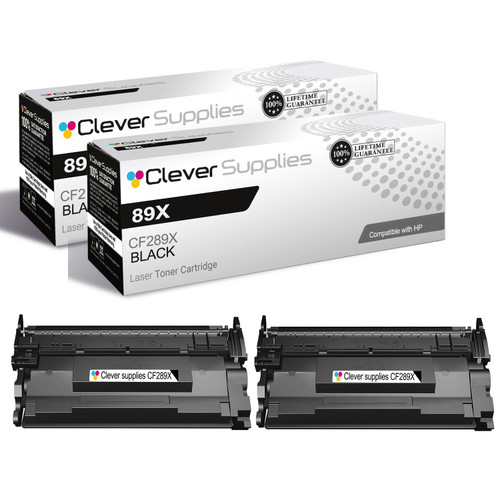
Set it against HP’s counter: two genuine 89X cartridges from HP’s own store total $631.98. This pair is priced at $166.13 for the same rated work — a difference of $465.85 on one order.
Shop the 89X 2-Pack →THE REST OF THE SHELF — DEEP STOCK FIRST, THEN THE SINGLES AND THE STANDARD LINE
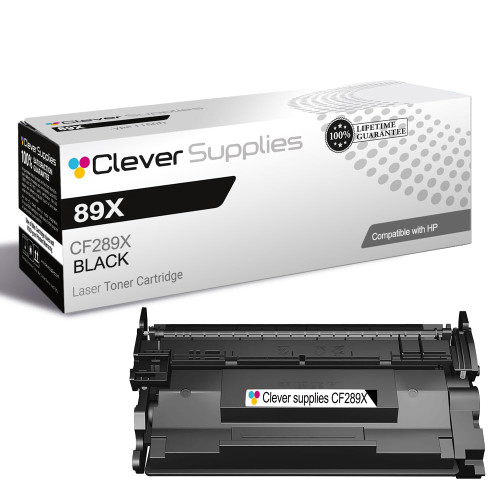
The high-yield unit bought alone, for a machine restocked as it empties. HP’s own price for this cartridge is $315.99 — and even HP’s standard-yield 89A, at $205.99, costs well over twice this one’s sale price.
Shop the 89X Single →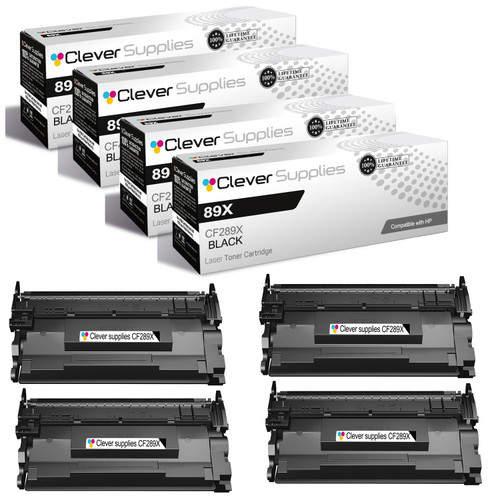
The shelf’s lowest page rate, at $79.05 a cartridge. The comparison worth pausing on: this whole box costs nineteen cents more than a single genuine 89X at HP — and carries four cartridges to its one.
Shop the 89X 4-Pack →
The shelf’s smallest outlay, sized for the Enterprise printer that idles more than it works. HP charges $205.99 for the genuine cartridge of this rating; the compatible, at its sale price, is $78.14.
Shop the 89A Single →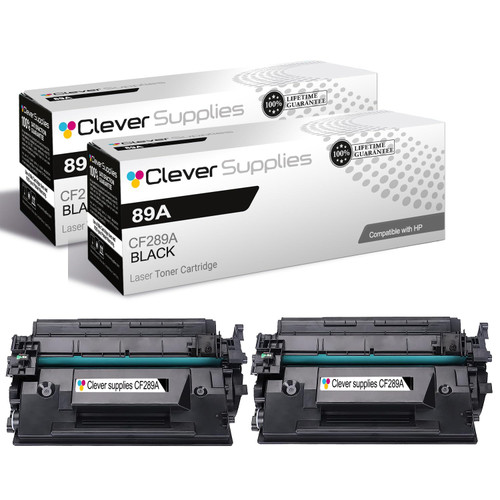
Two standard cartridges at $70.10 each. Its rated total matches a single 89X cartridge — the same pages delivered across two changes instead of one, which some stockrooms prefer; the table below prices the choice without flinching.
Shop the 89A 2-Pack →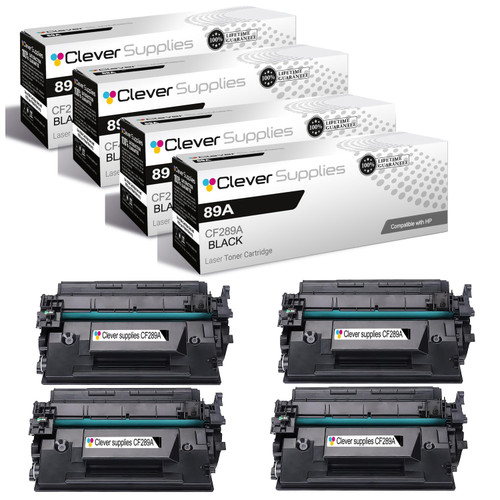
The deepest standard box: four cartridges at $66.08 apiece and the 89A line’s best page rate. It doubles the rated pages of the flagship pair, at a higher cost per page — a trade the yield section below takes apart.
Shop the 89A 4-Pack →Why do packs and singles share a shelf at all? Because Enterprise printers fail their owners in two different ways. A machine that stops mid-run wants a cartridge today, and the single is that answer. A department that plans its quarter wants the reorder already behind it, and the packs are that answer. Neither habit is wrong; the shelf keeps both shapes because real stockrooms run both.
A word on the prices themselves, because they are not the shelf’s resting figures. Every listing here is currently on sale — each sale price sits about thirteen percent under its list price — and the product pages still do their own per-page arithmetic from the list figures, which is why their cents-per-page numbers read higher than this page’s. The figures below are rebuilt from the sale prices, the ones checkout actually charges while the sale runs.
Six offers at sale prices — the table
HP rates this family under the footnote it prints across its toner range: an approximate average yield on the ISO/IEC 19752 standard, with actual yield varying by what the printed pages carry. Applied cartridge by cartridge, that is about 5,000 pages for the 89A and about 10,000 for the 89X. Pack totals in the table are additions, not new ratings — two or four cartridges’ worth of the same figure — and the per-page rates divide those totals into the sale prices, marked “blended” wherever a pack produced them.
| Offer | Fits | Sale price | Rating per cartridge | Cost per page | Against the singles |
|---|---|---|---|---|---|
| 89X 2-Pack — the flagship | All eight printers | $166.13 | Up to ~10,000 pages each | 0.83¢ blended | SAVE $16.07 |
| 89X Single | All eight printers | $91.10 | Up to ~10,000 pages | 0.91¢ | The high-yield slot, singly |
| 89X 4-Pack | All eight printers | $316.18 | Up to ~10,000 pages each | 0.79¢ blended | SAVE $48.22 |
| 89A Single | All eight printers | $78.14 | Up to ~5,000 pages | 1.56¢ | The entry point |
| 89A 2-Pack | All eight printers | $140.20 | Up to ~5,000 pages each | 1.40¢ blended | SAVE $16.08 |
| 89A 4-Pack | All eight printers | $264.33 | Up to ~5,000 pages each | 1.32¢ blended | SAVE $48.23 |
Read the table by columns and two different slopes appear. Down a single yield, pack size shaves the rate gently — 0.91¢, 0.83¢, 0.79¢ across the 89X shapes. Across the yields, the rate falls off a step instead: the most expensive way to buy an 89X page, the single at 0.91¢, still undercuts the cheapest way to buy an 89A page, the 4-pack at 1.32¢. The two lines never meet. One crossover deserves its own sentence: the 89A 2-pack and the 89X single promise the same roughly 10,000 rated pages, and they sit $49.10 apart — the pair buys two changes and a shelf spare, the single buys one long run, and the table prices both without preferring either.
Two yields on this shelf, a third that stays off it
The slot in every M507 and M528 accepts either fill without adjustment. The standard cartridge, the 89A (CF289A), is rated at about 5,000 pages. The high-yield cartridge, the 89X (CF289X), doubles that to about 10,000 in the same housing. Above them, HP’s own range adds a third step, the CF289Y at about 20,000 pages — and there the stocked range stops: no 89Y listing, genuine or compatible, is sold in this store, so the tier is named here once and given neither a card nor a price.
The step between the stocked tiers is priced gently per cartridge and steeply per page. A high-yield single costs $12.96 more than a standard single — $91.10 against $78.14 — and returns about 5,000 extra rated pages for it, which is why its page prices at 0.91¢ against 1.56¢. The 89A’s case is a volume case, not an economy case: an Enterprise printer relegated to light duty, in a satellite office or on overflow work, may take the better part of a year to spend 5,000 pages, and the standard cartridge keeps the least money parked inside the machine while it does. One structural comfort belongs to the standard line’s packs: the listings state that the warranty runs per cartridge, so a spare out of an 89A pack is still inside its cover on the day it is finally fitted.
Against HP’s genuine shelf, both tiers sit deep below. HP’s US store prices the genuine 89A at $205.99 and the genuine 89X at $315.99, so the compatible singles undercut their counterparts by $127.85 and $224.89 respectively at today’s sale prices. The starkest single figure on the page: the compatible 89X 4-pack — four cartridges, roughly 40,000 rated pages — costs $316.18, nineteen cents more than HP asks for one genuine 89X.
The cartridge in the box is a full standard measure
Enterprise printers often arrive with a shortened starter cartridge, and buyers learn to plan the first reorder around it. For this family, HP publishes the in-box figure openly, and it is not shortened: the technical details on HP’s own M507dn page state that the cartridge in the box yields 5,000 black pages on the ISO/IEC 19752 basis — the complete standard rating, identical to a retail 89A.
That has a practical consequence for the arithmetic on this page: it applies from the first cartridge, not the second. The replacement decision arrives after a full 5,000-page run — long enough for a department’s real monthly volume to show itself in the page counter, which is exactly the number the 89A-versus-89X choice should be made on.
The usual caution still applies to the figure itself: it is a rating under standard coverage and continuous printing, and a first cartridge spent partly on setup, calibration and dense early work will land short of it in impressions. What it will not be is short by design — no half-size starter is hiding in this family’s box.
On chips, this shelf is silent — so this page is precise
Read all six listings on this shelf end to end and one word never appears: chip. There is no statement that a chip is fitted, none that one must be moved over from the spent cartridge, none about firmware at all. That is a different posture from families whose listings argue their chip case at length, and this guide will not borrow their language to fill the gap. What the listings do not say, this page does not claim — in either direction.
The silence matters because the machines are not indifferent to the subject: the M507 and M528 are JetIntelligence-era printers, and HP builds anti-fraud and dynamic-security technology into this generation. Owners who want the family’s chip position tracked properly — which cartridges, which firmware, what has been reported — will find the CF289 family covered on our HP monochrome toner chip compatibility page, which follows the subject across the monochrome range and is kept for exactly this question.
What stands behind a purchase here, in the listings’ own terms, is cover rather than a chip statement: every cartridge carries a 1-year warranty — running per cartridge, so pack spares stay covered — and 1-year free returns. If a cartridge is rejected by the printer or fails early, the route the listings name is that warranty-and-returns process, with support staffed Monday to Friday, 9 AM to 5 PM Central. That is the whole of the offer on this point, stated at its true size.
Eight Enterprise models, one black cartridge
HP’s device list for the CF289X names eight models, and the six listings fit all eight at either yield. Two groups divide the list — four print-only M507 models and four M528 multifunctions — and the differences live in the machines: trays, finishing, scan and fax hardware. They never live in the cartridge, which is one shared unit across the eight. The store also files the six listings under the M507 series and M528 series categories, alongside the model pages below.
The print-only four: LaserJet Enterprise M507n, LaserJet Enterprise M507dn, LaserJet Enterprise M507dng and LaserJet Enterprise M507x.
The multifunction four: LaserJet Enterprise MFP M528dn, LaserJet Enterprise MFP M528f, LaserJet Enterprise Flow MFP M528c and LaserJet Enterprise Flow MFP M528z.
One roster note, made plainly: the listings’ own fit lists name seven of the eight models. The eighth, the M507dng, stands on HP’s device list for this family and is carried in the roster above on HP’s authority. Arrive by whichever name is on your machine — a model page, a series page, or the code on the spent cartridge — and the same six offers are waiting.
The terms behind every listing
Five checks before ordering for a departmental machine
Questions this family draws
About 5,000 extra rated pages in the same slot. Priced as singles, the high-yield cartridge costs $91.10 against the standard’s $78.14, and the premium works out at 0.91¢ a page against 1.56¢. A shared departmental machine burns through that difference quickly, and keeps burning it on every cartridge after. A lightly used M507 may take most of a year to spend even the standard fill — for that machine the 89A’s smaller outlay is the sensible buy, because per-page economy only pays out on pages that actually get printed.
Because it covers the two states a working printer cycles through: a cartridge in the machine and its replacement already in the building. It carries the high-yield rating, trims the per-cartridge price to $83.07, and puts roughly 20,000 rated pages under one order at $166.13. The 89X 4-pack takes the page rate lower still — 0.79¢ against 0.83¢ — and suits fleets that reorder by the quarter, but it asks $316.18 today. The pair is the balance; the deep box is the commitment.
It should inform you, which is a different thing. The six listings make no chip statement at all — nothing fitted, nothing to transfer, nothing promised about firmware — and this guide repeats that silence rather than papering over it. These are JetIntelligence-era machines with HP anti-fraud technology, so the subject is a live one for this family, and the store tracks the CF289 position on its HP monochrome chip compatibility page. What the listings do commit to is the remedy: a 1-year warranty and 1-year free returns on every cartridge, if one fails or is rejected.
Because the two sets of arithmetic start from different prices. The listings work their cents-per-page figures from the list prices — $89.86 for the 89A single, for instance — while every listing is currently on sale, and this guide rebuilds the same division from the sale prices checkout charges: $78.14 for that single, which is where its 1.56¢ comes from. If the sale ends, the listings’ figures become the live ones again; the product page’s price is the one that governs, as the note below sets out.
The listings answer with process, not workarounds: the cartridge goes through the 1-year warranty, and 1-year free returns stand behind it, with support available Monday to Friday, 9 AM to 5 PM Central. In the packs the warranty runs per cartridge, so a fault in the second unit is covered on the same terms months after the first was fitted. Keep the box until the opening pages have printed cleanly — it is the one piece of housekeeping the listings’ cover quietly assumes.