




Some toner families make you weigh standard against high-yield; this one never does. HP designed its compact LaserJet Pro line of 2010 around a single cartridge, the CE285A, rated at 1,600 pages, and never issued a second size — so the only question on this shelf is depth: the same cartridge sold one, two, three, four, five, eight and ten at a time, the cost of a page falling at every step. Three shadows hang over an otherwise plain shelf: a four-pack wearing a second, grander label, a single cartridge listed under four storefronts at once, and a switched-off listing for an oversized “85X” cartridge HP never made. All prices quoted here are sale prices.
Skip the tier debate — there is one cartridge here, so buy by the stack. A lone cartridge runs 1.454¢ a page; pairing it drops the rate to 0.951¢, and each deeper box trims it further until the ten-pack bottoms out at 0.549¢. HP still sells the genuine article from its US store at $104.99, shown in stock, which produces this family’s strangest comparison: the deepest compatible box on the page costs $17.09 less than a single genuine cartridge. Two cautions before the cards. First, no higher-yield version of this cartridge exists, whatever one switched-off listing claims — the panel beside the flagship card takes that claim apart. Second, the single cartridge appears under four different storefronts at the same price; the card below follows the original listing, its three copies accounted for in prose underneath the grid.
Ten cartridges deep — the rung where the page rate stops falling
Ten 1,600-page cartridges pool 16,000 rated pages for $87.90 — 0.549¢ a page, against 1.454¢ for the cartridge bought alone. Ten singles rung up one at a time come to $232.60, so the carton keeps $144.70 of that. And set against the genuine shelf the box looks almost mispriced: HP’s store asks $104.99 for one CE285A, which is $17.09 more than all ten of these. Beside the card sits the listing this family would rather you never meet — the bigger cartridge that was never built.
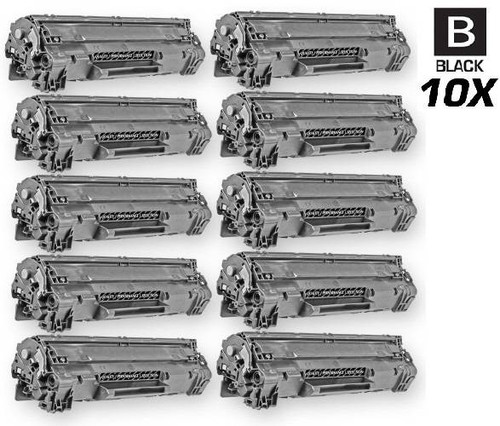
This is the supply-closet box: for an office where these little LaserJets sit on several desks, or one machine that prints all day, every day. Ten swaps’ worth of toner lands in one delivery, and at this depth the page rate has nowhere left to fall — every shallower box pays more for the identical cartridge.
Shop the 85A 10-Pack →Nothing is lost by the tier’s absence: the honest route to a lower page rate here is a deeper box of the real cartridge — what the card beside this panel sells.
Six shallower stacks of the same cartridge
Nothing changes inside the box as the count falls — it is the CE285A at every depth, 1,600 rated pages a unit. What changes is the rate: 0.575¢ a page at eight, 0.650¢ at five, 0.700¢ at four, 0.784¢ at three, 0.951¢ at two, and 1.454¢ for the cartridge on its own. Two listings below carry footnotes: the four-pack also exists under a second label, and the single under three further storefronts. Both are set out in the panels beneath the grid.
THE REMAINING BOXES
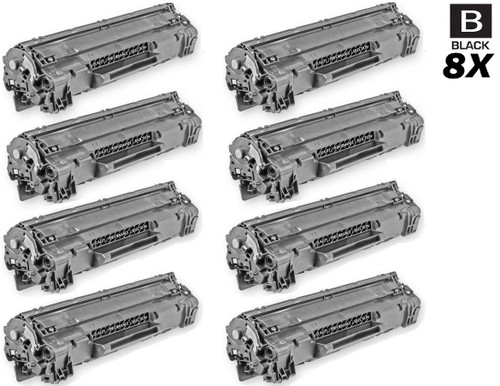
One step down from the flagship, for a workplace running several of these printers but not a fleet. Eight singles bought apart reach $186.08, so the box trims $112.54, and its rate sits within three hundredths of a cent of the ten-pack’s floor — nearly all the depth benefit for $14.36 less outlay.
Shop the 85A 8-Pack →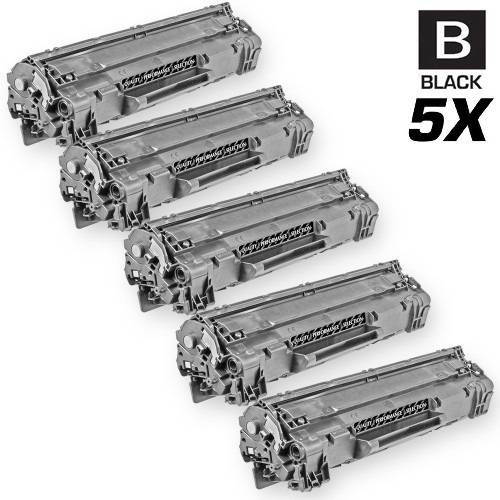
The middle of the ladder, and the natural size for one hard-working desk printer: 8,000 pooled rated pages is a long stretch between orders. Five singles at sale total $116.30, so the pack keeps $64.31, and each cartridge inside lands at $10.40 against the single’s $23.26.
Shop the 85A 5-Pack →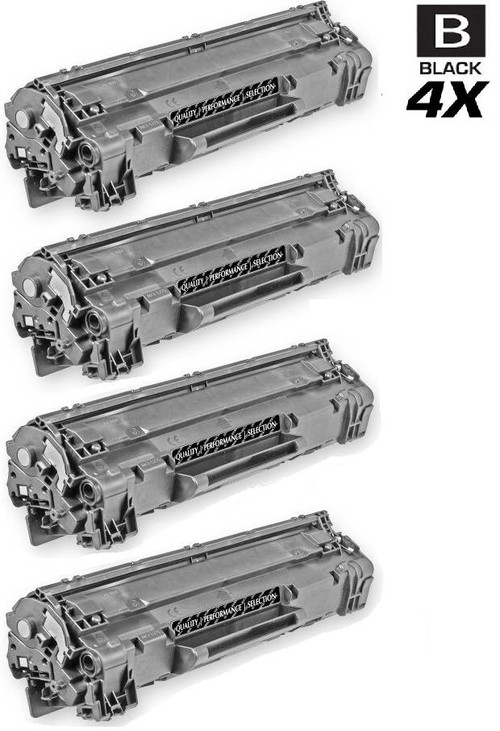
A half-year’s cushion for a single steady machine, at a rate less than half the lone cartridge’s. Four singles come to $93.04, so the box holds on to $48.23. One caution rides with this card: the same four-pack is also sold under a “Premium Quality” label at the identical price — the panel below explains why this plainer listing carries the card.
Shop the 85A 4-Pack →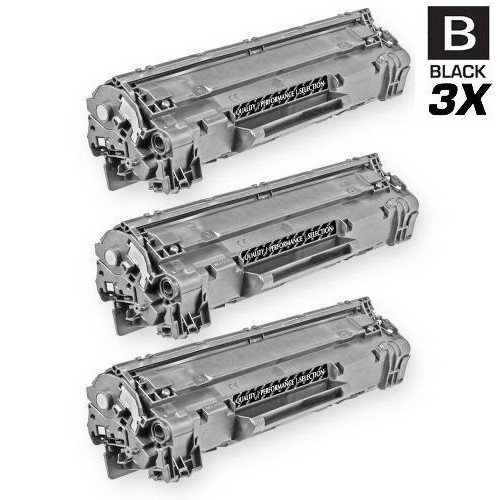
Three sealed cartridges, one in the machine and two behind it. Three singles total $69.78 at sale, so the pack trims $32.16. This listing carries the family’s most useful sentence: asked whether its box holds one oversized cartridge, it replies, “There is no oversized unit in this family” — the truth the invented-tier listing denies.
Shop the 85A 3-Pack →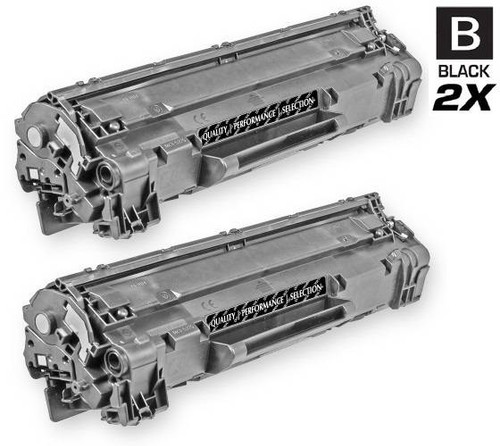
The smallest step off the single: one cartridge working, one waiting, and the page rate already down by a third. Two singles bought apart come to $46.52, so the pair keeps $16.08. It is also the shape HP chose for its genuine shelf, where the same cartridge is bundled two at a time as the CE285AD.
Shop the 85A 2-Pack →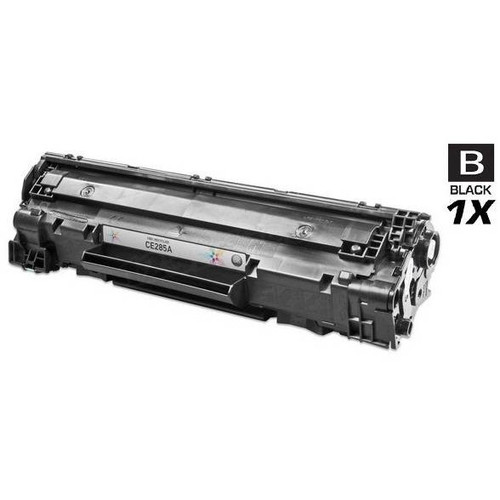
The cartridge by itself, and the benchmark every badge on this page is measured against: the lowest sum here and the steepest page rate. It fits a quiet home machine, a backup printer, or a first order placed to judge output before committing deeper. This is the original of the family’s four single listings — its three namesakes are handled in the second panel below.
Shop the 85A Single →Whichever of the four pages a search lands on, the cartridge and price are the same; the card above follows the original listing, and the copies are described here rather than linked.
Eight rows, one cartridge — the genuine price leads the table
Because HP still stocks the genuine cartridge, its current price stands at the head of the table rather than in a footnote. Below it, the seven compatible configurations in depth order. The invented tier’s claimed figures earn no row — a cartridge that does not exist has no place in a price table.
| Configuration | Price | Rated pages | Cost / page | Printer fit |
|---|---|---|---|---|
| Genuine HP 85A (CE285A) — HP US store, in stock | $104.99 | 1 cartridge · 1,600 pages | 6.562¢ | All 18 models |
| 85A 10-Pack — the flagship | $87.90 | 10 cartridges · ~16,000 pages | 0.549¢ pooled | All 18 models |
| 85A 8-Pack | $73.54 | 8 cartridges · ~12,800 pages | 0.575¢ pooled | All 18 models |
| 85A 5-Pack | $51.99 | 5 cartridges · ~8,000 pages | 0.650¢ pooled | All 18 models |
| 85A 4-Pack | $44.81 | 4 cartridges · ~6,400 pages | 0.700¢ pooled | All 18 models |
| 85A 3-Pack | $37.62 | 3 cartridges · ~4,800 pages | 0.784¢ pooled | All 18 models |
| 85A 2-Pack | $30.44 | 2 cartridges · ~3,200 pages | 0.951¢ pooled | All 18 models |
| 85A Single | $23.26 | 1 cartridge · 1,600 pages | 1.454¢ | All 18 models |
Read downward and the pattern never wavers: every step toward a shallower box raises the cost of a page, because the cartridge itself never changes. Read the first two rows against each other and the family’s oddity appears — the genuine row is the most expensive line on the table while delivering the fewest cartridges on it, a single unit priced $17.09 above the ten-cartridge flagship.
Eighteen compact LaserJets — and a fit record with nothing to correct
HP’s series documentation assigns the CE285A to eighteen machines: the P1100, P1102 and P1102w; the M1130, M1132, M1134, M1136, M1137, M1138 and M1139; and the M1210, M1212nf, M1212f, M1213nf, M1214nfh, M1216nfh, M1217nfw and M1219nf. Every card on this page fits every one of the eighteen. The store gathers the family under its HP CE285A category.
The fit claims in this family deserve a clean bill, and this guide gives it. All thirteen descriptions were read against the neighboring platforms third-party sellers routinely attach to this cartridge — the earlier P1005 and P1505 generations, the CE278A and CB435A families — and not one names a printer outside the roster above. Where these listings fall short is the opposite direction: the main group’s shared compatibility line manages three model names and an “etc.” against an eighteen-model roster, and its question-and-answer fit lists name subsets of seven or fewer. The roster in the paragraph above is the complete one.
One cross-brand fact belongs in this section because the newer listings state it accurately: the CE285A is the same cartridge Canon sells as its Cartridge 125, rated at the same 1,600 pages, serving Canon’s imageCLASS MF3010 line and the LBP6000 and LBP6030w. Owners of both brands’ machines are buying one cartridge under two names. This guide’s cards stay with the HP listings; the three duplicate singles described earlier each link out to a Canon 125 two-pack elsewhere in this store, a piece of catalog structure recorded in the closing note rather than followed here.
Naming the cartridge in your printer is a ten-second job: the unit that lifts out of any roster machine is stamped CE285A, with 85A as the short name for the same thing. A stamp reading anything longer — an X suffix, say — is not something a genuine cartridge from this platform will ever show you.
A single rating, repeated thirteen times without wandering
Yield discipline is this family’s quiet strength. HP’s supplies datasheet declares 1,600 pages for the CE285A under ISO/IEC 19752, and every genuine-tier listing repeats that figure exactly — no listing inflates it, trims it, or splits it between a specification field and its prose. The pooled totals in the table are simply that rating multiplied by the cartridges sealed in each box, and every per-page figure in this guide is a sale price divided by the same arithmetic.
In desk terms, 1,600 rated pages is a little over three reams per cartridge. Real output still leans on coverage — a month of dense reports spends a rating faster than a month of short letters — but since one rating governs the whole shelf, box comparisons stay honest at any coverage: the deeper box wins by the same proportion on heavy pages as on light ones.
The family’s lone departure from its own rating sits in the switched-off listing beside the flagship card, claiming 2,600 pages for a cartridge HP never issued. Against thirteen descriptions in agreement, that claim stands where this guide leaves it — labeled, unlinked, and out of the table.
The drum question none of the listings think to answer
Search all thirteen descriptions for the word “drum” and the search comes back empty — the listings never raise the subject. HP’s own store copy answers it instead, describing the CE285A’s all-in-one cartridge design: the toner supply and the imaging drum live in a single sealed unit and are renewed together at every swap. No drum unit exists for these series under a separate part number, so no card on this page needs a companion purchase — the cartridge price is the platform’s whole consumable cost.
Installation follows from that design. Each cartridge leaves the shelf with the latest-generation chip already installed — the current, trouble-free chipped supply this store carries across its compatible range — so the whole fitting procedure is to seat the unit, close the cover and print, with the printer reading its toner level as it would a genuine cartridge’s. Nothing has to be pried off the spent unit and carried over. The assurance behind that covers the firmware these printers run today; firmware that has not been written yet is beyond any seller’s honest guarantee.
One set of terms, worded the same way on all thirteen pages
Terms are where this family behaves itself. Every listing — the seven carded here, the labeled and duplicated copies, even the switched-off one — states the same cover in its own answers: a one-year warranty and one year of free returns. No features list anywhere reaches for a grander word, so the tiles below can be read without a footnote.
Choosing a depth, by how the printer earns its living
With the cartridge itself a constant, the choice reduces to how many swaps you want to buy at once:
Questions from P1100, M1130 and M1210 series owners
No — and this is the answer this guide most needs on the record. HP issued exactly one cartridge for this platform, the CE285A at 1,600 pages, and its datasheet lists nothing above it. A listing in this catalog nevertheless describes a “CE285X Maximum Yield” cartridge at 2,600 pages, written as though HP stood behind it, and even advises reading the CE285X code off the empty you remove — a stamp no cartridge from this platform has ever borne. That listing is switched off and cannot be ordered. The genuine three-pack’s own answer settles it: “There is no oversized unit in this family.” Depth, not a bigger cartridge, is how this platform lowers its page rate.
Because the single was listed four times. Three of the pages carry the name “Compatible HP 85A (CE285A) Toner Cartridge Black” word for word and the same $23.26 price as the original listing; two of their addresses differ only by the -1 and -2 endings the store appends to reused names. The cartridge behind all four pages is the same, so this guide cards the original and describes the copies in prose. The copies carry one extra wrinkle of their own: their introductions call this standard cartridge “high-yield capacity,” while their own later paragraphs correctly call it standard-yield.
Physically, yes. The CE285A and Canon’s Cartridge 125 are the same cartridge sold under two brands’ names, each rated at 1,600 pages; Canon’s version serves its imageCLASS MF3010 line and the LBP6000 and LBP6030w. The newer HP listings state that equivalence themselves, and on this point they are right. The cards on this page are the HP listings; nothing here links out to the Canon shelf.
Nothing the record can measure. The labeled listing prices identically to the plain one — $44.81 at sale — reads the same stock figure of 411, and sits in the same set of catalog categories. Where other families’ labeled copies concede the sameness outright, this one instead calls itself “the Premium Quality line’s way of buying it four at a time,” which is branding, not a difference in the box. The plain four-pack holds the card on this page.
No. This platform’s cartridge is an all-in-one unit in HP’s own description — toner and imaging drum sealed together and replaced in the same swap — and no separate drum exists for these printers under any part number. The product pages never tell you this: the word “drum” appears in none of the thirteen descriptions, so the answer comes from HP’s copy rather than the listings’.
Because the descriptions quote the list price while this guide quotes the sale price — the amount actually charged. The single’s own description prices it at $26.75, its list figure, where the register takes $23.26; the same pattern runs through every box size, and the sale figure appears in no description at all. Every price and per-page rate here is worked from sale, which is why the guide’s numbers sit below the ones on the product pages.
Price and disclosure note: Every price on this page is a sale price, taken from the carded listings on November 18, 2026; where a product page shows a different figure today, the product page governs. Sale is used throughout because sale is what a buyer actually pays. The descriptions work from list instead — $26.75 (single, at each of its four storefronts), $35.01 (two-pack), $43.26 (three-pack), $51.53 (four-pack, under both of its labels), $59.79 (five-pack), $84.57 (eight-pack), $101.09 (ten-pack) — and the sale figure is quoted in no description at all; the eight-pack’s description even colors its prose with the list-derived phrase “a $26 cartridge.” Badges are struck sale against sale, like against like: two singles at $46.52 against the two-pack’s $30.44; three at $69.78 against $37.62; four at $93.04 against $44.81; five at $116.30 against $51.99; eight at $186.08 against $73.54; ten at $232.60 against $87.90. The genuine price is HP’s own US store figure, read the same day with the cartridge shown in stock: $104.99 for the CE285A. The yield is HP’s declared rating under ISO/IEC 19752 — 1,600 pages — and fit follows HP’s published roster: LaserJet P1100, P1102, P1102w, M1130, M1132, M1134, M1136, M1137, M1138, M1139, M1210, M1212nf, M1212f, M1213nf, M1214nfh, M1216nfh, M1217nfw, M1219nf. The catalog’s own errors follow, one by one.
(1) An invented tier written as genuine HP identity: the switched-off “CE285X / 85X Maximum Yield” listing claims 2,600 pages for a cartridge no HP source contains, calls it “the highest-capacity cartridge this bay accepts,” and instructs buyers to read the CE285X code “stamped on the empty you pull out” — a stamp no genuine cartridge carries, so the instruction can never be followed. It has never sold, and the genuine three-pack’s answer states the truth it denies: “There is no oversized unit in this family.” (2) List-price arithmetic in all thirteen descriptions, as itemized above; the sale price appears in none of them. (3) Four storefronts for one single: three carry the identical product name, two of their addresses differ only by -1 and -2 suffixes, and the stock figure of 1,651 is read by five listings. (4) The Premium four-pack’s separate-line branding: identical price block, stock figure and category set to the plain four-pack, yet framed as a distinct “Premium Quality line” with none of the sameness concession other families’ labeled copies make. (5) Markup debris in the ten older-template descriptions: each carries a broken “<p> />” fragment in its boilerplate; the three newer descriptions are clean. (6) Fit under-naming in the main group: the shared compatibility line names three models and an “etc.” against HP’s eighteen-model roster, and the fit answers name subsets of seven or fewer. (7) A filing split: the three newer singles are absent from the family category and hang partly under the color LaserJet branch of the tree; both series pages above the family — monochrome and color alike — answer with server errors in the live store, and neither is linked from this page. (8) A “high-yield capacity” mislabel in the three duplicate singles’ introductions, contradicted by their own cross-reference paragraphs, which call the cartridge standard-yield. (9) Canon cross-links inside HP listings: each of the three duplicate singles carries a cross-reference section linking to a Canon 125 two-pack product in this store; the equivalence itself is accurate — the structure is what is recorded. (10) Weight fields that invert the shelf: the single is recorded at 3 while every pack from two to ten is recorded at 2, so on paper the ten-pack weighs less than the single and all pack sizes weigh the same. (11) Stock figures that repeat across storefronts: 1,651 read by five listings, 549 read by two — the genuine three-pack shares its pool with the switched-off invented-tier listing — and 411 read by two. What was searched for and not found is recorded too: no fit over-claim — every description was compared against the neighboring platforms third-party sellers routinely attach to this cartridge, and none names a printer outside the roster; no yield drift in the genuine tier; no “Lifetime” warranty boilerplate anywhere in the family; no false drum claim, the listings’ failing there being silence rather than error; no leaked production or prompt text; and no cross-link from any carded description into the family’s one excluded listing.
The buyable shelf is carried by seven cards, one per distinct configuration of the one genuine cartridge; five further listings — the four-pack’s labeled copy, the single’s three identical-name copies and the switched-off invented-tier listing — are handled in prose, never presented as separate offers. Beneath them sit the terms the listings state for themselves — a year’s warranty, a year of free returns, weekday support from 9 AM to 5 PM Central, and dispatch from warehouses in Illinois, Pennsylvania, Georgia and California.