




Everything due at once: take the four-color set at $318.82 — not because it undercuts anything (it costs more than its contents bought one by one, and the sums are shown below rather than waved past) but because it is the shelf’s only complete restock and the only box that contains a black cartridge. A single color gone: take that color’s single — $102.80 for cyan, $58.65 for yellow, $53.33 for magenta. Black gone while the colors still hold pages: there is no honest single to point to, because the black listing is switched off, so black comes back only as part of the set. Every price in this guide is a sale price read from the product’s own page; the listings themselves argue from list prices, higher figures checkout never charges, and none of their totals are repeated here.
One box, four bays, no discount
A flagship set usually earns its position with a badge — priced below its own contents, the saving printed next to the price. This set holds its position on different grounds, and its card carries no badge, because the sums run the other way. Added together at the sale prices used throughout this page, the four cartridges inside total $256.00 as singles; the set is priced at $318.82, which is $62.82 more, not less. Even that comparison is generous to the singles route, since one of the four cannot be bought at all: the black single’s listing is switched off. What the set actually sells is completeness — every bay renewed in a single order — together with the only black cartridge this family currently offers in any form.
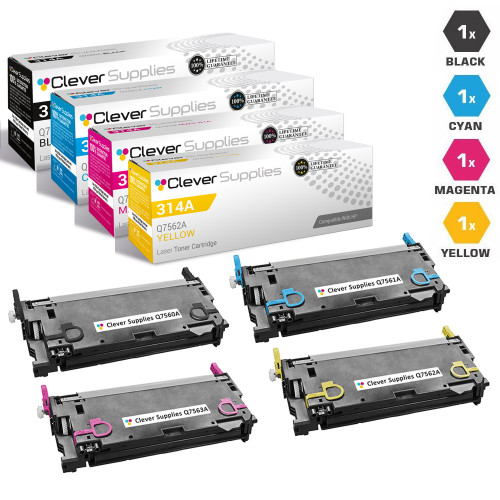
Inside sit the family’s four cartridges in HP’s order: Q7560A black, Q7561A cyan, Q7562A yellow, Q7563A magenta. (The listing’s own name scrambles the last two codes; the contents do not follow the name.) On this platform each cartridge is an all-in-one unit, toner and imaging drum in a single housing, and each is chipped with the supplier’s current generation before it is boxed — so fitting one is a straight swap, the old cartridge lifted out and its replacement seated, with no component carried across from the spent unit. A second listing offers this identical set under a “Premium Quality” name at the identical $318.82; its own text concedes the two are the same product, which is why the set is carded once, here.
Three colors, three very different prices
Bought one bay at a time, the colors are equals in rating and strangers in price. Each declares about 3,500 pages; each fits the same six models. But cyan is priced at $102.80 where yellow is $58.65 and magenta $53.33 — cyan runs close to double its siblings for the identical declared capacity, and nothing in HP’s documents explains the gap. Magenta, the least expensive of the three, is also the cheapest buyable printing in the family at 1.524¢ a page. Mind the code order while ordering: HP’s sequence runs cyan, yellow, magenta against Q7561A, Q7562A and Q7563A, so the 2-code is the yellow and the 3-code the magenta — whatever order a listing’s title happens to print them in.
THE COLOR SINGLES — ONE BAY AT A TIME
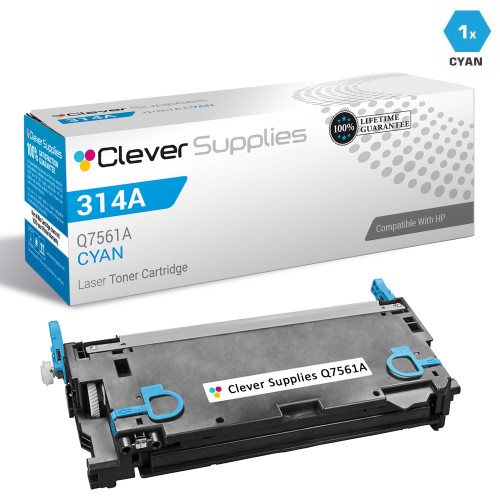
Pale blue headers and washed-out charts are cyan’s signature when it runs dry. This single renews the bay alone — at the family’s steepest per-page rate, nearly twice what magenta charges for the same rating.
Shop the 314A Cyan →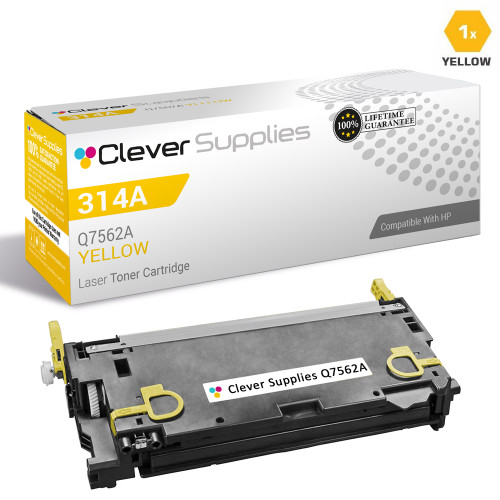
Yellow gives out quietly — greens drift toward blue and warm tones turn dirty long before the printer raises a warning. Q7562A is the code to match against the cartridge coming out.
Shop the 314A Yellow →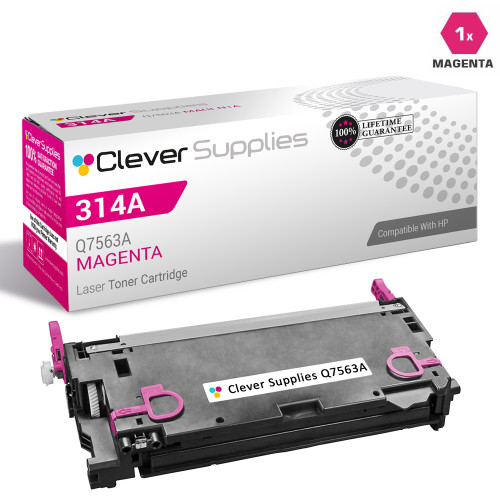
Reds sliding toward orange-brown point at this bay. The magenta single is the family’s least expensive cartridge outright, and per rated page the cheapest one here that can actually be ordered.
Shop the 314A Magenta →Four buyable boxes, one honest table
One method runs through every row: the sale price from the product’s own page, divided by its rated pages. The set’s figure is marked pooled, since its pages are spread across four bays. A fifth row is missing on purpose — the black single — and the notes beneath the table explain why its numbers survive only as a record. Cheapest buyable rate first:
| Configuration | Sale price | Rated pages | Cost per page | Printer fit |
|---|---|---|---|---|
| 314A Magenta Single | $53.33 | 1 cartridge · ~3,500 pages | 1.524¢ | All 6 models |
| 314A Yellow Single | $58.65 | 1 cartridge · ~3,500 pages | 1.676¢ | All 6 models |
| 314A 4-Color Set — the flagship | $318.82 | 4 cartridges · ~17,000 pages | 1.875¢ pooled | All 6 models |
| 314A Cyan Single | $102.80 | 1 cartridge · ~3,500 pages | 2.937¢ | All 6 models |
The set’s row needs its context read aloud. The three colors, bought as singles, total $214.78. The set asks $104.04 beyond that figure, and what the extra purchases is specific: a black cartridge rated at 6,500 pages, plus one order in place of three. Whether that is worth paying depends entirely on how much life the installed black has left — with a healthy black in the machine, the singles route is the honest one; with black near empty, the set is the only route there is. The absent row belongs to the black single: its switched-off listing priced it at $41.22, which would have made it the family’s cheapest printing at 0.634¢ a page. Would have is the operative phrase — those pages cannot currently be ordered on their own at any price.
For scale, a full-color page draws the three color rates together — roughly 6.14¢ of color at the coverage the ratings assume, with black riding on top from inside the set. Ordinary office output covers a page far more lightly than the ratings’ test basis assumes, so treat the figure as the ratings’ ceiling, not as a prediction. And no genuine row can be added beside these: all four codes have been delisted from HP’s US store, so no original-equipment price survives to compare against.
Six models share the whole family
HP assigns the 314A row to two series standing side by side. On one side the Color LaserJet 2700 and 2700n; on the other, the 3000, 3000n, 3000dn and 3000dtn. All six accept all four cartridges — no model is fenced off from the black or from any color — and the catalog gathers the family on its own shelf, the HP 314A category.
The store’s filing is more complete than its sentences. Every listing sits under every one of the six model categories, so arriving from any single machine’s page surfaces the whole shelf at once. The descriptions’ own fit lines are ragged by comparison: the sets’ intro leaves out the plain 3000, the sets’ fit answer names only the 3000 series and drops the 2700 pair the same listings claim elsewhere, and the singles manage to print “3000” twice inside a single line. The categories have the roster right; the prose has it untidy. The roster printed above is HP’s, and it is the one this guide follows.
The boundary runs at the series edge. The 3600 line and the 3800/CP3505 machines that neighbor these printers in HP’s catalog take entirely different cartridge rows, and no 314A cartridge fits them — nor do theirs fit anything here. Within the family there are no further fences: a set can be split across two machines on the roster, and cartridges can be fitted one bay at a time as each empties.
Two ratings, and the basis beneath them
HP declares about 6,500 pages for the black cartridge and about 3,500 for each color. The basis for both figures is five percent average page coverage — the measure HP used for this generation of machines, published before ISO/IEC 19798 standardized yield reporting — and it is stated here once, because every number on this page leans on it. Five percent is a lightly covered page. A color brochure covers several times that area and will drain a color cartridge in a fraction of its rated span; text documents carrying color accents can carry one considerably further. Spec field, listing prose and HP’s own documents agree on both ratings for every code, which is not true of every family in this catalog, and every division in this guide runs on those figures exactly as declared.
Pooled, a complete renewal puts back about 17,000 rated pages of capacity — 6,500 of black and 10,500 divided among the colors. The pooled total is an accounting convenience, nothing more: each bay still spends only its own pages, and black, which every printed page draws on, runs down on its own timetable in a working office. Read the totals as a restock measure, and the single-cartridge ratings as the numbers that govern an individual bay.
The drum rides inside — and the chips arrive fitted
On this platform the listings happen to be right about the hardware. Each 314A cartridge is an all-in-one unit, its imaging drum built into the same housing as the toner supply, and HP lists no separate drum part for the 2700 or 3000 series. A cartridge change therefore renews drum and toner together, and no second supply needs budgeting or tracking alongside. That is a property of this platform specifically — neighboring families in this catalog are built the other way — so it is stated plainly here rather than assumed, and it should not be carried across to other machines.
The chip side of the cartridge needs no work from the buyer. These units leave the supplier with its latest chip generation already in place — the same policy the store applies across its compatible range, and one its selling record backs up: no chip complaint has come back on a cartridge sold under it. Seat the cartridge and the printer reads it as it should, toner levels included; nothing has to be pried off the cartridge you are discarding. One honest limit belongs in the same paragraph: the assurance describes the cartridges as they ship today and the record they carry. Firmware that HP has not yet written cannot be promised against — by this store or by anyone — and this page does not pretend otherwise.
Warranty, returns and support
The same four terms stand behind all four products on this page — the set and the three singles alike — so they are gathered once, here.
Choosing by what is actually empty
Questions from 2700 and 3000 series owners
Not today. A black single exists in the catalog — Q7560A, carrying a price of $41.22 — but its listing is switched off: invisible on the storefront, unavailable to order, its page answering “Not Found”. The only black 314A cartridge that can be ordered rides inside the four-color set. Should the listing be switched back on, that changes; as this page is written, it has not been.
Because it is priced that way. The four singles total $256.00 at sale prices; the set is $318.82. Bundle pricing usually runs the other direction, and this page will not dress the gap up as a saving — there is no SAVE badge on the set because there is no saving to badge. What the premium buys is the black cartridge, which cannot be bought separately at all, and a single order in place of four.
No. The store lists the same set twice, and the second listing’s own answers concede that the cartridges, the ratings and the price are identical, and that the name adds no premium to any of it. This page cards the set once, under its standard listing, and records the duplicate in the disclosure below rather than presenting it as a choice.
Q7562A. HP’s order runs black, cyan, yellow, magenta against the codes Q7560A through Q7563A, so the 2-code is yellow and the 3-code, Q7563A, is magenta. The set listings’ own names print the codes out of that order — magenta ahead of yellow — which is exactly why the check matters: believe the code on the cartridge you remove, not the sequence in a title.
No. HP made this row in a single tier — about 6,500 pages for black, 3,500 for each color — and no X row stands behind it in HP’s data or on this shelf. The decision in this family is never which capacity to step up to; it is which bays need renewing, and by which route.
Yes — here, they do. The drum is built into every 314A cartridge’s housing, and HP publishes no separate drum part for either the 2700 or the 3000 series. A cartridge change is therefore the complete renewal, toner and drum together, and nothing else wears out on a schedule you need to track.
Twelve months of warranty and twelve months of free returns, both running from the day the cartridge is delivered and both on the terms the product’s own page sets out. Questions go to staffed support on weekdays, 9 AM to 5 PM Central, and deliveries leave from the store’s warehouses in Illinois, Pennsylvania, Georgia and California.
Price and disclosure note: Every price printed above was taken from the sale figure on that product’s own page on November 18, 2026, and was re-read there for this guide; should a price change afterwards, the product page is the authority. The choice of sale over list is deliberate. In their own text the listings argue from list prices — $366.64 for the set, $57.71 for the black single, $118.22 for cyan, $67.45 for yellow, $61.33 for magenta — figures higher than anything checkout asks, and their per-page claims are derived from those amounts. No SAVE badge appears anywhere on this page, for a reason worth stating plainly: the family’s only set costs more than its contents, so there is no saving to badge. Yield figures are the ones HP declares — roughly 6,500 pages for black, 3,500 per color — repeated without deviation by the listings in field and prose alike; where a total spans cartridges, it is marked pooled. No genuine price is quoted because HP’s US store has delisted all four codes and no such figure exists to quote. Compatibility follows HP’s published roster: 2700, 2700n, 3000, 3000n, 3000dn and 3000dtn. What follows is the catalog’s own untidiness, itemized.
First, the missing black: the family’s only black single is invisible and unavailable, its storefront page returning “Not Found”, while its description goes on quoting prices and per-page figures for a product nobody can order; in this family a black cartridge can be bought only inside a set. Second, the set is listed twice — a “Premium Quality” twin stands beside the standard listing with every figure identical, its own text conceding there is no difference and no premium in the price, and the same stock counted on both listings. Third, the list-price habit runs through everything, as noted above, down to a per-unit average for the set computed on the list figure. Fourth, cyan is priced far from its siblings — $102.80 against $58.65 and $53.33 at the identical 3,500-page rating — at both the list and sale levels. Fifth, the bundle is priced above its parts at both levels: $366.64 against $343.71 in list terms, $318.82 against $256.00 at sale. Sixth, the listings’ fit prose under-names the roster: the sets’ intro omits the plain 3000, the sets’ fit answer names only the 3000 series and leaves out the 2700 pair its own intro claims, and the singles print “3000” twice in a single line — while every listing is in fact filed under every model category. Seventh, the catalog carries a visible category for a “3000tn” model that HP’s own series documentation does not include among the 3000 series; this page neither links that category nor treats the model as part of the roster. Eighth, both sets’ names and part-number fields print the codes out of order, magenta before yellow; the color assignments themselves are stated correctly everywhere they matter. Two absences deserve recording as non-defects: no description in the family carries leaked production or prompt text, and the drum claims the descriptions make are, on this platform, accurate — the cartridges really are self-contained units, and HP publishes no separate drum for them.
What the four cards amount to is the shelf a buyer can actually use: four orderable products, each presented a single time, while the duplicated set and the darkened black listing are handled in words instead of being dressed up as further choices. The roster ends where HP ends it — six models, two series — and every rating printed is HP’s declared figure, unadjusted in either direction. On chips, this page’s position and its limit travel together: cartridges ship with the current chip generation fitted and the record behind them is clean to date, but firmware that does not yet exist cannot be warranted against, and is not. Behind everything stand the terms the family’s product pages themselves carry — twelve months of warranty, twelve months of free returns, support staffed on weekdays from 9 AM to 5 PM Central, and shipping from warehouses in Illinois, Pennsylvania, Georgia and California.