




HP’s LaserJet Enterprise 700 M712 printers and M725 multifunctions drink from one black cartridge family wound at two depths — the 14A (CF214A) at about 10,000 pages and the 14X (CF214X) at about 17,500 — which this store sells in eleven configurations. The family’s first fact is an absence: there is no fit fence here. Every printer on the roster takes both cartridges, so the standard-versus-high-yield decision is a page-cost decision and nothing more; nobody can order the wrong cartridge for their machine. All eleven boxes below carry the sale figure checkout actually charges, and deals plainly with the shelf’s three blemishes — a high-yield 2-pack priced above two high-yield singles, an invented “14XX” label that HP never issued, and listing fit lines that name printers HP never made while leaving out one it did.
Whichever badge your machine wears — an M712dn, its M712n and M712xh siblings, or any of the M725 multifunctions — both cartridges on this page fit it, so the only question is how much printing you want to buy at once. This page leads with the 14X single at $58.89: for $9.33 more than the standard single it carries about 7,500 extra rated pages and cuts the per-page rate from 0.50¢ to 0.34¢. A single leads, unusually, because the family’s 2-pack currently costs more than two singles bought separately — the anomaly is priced out in the open further down. Nothing on this shelf is a genuine HP cartridge — every offer is a Clever Supplies compatible — so where HP’s prices show up further down, they show up marked as HP’s own, as a yardstick. And one ladder note before the shelf: the 4-pack exists only in the standard tier — the high-yield line runs 1, 2, 3, 5, 10.
The whole shelf: two cartridges, eleven boxes
Twenty-six listings carry this family’s codes; strip out the re-listings and eleven configurations remain — the standard cartridge in six pack sizes, the high-yield in five. Eleven listings are duplicates (six of them the high-yield single wearing six different printer names), each priced exactly like the card that stands for it, and none is carded or linked twice. Badges, where a pack wears one, are sale-price arithmetic: the pack’s price subtracted from the cost of its cartridges bought singly in the same tier. One pack here wears none, and its card explains itself. Order on the page: flagship first, the remaining high-yield boxes, then the standard line end to end.
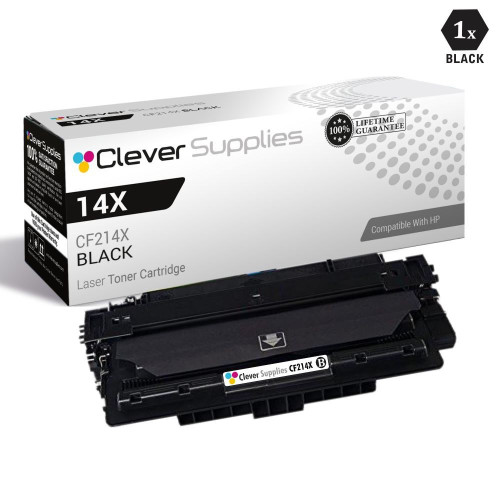
HP’s own shelf gives the comparison: the genuine CF214X sits in HP’s US store at $342.99, which puts this single $284.10 under its counterpart at an identical rating. A single leads this shelf for a reason stated once and plainly: the high-yield 2-pack below is priced at $120.59, while two of these singles total $117.78 — the pair box currently charges $2.81 for the privilege of arriving in one carton. Until that ordering reverses, the single is the tier’s honest front door, and buyers who want a spare should buy two of them.
Shop the 14X Single →THE REMAINING HIGH-YIELD BOXES — EVERY ONE FITS ALL SEVEN MODELS
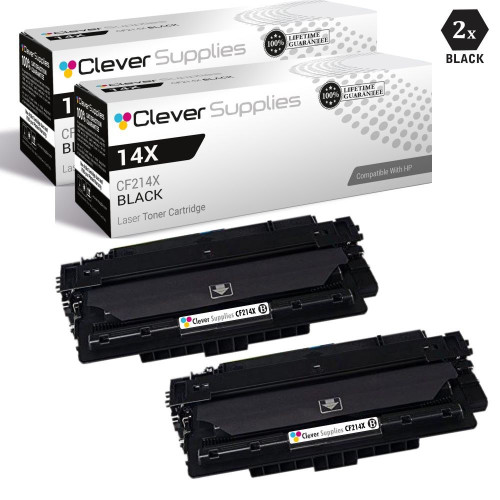
The pair that breaks the pattern, carded because the configuration is real — and carrying no SAVE badge because there is no saving: at $60.30 a cartridge it costs $2.81 more than two flagship singles. Buy the singles.
Shop the 14X 2-Pack →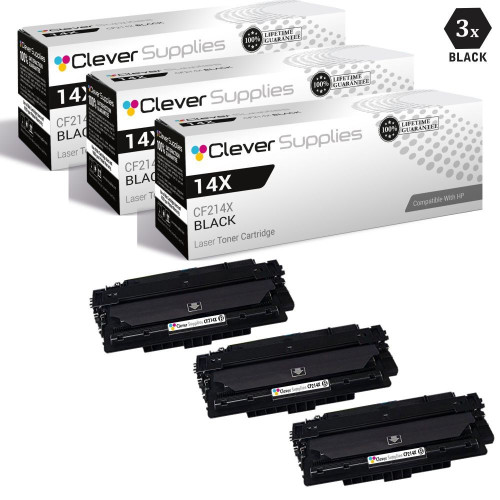
Cartridges at $57.62 apiece. The first high-yield pack that genuinely undercuts its singles — modestly, by $3.82. Three cartridges: one for the machine, two for the shelf behind it.
Shop the 14X 3-Pack →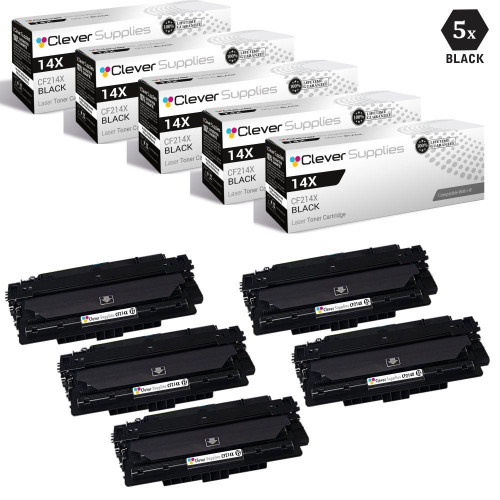
Cartridges at $55.47 apiece. About 87,500 rated pages — a half-year shelf for a busy M725 floor, in one order and at a rate the standard tier never reaches.
Shop the 14X 5-Pack →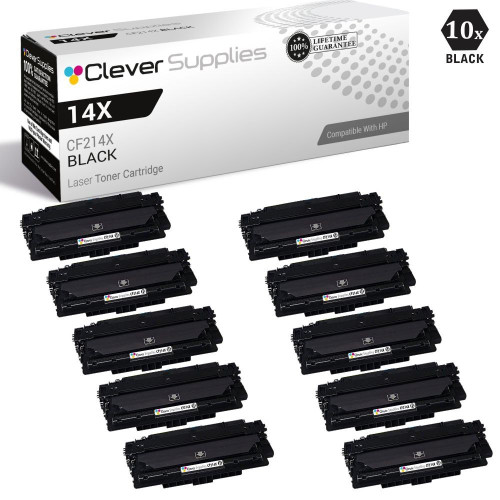
The shelf’s cheapest page, at $53.87 a cartridge. The comparison worth pausing on: ten of these cost $147.33 less than HP charges for two genuine CF214X singles.
Shop the 14X 10-Pack →THE STANDARD LINE — THE FULL LADDER, INCLUDING THE 4-PACK THE HIGH-YIELD LINE SKIPS
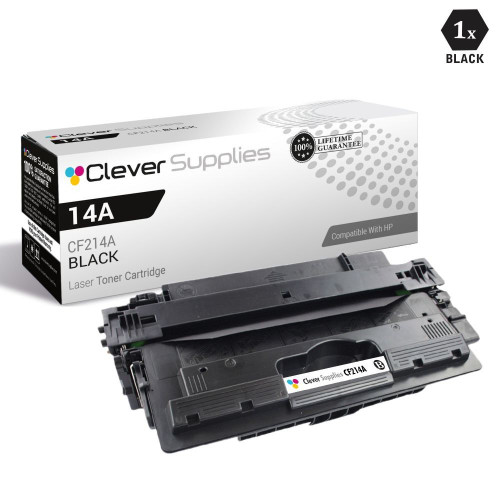
The family’s entry point — the same fill the printer itself arrives with. HP prices the genuine CF214A at $310.99, so this single runs $261.43 under its counterpart.
Shop the 14A Single →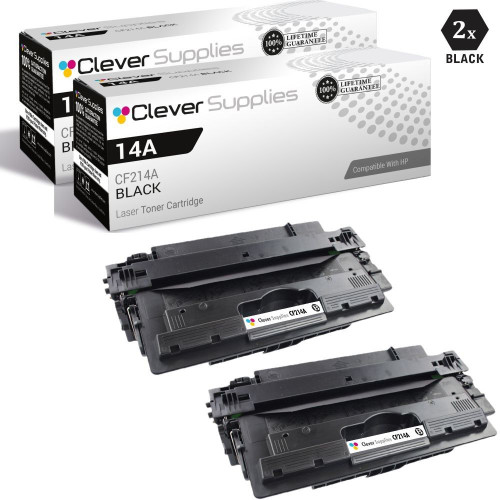
Cartridges at $41.52 apiece — this tier’s pair behaves the way a pair should, unlike its high-yield counterpart above. One printing, one in reserve.
Shop the 14A 2-Pack →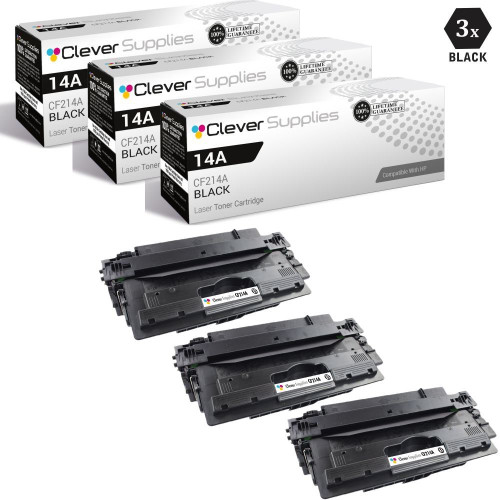
Cartridges at $38.84 apiece — about 30,000 pages of standard cartridges, a quarter’s cover for a department that would rather reorder by the calendar than by the warning light.
Shop the 14A 3-Pack →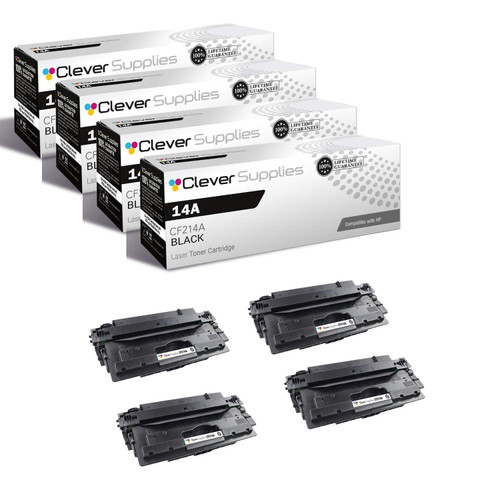
The rung only this tier has — there is no 14X 4-pack to set beside it. Cartridges at $37.50 apiece, and about 40,000 rated pages in the box.
Shop the 14A 4-Pack →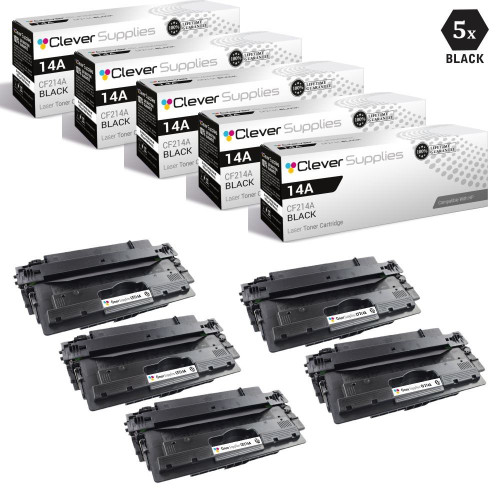
Cartridges at $36.70 apiece. Fifty thousand standard pages in one carton — the A tier’s deep box, for a fleet that has standardized on the A tier.
Shop the 14A 5-Pack →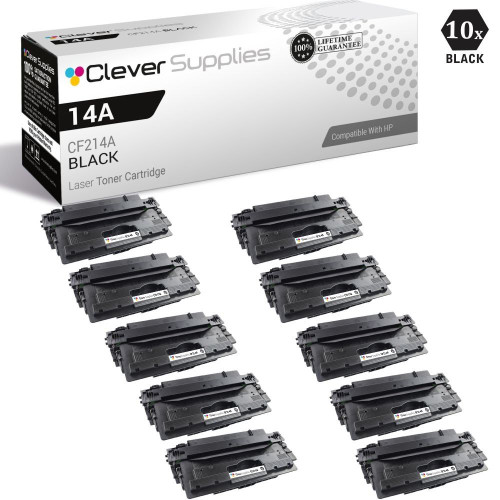
The standard line’s floor, at $35.09 a cartridge. Ten compatibles cost $39.91 more than HP charges for one genuine CF214A — ten cartridges, near enough, for the price of one.
Shop the 14A 10-Pack →One shelf name is missing from the cards on purpose. Two listings carry a “14XX Maximum Yield” label claiming yields of up to 21,000 pages. HP sells no CF214XX — its highest declared rating on this platform is the 14X’s 17,500 — and the two listings are priced exactly as the high-yield single and 3-pack, because what either box holds is the CF214X those cards sell. The name gets this one mention and nothing else — no card, no table row. Meet it on a product page and treat it as what it is: the 14X, to be priced against the 14X cards above.
Every box, priced by the page
Each row divides what the box costs by the rated pages inside it. Rows run from the cheapest page to the dearest, and the fit column is a formality — it reads the same on all eleven, because both cartridges fit every model. The table’s whole argument is the price of a page, and one row argues it backwards.
| Pack | Sale price | Pages the box is rated for | Per-page rate | Fits |
|---|---|---|---|---|
| 14X 10-Pack | $538.65 | 10 cartridges · ~175,000 pages | 0.31¢ | All 7 models |
| 14X 5-Pack | $277.37 | 5 cartridges · ~87,500 pages | 0.32¢ | All 7 models |
| 14X 3-Pack | $172.85 | 3 cartridges · ~52,500 pages | 0.33¢ | All 7 models |
| 14X Single — the flagship | $58.89 | 1 cartridge · ~17,500 pages | 0.34¢ | All 7 models |
| 14X 2-Pack | $120.59 | 2 cartridges · ~35,000 pages | 0.34¢ | All 7 models |
| 14A 10-Pack | $350.90 | 10 cartridges · ~100,000 pages | 0.35¢ | All 7 models |
| 14A 5-Pack | $183.49 | 5 cartridges · ~50,000 pages | 0.37¢ | All 7 models |
| 14A 4-Pack | $150.01 | 4 cartridges · ~40,000 pages | 0.38¢ | All 7 models |
| 14A 3-Pack | $116.53 | 3 cartridges · ~30,000 pages | 0.39¢ | All 7 models |
| 14A 2-Pack | $83.04 | 2 cartridges · ~20,000 pages | 0.42¢ | All 7 models |
| 14A Single | $49.56 | 1 cartridge · ~10,000 pages | 0.50¢ | All 7 models |
Read the two 0.34¢ rows closely, because the rounding hides the family’s one backwards step. The flagship single’s exact rate is 0.337¢; the 2-pack’s is 0.345¢ — the pair is the dearer way to buy the same page, and it is also the dearer way to buy the cartridge, at $120.59 against $117.78 for two singles. Every other row behaves: within each tier the rate falls as the box deepens, and across the tiers the step is clean — the dearest high-yield page in the table still undercuts the cheapest standard page, the 14A 10-pack’s 0.35¢. Settle the tier first, then the box size; and in the high-yield tier, settle the box size with the single’s price in hand.
Fit: both cartridges, all seven models
HP’s specification pages close the compatibility question in one line per printer: every model on this platform names both cartridges as its replacements — the 14A at about 10,000 pages and the 14X at about 17,500. The roster is seven machines. The printers are the LaserJet Enterprise 700 M712n, M712dn and M712xh; the multifunctions are the MFP M725dn, M725f, M725z and M725z+. Each name above links to that model’s category page in this store, and the family’s own page is filed under HP CF214A. HP’s page for the genuine CF214X additionally names the LaserJet Managed MFP M725zm, a managed-contract variant; the same cartridges serve it on HP’s record, but this store keeps no category for it, so it is named here without a link.
The store’s own fit lines do not all match that roster, and the corrections matter because they invent machines and lose a real one. One shared spec line in the older listings describes the family as covering an “M712 M715 and M725” series — HP has never made a LaserJet Enterprise M715. The newer listings’ printer lines name an “M725X MFP” that does not exist, and omit the M725f, which does — a model those same listings are sold for. The roster above follows HP’s record rather than either template: seven models, no M715, no M725X, and the M725f in its place. A buyer who checks fit against a listing’s printer line can be told about printers that were never built; a buyer who checks it here gets the platform as HP built it.
The practical consequence is the simplest stocking rule in this series. One shelf of cartridges serves printers and multifunctions indifferently — a spare pulled for an M712dn fits the M725z that runs dry the same afternoon — and the tier choice can be made for the fleet as a whole, on volume, rather than machine by machine. Platforms with fences force two stock lines and a fit check at every order; this one asks only how many pages the building prints.
The yield numbers need no referee — with HP’s prices alongside
Unusually for this series, yield is the quiet subject: both sides publish the same page. The listings give 10,000 pages for the standard cartridge and 17,500 for the high-yield in their feature lines and texts, and multiply them faithfully into pack totals — 52,500 for the high-yield 3-pack, 175,000 for its 10-pack. HP declares the same two figures for the CF214A and CF214X, each an approximate average in accordance with ISO/IEC 19752. So every rate in this guide divides by 10,000 and 17,500 with nothing to reconcile. Two housekeeping notes belong with that: no listing in this family carries a structured yield field at all — the figures live in description prose only — and the one number that does not survive is the 21,000 pages claimed for the “14XX” listings, a rating HP has never issued for any cartridge on this platform.
HP’s genuine shelf stands across from it, with prices pulled from HP’s US store and flagged as HP’s at every quotation: the genuine CF214A at $310.99, which works out to 3.11¢ a page at its rating, and the genuine CF214X at $342.99, or 1.96¢. HP sells no genuine multipack for this platform — no dual pack exists — so where a pack is compared with HP at all, the comparison runs against that many genuine singles and says so. The gaps are wide. Against genuine prices, the standard single saves $261.43, the high-yield single saves $284.10, the high-yield 2-pack saves $565.39 against two genuine high-yield singles, and the high-yield 10-pack costs $147.33 less than two genuine singles while carrying five times their pages.
One warning about price bases covers the family, and it accounts for any product-page number that disagrees with the ones here: About and FAQ prose keeps its books at list, while every configuration on this shelf currently sells under list, and this guide counts nothing but checkout figures. The high-yield single’s text, for instance, prices the cartridge at $82.45; the 0.34¢ rate in the table above comes out of the $58.89 checkout actually charges. If a promotion lapses, trust the product page’s own figure; the closing note records the whole basis.
No separate drum — and the box starts with a full cartridge
No second imaging consumable exists on this platform. The CF214A and CF214X are all-in-one cartridges — toner and imaging drum in a single unit — so drum wear is priced into the cartridge and its rating, and every change starts print quality over. HP’s genuine supply list for these machines holds exactly two numbers, CF214A and CF214X, both of them toner; no separate drum is sold for the M712 or M725. The store’s own prose agrees, in the standard single’s words: “There is no separate drum to buy for these printers, so this single cartridge is the complete consumable change.” The fuser kit belongs to the printer’s service schedule and turns over far more slowly than any cartridge; toner orders are never timed against it, and it is not sold here.
What the printer arrives with deserves its own sentence, because this platform does not do the cut-down starter. HP’s specification pages put a black cartridge of about 10,000 pages in the box across the roster — a full standard fill, the 14A’s own rating — so the first replacement decision arrives only after a complete standard run — a genuine stretch of the department’s real printing, already counted, on which to base the tier step. The 14X never rides in the box: HP’s datasheet footnote reserves it as a separate purchase, in so many words, “The HP LaserJet CF214X black toner cartridge is not included; please purchase separately.” A buyer whose first cartridge lasted months has already run the experiment that tells them whether the standard tier is enough.
Chips: the newer listings say it, the older ones say nothing
Ask the listings about chips and the answer depends on which template wrote the page. The newer batch’s boilerplate describes cartridges built wholly from new components — OPC drums, wiper blades and, among them, a smart chip. The older batch says nothing on the subject at all: not the singles, not the 3-packs, not the standard 4-pack. Firmware and dynamic security are mentioned by no listing in the family, in either batch. That uneven record is reported exactly as it stands; a buyer who reads only an older listing’s page will find the chip question neither raised nor answered there.
What covers the whole shelf is the store’s standing position for its compatibles, and it is worth stating at full strength: the supplier fits a current-generation chip in every cartridge; installation is plug-and-play; and the chip in the spent cartridge leaves with it — there is nothing to transplant. The boundary this series always observes applies unchanged: nothing here promises anything about firmware HP has not yet released. The cover behind the claim follows in the next section, stated as the listings state it.
The cover behind every cartridge
Choosing by the work the machine does
Answers for the M712 and M725 owner
Either fits. There is no tier fence on this platform: HP’s specification pages name both the CF214A and the CF214X as the replacement cartridges for every one of the seven models, from the M712n to the M725z+. Choose on volume: the 14X carries about 17,500 rated pages against the 14A’s 10,000, and costs less per page at every comparable size.
Because in this family the pair box is the dearer way to buy the pair. The high-yield 2-pack is priced at $120.59, while two 14X singles total $117.78 — the 2-pack charges $2.81 more for the same two cartridges, and its exact per-page rate is worse than the single’s. A flagship slot should hold the configuration a buyer is best served by, so the single leads, the 2-pack keeps its card with no SAVE badge, and the anomaly is printed rather than smoothed over.
No such cartridge exists in HP’s catalog. The highest rating HP declares anywhere on this platform is the 14X’s 17,500 pages; a “14XX” tier appears in no HP document. What the two listings wearing that name actually sell is the high-yield cartridge itself — their prices are the X single’s and X 3-pack’s to the cent — and one of them uses its own FAQ to steer buyers toward “the full code CF214XX,” a code that cannot be matched because it was never issued. The name is noted once in this guide’s shelf section, given no card, and its contents are priced throughout against the 14X cards above.
No. The pack ladders are not mirror images: the standard tier runs 1, 2, 3, 4, 5 and 10, while the high-yield tier runs 1, 2, 3, 5 and 10. The only 4-pack on the shelf is the 14A 4-pack at $150.01. A buyer who wants four high-yield cartridges buys the 3-pack and a single, or steps to the 5-pack — there is no fourth high-yield rung to find.
Never. Toner and imaging drum are built into the same unit on this platform, so a cartridge change renews both at once and there is no drum part number to order, ever. HP’s supply list for the M712 and M725 contains two entries — CF214A and CF214X — and both are the toner cartridge itself. The fuser kit a service engineer replaces on a long cycle is a printer part, not a supply, and this store does not sell it.
A full one. HP’s specification pages put a black cartridge with a rating of about 10,000 pages in the box across this roster — the standard cartridge’s complete fill rather than a cut-down starter. The first replacement therefore gets decided after a full standard run, not a brief honeymoon. The 14X is never the unit in the box; HP’s datasheet reserves it as a separate purchase, in so many words. Let that first cartridge’s page count make the tier argument: a machine that emptied it inside a quarter is a high-yield machine, and one that took a year over it has made the standard case just as plainly for itself.
Price and disclosure note: What this guide charges you with is the sale figure in every case — each one read live from the store’s catalog and confirmed on the listing’s own storefront page, title-matched, on November 17, 2026. A higher list price hangs over every sale price; when a promotion ends, go by the figure on the product page. SAVE badges are sale-basis arithmetic from end to end: what a pack saves is what its cartridges would cost bought singly in its tier, minus the pack’s price. Standard line: the 2-pack’s $16.08 badge is $99.12 of singles less its price; the 3-pack’s $32.15 is $148.68 less; the 4-pack’s $48.23 is $198.24 less; the 5-pack’s $64.31 is $247.80 less; the 10-pack’s $144.70 is $495.60 less. High-yield line: $3.82 against $176.67 of singles for the 3-pack, $17.08 against $294.45 for the 5-pack, $50.25 against $588.90 for the 10-pack. The high-yield 2-pack carries no badge: two singles total $117.78 and the pack charges $120.59, $2.81 more for the same two cartridges — the anomaly is stated on its card and in the table rather than badged away. HP’s figures come from HP’s US store, were checked the same day, and are flagged as HP’s at every appearance — CF214A at $310.99, CF214X at $342.99. No genuine multipack exists for this platform, so every genuine pack comparison in this guide runs against that many genuine singles, labeled as such. On yields there was nothing to arbitrate: listing prose and HP’s own declarations, each under ISO/IEC 19752, settle on about 10,000 pages for the CF214A and about 17,500 for the CF214X — and no listing in this family carries a structured yield field, the numbers living in prose alone. Pack totals add their cartridges’ ratings together; per-page rates divide price by that sum. Fit is taken from HP’s specification pages and cartridge pages for the platform. Against that record, the store’s own surfaces depart from it in five recorded respects.
First, price basis. Family-wide, About and FAQ prose does its sums at list: the high-yield single’s text prices it at $82.45 where checkout charges $58.89; the standard 3-pack’s at $134.01 against $116.53; the standard 4-pack’s at $172.51 against $150.01. Every figure in this guide is a checkout figure instead. Second, fit lines: the older batch’s shared spec line reads “Compatible with: HP LaserJet LaserJet Enterprise M712 M715 and M725 printer series” — a doubled “LaserJet” and an M715 series HP has never made — while the newer batch’s printer lines name an “M725X MFP” that does not exist and omit the real M725f from their prose and their category filing alike. The phantom names also live in the store’s category tree, in visible M715 categories and an M725X category, and the two batches are filed under them; this guide links none of those categories and follows HP’s seven-model roster. Third, the six printer-named high-yield single listings carry boilerplate that merges the printer’s model into the cartridge’s code — “CF2M725DN MFP”, “CF2M725Z MFP”, “CF2M725Z+-MFP”, “CF2M712DN”, “CF2M712N” and “CF2M712XH”, five occurrences per listing — where the family’s generic listings render the same passage correctly. Fourth, filing: the standard 4-pack’s category set runs one branch through COLOR LASERJET SERIES, though the cartridge is black-only and its machines are monochrome; and the family category, “HP CF214A”, holds only the older batch — the eleven newer listings are not filed in it at all. Fifth, the two “14XX” listings wear an invented code in name and SKU, claim 21,000 pages per cartridge, and are priced exactly as the high-yield single and 3-pack are; one of them instructs buyers in its FAQ to “Match the full code CF214XX — the double-X maximum-yield black for the Enterprise 700 M712dn and the M725 MFP family.” Neither is carded or linked. A smaller legacy artifact rides along: the older batch’s high-yield boilerplate calls the cartridge a “Printhead” — inkjet vocabulary on a laser cartridge.
Eleven cards stand above, one for each unique configuration of the two genuine tiers. What remains on the shelf is re-listings — eleven of them, among them six printer-named versions of the high-yield single, second generic listings of both singles, pack twins and a “Premium Quality” standard 3-pack — each priced exactly like the configuration carded to stand for it, and not one of them carded or linked a second time. Chip wording divides by batch, as the chip section records: newer boilerplate names a smart chip among all-new components; the older batch and the standard 4-pack say nothing; firmware is mentioned nowhere. The position stated in the chip section is the store’s standing one for its supplier, bounded by the usual limit on future firmware. The in-box figure is HP’s, from its specification pages for the platform. Every offer carries the cover its own listing states — a year of warranty, a year of free returns, support between 9 AM and 5 PM Central on weekdays, and with stock warehoused in Illinois, Pennsylvania, Georgia and California.