




This is the top rung of its ladder. Brother builds two ink tiers for the three standard-cassette Business Smart printers named below, and LC3019 is the upper one — the Super High-yield tier, where the black cartridge is rated up to 3,000 pages and every color up to 1,500. Does capacity on that scale repay a higher price per cartridge? And how do you steer around the neighboring Tank shelf, whose cartridges publish the identical yield figures on ink that will never fit these machines? Both questions are answered head-on below: all six offers priced per page, the cheaper tier underneath weighed fairly, and the one display message a compatible cartridge can leave behind named in advance.
If your printer is the MFC-J5330DW, MFC-J6530DW or MFC-J6930DW, everything priced below fits it: six listings in all, every one of them compatible, each cartridge fitted with a new compatible chip — and no genuine LC3019 anywhere in this store. The Set of 4 at $44.94 is the refill this page leads with; the Set of 9 at $87.62 is the deep stock-up and the family’s only free-shipping ticket on its own. Two judgments shape the rest of the page: against the LC3017 tier underneath, this tier costs more per cartridge and less per page — both halves get their numbers — and against the INKvestment Tank line next door, the yield figures match exactly while the cartridges do not.
Six offers at the top tier: the full refill, the deep box, four singles
Because a single roster covers the family, the ladder is sorted by how much printing an order puts in the drawer. The Set of 4 opens it — one cartridge per slot at the tier’s full ratings. The Set of 9 follows for owners who would rather stock deep once than reorder often; the four singles close the ladder, answering whichever slot runs dry first.
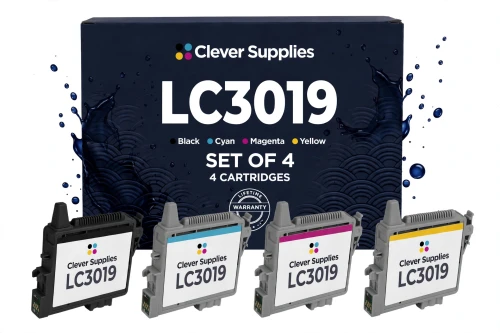
Against Brother’s own counter the spread widens: Brother prices its genuine black single at $63.49 and its genuine color 3-pack at $99.29, so filling these four slots with genuine ink totals $162.78 — and no genuine four-pack exists to soften that figure. This box fills the same slots at the same published ratings for $44.94. It sits below the $49 free-shipping line by itself; in this family, free freight begins with the deep box below.
Shop the LC3019 Set of 4 →THE REST OF THE LADDER — THE DEEP BOX, THEN THE SINGLES
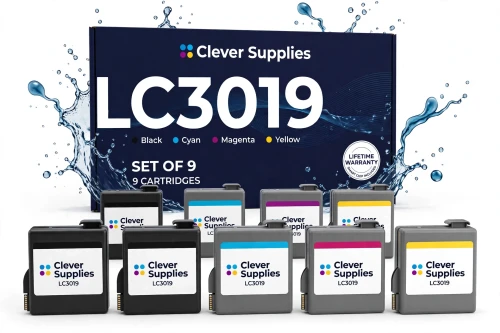
At $9.74 a cartridge this is the family’s lowest unit price; the mix leans black because black is what these printers spend, and the box ships free standing alone.
Shop the LC3019 Set of 9 →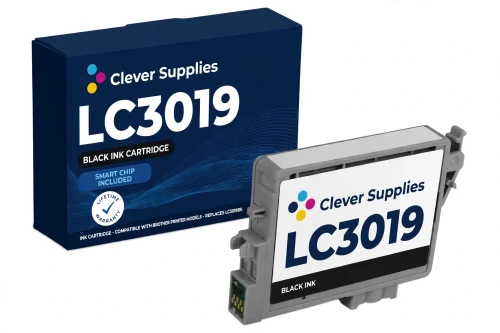
The cheapest page in the family, in the slot that does the document work. A rating of up to 3,000 pages stretches the gap between changes to months; Brother’s genuine version of this cartridge is $63.49.
Shop LC3019BK Black →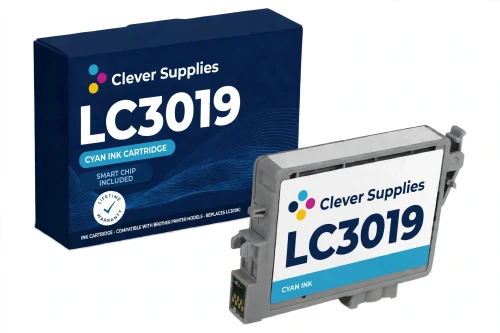
Cyan carries the blues in charts, letterheads and links, and usually asks for replacement first among the colors. The shelf price matches the tier below’s cyan exactly — what changes is the rating behind it, 1,500 pages against 550.
Shop LC3019 Cyan →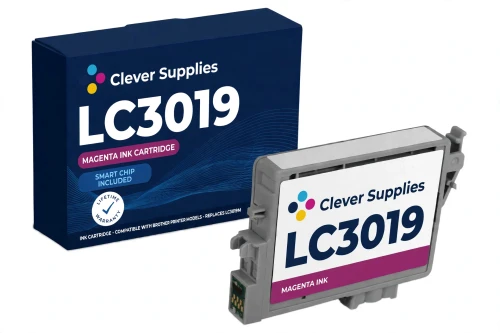
Magenta at the same $11.99 asked on both of this platform’s shelves — except that here the figure buys 1,500 rated pages instead of 550. Brother’s genuine magenta single is $37.29.
Shop LC3019 Magenta →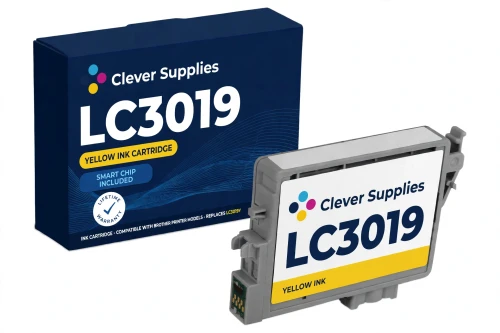
Yellow gives out quietly — prints turn pale before they turn wrong — and a 1,500-page rating pushes that discovery far into the future. $11.99 here; the genuine article on Brother’s shelf is $37.29.
Shop LC3019 Yellow →The whole shelf, priced per page
Ratings split by slot here — black up to 3,000 pages, each color up to 1,500 — on the basis Brother prints for this platform: “Approximate page yield in accordance with ISO/IEC 24711.” Ratings attach to individual cartridges, never to boxes, so set rows divide the box price across the cartridges’ own rated pages: 7,500 behind the Set of 4’s blended figure, 18,000 behind the Set of 9’s — a costing method, never a box yield.
| Offer | Fits | Price | Rating per cartridge | Cost per page | Against the singles |
|---|---|---|---|---|---|
| LC3019 Set of 4 BCMY — the flagship | All three printers | $44.94 | Black up to 3,000; each color up to 1,500 | 0.60¢ blended | SAVE $6.02 |
| LC3019 Set of 9 | All three printers | $87.62 | Three blacks at 3,000 each, two of each color at 1,500 | 0.49¢ blended | SAVE $29.29 · ships free alone |
| LC3019BK black single | All three printers | $14.99 | Up to 3,000 pages | 0.50¢ | For the slot that empties first |
| LC3019C cyan single | All three printers | $11.99 | Up to 1,500 pages | 0.80¢ | The one-slot top-up |
| LC3019M magenta single | All three printers | $11.99 | Up to 1,500 pages | 0.80¢ | Single-slot refill |
| LC3019Y yellow single | All three printers | $11.99 | Up to 1,500 pages | 0.80¢ | The one-slot top-up |
Two patterns run down the rows. The price of a single cartridge steps downward as the box grows — $14.99 and $11.99 singly, $11.24 apiece inside the Set of 4, $9.74 inside the Set of 9 — and the per-page column descends with it, from the colors’ 0.80¢ to the deep box’s 0.49¢ blended floor. The black single quietly beats every color: at 0.50¢ a page it is the cheapest printing on the page.
The tier below, weighed fairly: LC3017 is cheaper to buy, costlier to run
Brother runs exactly two tiers over these three printers, and there is nothing above this one. LC3017, the High-yield tier, rates every cartridge — black and colors alike — at up to 550 pages; LC3019, the Super High-yield tier priced on this page, rates its black at up to 3,000 and its colors at up to 1,500, on the same ISO/IEC 24711 basis. The two tiers are sizes of one supply rather than rival systems: they serve the same printers, occupy the same slots, and can be mixed slot by slot inside a single machine. This store stocks the LC3017 tier as a family of its own, and the LC3017 guide in this series gives that shelf the same treatment; here it enters only as the comparison this tier has to win honestly.
The arithmetic is not close, and this page will not pretend otherwise. Take the colors first: the ticket is $11.99 on either shelf — the identical figure — but the rating behind it is 1,500 pages here against 550 below, so the page costs 0.80¢ here against 2.18¢. The black asks a $3.00 step, $14.99 against $11.99, and answers it with 3,000 pages against 550 — 0.50¢ a page against 2.18¢. At box scale the same story repeats. For the Set of 4, $1.50 separates the tickets — $44.94 here, $43.44 below — while the cartridges inside carry 7,500 rated pages between them against 2,200, which is how the blended figures land at 0.60¢ against 1.97¢. The Set of 9 asks $6.75 more, $87.62 against $80.87, and blends to 0.49¢ against 1.63¢. Add change frequency, where a 3,000-page black simply asks for attention a fraction as often, and the conclusion writes itself: stepping down saves money per cartridge and never per page.
What the lower tier keeps is nonetheless real, and it is the whole of its case: the smallest amount of money that will put a fresh cartridge into any of these slots. Black there is $3.00 cheaper, the colors are tied at $11.99, and both of its set tickets undercut this tier’s. For a machine in genuinely light service — a few hundred pages a year — a small ticket today can matter more than a per-page figure that takes years to accumulate, and nobody should be talked out of that arithmetic. Brother’s genuine packs underline the point: its only genuine black multi-pack on this platform is the tier below’s LC30172PK 2-pack at $56.29, and for this tier it sells no black 2-pack and no four-pack at all. Choose this tier for cost per page and long intervals between changes; choose the one below for the smallest possible outlay per purchase. The printers accept either, in any slot, in any mixture.
The lookalike shelf: identical yield numbers, entirely different ink
Brother sells a second group of machines in this same model neighborhood, and the resemblance is close enough to cause real ordering mistakes. The MFC-J5830DW and its XL variant, the MFC-J5930DW, the MFC-J6535DW and its XL variant, and the MFC-J6935DW belong to the INKvestment Tank line. They are not larger editions of the three printers this page serves, and they do not drink from this shelf: their cartridge family is the LC3029, a physically different cartridge built for the Tank ink system.
Here is the trap, stated as plainly as it deserves. The LC3029 family publishes headline yields that match this page’s exactly — black up to 3,000 pages, colors up to 1,500 — so a shopper who searches by yield figure, or who reads a rating and stops there, can land on the wrong cartridge with complete confidence in the numbers. The numbers are not lying; they are simply not the deciding fact. Yield describes how much a cartridge prints, not which machine it fits, and between these two platforms the cartridges are not interchangeable in either direction: an LC3019 cartridge will not serve a Tank printer, and an LC3029 cartridge will not serve any of the three models on this page. The model name on the front panel is the only authority — match the cartridge family to it.
The three machines this guide covers are the standard-cassette Business Smart models, with ordinary front-loading cartridges of the kind both LC3017 and LC3019 are. Nothing about them is a Tank design, and the store files the two platforms in separate categories so the shelves never mingle. If your model number is one of the Tank six above, this page’s offers are not yours at any price; if it is one of the roster three, everything here is.
A new compatible chip in every cartridge, and the one message it can bring
The claim belongs to the products, and it is uniform across them. All six listings carry a specification field reading “New compatible chip”, and their descriptions say the same thing in sentences — a single cartridge carries a new compatible chip; every cartridge inside a set box carries one. The part itself is identified too: the small green chip seated on top of the cartridge, the contact Brother’s own support pages ask about first when a cartridge is not being detected. No offering on this page is without one.
The limit that rides with the claim is printed in the same texts, and this guide keeps it attached rather than trimming it away. With a compatible cartridge fitted, the printer may show “Cannot Detect Ink Volume”. The listings explain why, following Brother’s support text for the family: a genuine cartridge’s microchip is what lets the machine register ink volume and confirm proper installation, so a non-genuine cartridge may leave that display unread. Printing carries on regardless — what can fall silent is the ink-level gauge, not the printer. From then on, ink is judged by the page in front of you and by keeping a spare within reach. The texts also concede that a firmware update can occasionally be followed by a recognition hiccup, and they promise no recognition guarantee under any firmware; this guide leaves that limit exactly where the listings put it. Brother’s own published position cuts the other way: since March 2025 the company has stated that its firmware updates do not block third-party replacement ink.
The handling routine is short, because most detection trouble starts with fingertips: grip the housing, never touch the green chip, seat the cartridge firmly until it settles, and fit it promptly once the packaging is opened. If a cartridge still refuses to register after that, each listing’s specification fields carry a lifetime warranty standing behind it. And this account speaks only for these six ink listings, at the size the products themselves state it; the store’s toner and drum shelves are outside its scope entirely.
Three printers, and everything on this page fits all three
Brother gives the same three names on the page of every cartridge in this family, in these words: “For use with: Brother MFC-J5330DW, MFC-J6530DW, MFC-J6930DW.” One list, no sub-groups, no exceptions hiding inside it — the black serves where the colors serve, and the sets serve where the singles serve. The store’s filing follows Brother’s to the letter: the same six listings appear in every one of the three model categories and in this family’s own code category, the Brother LC3019 category, so you reach the identical shelf whether you start from a printer or from a cartridge code.
One piece of housekeeping belongs here, because owners meet these cartridges in a specific order. The three printers ship from Brother with LC3017 cartridges in their slots — the High-yield set, not this tier — and a footnote on Brother’s printer pages puts the in-box yield at approximately 65% of what a replacement LC3017 delivers, the shortfall going to the ink system initialization process. There is no LC3019 starter cartridge and no starter rating for this tier: your first LC3019 cartridge is a full-rated replacement. Measured against a starter LC3017 that began life at roughly two-thirds of a 550-page rating, a first 3,000-page black is not merely an upgrade — it is a different scale of supply altogether.
What stands behind all six listings
Five checks before this tier goes in the cart
Questions owners of these printers ask
Because the two prices buy very different amounts of printing. The $3.00 step buys a cartridge rated up to 3,000 pages instead of up to 550 — 0.50¢ a page against 2.18¢ — and stretches the interval between black changes by the same multiple. The colors make the point even more sharply: they cost the identical $11.99 on both shelves, so the only difference is 1,500 rated pages here against 550 there. The LC3017 black remains the right buy for a printer whose yearly volume is small enough that outlay, not cost per page, is the binding constraint; for anything busier, this tier prints those same documents for less.
They can, in any mixture. Brother treats the two series as two sizes of a single supply for the same three printers — same slots, same fit — so a machine can run an LC3019 black beside LC3017 colors, or the reverse, and each slot can step up at its own next change. There is no conversion step and no setting to adjust — the only discipline is timing: move a slot up when its current cartridge is actually spent, not before.
No, and the matching yields are precisely what makes the question worth asking in print. The MFC-J6935DW is an INKvestment Tank model — one of six, alongside the MFC-J5830DW, MFC-J5930DW and MFC-J6535DW lines — and Tank machines take LC3029 cartridges, a physically different design. LC3029’s published ratings match this family’s figure for figure — 3,000 pages on the black cartridge, 1,500 on each color — which is why the confusion is so easy; but the cartridges do not interchange in either direction. The roster for everything on this page is the MFC-J5330DW, MFC-J6530DW and MFC-J6930DW, and the model name decides the matter.
No — every one of the three printers leaves Brother’s factory with LC3017 cartridges in the slots, whichever tier its owner later chooses. Brother’s own footnote rates those in-box cartridges at approximately 65% of a replacement LC3017, because part of their ink is spent initializing the system. There is no LC3019 starter cartridge at all, so nothing was withheld from your box: the first LC3019 you fit is a full-rated replacement, and the jump in endurance from a starter — roughly two-thirds of a 550-page rating — to a 3,000-page black is the largest single step this platform offers.
That message, on this family, is documented behavior rather than a defect. The listings, relaying Brother’s support text, explain the mechanism behind it: registering ink volume and confirming installation are jobs a genuine cartridge’s microchip performs, and a compatible cartridge may not reproduce that registration — so the display reports that it cannot detect the volume while the machine prints on normally. The practical consequences are modest: the ink gauge may not read, so ink gets judged by output quality, and a spare cartridge kept nearby covers the day a slot truly runs dry. Keep handling care in place — housing only, never the green chip on top — because recognition lives or dies on clean contact at that chip.
Throughput, with freight riding along as the tiebreaker. The Set of 4 renews the whole machine once for $44.94 at 0.60¢ blended; the Set of 9 carries three black renewals and two per color for $87.62 at 0.49¢ blended, brings the per-cartridge price down to $9.74, and is the only offer here that ships free on its own, while the Set of 4 stops short of the $49 line. A busy office earns the deep box quickly; a quieter one is better served by the Set of 4 and singles as slots empty — the cartridges inside are identical either way, so today’s choice commits you to nothing next time.