




Some platforms climb through three yield tiers; this one keeps two, and LC3011 is the lower of them — the Standard-yield specification that four Work Smart printers were delivered with. The page below is the smallest in this series: four compatible singles, one for each slot, every cartridge rated at up to 200 pages and priced at the same $9.74, with no set of any size sold under this code. What the family lacks in variety it makes up in one honest surprise, printed where it belongs rather than buried: restocking all four slots at this tier costs more than the set sold one tier up, and the sections below show that arithmetic in full.
Own one of the four Work Smart models listed further down and this page is the ground floor of your ink shelf: four Clever Supplies compatibles, each carrying a new compatible chip, each priced at $9.74, each rated for up to 200 pages — and nothing else. This store stocks no genuine LC3011, and no box set exists at this tier in either direction: the range is four singles, bought one slot at a time. Two facts shape everything that follows. Buying all four singles in one go adds up to $38.96, which is more than the four-cartridge set one tier up costs — so the full-refill decision deserves a look before it is made — and no purchase on this page, not even all four singles together, reaches the $49 line where shipping turns free.
The black single fronts the shelf; its three companions match it line for line
With no set to lead with, the order below follows the way these cartridges are actually consumed. Black does the everyday work in a home or small office — letters, forms, school runs — and wears out first, so the black single takes the featured card. The three colors stand beside it in a row, identical in price and rating, ready for whichever slot gives out next.
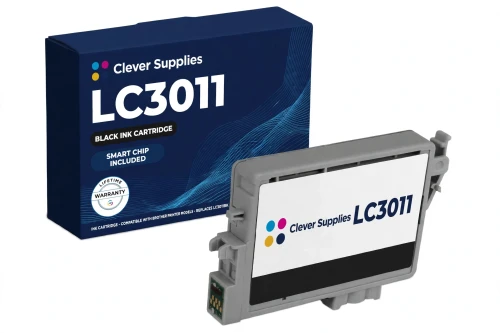
Why feature a single on a page with no box to push? Because this tier’s honest unit of purchase is one slot. A printer rarely empties evenly; the black gives out mid-month while the colors still hold weeks of ink, and a $9.74 single answers that moment without buying ink that is already in the machine. The exception is printed in full further down: when all four slots run dry together, this tier is the expensive way to refill them, and this page will show you the cheaper one rather than pretend otherwise.
Shop the LC3011BK Black →THE COLORS — CYAN, MAGENTA AND YELLOW, $9.74 EACH
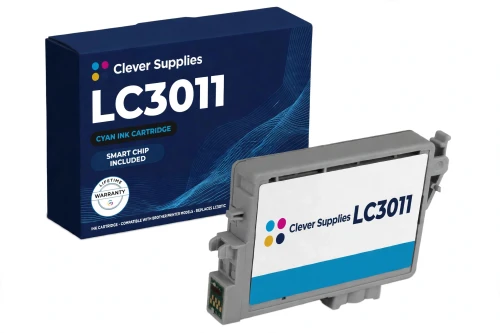
Brother’s genuine cyan lists at $11.29 — and stood out of stock at Brother when this guide was assembled, with the line itself still current.
Shop LC3011 Cyan →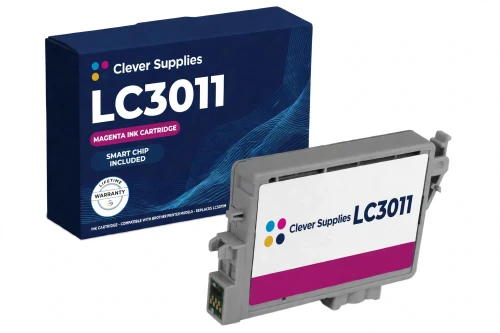
The color that presentations, charts and photo prints burn through fastest; a 200-page rating makes a drawer spare a small thing to keep.
Shop LC3011 Magenta →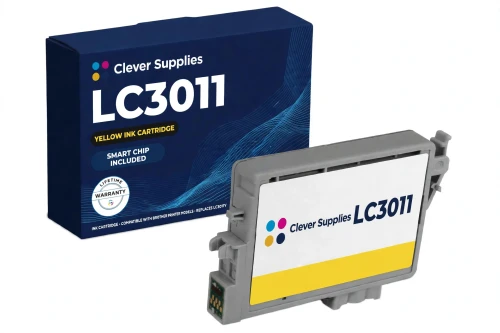
Yellow fades quietly — prints wash out before any warning appears — so its 200-page rating is the number to schedule the spare by.
Shop LC3011 Yellow →One caution belongs to the whole band: every cartridge here fits all four printers in every slot, and nothing outside those four models. The roster below draws that boundary, and the tier section draws the staircase above it.
Four singles, one flat line — the table
Each rating in this table hangs on the same footnote, the one Brother prints across its LC3011 cartridge pages: “‡Yield: Approximate page yield in accordance with ISO/IEC 24711 (letter/A4).” Brother pins that figure to the cartridge — up to 200 pages from the black, up to 200 from every color — and because this tier sells no box, no rate here needs blending: the price divided by 200 rated pages is the whole of the arithmetic.
| Offer | Fits | Price | Rating | Cost per page | The slot it serves |
|---|---|---|---|---|---|
| LC3011BK black single — the flagship | All four Work Smart printers | $9.74 | Up to 200 pages | 4.87¢ | The document slot |
| LC3011C cyan single | All four Work Smart printers | $9.74 | Up to 200 pages | 4.87¢ | One slot, one cartridge |
| LC3011M magenta single | All four Work Smart printers | $9.74 | Up to 200 pages | 4.87¢ | The photo-and-charts slot |
| LC3011Y yellow single | All four Work Smart printers | $9.74 | Up to 200 pages | 4.87¢ | The quiet slot |
A table with no slope in it is easy to misread as a table with nothing to say. Read it for what it settles: there is no bargain slot and no penalty slot — black and colors cost the same, rate the same and divide to the same 4.87¢. The only number on this page that behaves unexpectedly is a sum, not a row: add the four prices together and you arrive at $38.96, four separate purchases accumulated, with no bundle discount folded in. That sum is the subject of the next section, because one tier up, a single box undercuts it.
Refilling all four slots? The box upstairs costs less than these four singles
Here is the comparison this page owes you before the featured card’s praise settles in. Four LC3011 singles — one for each slot — come to $38.96 and carry 200 rated pages apiece. The LC3013 Set of 4, sold one tier up for the same four printers, costs $35.94 and carries 400 rated pages in every slot, which blends to 2.25¢ a page against the 4.87¢ these singles divide to. On a full refill, the higher tier is cheaper to buy and cheaper to run; no wording on this page will make that come out differently.
What the Standard tier still wins is the errand it was built for. A single dry slot costs $9.74 to put right here — the lowest price ever asked for one cartridge on this platform — against $10.49 for the same errand one tier up. Owners who print lightly, top up one slot at a time and would rather not hold spare ink they may never use are served exactly by this shelf. Owners who refill the whole machine at once should climb; the next section prices the climb, and the guide to that shelf is linked from it.
Two tiers and no third step: where LC3011 sits
Brother builds this cartridge shape in exactly two yield levels, and this page covers the lower one. LC3011 is the Standard tier, up to 200 pages a cartridge, belonging to four Work Smart printers. Directly above it, LC3013 is the High-yield tier at up to 400 pages, fitting the same four printers — the top of this platform. There is no LC3015 and no third step: Brother’s catalog simply stops at two, and the “LC3013XL” wording seen in some marketplace listings is a seller’s label, not a Brother cartridge. One Brother support summary reportedly names this pair High and Super High; Brother’s own product pages — the pages these cartridges are sold from — call them Standard and High, and this guide follows the product pages.
The step itself costs 75 cents a cartridge. An LC3013 single is $10.49 — $0.75 beyond the $9.74 asked here — returns exactly twice the rated pages, and prices its page at 2.62¢ against 4.87¢ on this shelf, a cut of close to half. The sets, which exist only upstairs, finish the map: the LC3013 Set of 4 at $35.94 blends to 2.25¢ a page, and the LC3013 Set of 9 at $72.77 blends to 2.02¢ — and is the only offer on the platform that clears the $49 free-shipping line standing alone. That whole shelf, priced and compared, lives in our Best Brother LC3013 Ink Cartridges guide.
What remains on this floor is the position itself: the specification these four printers were sold with, the lowest price ever put on a single cartridge for them, and the retail match for the starter cartridges they arrived holding. For a machine that prints now and then, that is a complete case. For a machine that prints daily, the two paragraphs above are the case for the floor above — set out here in full, not held back for the other page.
The starters were not cut down — a first for this series
Unbox any of the four printers and the cartridges inside are LC3011 Series starters. On most platforms in this series the in-box set is a trimmed version of the retail cartridge; here Brother’s footnote does something unusual — it rates the starter at approximately 100% of a replacement LC3011 cartridge, roughly the same 200 rated pages, with only the ink system’s first-time priming accounting for any difference in practice. That figure belongs to this tier alone: it is printed here with its LC3011 scope attached, and no other platform’s percentage stands in for it.
The practical consequence is small but pleasant: the first retail LC3011 you buy is not a step up from what the printer came with — it is a continuation of it, the same specification at the same rating. Owners arriving from other Brother platforms, where the starter-to-retail jump is a real event, can set that expectation aside here. What does change at the first refill is only the choice this page exists to frame: stay at the tier the machine was born with, or take the 75-cent step to double pages described above.
The green chip, the gauge that may stay silent, and the limits printed with both
Open the specification block on any of the four listings and the chip entry reads the same: “New compatible chip”. The listings fill that entry out in Brother’s own terms — Brother’s support pages for this platform direct owners to the small green chip on top of the cartridge when a machine will not recognize one — and each of the four arrives carrying that chip, fresh.
The limit is printed in the same listings, in their own words: with a compatible cartridge fitted, the printer may display “Cannot Detect Ink Volume”. Brother’s support text, as the listings relay it, holds that the machine carries on printing with that message showing, that only a genuine cartridge makes the message clear, and that the ink-level gauge may not give a reading in the meantime. Treat it as a display behavior to expect rather than a failure to fix: the pages keep coming.
Care is the cheap half of the bargain. Lift the cartridge by its body, keep fingers off the green chip’s contact, and push the unit home until it clicks; a recognition hiccup after a firmware update is the known occasion for trouble, and the listings’ routine — reseat the cartridge, restart the printer — is the first answer. Brother’s published position since March 2025 is that its firmware updates do not block third-party ink. What no listing here offers, and this guide will not invent, is a promise that every firmware version will read every chip: the claim is a new chip in every cartridge, with the caveat riding beside it.
The roster is four printers long — and the same four take the tier above
Brother prints one fit line across its LC3011 pages, and it names four models. Everything on this page fits everything on that line, in every slot; and because the tier above shares the roster exactly, no owner has to sort printers by tier.
The four: MFC-J491DW, MFC-J497DW, MFC-J690DW and MFC-J895DW. If your printer stands among them, every cartridge above is a candidate. If it does not — an LC3017, LC3019 or LC3033 machine in particular — nothing on this page fits it, however similar the cartridge shape may look.
The store files the family the way Brother draws it: all four listings sit in each of the four model categories and together in the family’s own code category, the Brother LC3011 category. A closing distinction, kept separate from the cartridges: Brother has discontinued all four printers as hardware, while the LC3011 cartridge line itself remains current — a discontinued machine with a living ink shelf.
What backs each of the four listings
Five checks before ordering from the bottom tier
Questions from the singles-only shelf
Because the Standard tier of this range is sold as singles only — that is how the ladder itself is built, not a gap in this store’s stocking. Sets exist one tier up, where the LC3013 Set of 4 stands at $35.94 and the Set of 9 at $72.77; owners set on buying a box should start there. Everyone else is served by the four cards above.
Both fit the same four printers, so the choice is arithmetic and printing habit. The LC3013 single costs $0.75 more and carries exactly twice the pages, pricing its page at 2.62¢ against 4.87¢ here. Buy the LC3011 when one slot has run dry and the rest still hold ink; buy the LC3013 when refills come often or all at once — its four-cartridge set, at $35.94, undercuts even the $38.96 these four singles add up to.
Any of the four listings above, directly. Unusually for this series, Brother rates the in-box LC3011 Series starters at approximately 100% of a replacement LC3011 — about the same 200 pages — so the retail cartridge is a like-for-like continuation rather than an upgrade. The one thing that changes at the first refill is the option to step up a tier, priced in the tier section.
No — and the listings say to expect the possibility. With a compatible cartridge fitted, that message can appear; Brother’s support position, as the listings relay it, is that the printer keeps working with it showing, the ink-level gauge may not read, and only a genuine cartridge clears the message outright. Reseating the cartridge firmly and restarting the printer settles most recognition hiccups; the message itself is a display behavior, not a print failure.
For the colors, $11.29 each — though all three stood out of stock at Brother on the day this guide was checked, with the line itself current. Brother’s genuine color three-pack, LC30113PKS, is $29.99 and was in stock. Brother’s own four-cartridge bundle, LC3011BUND, is $45.99 — more than the $38.96 the four compatibles here total — and was likewise out of stock. One figure is missing on purpose: Brother’s page for the genuine black single would not render, so this guide quotes no genuine black price rather than guess one.