




Fifteen Brother workgroup printers share one toner platform, and every one of them forms its images on the same drum: the DR720, the unit the toner cartridge seats into and the part that stays in the machine through cartridge after cartridge. This guide prices the drum four ways, from a single unit to a box of five; sets out the toner-and-drum sets for the day both warnings arrive together; and corrects, in the open, a wrong lifespan figure that this store’s own product text has been printing about this drum.
One drum serves this whole platform, Brother rates it at approximately 30,000 pages, and each printer holds exactly one. The compatible shelf is a four-step ladder — a single at $36.33, then two, three and five units at $56.58, $76.83 and $117.33, with the price per drum falling at every step and no 4-pack anywhere in the family. Eight toner-and-drum sets pair the drum with TN720 or TN750 cartridges for owners replacing both supplies at once, and Brother’s genuine drum stands in stock at $174.47 for buyers who want the manufacturer’s part. Two cautions shape the page: the product listings’ own text understates this drum’s life at 12,000 pages, which is wrong, and the two middle toner tiers are priced identically here, which is merely odd — both are dealt with below, with figures.
Four ways to buy the same drum — and the single is the default
Nothing about the part changes from box to box: one DR720 is one DR720, carrying the same approximate 30,000-page rating whether it ships alone or in a stack. What the packs trade in is foresight — how many future drum changes you settle today, and at what discount for settling them early. Measured against buying singly, two drums bought one at a time would come to $72.66, three to $108.99 and five to $181.65; hold those totals against the pack prices below and the saving at each rung is plain arithmetic, printed on each card. The ladder starts where most owners should start.
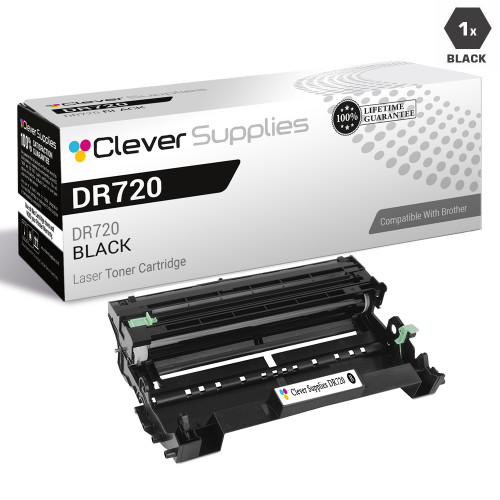
Why does the smallest box front this guide? Because a drum change is a rare, unscheduled event — at roughly 30,000 pages it may be years away — and the single answers it exactly, with no spare hardware ageing on a shelf in the meantime. The packs below earn their place for offices running several of the fifteen models, or for buyers who would rather stock the next change now at a lower per-drum price. The 2-pack in particular carries a genuine second argument: at $56.58 it is the least expensive drum offer on this page that ships free standing alone, and it puts a spare in the building. Both arguments are printed where they belong — on the packs’ own cards — without displacing the default.
Shop the Single Drum →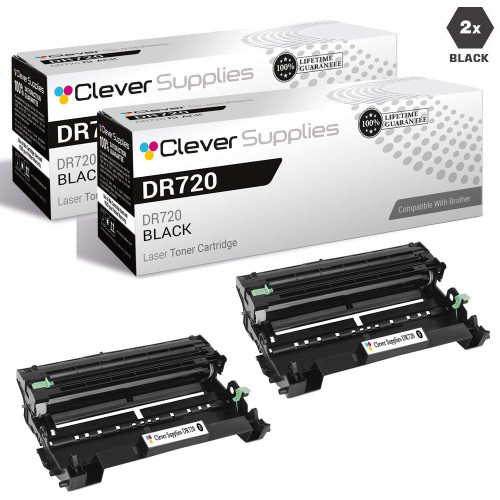
$28.29 a drum and $0.94 per thousand rated pages. The cheapest drum offer here that clears the $49 free-shipping line by itself — one drum fitted, one waiting.
Shop the 2-Pack →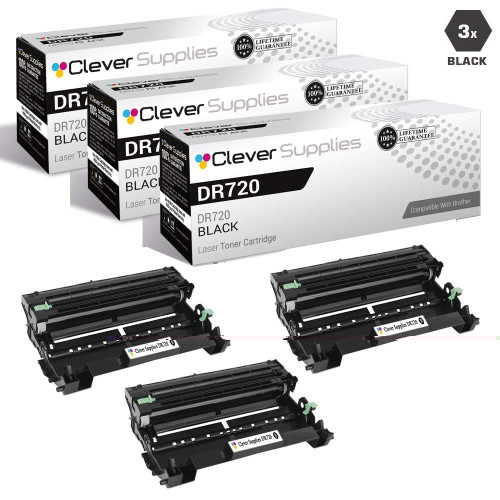
$25.61 a drum and $0.85 per thousand rated pages. Stock for two or three machines on staggered cycles, and it ships free on its own.
Shop the 3-Pack →
$23.47 a drum — the ladder’s floor, at $0.78 per thousand rated pages. Note the jump: the ladder goes from three to five, because no drum 4-pack exists in this family.
Shop the 5-Pack →The ladder reduced to numbers: what a drum costs, and what a thousand pages cost
Each row is the same DR720 under the same Brother rating of approximately 30,000 pages. The per-thousand column divides the box price by the rated pages inside it, and the final column holds every pack against the cost of buying that many drums one at a time. The genuine unit closes the table as a reference point only — it is discussed, not sold, in the genuine section below.
| Offer | Box price | Per drum | Cost per 1,000 pages | Against buying singles |
|---|---|---|---|---|
| Single — this page’s flagship | $36.33 | $36.33 | $1.21 | The baseline |
| 2-Pack | $56.58 | $28.29 | $0.94 | SAVE $16.08 |
| 3-Pack | $76.83 | $25.61 | $0.85 | SAVE $32.16 |
| 5-Pack | $117.33 | $23.47 | $0.78 | SAVE $64.32 |
| Genuine Brother DR720, single (reference) | $174.47 | $174.47 | $5.82 | In stock here — Brother’s own store lists it at $171.79 |
Read the steps honestly and they argue for restraint. Moving from one drum to two cuts the per-thousand cost by more than a fifth; the rungs after that shave off smaller and smaller amounts. Beyond the 2-pack you are mostly purchasing convenience — fewer orders placed, fewer deliveries chased, a shelf that stays stocked — and there is nothing wrong with buying convenience, as long as it is bought knowingly rather than mistaken for a bargain on pages.
Fifteen printers, one roster, and no model standing on the wrong side of a split
Brother publishes a supply page for the drum and one for each of this platform’s toner tiers, and the printer list does not move between them: the roster on the DR720 page is the roster on the TN720 page is the roster on the TN750 page, name for name. There is no high-yield subset and no model that takes the toner but not this drum. The toner tier riding above the drum is a yield decision and nothing more — TN720 at roughly 3,000 pages, TN750 at roughly 8,000, both rated under ISO/IEC 19752, and, on four of the fifteen machines only, TN780 at roughly 12,000. The fifteen are:
DCP series: DCP-8110DN · DCP-8150DN · DCP-8155DN
HL series: HL-5440D · HL-5450DN · HL-5470DW · HL-5470DWT · HL-6180DW · HL-6180DWT
MFC series: MFC-8510DN · MFC-8710DW · MFC-8810DW · MFC-8910DW · MFC-8950DW · MFC-8950DWT
The TN780 tier deserves its boundary drawn precisely, because it is the one place this platform does divide. That cartridge fits only the HL-6180DW, HL-6180DWT, MFC-8950DW and MFC-8950DWT — yet on those four machines it drinks from this same drum, so a TN780 owner reading this page is in the right place for the drum and the wrong one nowhere. Every printer on the list holds a single drum with the toner cartridge seated inside it; the two supplies are ordered, counted and replaced independently.
One fit note, made once and plainly: most of this store’s DR720 listings print a roster of fourteen in their text, leaving the MFC-8950DWT off the list even though Brother includes it and the listings themselves are filed under its category. The drum multi-packs go the other way and print the fifteen alongside a dozen shortened name forms, as though DCP-8110 and HL-5470 were extra machines. Neither version is the authority. The fifteen linked above are Brother’s published roster, and this guide follows Brother wherever the store’s text and Brother’s list part company.
The rating, corrected: this drum is a 30,000-page part, whatever the listings say
Here is a defect this page is not going to step around. Open any compatible DR720 listing in this store — the single, the packs, the toner-and-drum sets — and its question-and-answer text will tell you the drum is good for 12,000 pages. It says so repeatedly, between four and seven times a listing; the single drum’s own text says it six times. That figure is wrong. Brother rates the DR720 at approximately 30,000 pages, states the basis in one sentence — “Drum yield is approx., and may vary by type of use” — and attaches no ISO standard and no per-job tier to it. Twelve thousand pages is the rating of the TN780 toner cartridge, a different supply entirely, and it appears to have wandered into the drum’s text and settled there.
The store’s own pages argue against themselves on this point, which is how the error can be corrected with confidence rather than preference. The specification layer of those same listings states 30,000 pages outright — the single’s own yield field reads “30,000 Pages” — and the genuine drum’s text gives 30,000 as well. Only the prose layer disagrees, and prose is where templates live. The wrong number also drags wrong arithmetic behind it: the single’s text works out the drum’s cost per page from the shorter life and from a $41.78 figure that is not the price the drum sells at, landing several times too high — at the real $36.33 across a real 30,000 pages, the drum contributes roughly 0.12¢ a page. A pack listing’s claim about changing toner three times for every two drum changes inverts the relationship the same way; at Brother’s figures, one drum outlasts close to four TN750 cartridges.
So the position of this guide is simple, and it applies to every figure printed above: the drum’s rating is approximately 30,000 pages, the listings’ 12,000 is an error in the seller’s own copy, and the error happens to run against the seller — it makes the part look shorter-lived than Brother says it is. Correcting it here costs the store nothing but accuracy, and accuracy is the whole of the transaction.
Before you order: telling a tired drum from a tired cartridge
The two supplies fail in different handwriting, and reading the page correctly can save an unnecessary purchase in either direction. Toner running low writes in fading ink: pages come out pale, coverage thins unevenly, and rocking the cartridge gently from side to side coaxes a little more life from what remains. A drum at the end of its surface writes in repetition: the same spot or streak returning at the same interval down page after page, a gray haze settling behind text that once sat on white paper, lines that recur like a pattern instead of smearing like a spill. The deciding experiment is free — print the problem page again with a cartridge you trust in the machine. Anything the fresh cartridge cures was the cartridge. Anything it reproduces, mark for mark, lives on the drum’s surface, and no second cartridge will move it.
The machine’s bookkeeping supports the same distinction. Toner and drum keep separate tallies, and a Replace Drum message concerns the unit on this page alone, however new the cartridge inside it happens to be. Because one drum spans roughly ten standard cartridges, the warning typically lands long after the last drum change has faded from memory — owners meet it mid-run, with a nearly full cartridge fitted, and reasonably suspect the printer is confused. It usually is not.
After the swap comes the step that gets skipped: the printer does not sense the new drum. It keeps counting against the old one until the drum tally is reset from the machine’s own menu — Brother publishes the key sequence for each model — and until that reset, the display goes on reporting a worn-out drum that has already left the building. Reset the drum tally and nothing beside it; the toner keeps a ledger of its own. And never reset the tally on a worn drum just to silence the message: the counter will quiet down, the surface will not heal, and the repeating marks will keep their appointment on every page.
Toner and drum in one box: eight set shapes, two labels, one price list
When the drum warning and the low-toner warning arrive in the same month, the store also sells the two supplies boxed together. Four shapes exist — one drum with one, two, three or four toner cartridges — and each shape is offered under both toner tiers. Here the family plays its oddest trick: the TN720 and TN750 versions of every set carry the identical price, to the cent, so the table below is one price list wearing two labels. The parts column prices each set’s contents bought separately on this shelf — the drum single at $36.33 and toner singles at $29.21 apiece — and the last column is what the boxing saves against that.
| Set shape | With TN720 toner | With TN750 toner | Parts bought separately | Against parts |
|---|---|---|---|---|
| 1 toner + 1 drum | TN720 set — $49.46 | TN750 set — $49.46 | $65.54 | SAVE $16.08 |
| 2 toners + 1 drum | TN720 set — $62.58 | TN750 set — $62.58 | $94.75 | SAVE $32.17 |
| 3 toners + 1 drum | TN720 set — $75.71 | TN750 set — $75.71 | $123.96 | SAVE $48.25 |
| 4 toners + 1 drum | TN720 set — $88.84 | TN750 set — $88.84 | $153.17 | SAVE $64.33 |
Equal shelf prices do not make the two labels equal value. A TN720 cartridge is rated near 3,000 pages and a TN750 near 8,000, so at this store’s identical $29.21 single price the toner inside a TN750 set costs roughly 0.37¢ a page against roughly 0.97¢ for the TN720 — the drum is tier-blind, and the tier decision belongs to the toner side of the platform. Every set in the table clears the $49 free-shipping line on its own; the smallest clears it by 46 cents. Two reading warnings. The “4 Pack” in the bottom row’s listing titles counts four toner cartridges plus the drum — it is not the drum 4-pack this family does not sell. And the TN750 one-toner set stands in the catalog twice under two near-identical titles, same price, same stock, same description; this table links one of them, and buying either buys the same box.
The genuine drum: in stock, and priced almost exactly where Brother prices it
Brother’s own DR720 is stocked in this store at $174.47, and the first thing to notice is how unremarkable that figure is: Brother USA sells the same unit directly for $171.79, so this shelf stands $2.68 — about one and a half percent — above the maker’s own counter. There is no genuine multipack or bundle to compare against; Brother sells the drum singly, and the store’s genuine holding is that single unit. Against the compatible single at $36.33 carrying the same published rating of approximately 30,000 pages, the genuine drum costs a little under five times as much — $5.82 per thousand rated pages against $1.21.
What the difference buys is provenance and its paperwork: Brother’s own part, covered by the manufacturer’s warranty, with returns closing 30 days after delivery. The compatible shelf runs on this store’s terms instead — a one-year warranty and a one-year window for returns. A workplace whose service agreement names genuine parts already knows which column it reads; everyone else can set a rated-identical drum at about a fifth of the price beside those terms and judge for themselves. The figures stand as printed either way.
Chips: three stray mentions in sixty listings, and no claim built on them
Begin with the part itself: a drum unit is an imaging surface. It stores no toner, gauges no level and has no consumption for a chip to report, which is why this guide claims nothing about chips for the DR720. The claim has to be declined actively here, because the store’s text leaves a trail in the other direction: across all sixty listings on this platform, the word appears exactly three times — once each in the three drum multi-packs — and every appearance is the same inherited sentence about new parts, a list that runs from OPC drums and wiper blades to “a smart chip.” The flagship single says nothing of the kind, nor do the sets, nor does any toner listing; no product in the family carries a chip specification of any sort. A line copied from template to template is not evidence that a part is fitted, so it is not repeated as fact on this page. The single statement that can stand on the record is Brother’s, from its published support answers: “Brother firmware updates do not block the use of third-party ink and toner cartridges in our machines.” Nothing beyond that sentence is promised here — not about recognition, which a drum has nothing to do with, and not about firmware to come.
The terms standing behind the compatible shelf
Five checks before a DR720 goes into the cart
Questions this platform’s owners put to the drum
Almost never. The two supplies keep separate page tallies and wear on very different clocks — one drum’s rated life spans about ten TN720 cartridges or three and three-quarter TN750s — so a young cartridge seated in an old drum is the ordinary state of things when the message appears. The message is about the unit this page prices, and fitting a new drum, then resetting its tally, is the whole remedy.
Brother rates it at approximately 30,000 pages, with the condition stated in Brother’s own sentence: drum yield is approx., and may vary by type of use. Job length, coverage and duty cycle all move the real number around that rating. Unlike this platform’s toner cartridges, the drum carries no ISO yield standard — 30,000 is the manufacturer’s published figure with the manufacturer’s published caveat, and that is exactly how this guide quotes it.
Brother’s. The 12,000-page figure in the listings’ question-and-answer text is an error — it is the TN780 toner cartridge’s rating, transplanted into the drum’s copy, where the compatible listings repeat it between four and seven times each. The same pages’ own specification fields state 30,000 pages, the genuine drum’s text states 30,000, and Brother’s DR720 page states approximately 30,000. This guide follows the manufacturer and the spec fields, and the rating section above lays the whole discrepancy out.
Because the shelf simply does not stock one: the drum ladder runs single, 2-pack, 3-pack, 5-pack, and stops there. Search results can mislead on this point, because the family does contain listings with “4 Pack” in their titles — those are the toner-and-drum sets in the table above, holding four toner cartridges alongside one drum. A buyer wanting four drums buys the 3-pack and a single, or steps to the 5-pack.
On price there is nothing to choose — every set shape is priced identically across the two tiers. On value the TN750 set wins wherever your printing is steady: its cartridges are rated near 8,000 pages against the TN720’s 3,000, which at this store’s matching prices works out near 0.37¢ of toner per page against 0.97¢. The drum inside either box is the same DR720, so the decision is purely about how much toner you want riding along.
No — they are the same offer standing in the catalog twice under two near-identical titles, at the same price, showing the same stock, carrying the same description word for word. One of them is the listing this store’s TN720 guide already points to, and it is the one linked from the table above. Ordering the other costs you nothing and gains you nothing; the box that arrives is the same box.
Chiefly a requirement, not a performance gap: the rating is the same approximately 30,000 pages, and this store’s price sits only $2.68 above Brother USA’s own $171.79, so the premium is not a markup artifact. What the genuine figure buys is Brother’s part under the manufacturer’s warranty with a 30-day return window, where the compatible drums carry this store’s one-year warranty and one-year returns. Buyers bound to genuine parts by a service agreement have their answer; buyers free to choose can weigh provenance against a compatible drum at about a fifth of the price.
In all likelihood, the tally reset. These machines judge a drum by pages counted, not by inspecting the unit, and the count still belongs to the drum you removed until it is cleared from the printer’s menu — Brother documents the sequence for each of the fifteen models. Clear the drum tally only; the toner’s count is a separate ledger and should be left exactly where it stands.