




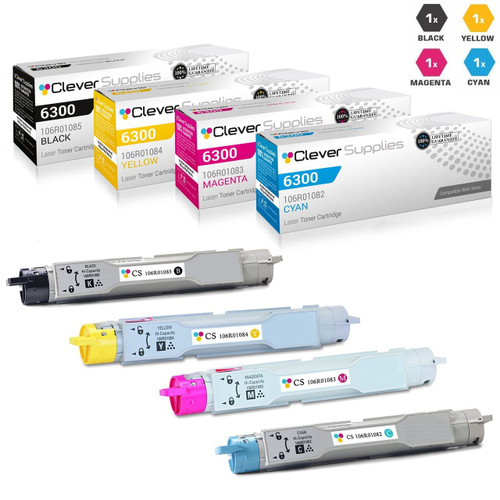
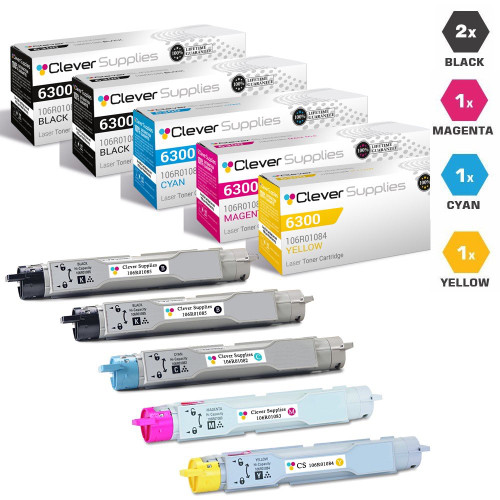
Start with the 4 Color Set at $161.21. Black 106R01085, cyan 106R01082, magenta 106R01083 and yellow 106R01084 refill all four bays in one order — $48.23 less than the $209.44 the singles total, free shipping included. Read the yield line with care: Xerox rates each cartridge at 7,000 pages on a 5%-coverage basis and did not declare them in accordance with ISO/IEC 19798 — the 8,000 pages printed across the CS listings is the store’s figure, not the maker’s, and every rate here is worked at 7,000. Savings in the copy are struck from base prices, so recompute them at charged prices, as this guide does. Black buyers get the shelf’s gift: the 3-Pack and 2-Pack wear one price, $88.65, so the three-cartridge box is the buy. Postage, last: nothing here pays it alone.
Two configurations, both networked, one duplex step between them
Everything on this shelf feeds the Phaser 6300 — a workgroup color laser printing black-and-white at up to 36 pages a minute and color at up to 26, with output up to 2,400 dpi, PostScript and PCL, a duty cycle rated at up to 100,000 pages a month, and 700 sheets of standard paper capacity (a 150-sheet multipurpose tray over a 550-sheet tray), with extra feeders as options.
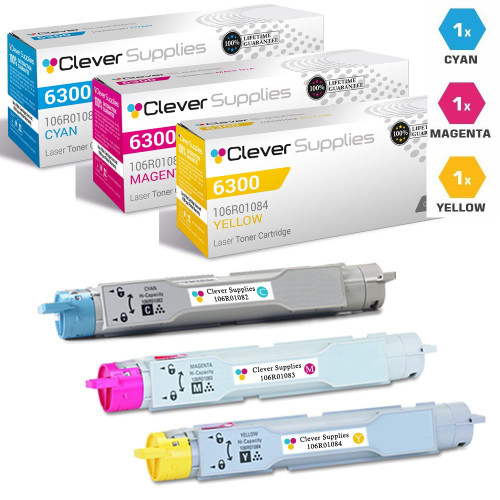
Xerox sold this machine in exactly two configurations — Phaser 6300N and Phaser 6300DN — and never offered a suffix-less 6300; the bare name is the family name the store’s category and listings use. The two are closer than the store copy suggests: both carry Ethernet and 256 MB of memory, and the single step between them is automatic two-sided printing, which the N lacks and the DN adds — Xerox even sold an upgrade kit converting an N into a DN:
| Configuration | Memory | Internal hard drive | Automatic two-sided printing | 10/100 Ethernet |
|---|---|---|---|---|
| Phaser 6300N | 256 MB | Optional | No | Yes |
| Phaser 6300DN | 256 MB | Optional | Yes | Yes |
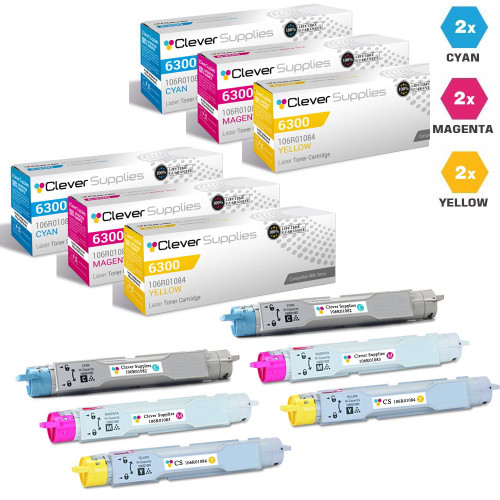
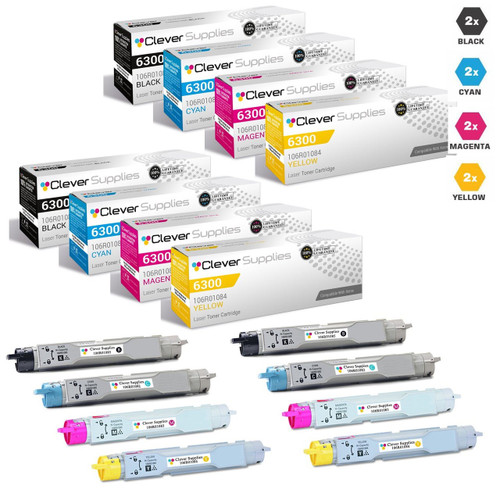
The twenty-four listings spread unevenly across the twelve boxes: the 4 Color Set is posted eight times — seven times under model names and Premium labels, plus the CS original — the black, cyan and magenta singles twice each, the yellow single three times counting a much older posting, and every pack and remaining set once. Each box is carded once below, under its audited CS posting.
The middle rung of the ladder, and the basis its ratings stand on
The platform’s cartridges come in three tiers. At the bottom sits a standard-capacity tier both model lines share; above it, Xerox split the range, giving the 6300 and the 6350 separate high-capacity tiers that answer to their own model only. This guide covers the 6300’s tier — the middle one:
| Rung | Cyan | Magenta | Yellow | Black | Rated yield | Sold here? |
|---|---|---|---|---|---|---|
| Standard capacity — Phaser 6300/6350 | 106R01073 | 106R01074 | 106R01075 | 106R01076 | 4,000 pages each | No — not stocked |
| Phaser 6300 high capacity — this guide | 106R01082 | 106R01083 | 106R01084 | 106R01085 | 7,000 pages each | Yes — the twelve boxes below |
| Phaser 6350 high capacity | 106R01144 | 106R01145 | 106R01146 | 106R01147 | 10,000 pages each | No — a separate family |
Xerox states the fence between the two high-capacity tiers in its own user guide: “The high-capacity toner cartridges for the Phaser 6300 and the Phaser 6350 printers are different and not compatible.” The shared standard tier below fits both machines; the tiers above it do not cross.
These are 5%-coverage ratings, and Xerox’s own paperwork says so twice over. Its Commercial Price List prints “5%” in the yield-standard column against all four codes — pointedly, since rows elsewhere in that same document name the test standard outright — and the platform brochure footnotes its capacities as approximate, at 5% coverage of an A-size page. So nothing in this family carries a declaration in accordance with ISO/IEC 19798, and this guide never lends the ratings that formality. If the listings seem to say otherwise, look closer at the wording: the ISO that appears there is “ISO9001 Certified Factory”, a credential of the factory that built the cartridges, silent on how pages were counted.
Toner is only part of what this machine consumes. Xerox’s maintenance schedule for the platform lists an imaging unit, 108R00645, good for up to 35,000 pages, plus a transfer roller, a fuser and a feed roller kit, and calls for a long-life maintenance kit at 300,000 pages. This family sells none of them and no set bundles one in; the imaging unit, when its turn comes, is a service purchase of its own — as two of the older listings’ FAQs already tell their buyers.
What a new 6300 shipped with, this guide leaves blank. Neither Xerox’s user guide nor its price list states a rating for the in-box cartridges of this machine, so there is no maker figure to print — and a starter number quoted anywhere else has no Xerox source behind it.
Genuine money, for scale, comes from one dated document: Xerox’s Commercial Price List effective April 1, 2015, where a genuine color cartridge lists at $259.99 and the genuine black at $114.99 — the color more than double the black, against $52.36 for the compatible color single sold here. No current genuine price could be verified, so the 2015 figures keep their date wherever used.
An extra thousand pages nobody rated, base-price money, and a pack priced as its smaller sibling
The yield defect first, because it contaminates everything downstream. All twelve CS listings claim each cartridge is “rated at up to 8,000 pages”; Xerox rates these four codes at 7,000. The pack totals in the copy are plain multiples of the inflated figure — 16,000 pages for the 2-Pack, 24,000 for the 3-Pack, 40,000 for the 5-Pack, 64,000 for the 8 Color Set — where the maker’s rating supports 14,000, 21,000, 35,000 and 56,000. The store’s older listings tell the truth: the model-named sets and the code-named singles claim 7,000 throughout, in spec blocks and FAQs alike. One older yellow posting errs in the opposite direction, claiming 5,000 pages and working out “about 1.2 cents a page” from it. Every figure in this guide is computed at Xerox’s 7,000.
The money runs on a second, quieter distortion: every total in the copy is struck at the base price, one tier above the price checkout charges (the charged price is the base divided by 1.15). The 4 Color Set’s pages quote “$185.39 … $46.35 per cartridge … near 0.58 cents per page” and claim no saving at all; charged, the set is $161.21 and the saving against the singles is $48.23. The Black 2-Pack’s FAQ promises “$101.95 together — $50.98 per cartridge against $60.21 bought one at a time, so $18.47 stays in your pocket”, at “about 0.64 cents per rated page”; at charged prices the pair is $88.65, the cartridge $44.33, the saving $16.07 and the rate about 0.63 cents. The 5-Pack’s FAQ runs “$227.13 — $45.43 per cartridge against $60.21 bought singly, saving $73.92 across the five”; charged, those become $197.50, $39.50 and $64.30, about 0.56 cents a page. The 3 Color Set’s FAQ reckons a cartridge “works out to $47.89” at its $143.67 base; charged, it is $41.64, about 0.59 cents a page. The 5 Color Set repeats the 5-Pack’s base figures; the 8 Color Set quotes “at $352.30 for eight, each cartridge costs $44.04”; the 6 Color Set quotes its $268.85 base and claims nothing at all. Two curiosities survive: the CS singles’ copy derives “roughly 0.75 cents” from the base price at the claimed 8,000 pages, and the charged price at the true 7,000 lands on the same rounded 0.75 cents by coincidence — two errors cancelling. The code-named older singles make the mirror-image slip: the same $60.21 base at the correct 7,000 pages, for “roughly 0.86 cents per page”.
Then the anomaly, which is in the prices themselves rather than the prose. The Black 3-Pack is priced identically to the Black 2-Pack — $101.95 base, $88.65 charged — so the third cartridge in the box costs nothing. The copy’s own claims trip over it: the 3-Pack’s FAQ boasts “a saving of $78.68 across the three”, a larger saving than the 5-Pack’s claimed $73.92, an inversion that survives correction, since at charged prices the 3-Pack saves $68.43 against the 5-Pack’s $64.30. Worked per cartridge, the 3-Pack’s $29.55 is the lowest black rate on the shelf — better than the 5-Pack’s $39.50, which is not how pack ladders usually run. This guide reports the pricing as it stands, without guessing at intent: while it stands, the 3-Pack is the rational black purchase, and the 5-Pack is bought for depth, not for rate. A second shared price is harmless: the 5 Color Set and the Black 5-Pack both sit at $197.50.
The configuration copy errs in two directions at once. CS FAQs describe the DN as adding “networking and automatic two-sided printing”, “networking and duplex hardware”, “built-in networking and duplexing” — but the N is already networked; the DN step adds the automatic duplex unit and nothing else. One older posting treats a suffix-less 6300 as “the base machine”, a configuration Xerox never sold. Every listing’s boilerplate compatibility line names all three names — 6300, 6300DN and 6300N — yet the prose fit lists in the CS FAQs name only the 6300 and the 6300DN, leaving the 6300N out of every one; most older prose does the same, though older spec blocks name all three. No listing names a wrong machine and none swaps a line — the N is dropped, not misassigned — and the roster above restores it.
The set contents divide by disclosure grade, as they did on the Phaser 6350 shelf. The 5 Color Set never says which color its fifth cartridge is; the 6 Color Set never states its split; the 8 Color Set is framed as two full rounds — “two full cycles … the second four are the reserve” — without itemizing two of each. Yet all three savings are exact, and badged, because of a property the Phaser 6125 shelf lacked: every single here costs the same $52.36, black and colors alike, so any five, six or eight cartridges total the same as singles whatever their mix, and the undisclosed contents cannot move the arithmetic. On the 6125 shelf the color singles are priced individually — cyan $21.96, magenta $22.57, yellow $22.35 — so the same omissions there left the singles totals genuinely unknowable and no badge could honestly be printed.
Closing notes. The “Premium Quality” 4 Color Sets are the flagship box under other labels, and all three Premium listings concede it in their own FAQs: the cartridges, yield and price are identical to the standard listing. The CS listings carry the family’s chip statement in the correct toner boilerplate — cartridges built with “all new parts including OPC drums, wiper blades, a smart chip” among their internals — so this guide’s chip wording follows that CS statement: current chipped stock from the supplier, with no promise about future firmware. Six of the twelve canonicals — the flagship set, the yellow single and all four color sets — showed zero counted inventory in November while listed as visible and available; that zero is treated here as unverified, not as an empty shelf, so no stock figure is printed for those six. And the feed fields, as ever: a UPC on all twenty-four listings, MPN and GTIN blank on all twenty-four.
The full shelf: twelve boxes, twenty-four listings
Sorted into physical boxes, the twenty-four listings make the twelve rows below. Buy through the posting carded for a box and the duplicates become irrelevant — same cartridges, same prices. Prices are November 2026 charged amounts; per-page rates divide by 7,000 pages, Xerox’s 5%-coverage rating, not by the 8,000 the listings advertise. Stock, where a box has a count worth printing, sits on its card.
| Box | Contents | Price charged | Each cartridge | Per rated page | Free shipping on its own? |
|---|---|---|---|---|---|
| 4 Color Set | Black, cyan, magenta and yellow, one apiece | $161.21 | $40.30 avg | ≈0.58¢ blended | Yes — clears by $112.21 |
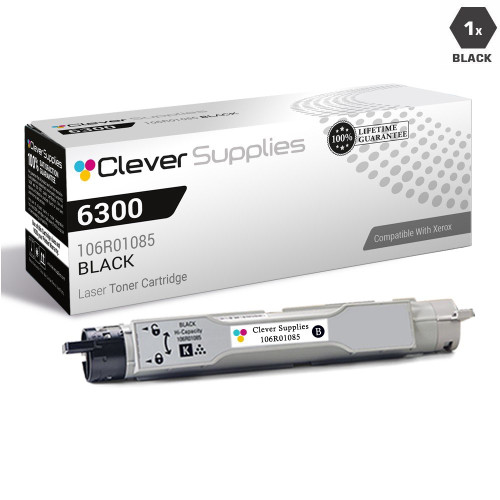
| Black single | 1 × 10⁶R01085 black | $52.36 | $52.36 | ≈0.75¢ | Yes — by $3.36 |
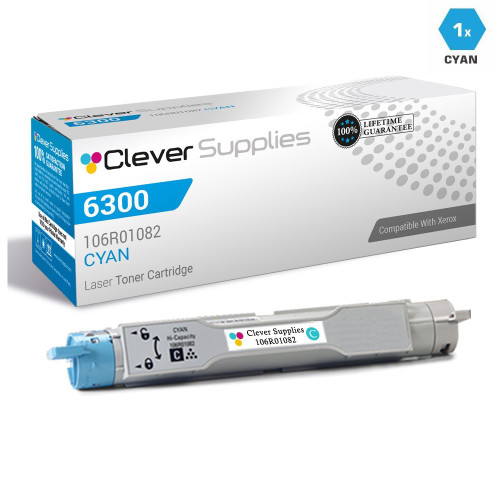
| Cyan single | 1 × 10⁶R01082 cyan | $52.36 | $52.36 | ≈0.75¢ | Yes — by $3.36 |
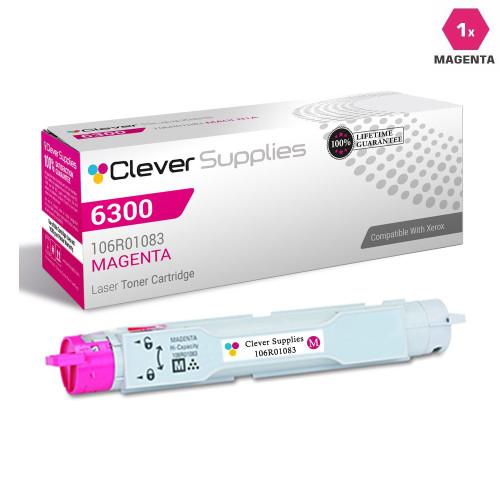
| Magenta single | 1 × 10⁶R01083 magenta | $52.36 | $52.36 | ≈0.75¢ | Yes — by $3.36 |
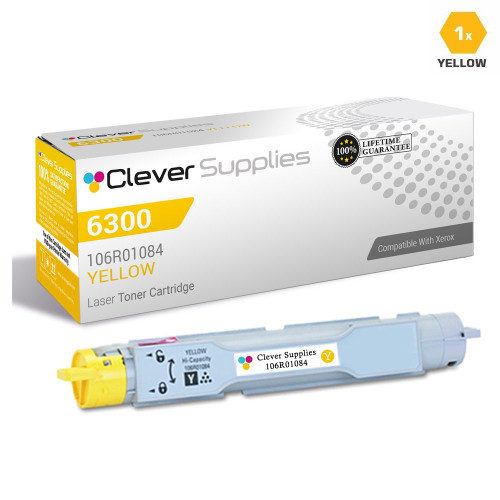
| Yellow single | 1 × 10⁶R01084 yellow | $52.36 | $52.36 | ≈0.75¢ | Yes — by $3.36 |
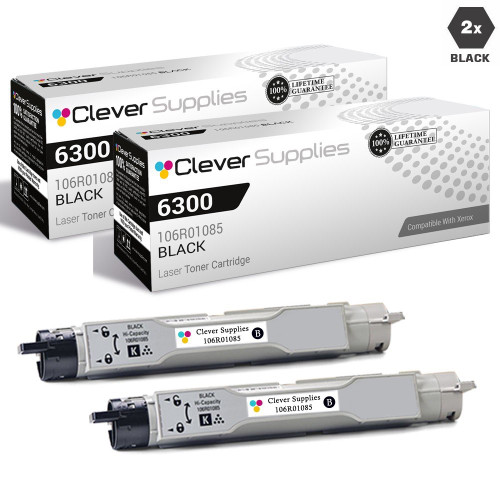
| Black 2-Pack | 2 × 10⁶R01085 black | $88.65 | $44.33 | ≈0.63¢ | Yes — by $39.65 |
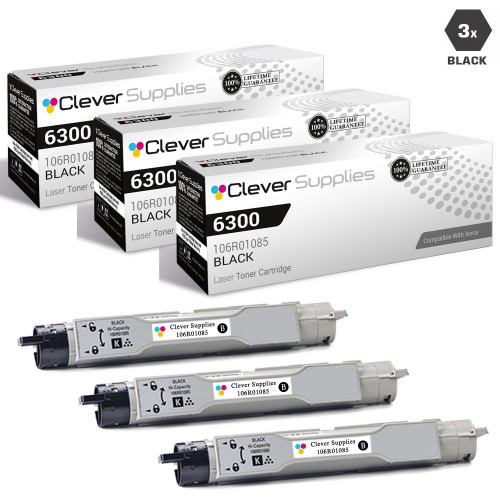
| Black 3-Pack | 3 × 10⁶R01085 black | $88.65 | $29.55 | ≈0.42¢ | Yes — by $39.65 |
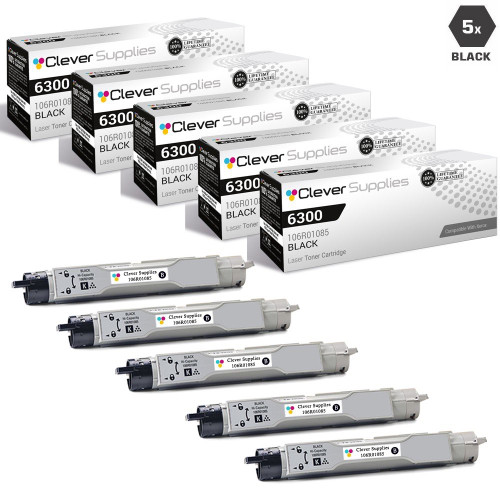
| Black 5-Pack | 5 × 10⁶R01085 black | $197.50 | $39.50 | ≈0.56¢ | Yes — by $148.50 |
| 3 Color Set | Cyan, magenta and yellow, one apiece | $124.93 | $41.64 | ≈0.59¢ | Yes — by $75.93 |
| 5 Color Set | Four cartridges plus a fifth in an unnamed color | $197.50 | $39.50 avg | ≈0.56¢ | Yes — by $148.50 |
| 6 Color Set | Six color cartridges, split not stated | $233.78 | $38.96 | ≈0.56¢ | Yes — by $184.78 |
| 8 Color Set | Two full rounds of the four codes | $306.35 | $38.29 avg | ≈0.55¢ | Yes — by $257.35 |
Notes on three rows. The 2-Pack and 3-Pack rows show one price, $88.65, because the store prices them identically — that is the anomaly, printed as found, and it hands the 3-Pack the shelf’s best black rate at $29.55 a cartridge. The big sets’ savings stand exact although their contents are partly undisclosed: at a uniform $52.36 single price, no mix of five, six or eight cartridges changes the singles total. And the last column needs no strategy — every row ships free alone, the singles by the smallest margin, $3.36.
Each box on its own numbers
Picking a box: the restock, the black anomaly, and sets whose math closes anyway
Four bays low at once means one box: the 4 Color Set, at $161.21 against $209.44 for the same cartridges bought singly, shipping free alone. Eight listings sell it; take the CS posting carded above and leave the Premium Quality versions alone — their own FAQs say the box that arrives is identical.
Black is where this shelf breaks its own ladder. The per-cartridge rates run $44.33 in the 2-Pack, $29.55 in the 3-Pack and $39.50 in the 5-Pack, against $52.36 singly — the middle pack is the cheapest black here, because it is priced as the 2-Pack. Until that changes, the 3-Pack is the default black order; the 2-Pack has no remaining argument, and the 5-Pack earns its place only where 35,000 pages of depth and one order matter more than rate. Every rung ships free alone.
Color in bulk divides by disclosure grade, but not by arithmetic risk. The 3 Color Set states its contents outright and saves a verified $32.15. The 5, 6 and 8 Color Sets leave a spare unnamed, a split unstated and a split framed rather than itemized — yet all three savings are exact ($64.30, $80.38, $112.53), because uniform $52.36 singles make every mix total the same. Buy any of the three on its numbers; note the actual contents on the carton when it arrives.
A single fading bay is the singles’ whole job, and this family lets them do it without a postage penalty: each one clears the $49 free-shipping line by $3.36 on its own. November’s counts put black and cyan deepest at eight each, magenta and the Black 5-Pack thinnest at one each. Six boxes — the flagship, the yellow single and the color sets — carried no count at all; read that as unverified, not as sold out.
Day to day: 7,000-page cycles and a 35,000-page appointment
A 6300 in a busy office works through a 7,000-page cartridge roughly monthly, and since all four bays carry the same rating, whichever position your work leans on — black for text, colors for graphics — empties first. Budget replacements against 7,000 pages, not the 8,000 printed on the listings: a stockroom planned on the higher number runs out about a seventh early. Mark each fresh carton with the date and the machine’s page count, and note the count again at removal; two or three cycles of that bookkeeping gives you measured yields of your own to plan by.
The appointment to watch is not a toner change. Around 35,000 printed pages — five black cartridges in — the imaging unit (108R00645) reaches the end of its rated life. The transfer roller and fuser run longer clocks of their own, and at 300,000 pages a long-life maintenance kit falls due. None of those parts is stocked in this family or packed inside any set sold here — as two of the older listings’ FAQs fairly warn. Treat the imaging unit as a planned service purchase, and the day it is needed will not stall a print run.
Two habits pay off with the loosely described boxes. Count a 6 Color Set’s contents on arrival and write the split on the carton, since the listing never published it; do the same with the 5 Color Set’s spare, whose code decides which bay it can serve, though not what the box saved. The CS cartridges on these cards are chipped, built with a smart chip among their all-new parts from the supplier’s current stock; that is a statement about today’s cartridges, not a guarantee against some future firmware revision. Store spares flat, sealed, cool and dry.
The terms behind the twelve boxes
Every cartridge carded above is a Clever Supplies compatible built for the Phaser 6300N and Phaser 6300DN. Each carries a one-year warranty and a year of free returns; help runs weekdays, 9 AM to 5 PM CST; parcels leave from warehouses in Illinois, Pennsylvania, Georgia and California. Shipping is free once an order reaches $49 — and on this shelf even the cheapest single box passes that mark, by $3.36.
Running a Phaser 6300 without surprises
Questions Phaser 6300 buyers ask
Which cartridges does my Phaser 6300 take?
This shelf’s four codes, one for each bay: 106R01085 black, 106R01082 cyan, 106R01083 magenta, 106R01084 yellow, rated 7,000 pages apiece. Both configurations take them — Phaser 6300N and Phaser 6300DN alike — since the only difference between those machines is automatic two-sided printing, not the cartridge bays. Xerox never sold a suffix-less 6300, so the bare name on the category is the family name, not a third model. The machines also accept a 4,000-page standard-capacity tier (106R01073–106R01076); this store simply does not carry it.
The listings say 8,000 pages. Why does this guide say 7,000?
Because Xerox says 7,000. Its price list and platform documentation rate all four codes at 7,000 pages; the 8,000-page figure appears only in the store’s CS listings, whose pack totals are multiples of it. The store’s older listings agree with Xerox — 7,000 pages throughout — and one older yellow posting even claims 5,000. Every page total and per-page rate in this guide is worked at the maker’s 7,000.
Are these yields declared under the ISO test standard?
No. Xerox rated this family on a 5%-coverage basis: its Commercial Price List prints “5%” in the yield-standard column for all four codes — where other families’ rows in the same document carry the standard’s name — and the platform brochure footnotes its capacities as approximate, based on 5% coverage of an A-size page. That is not an ISO/IEC 19798 declaration.
What is the difference between the 6300N and the 6300DN?
One feature: automatic two-sided printing. Both configurations carry 10/100 Ethernet and 256 MB of memory, and Xerox sold an upgrade kit that converted an N into a DN by adding the duplex unit. Listing FAQs that credit the DN with adding “networking and automatic two-sided printing” are half wrong — the N is already networked — and the CS listings’ prose fit lists name only the 6300 and the 6300DN, omitting the 6300N their own compatibility lines include. Both machines take the four cartridges on this page.
Why is the Black 3-Pack the same price as the 2-Pack?
As listed in November 2026, both boxes sit at $101.95 base and $88.65 charged — the identity is in the store’s pricing, reported here as found. The effects are real: the 3-Pack’s per-cartridge price falls to $29.55, the lowest black rate on the shelf and below the 5-Pack’s $39.50, and the copy’s claimed savings invert, the 3-Pack boasting $78.68 saved at base prices against the 5-Pack’s $73.92. At charged prices the figures are $68.43 and $64.30. While the pricing stands, the 3-Pack is the rational black purchase; the 5-Pack is bought for depth.
What else does the machine need besides toner?
Wear parts, running on slower clocks than toner. Xerox’s maintenance schedule for the platform lists an imaging unit (108R00645) rated to 35,000 pages, a transfer roller, a fuser and a feed roller kit, with a long-life maintenance kit falling due at 300,000 pages. None is stocked in this family, and no toner set contains any of them. Two of the older listings’ FAQs already flag these parts as separate supplies; expect the imaging unit to become its own purchase as the page count nears 35,000.
How this guide was assembled
Two sources stand behind everything above. The first is the store’s own catalogue: twenty-four listings under these four codes, collapsing into twelve physical boxes, each carded once here under its audited CS posting. The flagship set alone accounts for eight of those listings, three of them Premium Quality variants whose FAQs admit the box, the price and the terms match the standard posting. The second source is Xerox’s own paper: the Phaser 6300/6350 user guide, for configurations and the maintenance schedule, and the Commercial Price List effective April 1, 2015, for yields and genuine prices. Where the two sources conflict, this guide follows Xerox and says so: the yield used throughout is the maker’s 7,000 pages at 5% coverage — not the 8,000 the CS listings claim, and not presented as declared in accordance with ISO/IEC 19798, because Xerox declares no such thing for these codes. Money runs the other way: prices are what checkout charged in November 2026, and because listing copy reckons from a higher base tier, each saving and per-page rate was recomputed from the charged figure, including the $48.23 the flagship’s listing never claims. The big sets’ savings are exact although their contents are partly undisclosed, for the reason given in the defects section: with every single at one $52.36 price, no mix changes the total — the opposite of the individually priced Phaser 6125 shelf, where the same omissions blocked any badge. The Black 3-Pack wearing the 2-Pack’s price is reported exactly as found; correcting prices is not a guide’s business. Genuine Xerox prices appear only from the April 1, 2015 list — colors $259.99, black $114.99 — date attached every time, never dressed as current. Wear parts such as the imaging unit are named for context only — not sold in this family, not linked. No starter yield is printed, because Xerox’s sources state none. The Phaser 6350 family appears only as a boundary. Stock is a November 2026 count where one exists; six boxes — flagship, yellow single and the four color sets — showed zero counted inventory while remaining visible and available, so they carry no stock figure here: the zero reads as unverified, not as an empty shelf.