




Some cartridge families sprawl across a dozen part numbers; this one fits on an index card. Four Lexmark multifunction printers — the X264dn, X363dn, X364dn and X364dw — draw their toner from a single stocked code, the high-yield X264H11G, rated at about 9,000 pages and sold here as a single cartridge, a 2-pack and a 4-pack. Lexmark’s catalog holds three further codes for these machines, among them a cheaper standard cartridge of about 3,500 pages, yet not one of them has a listing in this store, and no product page so much as names them. Fit, meanwhile, is the calmest question in this entire guide series: every surface the store publishes — the category filing, the fit paragraphs, the printer link blocks, the answers inside the listings — names the same four models Lexmark names, neither adding a machine nor dropping one. So the whole decision reduces to pack size, and the pages that follow price each box at the sale price a buyer actually pays.
Own any of the four machines and the cartridge question is already answered: the X264H11G is the only code on the shelf, it fits your printer whichever of the four it is, and the only choice left is how many to hold. This guide leads with the 2-pack at $120.98 — roughly eighteen thousand rated pages at 0.67¢ each — because it halves the reorder rhythm of a single without committing to four. The 4-pack underneath it brings the rate down to 0.63¢ for busier offices; the single, at $68.53, suits a machine that prints now and then. Two facts belong in the short version rather than the footnotes. Lexmark makes a standard cartridge for these printers at about 3,500 pages, plus outright-sold twins of both rungs, and this store stocks none of them — depth here comes from pack size alone. And the printer carries a second consumable, a photoconductor kit rated at 30,000 pages, which no listing mentions and this store does not sell; it is named further down so it can be planned for rather than discovered.
The whole shelf: three boxes, one code
Nothing has been curated out of what follows. The family holds exactly three listings — one code in three pack sizes, each configuration present a single time, no duplicate hiding under a printer’s name — so the cards below are the shelf complete, not an editor’s pick from it. The flagship pair comes first; the remaining two boxes sit in the grid beneath. A SAVE badge appears only on the two multi-packs, and the arithmetic behind it never changes: the cartridges inside, priced one at a time at the sale figures on this page, minus the pack’s own sale price. The listings run the same comparison off list prices instead, which inflates every badge; the note closing this page lays the two bases side by side.
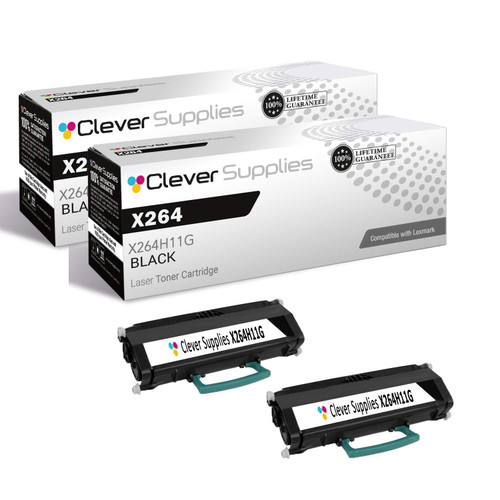
The pair earns the lead on arithmetic rather than habit. Two singles bought apart come to $137.06, so the box hands back $16.08 before a page is printed, and each cartridge inside it works out to $60.49 against $68.53 bought alone. Stepping up to the 4-pack saves only about four hundredths of a cent more per page — worth having at volume, but no reason for a quieter office to stock four cartridges deep. One in the machine and one on the shelf is the arrangement this platform’s owners actually live with, and this is the box that provides it.
Shop the X264H 2 Pack →THE OTHER TWO BOXES

The lowest page rate on the shelf, bought with the largest single outlay — about thirty-six thousand rated pages, enough to carry a busy multifunction through a long stretch without a reorder. Four singles bought one by one would total $274.12.
Shop the X264H 4 Pack →
The shelf’s smallest commitment and its dearest page — the right box for a lightly used machine, or for a first order before a pack has justified itself. The full high-yield rating rides in it either way; nothing about the cartridge shrinks when it is bought alone.
Shop the X264H Single →All three cards fit the same four printers, so the choice among them is purely one of rhythm: how often the office would rather think about toner. The table below converts each box into a per-page figure.
Three boxes, priced by the page
A box’s rate is its sale price spread across the rated yield of everything inside it. With a single code stocked, the table has no tier step to price — the rungs climb by pack size only — and the fit column is identical on every row, because Lexmark attaches no model restriction to this cartridge at all.
| Offer | Sale price | Rated pages per box | Per-page cost | Fits |
|---|---|---|---|---|
| X264H 4 Pack | $225.88 | 4 cartridges · ~36,000 pages | 0.63¢ | All 4 platform models |
| X264H 2 Pack — the flagship | $120.98 | 2 cartridges · ~18,000 pages | 0.67¢ | All 4 platform models |
| X264H Single | $68.53 | 1 cartridge · ~9,000 pages | 0.76¢ | All 4 platform models |
Thirteen hundredths of a cent separate the dearest row from the cheapest — 0.76¢ against 0.63¢ before rounding — and most of that gap is won at the first step, from single to pair. Counted per cartridge, the boxes hold theirs at $60.49 inside a 2-pack and $56.47 inside a 4-pack, against $68.53 for one bought alone. No row is a trap: the rates sit close enough that a buyer should choose by how much printing the office does between orders, not by fear of overpaying on any particular box.
Fit: four models, and every record agrees
Lexmark scopes this cartridge to four multifunction models, all of them under the Lexmark X Series: the X264dn, the X363dn, the X364dn and the X364dw. Each name links to that model’s category page in this store, and the three listings are filed under all four. No restriction footnote attaches to the cartridge for any of them — not for the stocked high-yield code, and not for the standard code either — so there is no fence on this platform for a buyer to fall foul of.
What makes the family worth a sentence is how completely the store’s own record lines up behind that roster. The category filing names the four models and the three series pages above them. The fit paragraphs in the two pack listings enumerate the same set. The Compatible Printers link blocks carried on all three products link exactly those seven destinations — four models, three series — no more, no fewer. And the fit answers inside the listings’ questions repeat the enumeration without trimming it. On shelves elsewhere in this series, at least one of those surfaces usually wanders; here none does, and a buyer who cross-checks any two of them will get the same answer twice.
One neighbouring line does need separating, because it shares this platform’s engine generation and even its photoconductor kit. The X463de, X464de and X466 machines are not X264 fits: Lexmark gives them a cartridge family of their own, no surface in this store claims them for the X264H11G, and nothing on this page is offered for them. If the badge on the machine carries one of those numbers, this shelf is not its supply, however similar the hardware underneath may be.
One rating everyone states — and a ladder nobody stocks
Yield is the other quiet subject in this family. The structured yield field on all three listings reads 9,000 pages for black; the descriptions repeat the figure and carry it honestly into their pack totals, 18,000 pages inside the 2-pack’s box and 36,000 inside the 4-pack’s; and Lexmark’s own page for the cartridge declares the same 9,000, expressly under ISO/IEC 19752, the measurement standard every figure in this guide rests on. Field, prose and manufacturer land on one number, so no reconciliation is needed and none is performed: about 9,000 pages is the rating, full stop.
Behind that single stocked code, Lexmark’s ladder for the platform has a second rung, and both rungs were sold two ways. The standard cartridge, rated at about 3,500 pages, is the X264A11G in the Return Program and the X264A21G sold outright as the Regular. The high-yield rung pairs the stocked X264H11G with a Regular twin, the X264H21G, at the same 9,000-page rating. Of those three companion codes, this store lists none — not in a single, not in any pack — and no description in the family mentions any of them, so a buyer reading only the product pages would never learn the platform had a cheaper, shorter cartridge at all. The stocked high-yield is roughly two and a half times the standard’s rating; whether a 3,500-page cartridge at a lower ticket would suit a given office better is a choice the shelf simply does not offer.
The label on the cartridge coming out of the printer settles which card above is yours. A label reading X264H11G is this shelf exactly. A label reading X264H21G names the unstocked Regular twin — same rating, same four printers — and the stocked Return Program code is its replacement here. A label reading either standard code means the machine has been running 3,500-page cartridges; the stocked cartridge is the long step up from there, and it fits the same four models.
Against Lexmark’s own list price
The genuine figure used in this guide comes from one document and is labeled every time it appears: the Texas DIR list, the price schedule Lexmark publishes for US institutional buyers and hosts on lexmark.com, dated July 25, 2024. In that list the genuine X264H11G carries a price of $391.12 — a list price (MSRP), not a checkout price, since Lexmark’s US retail store returned none for this discontinued part and shows it out of stock or on back-order. Set against the compatible single at $68.53, the genuine cartridge lists at well over five times the money — under a fifth of the list price buys the compatible — or, page for page, 4.35¢ genuine against 0.76¢.
Worked in blocks of ten thousand pages, the shelf answers about $76 bought as singles, about $67 in 2-packs and about $63 in 4-packs, where the same block at the genuine list price runs to roughly $435. An office printing ten thousand pages a month would spend about $5,215 a year on genuine cartridges at list; the same pages at the compatible 4-pack rate come to about $753 — a difference in the region of $4,460 a year, on a platform whose printers have already given a decade and a half of service.
One caution before any of this is set beside the product pages: their savings and per-page sums are worked from list prices rather than from the prices at checkout. The single’s text, for instance, prices the cartridge at $78.81 and lands near 0.88¢ a page; start from the $68.53 actually charged and the rate is the 0.76¢ used throughout this guide. The closing note works through each listing’s figures in turn.
A second consumable, and the starter in the box
Toner is only half of this platform’s running costs. The image is formed on a separate photoconductor kit, Lexmark’s E260X22G — one part shared across the E260, E360, E460 and X-series lines of the same generation — and the cartridges above carry no drum inside them, so none of the kit’s life is bundled into their ratings or their prices. Lexmark rates the kit at up to 30,000 pages, a little over three of these cartridges’ rated lives, and the printer itself warns as the kit nears its limit. This store does not stock the kit, and no listing in the family mentions it; its Texas DIR list price (MSRP) of $53.26 is printed here for one reason only — so the platform’s other consumable can sit in the budget from the start instead of arriving as an unexplained warning on the display.
Lexmark also documents what each machine starts life with, and the answer is not the same across the four models. The X264dn ships with a Return Program starter cartridge rated at up to 1,500 pages — less than half the standard retail rung’s 3,500 — so its first replacement arrives early in the machine’s life. The X363dn, X364dn and X364dw each ship with a 3,000-page starter, just under that standard rung. Either way, the cartridge a machine is born with is the shortest it will ever hold; the first full cartridge, at 9,000 pages, is a three- to six-fold step up in stamina.
Chips and firmware: a claim the packs make and the single doesn’t
No specification field on this shelf covers chips, so whatever is said lives in the descriptions’ prose — and the prose is not uniform. The 2-pack and the 4-pack share a boilerplate passage describing cartridges built entirely from new parts, a smart chip named among the OPC drums and wiper blades, with the added assurance that running these cartridges does not void the printer’s warranty. The single’s description carries no such passage: it opens with a keyword line and moves straight to its questions, making no chip claim at all. Firmware goes unmentioned in all three listings — nothing promised about it, nothing warned against it — and this guide reports that split exactly as found rather than smoothing it over.
One mechanism in this story is Lexmark’s alone, and it belongs to the genuine program rather than to anything sold here. Lexmark’s own page for the genuine X264H11G describes its Return Program cartridges as licensed for a single use, engineered to stop once a fixed amount of toner has been delivered, and designed to update the printer’s memory as a guard against counterfeit and unauthorized cartridges. Those terms, by their own wording, attach to Lexmark’s genuine Return Program cartridges. The compatibles carded above are sold under this store’s terms, and no dynamic-security regime of the kind some newer platforms run is documented for these machines — none is described here, because none exists to describe.
What backs each cartridge
Choosing by volume — the only choice there is
Answers for the X264, X363 and X364 owner
Four models, and only four: the X264dn, X363dn, X364dn and X364dw. Lexmark’s user guide for the platform is scoped to exactly those machines, its cartridge pages name the same four, and no restriction attaches to the cartridge for any of them — the standard code fits all four too, so the roster does not change by tier. The store’s record matches that roster on every surface this guide checked: category filing, fit paragraphs, printer link blocks and the answers inside the listings. The neighbouring X463, X464 and X466 machines are not on it; they take a cartridge family of their own.
In Lexmark’s catalog, both. A standard rung rated at about 3,500 pages exists as the X264A11G (Return Program) and the X264A21G (Regular), and the stocked cartridge has a Regular twin, the X264H21G, at the same 9,000-page rating. In this store, none of the three has a listing in any pack size, and no product page in the family mentions any of them. The Return Program high-yield cartridge carded above is the platform’s sole representative on this shelf, so depth here is a matter of pack size, never of tier.
A Return Program starter, and its size depends on the model, per Lexmark’s own printer pages. The X264dn leaves the factory with a starter rated at up to 1,500 pages — less than half the standard retail cartridge — so its first replacement comes early. The X363dn, X364dn and X364dw ship with 3,000-page starters, a shade under the standard rung. Whichever machine you run, the starter is the shortest-lived cartridge it will ever hold; the stocked 9,000-page cartridge is the first full one.
No. The kit is a separate, printer-side part — Lexmark’s E260X22G, shared with the E260, E360 and E460 lines — which Lexmark rates at up to 30,000 pages. The toner cartridges contain no drum, so none of that life sits inside their 9,000-page rating or their prices, and the two parts run down on independent clocks. The kit is not stocked in this store and no listing mentions it; Lexmark’s Texas DIR list prices it at $53.26 (MSRP), a figure given here so the expense can be anticipated rather than met as a surprise.
For Lexmark’s genuine cartridges, the program is a license: the cartridge is sold for a single use, is designed to stop after delivering a fixed amount of toner, and is designed to update the printer’s memory against counterfeit and unauthorized cartridges. Those are the terms Lexmark attaches to its own X264H11G. The cartridges carded here are Clever Supplies compatibles sold under this store’s own terms — a year of warranty cover and free returns through that year — whichever program code they carry. One honest wrinkle, recorded rather than smoothed: the two packs’ boilerplate names a smart chip among the cartridge’s new parts, while the single’s description makes no chip claim at all.
Because the two sets of sums begin from different prices. The listings reckon from list prices; this guide reckons from what a buyer is charged at checkout. On the 2-pack’s page, the pair is presented at its $139.13 list price — $69.57 a cartridge, an $18.49 saving, about 0.77¢ a page. At sale prices — $120.98 for the pair, two singles at $137.06 — the cartridge costs $60.49, the saving is $16.08 and the rate is 0.67¢. The single and the 4-pack show the same pattern in their questions and About text, and the note below documents each instance.
Price and disclosure note: Every price printed here is the sale price from that product’s own storefront page, verified title by title on November 17, 2026 and confirmed live once more just before this guide went up. Each listing also shows a higher list price; should a promotion end, the product page is what governs. A pack’s SAVE figure is the gap between its sale price and the cost of its cartridges bought singly at sale prices — $137.06 for two singles and $274.12 for four — giving badges of $16.08 and $48.24. Genuine figures are sourced where they stand: the $391.12 for a genuine X264H11G is the MSRP in Lexmark’s official US price list — the Texas DIR schedule of July 25, 2024, hosted on lexmark.com — and the kit’s $53.26, together with the unstocked codes’ reference figures ($202.66 for the X264A11G, $245.66 for the X264A21G, $434.12 for the X264H21G), comes from that same schedule. No checkout price for the stocked code could be obtained from Lexmark’s US retail store, so none appears. On yields there is nothing to choose between: listing fields, listing texts and Lexmark’s ISO/IEC 19752 declaration coincide at about 9,000 pages for the stocked code, while the standard rung’s 3,500 pages rest on Lexmark’s record alone. Fit follows the ordering table in Lexmark’s platform user guide, backed by its cartridge pages. Measured against that record, the store’s surfaces depart in two recorded respects. First, price basis: the listings do all of their savings and per-page arithmetic on list prices. The single is figured at about 0.88¢ a page off its $78.81 list price, where the $68.53 actually charged gives 0.76¢. The 2-pack claims an $18.49 saving and $69.57 a cartridge at about 0.77¢, where sale prices produce a $16.08 saving, $60.49 a cartridge and 0.67¢. The 4-pack claims $55.48 saved and $64.94 a cartridge at about 0.72¢, where sale prices produce $48.24, $56.47 and 0.63¢. In each case the arithmetic itself is sound; it is the starting price that misleads. Second, silence: no listing names the family’s other three codes or the platform’s photoconductor kit, so neither the cheaper standard cartridge, nor the Regular twins, nor the printer’s second consumable can be learned from the product pages at all.
Nothing has been held back from the cards above: the family is three listings, one per pack configuration, with no duplicates, and each is carded exactly once. Nothing else from Lexmark’s ladder for this platform is stocked, in any size: not the standard codes X264A11G and X264A21G, and not the Regular high-yield twin X264H21G. The photoconductor kit (E260X22G) appears as background only, not being stocked here; Lexmark rates it at up to 30,000 pages, and its $53.26 figure is a list price drawn from the same Texas DIR schedule. Starter figures come from Lexmark’s own printer pages: a 1,500-page Return Program starter in the X264dn, 3,000-page starters in the other three models. On structure, one listing departs from the family’s shared template: the single opens with a keyword header and goes straight to its questions, carrying no fit paragraph, no warranty boilerplate and no chip claim in its introduction, though its answers still state the one-year warranty and free returns. On chips, no listing carries a specification field; the smart-chip line appears in the two packs’ boilerplate only, and firmware is mentioned nowhere. One catalog question is recorded without being settled here: the store keeps a visible category for an X264dnw, but no product in this family is filed under it and no Lexmark compatibility list retrieved for this cartridge names such a model, so the roster above follows Lexmark’s documented four. All three SKUs in the family are clean, and the words “genuine” and “authentic” appear nowhere in its product wording. The cover behind each offer is the one its own listing promises: twelve months of warranty against defects in materials and workmanship, and returns free for that first year.