




Two part numbers, one cartridge rating, one price. The E260A family feeds Lexmark’s E260, E360 and E460 monochrome lasers, and the shelf for it holds a pairing no other family in this wave repeats: the same standard-yield cartridge stocked under both of Lexmark’s sales programs — E260A11A, the Return Program code, and E260A21A, the Regular code — each in a single, a 2-pack and a 4-pack, six listings and six distinct products with not one duplicate among them. The twins match on everything a buyer can measure here: the same rated yield of about 3,500 pages under ISO/IEC 19752, the same whole-platform fit, and prices identical to the cent at all three pack sizes. What separates them is the program behind the code — a distinction Lexmark’s own list prices price at $43.00 and this store’s compatibles erase entirely. This guide explains the pairing, prices all six boxes on the prices actually charged, and records the two things no listing mentions: the longer cartridges Lexmark makes for the bigger machines on this platform, and the wider roster of models the cartridge fits beyond the eight the store names.
Read the code on the cartridge you are replacing, then buy its twin in the depth your volume justifies — and know that on this shelf the choice of code costs nothing either way. Both part numbers carry the same rating, fit the same printers and are priced identically at every size, so the flagship E260A11A 2-pack at $168.31, roughly seven thousand rated pages at 2.40¢ each, leads this guide on Lexmark’s own ordering: the Return Program code is the platform’s primary US cartridge, the one Lexmark lists first and prices lower as a genuine part. The E260A21A 2-pack carded directly beneath it is the same purchase under the other code. Two cautions complete the short version. Nothing on this shelf runs longer than about 3,500 pages per cartridge — Lexmark builds 9,000- and 15,000-page cartridges for the E360 and E460 lines, but this store stocks neither, so depth here is bought in pack size, not in yield. And the roster runs wider than the listings say: the store names eight models, while Lexmark’s record covers the platform’s tray and duplex variants as well, as the fit section below sets out.
Two codes, one cartridge: the program twins
Lexmark sells this platform’s standard cartridge under two programs, and the part number is where the program shows. E260A11A is the Return Program cartridge. In Lexmark’s own description of the program, these are patented cartridges sold at a discount against the buyer’s agreement that each will be used once and returned only to Lexmark for remanufacturing or recycling, and they are designed to stop working after delivering a fixed amount of toner. E260A21A is the Regular cartridge — the same rating, sold outright, with no return attached. That license language belongs to Lexmark’s genuine Return Program cartridges; the compatibles on this shelf are Clever Supplies cartridges sold under the store’s own terms, and no return-to-Lexmark condition rides on them whichever code they carry. What the twinship means in practice is narrower and simpler: two order codes for one specification, and a buyer matching the code on a spent cartridge is matching a program label, not a different supply.
Lexmark prices the distinction. On its official US price list the genuine Return Program cartridge carries a $202.66 list price and the genuine Regular cartridge $245.66 — the $43.00 gap is the program discount, charged by the manufacturer itself. The compatibles erase it: a single is $92.19 under either code, a 2-pack $168.31 under either code, a 4-pack $320.53 under either code. So the one decision this family usually forces — pay more for the outright cartridge or accept the return program — is not a decision here at all. Pick the code your records already use, or the flagship’s code; the box that arrives is rated the same, fits the same and cost the same.
One naming quirk of the shelf deserves a sentence before the cards, because it can send a model-first shopper to the wrong stem. The store lists the Return Program code under listings named for the E260D and the Regular code under listings named for the E260. Both stems name members of the same platform, and neither limits the cartridge: an E260 owner holding an E260A11A cartridge is looking at the right supply on the E260D-named pages, and the reverse holds as well. The cards below are titled by code and pack, not by the stem a listing happens to wear.
The whole shelf: six boxes, two codes
Nothing below is a selection. Six listings exist for this family and all six are distinct products — each code in each of the three pack sizes, exactly once — so the cards that follow are the shelf entire, not a shortlist drawn from it. Two cards lead: the flagship, and beneath it its Regular twin, carded at the same prominence because on this shelf the twin is not a lesser offer but the same one under the other program. Where a badge appears — on the multi-packs only — it is always figured the same way here: what the pack saves against its own cartridges bought one at a time at the sale prices on this page. The listings figure theirs from list prices, a different starting point that produces different badges; the note at the foot of the page sets the two side by side.
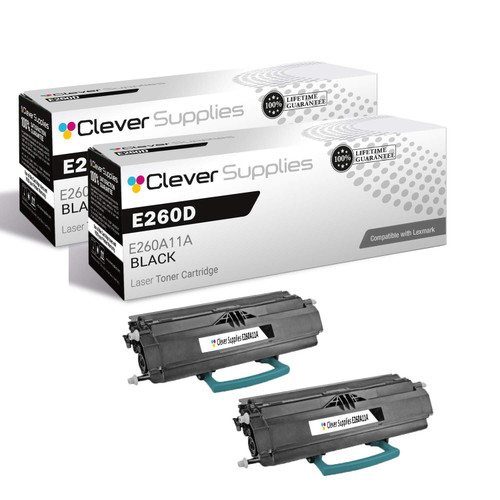
The lead here is convention, stated openly: this family stocks no yield tier above the standard rung, so there is no longer cartridge’s 2-pack to put first, and between the two identical 2-packs the Return Program code takes the flagship’s place on Lexmark’s own ordering. The pair is also the family’s sensible middle — the 4-pack below shaves eleven hundredths of a cent a page, but doubles the commitment on a 3,500-page cartridge, while two singles bought one by one would come to $184.38. One disclosure belongs on this card rather than in a footnote: this listing’s own product page is the family’s plainest, opening with a keyword header and going straight to its questions, with none of the boilerplate its five siblings carry — the cartridge and its terms are unaffected, and its answers still state the same one-year warranty and free returns.
Shop the E260A11A 2 Pack →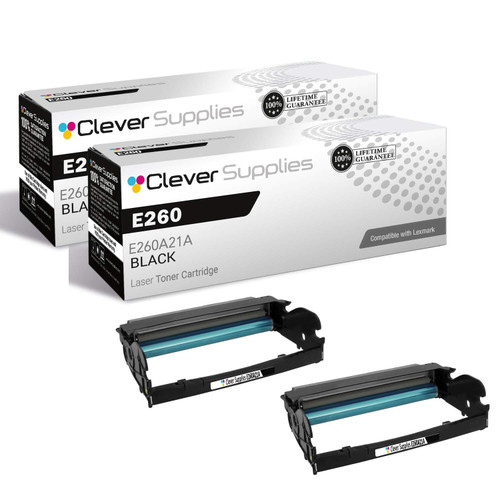
This card is not a consolation for buyers the flagship excludes — it excludes nobody. It exists because half the platform’s spent cartridges carry this code, and a buyer matching labels deserves the pair under their own number at the same prominence. Nothing is gained or lost between the two 2-packs: not a page of rating, not a model of fit, not a cent of price. If an office standardizes its records on the Regular code, this is its box; if it has no preference, the flagship above is the default.
Shop the E260A21A 2 Pack →THE REST OF THE SHELF

The Return Program code bought one at a time — the smallest outlay on the shelf and its most expensive page, for a machine that prints lightly or a first cartridge after a printer changes hands.
Shop the E260A11A Single →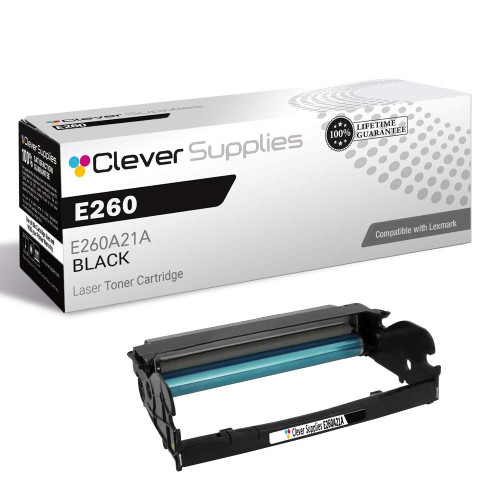
The Regular code’s single, at the same $92.19 as its twin — the one-off replacement for a spent E260A21A, with the packs below standing by when one cartridge stops being enough.
Shop the E260A21A Single →
The cheapest page on the shelf and its deepest box — the stocking choice for a machine that works daily, or for several machines drawing on one code. Four singles bought separately would total $368.76.
Shop the E260A11A 4 Pack →
The Regular code at the shelf’s best rate — the same 2.29¢ a page as its twin’s 4-pack, for offices whose records, labels and habits run on E260A21A.
Shop the E260A21A 4 Pack →Read the cards in pairs. At every size the two codes sit side by side at one price, so the shelf’s only real gradient is depth: singles at the top rate, pairs in the middle, fours at the bottom. The table in the next section puts all six rates in a single rank, and the fit section after it settles which machines any of them may serve.
Six boxes, three rates
To get a rate, take what a box costs at its sale price and spread it over the rated pages of every cartridge inside. The table’s shape is the family’s story in miniature: the two codes never separate, so the ranking runs in three tied steps — one per pack size — and the only column that changes as you move down is the commitment, not the cartridge.
| Offer | Sale price | Rated pages per box | Per-page cost | Program |
|---|---|---|---|---|
| E260A11A 4 Pack | $320.53 | 4 cartridges · ~14,000 pages | 2.29¢ | Return Program |
| E260A21A 4 Pack | $320.53 | 4 cartridges · ~14,000 pages | 2.29¢ | Regular |
| E260A11A 2 Pack — the flagship | $168.31 | 2 cartridges · ~7,000 pages | 2.40¢ | Return Program |
| E260A21A 2 Pack — the twin | $168.31 | 2 cartridges · ~7,000 pages | 2.40¢ | Regular |
| E260A11A Single | $92.19 | 1 cartridge · ~3,500 pages | 2.63¢ | Return Program |
| E260A21A Single | $92.19 | 1 cartridge · ~3,500 pages | 2.63¢ | Regular |
Two steps do all the work. Moving from a single to a 2-pack saves twenty-three hundredths of a cent on every page; moving on to a 4-pack saves eleven hundredths more. In cartridge terms the packs pay $84.16 apiece inside a pair and $80.13 apiece inside a four, against $92.19 bought singly — the pack arithmetic is the only discount this family offers, and it is the same under both codes.
What the table cannot show is a yield step, because the shelf has none: every row divides by the same 3,500-page rating. On platforms where a high-yield tier is stocked, the table’s cheapest rows belong to the longest cartridge; here the longest cartridge Lexmark makes for these machines is simply absent, and the next section names it.
Fit: one platform, stated wider than the store states it
Both stocked codes fit the whole platform — that much is uncomplicated. Lexmark’s ordering table for the E260 series attaches no model restriction to either code inside the platform, its own pages for both cartridges title them for the E260, E360 and E460 lines together, and its North America compatibility table prints the same fit. The store’s eight named models sit under the Lexmark E Series: the E260, E260D and E260DN; the E360 and E360DN; and the E460, E460DN and E460DW. (The plain E360 and E460 categories are series-level names; Lexmark’s model lineups are the suffixed variants.) Every model name in this paragraph links to its own category page on this store.
Lexmark’s platform, however, includes the tray and duplex variants of those same series, and the cartridge fits them on the same record: the E260dt and E260dtn; the E360D, E360dt and E360dtn; and the E460D, E460dtn and E460dtw. Those eight models hold visible category pages in this store — linked above — yet no listing files under them and no surface on any product page names them: the filing, the fit paragraphs, the printer link blocks and the question answers all stop at the same eight names. The store’s surfaces agree with each other completely; they simply sit one step narrower than Lexmark. An E360d or E260dtn owner who trusts a product page concludes the cartridge is not for their machine. Per Lexmark, it is — and this guide follows Lexmark.
One further model belongs in prose, because it has no category page to link: the E462dtn, which Lexmark’s price-list scope for these codes and its E460-series user guide both place on this platform. It takes the same standard cartridge on the same record. No store surface names it; the guide names it here so its owners are not left to guess.
The ladder Lexmark built — and the rung this shelf stops at
On yield, every witness agrees. The listings’ yield fields read 3,500 pages for all six products, their texts state the same figure and its pack totals — 7,000 pages in a 2-pack box, 14,000 in a 4-pack — and Lexmark declares the identical rating for both codes on its own cartridge pages, in its compatibility table and in its price-list descriptions, all under ISO/IEC 19752. There is no split to reconcile and no figure in this guide rests on a single source: 3,500 pages is the rating, for both twins, everywhere.
But 3,500 pages is the bottom of Lexmark’s ladder for this platform, not the whole of it. Above the stocked rung sit two more, each in its own pair of program twins: a high-yield cartridge, E360H11A / E360H21A, rated at about 9,000 pages and fenced to the E360 and E460 lines — it does not fit the E260 series — and an extra-high cartridge, E460X11A / E460X21A, rated at about 15,000 pages and fenced to the E460 line alone. This store stocks none of the four: no listing exists for any of them, in any pack size, and no product page in this family so much as mentions them. The fences matter in one direction only — they fence nothing that is sold here, since both stocked codes fit everything — but an E460 owner deserves to learn from this page that Lexmark makes a cartridge rated more than four times the stocked one for their machine, rather than leave believing 3,500 pages is the platform’s ceiling. Depth on this shelf is bought with pack size because pack size is the only depth offered.
The spent cartridge’s label settles which card is yours. If it reads E260A11A or E260A21A, its match is above, under the same code or its twin. If it reads one of the higher codes — E360H or E460X, in either program — this store cannot replace it like for like, and the stocked standard cartridge is the fallback its machine also accepts. Regional suffix variants of the stocked codes (the E, P and L suffixes Lexmark lists for other markets) are not US codes and are not stocked; a contract-channel GSA variant exists in Lexmark’s price lists and is likewise absent here.
Against Lexmark’s own list prices
Every genuine figure in this section traces to one document: the Texas DIR price list, Lexmark’s official US price list, hosted on lexmark.com — which makes them list prices (MSRP), and they are flagged as such wherever this guide uses them. Lexmark’s US retail store offered no checkout price to set against them; its cartridge pages for both codes show the parts out of stock instead. On that basis the genuine Return Program cartridge lists at $202.66 against $92.19 for the compatible single — under half the list price, or 5.79¢ a genuine page against 2.63¢. The genuine Regular cartridge lists at $245.66 against the same $92.19 — a little over a third of the list price, 7.02¢ a page against 2.63¢. The twins’ $43.00 separation exists only on the genuine side of the comparison; the compatible side holds them level.
Price ten thousand pages at a time and the compatible shelf answers with three figures, the same under either code: about $263 when the pages are bought as singles, about $240 in the 2-packs, about $229 in the 4-packs. The same ten thousand pages at genuine list prices come to roughly $579 under the Return Program code and roughly $702 under the Regular. Held at ten thousand pages a month, the genuine Return Program cartridge at list would run to roughly $6,950 a year, where the compatible 4-pack rate brings the same pages to about $2,750 — a difference on the order of $4,200 a year, before the Regular code’s higher list price widens it further.
A caution before comparing any of this with the product pages: their savings and per-page sums are worked from list prices, not from the sale prices a buyer is charged at checkout. The singles’ texts arrive at about 3.03¢ a page from a $106.02 list price, where the $92.19 sale price gives the 2.63¢ used here; the 2-packs report an $18.48 saving where sale prices make it $16.07; the 4-packs report $55.46 where sale prices make it $48.23 — and that figure is a cent short even on its own list basis. The closing note works through the family’s figures in full.
The kit behind the cartridge — and the first cartridge
Toner is not this platform’s only consumable. The image is formed by a separate photoconductor kit, Lexmark’s E260X22G. Cartridge and kit come out of the printer as a unit but are replaced independently, and since the cartridges above contain no drum, none of the kit’s life is counted inside their ratings or their prices. Lexmark puts the kit’s life at up to 30,000 pages, declared on a job-average footing of its own — an average of three pages per job at about five percent coverage — rather than the ISO cartridge basis behind the toner figures. This store sells no photoconductor kit for the platform. Lexmark’s Texas DIR list prices it at $53.26, a figure carried here for one reason: so the platform’s second consumable can be planned for. It falls due far less often than toner, and when its turn comes, no toner order covers it.
Of the cartridge a new machine ships with, this guide prints nothing — because no figure could be retrieved to print. The platform user guide’s ordering sections and Lexmark’s cartridge and printer pages consulted for this guide state no ships-with rating for any E260, E360 or E460 model, and rather than borrow a number from a third-party manual mirror, the guide leaves the starter unrated. What fills the machine after it is the shelf above, at the ratings stated there.
The chip line, and where it is missing
This shelf carries no chip field among its specifications; what is said about chips is said in prose, and the prose divides five listings against one. Five share a boilerplate passage describing units built entirely from new parts — a smart chip named among the OPC drums and wiper blades — and adding that a printer’s warranty survives the use of these cartridges. The exception is the flagship’s own listing: the E260A11A 2-pack carries no boilerplate at all, so it makes no chip claim in its introduction — a gap in the listing’s text, recorded here as found, and the same outlier pattern this wave has met on one other family’s 2-pack. Firmware is mentioned nowhere in the family, in either direction: no listing promises anything about future firmware, and none warns of any.
The one chip-adjacent mechanism worth naming belongs to Lexmark’s genuine program, not to these cartridges. Lexmark describes its genuine Return Program cartridges as designed to stop working after delivering a fixed amount of toner — the enforcement behind the return agreement. That design is Lexmark’s, attached to its own E260A11A; the compatible cartridges above are sold under this store’s terms, and the program distinction between the two codes is, for them, a matter of the label and the order code only. There is no dynamic-security regime on this platform to describe, and this guide does not invent one.
What backs each cartridge
Start from the label on the spent cartridge
Answers for the E260, E360 and E460 owner
The sales program, and nothing measurable. E260A11A is Lexmark’s Return Program code — for genuine cartridges, a discounted price against the agreement that the cartridge is used once and returned to Lexmark, with the cartridge designed to stop after a fixed amount of toner. E260A21A is the Regular code, sold outright. Both are rated at about 3,500 pages under ISO/IEC 19752, both fit the whole platform, and in this store both are priced identically at every pack size. The compatibles carry neither Lexmark’s license nor its return condition; they are sold under the store’s own one-year terms under either code.
The whole E260, E360 and E460 platform, on Lexmark’s record. This store names and files eight models — E260, E260D, E260DN, E360, E360DN, E460, E460DN and E460DW — and Lexmark’s ordering table, cartridge pages and compatibility chart extend the same fit to the platform’s variants: E260dt, E260dtn, E360D, E360dt, E360dtn, E460D, E460dtn and E460dtw, which hold category pages here, plus the E462dtn, which has none. Neither stocked code carries a model restriction anywhere in that record.
Yes, on the manufacturer’s record. Every surface on these product pages — the category filing, the fit paragraphs, the printer link blocks and the question answers — names the same eight models, and the variant models are absent from all of them. The surfaces agree with each other; they are simply one step narrower than Lexmark, whose documentation covers the platform including its tray and duplex variants. This family’s fit defect is understatement, the reverse of the overstatement found elsewhere in this wave, and the guide follows Lexmark: your machine takes either stocked code.
In Lexmark’s line, yes — two of them. The E360H codes are rated at about 9,000 pages for the E360 and E460 lines, and the E460X codes at about 15,000 pages for the E460 line alone, each in Return Program and Regular twins. This store stocks none of the four, in any pack size, and no listing mentions them. Until that changes, the stocked shelf tops out at about 3,500 pages per cartridge for every model on the platform, and the 4-packs are how depth is bought here.
Because the $43.00 between them is program pricing, and it lives on Lexmark’s genuine list: $202.66 for the Return Program cartridge against $245.66 for the Regular, the discount being the value Lexmark puts on getting its cartridge back. The compatible shelf prices the two codes as what they are here — the same cartridge specification from the same supplier — and holds them level to the cent at $92.19, $168.31 and $320.53. A buyer gains no pages and loses no rights by choosing the code on their spent cartridge’s label.
No — on this platform the kit is a separate, printer-side part: Lexmark’s E260X22G, which Lexmark rates at up to 30,000 pages on a job-average footing (three pages per job at about five percent coverage). Nothing drum-shaped sits inside the toner cartridges, so neither their ratings nor their prices carry any of the kit’s life; the two parts come out of the printer together but are replaced on their own schedules. This store does not stock the kit. Lexmark’s Texas DIR list prices it at $53.26, and it is named here so the cost is not a surprise when it falls due.
The two sets of figures begin from different prices. The product pages work from list prices; this guide works from the sale prices a buyer actually pays. On the 2-packs’ pages, two singles at list ($212.04) are set against the pack’s list price ($193.56) to report an $18.48 saving and about 2.77¢ a page; at sale prices — $184.38 against $168.31 — the saving is $16.07 and the rate 2.40¢. The 4-packs report a $55.46 saving that is a cent short even on its own list basis — four singles at list are $424.08, making the list-basis saving $55.47 — where sale prices give $48.23. All six listings follow the pattern; the closing note below documents it in full.
Price and disclosure note: Every price printed in this guide is a sale price, read from the product’s own storefront page, matched title-by-title against its listing on November 17, 2026, and checked live once more ahead of publication. Each of the six listings also shows a higher list price over its sale price; should a sale end, the product page is the authority. A pack’s SAVE figure measures the pack’s sale price against the cost of its cartridges bought singly at sale prices — $184.38 for two singles and $368.76 for four, giving badges of $16.07 and $48.23 — and because the store prices the two codes identically, the same badges hold under both part numbers. Where a genuine Lexmark price is quoted, its source travels with it: the genuine E260A11A at $202.66 and the genuine E260A21A at $245.66 are list prices (MSRP) from the Texas DIR list of July 25, 2024 — Lexmark’s official US price list, hosted on lexmark.com. Lexmark’s US retail store returned no checkout price for either code, so none appears here. On yields, no source disagrees with any other: the listings’ yield fields and texts, Lexmark’s own pages for the two cartridges, its North America supplies compatibility table and its price-list descriptions all land on about 3,500 pages per code, under ISO/IEC 19752. Fit follows the ordering table in Lexmark’s E260-series user guide, backed by the same compatibility table and by Lexmark’s cartridge pages. Set against that record, the store’s surfaces depart from it in three respects, each recorded here. First, every surface understates the roster: the category filing, the fit paragraphs, the printer link blocks and the question answers all name the same eight models, while eight further visible categories — E260dt, E260dtn, E360D, E360dt, E360dtn, E460D, E460dtn and E460dtw — hold no filing from this family and are named nowhere, and the E462dtn that Lexmark documents has no category at all; the surfaces are consistent with each other and narrower than the manufacturer. Second, no listing states the family’s own structure: no cross-reference paragraph anywhere names the higher rungs (E360H11A / E360H21A at about 9,000 pages, E460X11A / E460X21A at about 15,000) or explains that the two stocked codes are program twins rather than different cartridges. Third, the listings’ savings and per-page math is computed on list prices throughout: the singles at about 3.03¢ a page where the sale price gives 2.63¢; the 2-packs saving $18.48 at about 2.77¢ where sale prices give $16.07 and 2.40¢; the 4-packs saving $55.46 at about 2.63¢ where sale prices give $48.23 and 2.29¢ — the $55.46 itself a cent short of the $55.47 its own list basis produces.
The six cards above are the family entire: zero duplicates, a complete grid of six configurations across the two codes, each listed exactly once under its cartridge name, and no listing carded twice here. Beyond the six, nothing in Lexmark’s ladder for this platform is stocked in any pack size: not the high-yield E360H11A or E360H21A, not the extra-high E460X11A or E460X21A, and not the contract-channel GSA variant. One description departs from the family’s shared template: the flagship listing itself, the E260A11A 2-pack, carries no boilerplate at all — it opens with a keyword header naming the eight models and goes straight to its questions, so it is the family’s only listing with no fit paragraph, no warranty boilerplate and no chip claim in its introduction, though its answers still state the one-year warranty and free returns. The other five descriptions share the boilerplate, including its line naming a smart chip among the cartridge’s all-new parts. Firmware is mentioned nowhere in the family. The photoconductor kit (E260X22G) appears as background only, not being sold here; its 30,000-page rating and its $53.26 figure are both Lexmark’s, the second of them a list price from the same Texas DIR list. No ships-with or starter rating was retrieved from a Lexmark source for any model on this platform, so none is printed. All six SKUs in this family are clean, and no “genuine” or “authentic” product wording appears anywhere in it. Every offer on this page carries the store’s standard compatible cover: twelve months of warranty against defects in materials and workmanship, and returns free for the first year.