




Lexmark built one high-yield cartridge for the Optra S workgroup printers and then sold it under two programs. The 1382925 is the Return Program version: the genuine cartridge went out at a discount, licensed for a single use, with the empty to be sent back to Lexmark. Its Regular sibling, the 1382625, is the identical supply sold outright, and it sits on a shelf of its own in this store. What is carded below is the Return Program shelf — one code stocked as a single cartridge, a pair and a box of four, priced under the Regular shelf at every size — although a reader of the product pages alone would never learn the program existed, because no listing breathes a word of it. The yield needs no detective work: fields, descriptions and Lexmark’s own table all land on 17,600 pages. Fit takes one clarification, given in its own section below: the store’s printer link blocks cover all nine Optra S models, while its prose, its answers and its category filing each stop at six.
Owners of the nine Optra S models — S 1250, S 1255, S 1620 and S 1625, S 1650 and S 1855, and the S 2420, S 2450 and S 2455 — are this page’s audience, and the 2-pack at $174.24 is its recommendation: roughly 35,200 rated pages at 0.50¢ each, with one cartridge spare against the day the working one fades. The 4-pack takes the rate down to 0.47¢ for heavier volume; the single at $95.16 is the cautious first purchase. Three things are worth carrying into the cards. First, the program: this is Lexmark’s Return Program cartridge, and the return-the-empty license Lexmark attached to it binds the genuine article only — the compatibles below are sold on this store’s ordinary warranty and returns terms. Second, the twin: the Regular 1382625 shelf stocks the same supply at higher prices, so a spent cartridge from either program can be replaced from this one. Third, the exception: the Optra Se 3455, same generation and same paper path, runs a different cartridge family and is not fed by anything on this page.
Three pack sizes of a single cartridge
Twenty-four listings wear this part number, yet they resolve to three boxes. The store re-lists the single, the 2-pack and the 4-pack under the machine type 4059 twice and under six individual printer names besides, at identical prices throughout — so the cards below take the 4059-named set as canonical and show each box exactly once; the other twenty-one listings are the same offers wearing other printers’ names. Badges marked SAVE appear on the two packs and nowhere else, and the saving is always computed the same way: the cartridges inside, bought singly at the sale prices on this page, less the pack’s own sale price. On the product pages the same comparison is run off list prices, which fattens each badge; the note at the end of this guide reconciles the two.
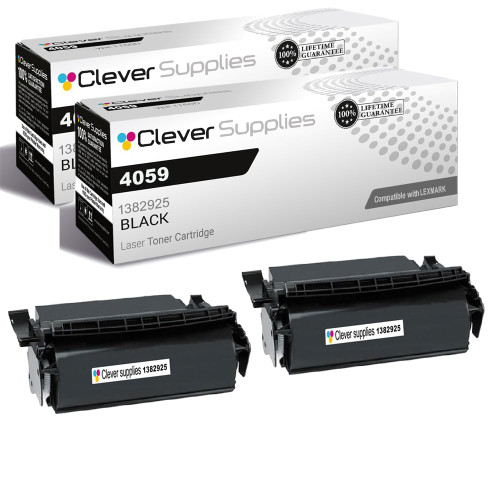
Why the pair and not the four-pack? Because the deeper box earns its discount slowly: it buys back barely two hundredths of a cent per page while tying up nearly twice the cash. Two singles bought apart would come to $190.32, so the pair hands $16.08 back at the till, and across two printers it divides cleanly — a cartridge apiece — while in a one-printer office it leaves the second unit sealed as insurance.
Shop the 1382925 2 Pack →THE OTHER TWO BOXES

The lowest page rate available for this platform, bought at the price of the largest single outlay — roughly seventy thousand rated pages under one lid. Purchased one cartridge at a time, the same four would total $380.64.
Shop the 1382925 4 Pack →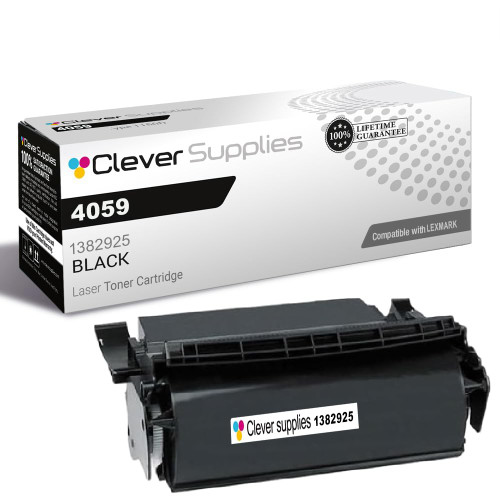
The entry point: the least money committed and the dearest page of the three, suited to a machine that prints in bursts or to a first order before a pack has justified itself. The rating inside is the full high-yield one.
Shop the 1382925 Single →Fit does not separate these cards — Lexmark assigns the cartridge to the same nine printers whichever box it travels in — so the comparison that matters is purely financial, and the table below states it per page.
What each box costs per page
The rate in the fourth column is nothing more exotic than the box’s sale price divided by the rated pages inside it, at 17,600 pages per cartridge. One code means one tier, so the rows can only be ordered by how many cartridges are bought at once; the fit column is a constant, because Lexmark hangs no model condition on this cartridge.
| Offer | Sale price | Rated pages in the box | Per-page cost | Fits |
|---|---|---|---|---|
| 1382925 4 Pack | $332.39 | 4 cartridges · ~70,400 pages | 0.47¢ | 9 models — the Optra S line |
| 1382925 2 Pack — the flagship | $174.24 | 2 cartridges · ~35,200 pages | 0.50¢ | 9 models — the Optra S line |
| 1382925 Single | $95.16 | 1 cartridge · ~17,600 pages | 0.54¢ | 9 models — the Optra S line |
From the dearest row to the cheapest, the entire spread amounts to less than seven hundredths of a cent — and the bulk of it, roughly five hundredths, is surrendered at the very first step, from a single cartridge to a pair. Priced per cartridge instead, the boxes work out at $87.12 inside a 2-pack and $83.10 inside a 4-pack, against $95.16 for one bought alone. No row punishes its buyer; the sensible question is how much printing stands between this order and the next.
Nine printers take it — the store’s pages name six
Lexmark’s supplies table assigns this cartridge to nine models, every one of them under the Lexmark Optra Series: the Optra S 1250, Optra S 1255, Optra S 1620, Optra S 1625, Optra S 1650 and Optra S 1855, and the Optra S 2420, Optra S 2450 and Optra S 2455 — the platform Lexmark numbered machine type 4059, and the name each model links to is its own category page in this store.
Now for the split this guide flagged in its opening. One of the store’s surfaces gets the roster exactly right: the Compatible Printers block carried on every listing links all nine models and the 4059 category besides. The other three surfaces stop short in unison. The introduction printed on all twenty-four listings names six models. The fit answers inside the listings name the same six. And the category filing places the products under those same six models’ pages — an owner of an S 1255, S 1625 or S 2455 who browses their own model’s category will find the Regular twin’s cartridge waiting there, but not this one, even though the missing three take the 1382925 on Lexmark’s word. It is the precise mirror of the twin family’s filing, which covers all nine models yet never the 4059 category this family does file under. Nothing anywhere in the family claims a printer Lexmark denies; the fault is omission, repeated on three surfaces out of four.
A relative also has to be fenced off, since it shares the generation, the paper path and half a name. The Optra Se 3455 does not use this cartridge: Lexmark feeds it from a separate smart-cartridge family, its 12A0725, 12A0825 and 12A0829 supplies, and no product page in this family pretends otherwise. Anyone whose machine carries the Se badge should shop that family, not this one.
17,600 pages, stated in full
Yield disputes have dogged this guide series, but this family gives nobody anything to dispute. The structured yield field on all twenty-four listings reads 17,600 pages for black. The descriptions say the same and multiply it faithfully into their pack totals — 35,200 pages in a 2-pack, 70,400 in a 4-pack. And Lexmark’s compatibility table rates the genuine 1382925 at 17,600 pages, so field, prose and manufacturer coincide to the page. Readers who have met the twin family will notice the contrast: over there, every store surface quotes 17,500, a hundred pages under Lexmark’s figure. On this shelf the understatement never happens, so the rates throughout this guide are worked on the full 17,600.
A dating caveat travels with the number, as it does for the whole platform. The 17,600 is a rating at roughly five percent page coverage from the late 1990s, printed under that basis in Lexmark’s table; it predates the ISO/IEC 19752 standard by which modern cartridges are measured. It can fairly be set against the platform’s own 7,500-page standard cartridge, rated the same way, and against the twin shelf’s identical figure — but not held up against a present-day ISO yield as though the two yardsticks were one.
Two programs, one cartridge: this code and its Regular twin
Lexmark’s Optra S toner ladder held two yields, each sold two ways. Down at about 7,500 pages sat the standard cartridge: the 1382620 sold outright, and the 1382920 under the Return Program. Up at 17,600 pages sat the high-yield pair: the 1382625 outright — the Regular cartridge — and the 1382925, this page’s code, under the Return Program. A fifth number, the 1382929, was a Return Program variant carrying a built-in label fuser cleaner for label stock, a media tool rather than a rung. Of those five codes the store stocks two, each on a shelf of its own: the Regular high-yield and this Return Program high-yield. Neither standard code, and not the label cartridge, has a listing in any pack size.
What separated the two stocked codes was never the cartridge. Both are rated at 17,600 pages, both serve the same nine printers, and a spent cartridge from one program is replaced perfectly well from the other shelf. The difference lived in the terms Lexmark sold the genuine article under: the Regular cartridge was bought outright, while the Return Program cartridge was discounted in exchange for a single-use license and the promise to send the empty back to Lexmark alone. That license, by its own wording, governs Lexmark’s genuine cartridge. It does not follow the compatibles carded here, which this store sells under its own warranty and returns terms whichever code they carry. The program still leaves one practical fingerprint on this shelf — price. Lexmark discounted the Return Program cartridge, and the pattern survives here: at every pack size this shelf undercuts the Regular shelf, $95.16 against $112.38 for a single, $174.24 against $208.69 for the pair, $332.39 against $401.30 for four.
Oddly, none of this reaches the product pages. Across all twenty-four descriptions the words Return Program never appear; nor does any listing mention the twin, the standard pair or the label cartridge. A buyer reading only those pages meets eight apparently distinct printer cartridges and no hint that two programs ever existed. The label on the cartridge being replaced is the reliable guide: 1382925 is this shelf; 1382625 is the twin’s shelf, same supply at higher prices; a standard code (1382620 or 1382920) means the machine has been running 7,500-page cartridges, and the stocked high-yield — more than double that rating — drops into the same nine printers.
The genuine price that isn’t there
No genuine figure is set against this shelf anywhere in this guide, because no genuine figure could be found that a buyer could act on. Lexmark discontinued the 1382925 decades ago; its US store gives the part no checkout price, and the Texas DIR schedule — the official US price list on lexmark.com, and the document behind the labeled genuine figures quoted for other families in this series — contains no Optra S entry at all. Rather than borrow a number from a marketplace listing or an old catalog, where the figure would be somebody’s asking price and not Lexmark’s, the guide quotes no genuine price, derives no genuine per-page rate and claims no saving against genuine.
The comparison the shelf does support is internal. Ten thousand pages run about $54 bought as singles, about $49.50 at the 2-pack’s rate and about $47 at the 4-pack’s. Carried across a 4-pack’s full rated span, the arithmetic sharpens: 70,400 pages accumulated one cartridge at a time cost $380.64, against $332.39 for the four-pack box. Pack against single at the prices checkout actually charges — that is the whole of the case, and it is enough.
The drum rides inside — and service waits at 250,000 pages
Budgeting for this platform is simple because the cartridge is the whole consumable. The drum that builds the image lives inside the print cartridge itself, and Lexmark’s compatibility table leaves the photoconductor row for the Optra S blank — there is no imaging unit to price, stock or schedule against the toner. A fresh cartridge therefore renews the image-forming surface along with the toner supply, and nothing else on the supplies side ever falls due.
What does fall due, eventually, is a service visit. At 250,000 pages the printer raises its scheduled-maintenance message for a kit built around the fuser, with transfer and charge rollers and pickup rollers, installed by a technician. This store does not sell that kit; no part number or price is quoted for it, none having been verified, and the interval is recorded so it is not a surprise. Measured in cartridges, the appointment sits about fourteen of these high-yield units in the future.
Built before cartridge chips existed
Modern buyers have been trained to interrogate a cartridge about its chip, but this platform predates the question. Lexmark’s 1998 user’s guide for the Optra S contemplates neither a cartridge chip nor any firmware lock. The listings here are equally silent: the word chip appears in none of the family’s twenty-four descriptions, and — unlike the twin family, whose shared boilerplate claims a smart chip among the cartridge’s parts — this family’s plainer template makes no chip claim of any kind. There is no lock present for a cartridge to defeat, and no update mechanism that could introduce one.
For the cartridges carded above, the store’s standing position applies: the supplier builds with the latest-generation components and its chipped products have given no trouble; the cartridges go in and print without any chip being transferred from the old one; and, as every guide in this series states, no undertaking is given about firmware still to come. On machinery of this vintage that limit is close to theoretical, since the printers were built before firmware cartridge locks were a thing at all.
What backs each cartridge
Choosing how deep to stock
Questions Optra S owners ask
Lexmark gives the cartridge to the whole Optra S line, machine type 4059: S 1250 and S 1255, S 1620 and S 1625, S 1650 and S 1855, and the S 2420, S 2450 and S 2455. Its North America compatibility table names that set of nine, and the printer link blocks on the product pages link the same nine. One caution: the answers inside the product pages, their introductions and the store’s category filing each stop at six names, passing over the S 1255, S 1625 and S 2455. On Lexmark’s record those three printers use this cartridge like any other on the list; the gap sits in the store’s text, not in the cartridge’s fit.
Program, and nothing else. Lexmark rated both cartridges at 17,600 pages and assigned both to the same nine Optra S models; what differs is how the genuine article was sold. The 1382625 went out outright, as the Regular cartridge. The 1382925 is its Return Program twin, discounted by Lexmark under a single-use license with the empty to be returned to Lexmark. That license governs Lexmark’s genuine cartridge; the compatibles on either shelf are sold under this store’s own terms. Both codes are stocked here on separate shelves, the Return Program shelf priced lower at every pack size, and a spent cartridge from either program can be replaced from either shelf.
No. Same Optra generation, same paper path — different supplies. Lexmark feeds the Se 3455 from a smart-cartridge family of its own, the 12A0725, 12A0825 and 12A0829, and no Lexmark source places the 1382925 in that machine. The store’s pages keep to the same line: their fit text names the nine Optra S models and nothing beyond them. A machine badged Se 3455 needs that other family, not this shelf.
Lexmark made one; this store doesn’t stock it. The standard rung, rated at about 7,500 pages, was sold outright as the 1382620 and in the Return Program as the 1382920, for the same nine models — but neither code is listed here in any configuration. Of the platform’s five Lexmark codes only the two high-yield ones are stocked, each on its own shelf, so the choice on this page comes down to pack size and program rather than tier.
Because the two shelves’ texts were written differently, not because the cartridges differ. Lexmark rates both genuine cartridges at 17,600 pages at approximately five percent coverage. This family’s listings repeat that figure in their yield fields and their prose alike. The Regular twin’s listings quote 17,500 everywhere — a hundred pages lower, about half of one percent — an understatement that runs in the buyer’s favor but is an understatement all the same. This guide works its rates on 17,600, the number the listings and Lexmark agree on. Both shelves’ figures are pre-standard ratings at roughly five percent coverage — not ISO/IEC 19752 yields — and are best read that way.
No separate purchase exists to make. The drum is sealed inside the print cartridge, so a cartridge change renews it, and Lexmark’s table names no photoconductor or imaging unit for the Optra S. The platform’s only other dated event is the 250,000-page maintenance kit, which is a technician’s service job rather than a supply a toner order needs to anticipate.
A choice of starting point explains the whole gap. The product pages do their sums from the struck-through list price; this guide does its sums from the price a buyer is actually charged. Take the single: its page divides $109.43 and lands at about 0.62¢ a page, where the $95.16 charged gives 0.54¢. The 2-pack’s page advertises an $18.48 saving against a real one of $16.08, and the 4-pack’s page claims $55.47 against a real $48.25. Nothing in their arithmetic misfires — the input price is what changes — and the note closing this page documents every instance.
Price and disclosure note: Prices were taken from the products’ own storefront pages on November 17, 2026, title-matched to the listings and re-checked live before this guide was published; they are sale prices throughout, the amounts checkout charges. (Each listing also shows a higher list price, and if a promotion ends the product page governs.) The SAVE badges come from setting a pack against its own cartridges bought one at a time at those sale prices: $190.32 for two singles and $380.64 for four, producing badges of $16.08 and $48.25. Genuine pricing is absent by necessity, not choice: no checkout price for this cartridge exists at Lexmark’s US store, and the Texas DIR list on lexmark.com — its official US price list — carries no entry for any part number in this family, so there is no genuine figure of record from which a genuine rate or a saving against genuine could honestly be built. Yield needs no adjudication here. Fields, listing texts and Lexmark’s North America supplies compatibility table all state 17,600 pages for the genuine cartridge; that shared figure is a rating at approximately five percent coverage from before the ISO/IEC 19752 standard, and it is never dressed up as an ISO yield in this guide. The standard rung’s 7,500 pages, by contrast, rest on Lexmark’s record alone, no listing stating them. Fit follows Lexmark’s documentation — the compatibility table and its cartridge pages — and against that record the store’s pages depart in two ways worth recording. First, price basis: the questions and About text across the listings run every saving and per-page figure off list prices. The single is worked from $109.43 to roughly 0.62¢ a page, where the $95.16 charged yields 0.54¢. For the 2-pack the claimed saving is $18.48, with $100.19 a cartridge at about 0.57¢ (list singles $218.86 against a $200.38 pack); at sale prices the saving is $16.08, with $87.12 a cartridge at 0.50¢. For the 4-pack the claimed saving is $55.47, with $95.56 a cartridge at about 0.54¢ (list singles $437.72 against a $382.25 pack); at sale prices it is $48.25, with $83.10 a cartridge at 0.47¢. The arithmetic is sound in each case; the starting price is the defect. Second, enumeration: introductions and fit answers name six models and the products sit filed under six models’ categories, while the family’s own printer link blocks name all nine — the S 1255, S 1625 and S 2455 dropped from three surfaces out of four, despite Lexmark documenting them for this cartridge.
Completeness, for this family, needs a sentence of definition. Twenty-four listings reduce to three configurations of one cartridge — single, 2-pack, 4-pack — re-listed under eight printer names at identical prices; the cards above use the 4059-named primary set, show each configuration once, and leave the twenty-one model-named re-listings uncarded. Nothing else from the platform’s ladder is stocked in any size: not the standard pair (1382620, 1382920), not the label cartridge (1382929). The Regular cartridge, 1382625, is stocked as a separate family with listings and a guide of its own; it is named here, and its shelf’s prices quoted, solely so the two programs can be compared, and it is not carded on this page. It should also be recorded that the store’s own prose never discloses the program at all — across all twenty-four descriptions the words Return Program occur zero times. There is no photoconductor or imaging unit to budget for on this platform, the cartridge being all-in-one, and the 250,000-page maintenance kit is a technician’s service item: no part number or price could be verified for it, so none is quoted. Likewise, no ships-with or starter yield could be retrieved from a Lexmark source for any model here, so none is printed. On chips the record is blank in a way worth noting: no specification field, no occurrence of the word chip in any of the twenty-four descriptions, no boilerplate smart-chip line of the kind the twin family carries, and no mention of firmware anywhere. The family’s one substantive SKU defect sits on the flagship itself, whose SKU reads “2Balck”. No product wording in the family claims to be “genuine” or “authentic”. Behind each offer stands the cover its own listing promises — a year’s warranty against defects in materials and workmanship, with returns free throughout that first year.