




Most two-tier ink families let any printer on the roster drink from either row, and the buyer simply picks a capacity. This family breaks that habit, and the break is the first thing to understand about it. HP builds two complete rows for its PageWide machines — the standard 972A, coded F6T80AN in black and L0R86AN, L0R89AN and L0R92AN in cyan, magenta and yellow, and the high-yield 972X, coded F6T84AN in black and L0R98AN, L0S01AN and L0S04AN in the colors — then restricts the second row by machine. The 972A cartridges fit every model in the nine-model roster below. The 972X cartridges fit only the seven PageWide Pro models among them; the PageWide 352dw and 377dw are confined to the standard row, a limit HP states on every high-yield cartridge page and confirms outright for the 377dw. Inside whichever row a printer is allowed, the arithmetic rewards the bigger cartridge handsomely: the step up costs a flat fifteen dollars at any station and returns close to triple the black rating and well over double the color rating, which cuts the cost of a black page from 2.57¢ to 1.05¢. Pricing inside each row is strikingly level — all four standard singles cost $89.99 apiece and all four high-yield singles $104.99, black included at exactly the color price — so there is no station-level bargain hunting to do. Eleven listings make up the shelf: a set of four in each tier, a nine-cartridge volume box in the high-yield row, and eight singles. The printhead never enters the budget; PageWide printing runs from a fixed array built into the machine, and these cartridges are pigment ink tanks that feed it.
Own a PageWide Pro and the 972X Set of 4 at $360.00 is the purchase this page is built around: 31,000 rated pages at 1.16¢ blended, $59.96 below the four high-yield singles bought separately. Own a PageWide 352dw or 377dw and skip straight past it — HP will not let those machines run the X row at all — to the 972A Set of 4 at $298.50, the only set your printer can use, holding 12,500 rated pages and saving $61.46 against its own singles. Pro owners printing in real volume should weigh the nine-cartridge X box at $796.50, whose 1.11¢ blended page is the cheapest in the family. Singles need no deliberation about price: every cartridge in a tier costs the same, black exactly level with the colors, so the standard black quietly becomes its tier’s cheapest page at 2.57¢ and the only genuine decision is which tier your printer permits.
The X set leads, the A set answers, volume and singles follow
The cards run in buying order rather than code order: the high-yield set first because it is the value peak of the family, the standard set directly behind it because for two of the nine roster models it is the only set that exists, then the nine-cartridge box, then the eight singles tier by tier. Both sets of four state their contents cartridge by cartridge, as does the nine-pack in its name and its FAQ. Read the fit line on every X-tier card before anything else on it — that row belongs to PageWide Pro machines only, and no saving is worth a box a 352dw or 377dw cannot open. Every price shown is the listing’s regular price; this family carries one price per product and no markdowns, and every saving badge is measured against the same cartridges bought as singles on this page.
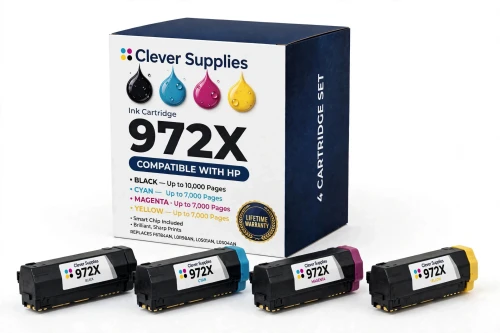
The restriction comes first, because it decides who may buy this card at all: HP limits high-yield cartridges to its PageWide Pro 400 and 500 series machines, so this set serves the 452dn, 452dw, 477dn, 477dw, 552dw, 577dw and 577z — and shuts out the PageWide 352dw and 377dw entirely. Set against genuine pricing, the case for Pro owners is stark. HP’s US store prices the four genuine X singles at $764.96 in total — $194.99 for the black, $189.99 for each color — and lists no genuine multipack for this family at all, so $360.00 for the same four stations at the same published ratings is the whole comparison: less than half the genuine outlay, with the standard set waiting underneath for the two models this box cannot serve.
Shop the 972X Set of 4 →THE OTHER TEN LISTINGS
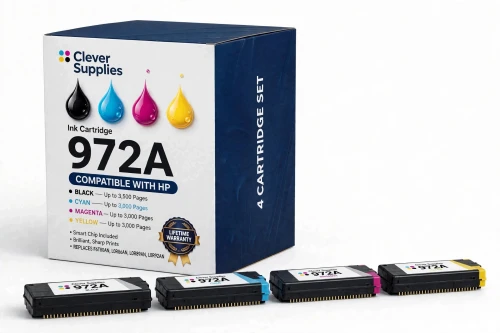
The universal set: the standard row is the one tier every model on the roster accepts, which makes this the only set a PageWide 352dw or 377dw owner can buy — and a perfectly sound restock for a lightly used Pro machine as well. Its $61.46 saving against the $359.96 singles total is the largest badge on the page, even though its per-page figure cannot match the X set above.
Shop the 972A Set of 4 →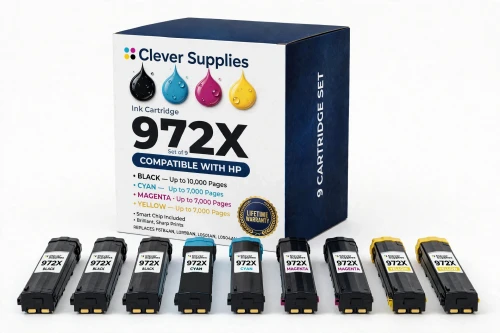
The volume box, composed the way office output actually falls — three blacks against two of every color — and the family’s cheapest page at 1.11¢ blended. Two qualifications ride with it: it is a high-yield box, so the PageWide Pro restriction applies in full, and it is also the shelf’s only source of spare blacks, since neither tier sells a black multi-pack. Its nine cartridges would total $944.91 bought as X singles.
Shop the Set of 9 →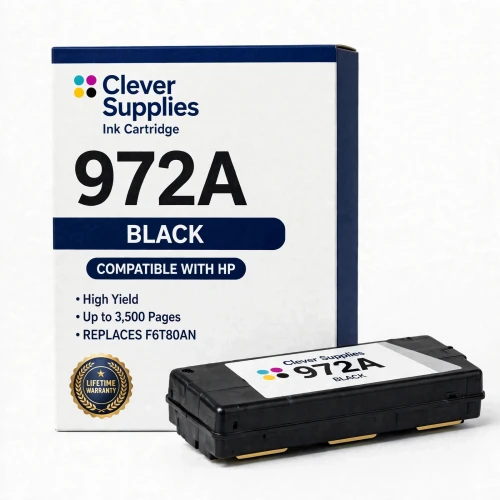
The standard black costs exactly what each standard color costs — $89.99 — yet carries the row’s highest rating, which quietly makes it the cheapest single page the A tier offers. It fits all nine roster models, and for a 352dw or 377dw it is the only black cartridge there is.
Shop the 972A Black Single →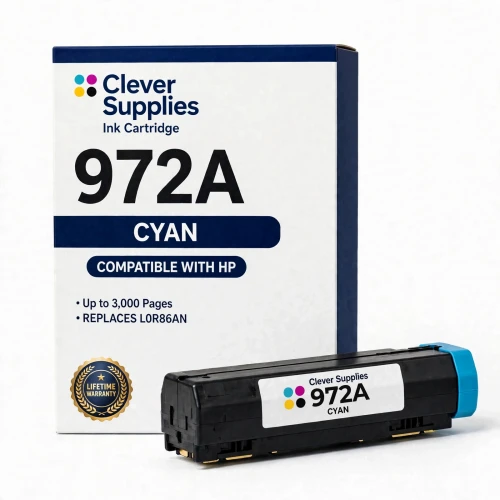
Standard cyan at the row’s shared $89.99, rated near 3,000 pages like its two color neighbors. Every model on the roster takes it; the choice it poses is purely the tier one, since the high-yield cyan further down more than doubles the rating for fifteen dollars more — Pro machines only.
Shop the 972A Cyan Single →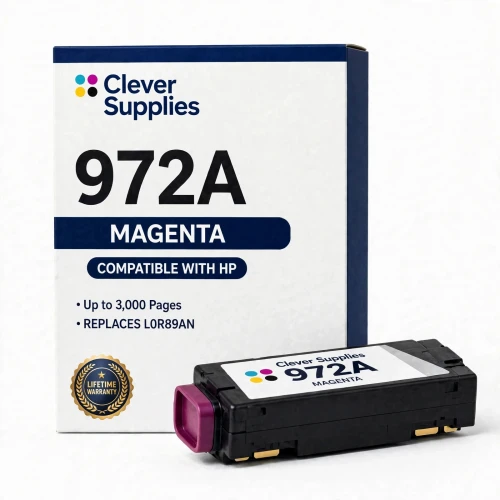
Magenta matches cyan and yellow on price and rating to the cent and the page, so nothing separates the three standard color cards except the station the printer has flagged. It is the one cartridge in the family whose ink volume HP publishes — 35.5 ml — a detail the other codes leave unstated.
Shop the 972A Magenta Single →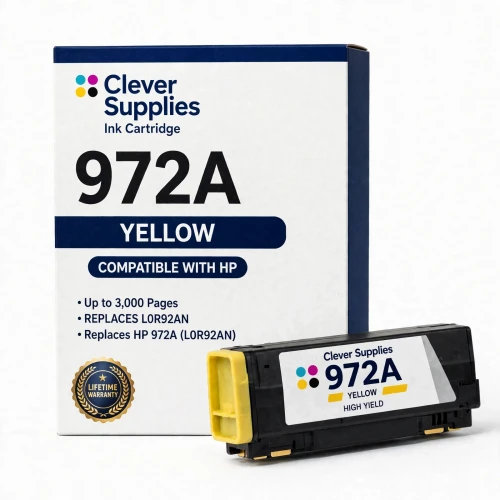
Yellow completes the standard row at the same $89.99 and the same near-3,000-page rating. With this card the A tier is fully laid out — four singles at one price, fitting all nine models — and the shelf turns to the high-yield row, where the fit rules narrow and the page costs fall away.
Shop the 972A Yellow Single →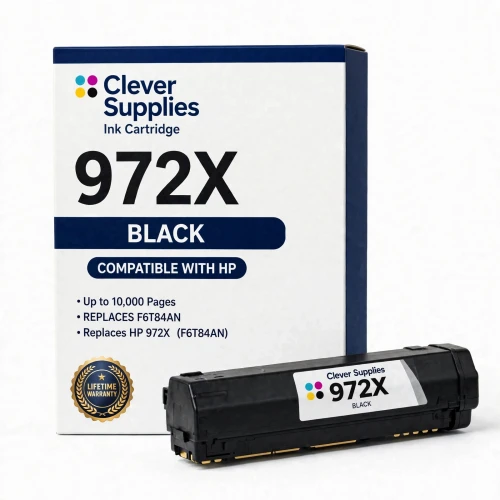
Fifteen dollars above the standard black buys close to triple its rating — the sharpest single-cartridge trade on the page, and the cheapest single page in the family at 1.05¢. The condition is the tier’s: PageWide Pro machines only, with the 352dw and 377dw excluded by HP’s own restriction.
Shop the 972X Black Single →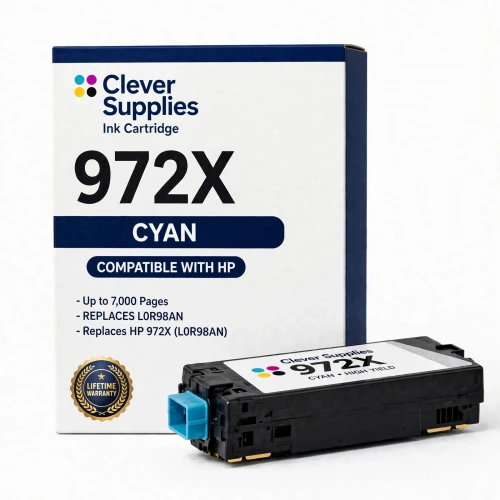
High-yield cyan halves the standard cyan’s page cost — 1.50¢ against 3.00¢ — at the row’s flat $104.99, the figure black and both fellow colors share. PageWide Pro models only; owners of the two 300-series machines stay with the standard cyan carded above.
Shop the 972X Cyan Single →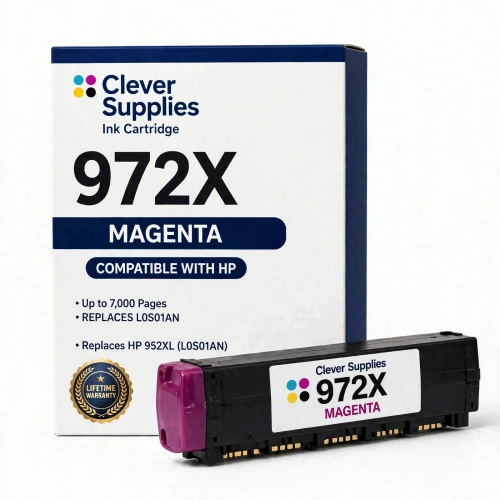
Magenta at the high-yield row’s uniform terms — $104.99, near 7,000 rated pages, 1.50¢ a page. Graphics-heavy Pro machines drain this station early, and the longer span between changes is the practical benefit; the restriction is the familiar one, Pro models only.
Shop the 972X Magenta Single →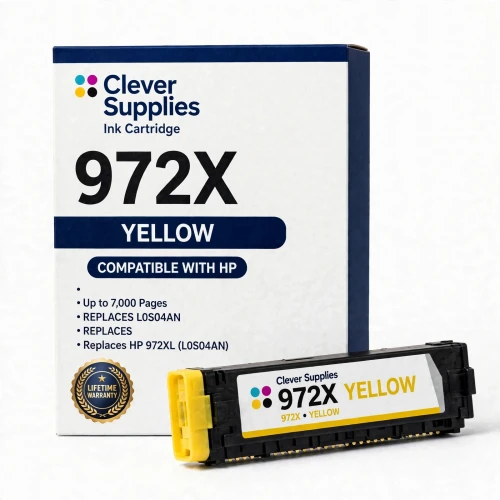
Yellow closes the shelf at the same $104.99 and the same rating as cyan and magenta beside it. Eleven listings, two tiers, one dividing line — the printer model, not the cartridge, decides which half of this shelf a buyer is shopping in.
Shop the 972X Yellow Single →Two absences shape the shelf as much as the eleven listings do. Neither tier sells a black multi-pack, so spare blacks exist only inside the nine-cartridge X box — and there is no standard-tier volume box at all, which leaves heavy-printing 352dw and 377dw owners restocking black one $89.99 cartridge at a time. The set of 9 aside, this is a singles-and-sets family, and its economics are settled almost entirely by the tier question.
Eleven listings, two tiers, one dividing line
Unlike the tables in most of these guides, this one cannot wave compatibility aside, because fit is exactly what splits the family: every 972A row serves all nine roster models, while every 972X row serves only the seven PageWide Pro machines among them. Hold that line in mind and the rest of the grid is simple — within a tier the singles share one price, and the boxes discount against them.
| Offer | Price | Contents | Cost per page | Saving against singles |
|---|---|---|---|---|
| 972X Set of 4 — the flagship (Pro only) | $360.00 | One each of black, cyan, magenta and yellow · ~31,000 pages | 1.16¢ blended | SAVE $59.96 |
| 972A Set of 4 (all nine models) | $298.50 | One each of black, cyan, magenta and yellow · ~12,500 pages | 2.39¢ blended | SAVE $61.46 |
| 972X Set of 9 (Pro only) | $796.50 | Three black, two of each color · ~72,000 pages | 1.11¢ blended | SAVE $148.41 |
| 972A Black Single (F6T80AN) | $89.99 | 1 black · ~3,500 pages | 2.57¢ | Bought one at a time |
| 972A Cyan Single (L0R86AN) | $89.99 | 1 cyan · ~3,000 pages | 3.00¢ | Bought one at a time |
| 972A Magenta Single (L0R89AN) | $89.99 | 1 magenta · ~3,000 pages | 3.00¢ | Bought one at a time |
| 972A Yellow Single (L0R92AN) | $89.99 | 1 yellow · ~3,000 pages | 3.00¢ | Bought one at a time |
| 972X Black Single (F6T84AN) — Pro only | $104.99 | 1 black · ~10,000 pages | 1.05¢ | Bought one at a time |
| 972X Cyan Single (L0R98AN) — Pro only | $104.99 | 1 cyan · ~7,000 pages | 1.50¢ | Bought one at a time |
| 972X Magenta Single (L0S01AN) — Pro only | $104.99 | 1 magenta · ~7,000 pages | 1.50¢ | Bought one at a time |
| 972X Yellow Single (L0S04AN) — Pro only | $104.99 | 1 yellow · ~7,000 pages | 1.50¢ | Bought one at a time |
The grid’s signature is its flatness. Eight singles, two prices, no exceptions — and black sits at the color price in both rows, which inverts the habit of families where black carries a premium of its own. Because the black rating is the higher one in each tier, level pricing hands the black page the best single-cartridge rate in its row: 2.57¢ in the standard tier, 1.05¢ in the high-yield. Everything above the singles line is a discount on that flatness, deepest in the nine-pack.
Fifteen dollars that halves the running cost
The tier step is priced like a rounding decision and performs like a different machine. At the black station, $104.99 against $89.99 buys a rating of roughly 10,000 pages against 3,500, so the page cost falls from 2.57¢ to 1.05¢. At each color station the same fifteen dollars moves the rating from roughly 3,000 pages to 7,000, and the page cost from 3.00¢ to 1.50¢. In workload terms: ten thousand black pages cost about $257 in standard cartridges and about $105 in high-yield ones, and seven thousand pages of a single color cost about $210 the standard way and about $105 the high-yield way. The boxes widen the gap further — 2.39¢ blended for the standard set, 1.16¢ for the X set, 1.11¢ for the nine-pack.
Genuine HP pricing shows the same shape at higher altitude. HP’s US store charges $96.99 for the genuine standard black and $110.99 for each standard color — note the genuine black sits below its colors, the reverse of this shelf’s level pricing — and $194.99 for the genuine X black with $189.99 for each X color. Even after HP’s own tier step, a genuine high-yield black page runs about 1.95¢ and a genuine color page about 2.71¢, so the compatible X row undercuts the genuine X row by close to half at every station. The genuine standard black, at about 2.77¢ a page, costs more per page than the compatible high-yield black at 1.05¢ — a comparison worth sitting with before defaulting to genuine out of habit.
All of that arithmetic, though, is fenced by the fit rule. A PageWide Pro owner who ignores the X tier pays roughly double per page for no benefit; a 352dw or 377dw owner cannot buy their way past the fence at any price, and for those machines the standard row’s figures — 2.57¢ black, 3.00¢ color, 2.39¢ blended in the set — are simply the platform’s running costs, to be managed with the set’s saving rather than the tier step.
Ratings with nothing to reconcile — and setup figures HP states two ways
These yields come from ISO/IEC 24711, the inkjet measurement standard; HP’s footnote for the family names the PageWide Pro 577dw as the test machine, gives the black figure per the standard, and states the color figures as continuous composite ratings across the three colors. The standard black is rated at roughly 3,500 pages and each standard color at roughly 3,000; the high-yield black at roughly 10,000 and each high-yield color at roughly 7,000. What makes the family easy to write about honestly is that the three records coincide: every listing’s yield field, every listing’s text and HP’s published figures agree on all eight codes, so no figure on this page rests on one source against another. A box’s page total is its cartridges’ ratings added together, nothing more exotic than that.
A new PageWide Pro does not start life on retail cartridges. HP’s datasheets put HP 972 Setup cartridges in the box at all four stations — introductory units, distinct from the retail 972A row. On their yield, however, HP’s own documents part company: the current printer page describes the setup black at roughly 2,500 pages with setup colors near 1,000 composite, while the datasheet for the same machine describes roughly 3,000 and 1,500. With the manufacturer quoting two figures for the same box contents, this guide prints neither as settled — setup cartridges are named here without a number, and the ratings above govern from the first retail set onward. No setup figure for the 352dw and 377dw could be sourced at all.
Above the X row sits one more tier that this guide deliberately leaves off the shelf. HP’s 976Y cartridges — an extra-high-yield row rated near 17,000 pages in black and 13,000 in each color — serve only the PageWide Pro 500 series and the PageWide Managed machines. They belong to a separate shelf of their own, so they are named here for completeness and neither carded nor priced on this page; Pro 500 and Managed owners will find that row waiting where the family’s listings cross-reference it.
Nor is there a printhead line in the budget. PageWide machines print through a fixed, page-wide array built into the printer itself, and the cartridges are ink-only tanks feeding it; HP’s replacement-supplies lists for the platform contain the ink cartridges and nothing else, and no other consumable is sold for these machines. Refilling ink is the entire maintenance routine the platform asks of its owner.
Nine models, split cleanly by tier
HP draws this roster in two bands, and the bands are the whole story. Seven PageWide Pro models accept both tiers — a machine there can run standard cartridges today and high-yield cartridges at the next change, station by station or all at once. The remaining two models, the PageWide 352dw and 377dw of the 300 series, accept the standard tier only: HP states the restriction on every high-yield cartridge page, and its support channel confirms the point directly for the 377dw, which requires 972A cartridges. Owners of those two machines should read every X-tier card on this page as belonging to somebody else’s printer.
The seven dual-tier models, each with its category page in this store: the PageWide Pro 452dn, the PageWide Pro 452dw, the PageWide Pro 477dn, the PageWide Pro 477dw, the PageWide Pro 552dw, the PageWide Pro 577dw and the PageWide Pro 577z. The standard-only pair: the PageWide 352dw and the PageWide 377dw.
One further model belongs on the record even though no listing on this shelf names it. HP’s own compatibility lists for these cartridges include the PageWide Managed P55250dw — shown for the 972A row and appearing on a 972X cartridge page as well — so this guide follows HP and counts that machine as fitting both tiers, while noting that the store’s 972 listings are filed under the nine models above and the Managed category currently carries the 976Y row. The three largest Pro models — the 552dw, 577dw and 577z — together with the Managed pair also take that 976Y tier, the extra-high-yield row described in the yields section.
A closing caution for machines bought outside North America: the same PageWide hardware wears different cartridge badges in other regions — HP 913 for the standard row and HP 973 for the high-yield — and a printer sold under those badges expects those codes. The part number on the cartridge coming out of the machine settles which family any individual printer belongs to.
Chips and firmware, stated from each side
Begin with what the listings themselves commit to. Every one of the eleven records its chip in the specification fields in identical words — “Yes — new compatible chip” — and the single-cartridge texts add that the chip is newly made, not a refilled HP shell and not a reset chip. Their shared passage says the chip reports ink levels to the printer, and addresses the firmware case head-on: if an update ever triggers a recognition warning, reseating the cartridge and restarting the printer clears most false alarms, and anything that still refuses to print is covered by the lifetime warranty. That is the compatible side’s position, stated in its own terms.
HP’s platform documents state the opposing design. The PageWide Pro printer pages and datasheets carry HP’s dynamic-security position: the printer is intended to work only with cartridges that have a new or reused HP chip, it uses dynamic security measures to block cartridges using a non-HP chip, and periodic firmware updates maintain those measures; an older datasheet wording adds that cartridges using a non-HP chip may not work, and those that work today may not work in the future. This platform predates HP+, so no enrollment lock of the kind found on newer OfficeJet families enters the question — there are no “e” models here. The two records are set out above without merging them; the buyer’s protection, on the compatible side, is the written one — the chip statement, the reseat guidance and the lifetime warranty standing behind a refusal.
The terms every listing on this shelf is sold under
Start from the printer, then pick the box
Questions this family raises, answered
Two things, and the second matters as much as the first. Capacity: the X black is rated near 10,000 pages against the standard black’s 3,500, and each X color near 7,000 against 3,000. Permission: HP restricts the X row to PageWide Pro machines, while the A row fits every model on the roster. The codes separate cleanly — F6T80AN and L0R86AN, L0R89AN, L0R92AN on the standard side; F6T84AN and L0R98AN, L0S01AN, L0S04AN on the high-yield side.
No. HP states on every high-yield cartridge page that X cartridges are compatible only with PageWide Pro 400 and 500 series printers and MFPs, and its support channel confirms the 377dw requires 972A cartridges specifically; owners report the 300-series machines rejecting X cartridges outright. If your printer is a 352dw or 377dw, shop the standard half of this page — the A set and the four A singles.
Because this store prices each tier flat: $89.99 for every standard single and $104.99 for every high-yield single, black included. HP’s own store does the opposite in the standard row, pricing its genuine black below its colors. The side effect here favors black-heavy printers — the black rating is the higher figure in each tier, so at a level price the black page becomes the cheapest single page in its row: 2.57¢ standard, 1.05¢ high-yield.
Nine models carry categories in this store: the PageWide 352dw and 377dw, which take 972A only, and the PageWide Pro 452dn, 452dw, 477dn, 477dw, 552dw, 577dw and 577z, which take both tiers. HP’s own compatibility lists add the PageWide Managed P55250dw for these cartridges — this guide follows HP on that point — and machines bought outside North America may expect the regional 913 and 973 badges instead, so read the code on the cartridge you are replacing before ordering.
Yes — HP’s 976Y extra-high-yield row, rated near 17,000 pages in black and 13,000 in each color. It fits only the PageWide Pro 500 series and the PageWide Managed machines, and it lives on a separate shelf of its own: this guide names it so Pro 500 and Managed owners know it exists, but cards and prices only the 972A and 972X listings. The 300-series and Pro 400 models cannot use it.
HP 972 Setup cartridges, one at each station — introductory units distinct from the retail 972A row, per HP’s datasheets for the platform. HP quotes their yield two different ways in its own documents — roughly 2,500 black and 1,000 color pages on the current printer page, roughly 3,000 and 1,500 in the datasheet — so this guide prints no starter figure rather than choose between the manufacturer’s two numbers. The ratings in the table apply from the first retail set onward.
The listings address that case in their own text. Each cartridge carries a new compatible chip that reports ink levels; if an update produces a recognition warning, reseating the cartridge and restarting the printer clears most false alarms, and a cartridge that still refuses to print is covered by the lifetime warranty. HP’s side of the record is that these printers are intended to work only with cartridges carrying a new or reused HP chip, with dynamic security measures maintained through firmware updates — the chip section above sets both statements out in full.