




Some ink platforms ask you to juggle four or five cartridges at once. This one asks for two. Every printer in the HP 60 family — the DeskJet, ENVY and PhotoSmart home and photo printers HP sold between 2008 and 2012 — runs on one black cartridge beside one tri-color cartridge that carries cyan, magenta and yellow in a single body, and the printhead is built into each cartridge, so fitting a cartridge also fits a fresh printhead. HP makes the pair in two sizes: the standard 60 (CC640WN black, CC643WN tri-color) and the bigger 60XL (CC641WN black, CC644WN tri-color). Unlike most families in this series, this store stocks both tiers in full — four singles and four sets, eight listings, no duplicates anywhere. The pricing holds a twist worth grasping before you order. The two standard singles cost exactly the same as each other, $25.49 apiece, and the XL black costs only $1.50 more than the standard black while carrying three times its rated pages. On figures like those, the tier decision nearly makes itself; the rest of this page simply shows the arithmetic, box by box.
Unless your printer barely prints, start with the XL pair. The 60XL Set of 2 at $55.47 refills both slots with 1,040 rated pages and works out to 5.33¢ a page; the standard Set of 2 at $49.47 looks cheaper on the shelf and is not — its 365 pages run 13.55¢ each, two and a half times the XL rate. The gap comes from the singles: the XL black is $26.99 against the standard black’s $25.49, a $1.50 step for three times the pages, and the XL tri-color is $29.99 against $25.49 for roughly two and two-thirds times the pages. Households that print steadily should look one row further, at the 60XL Set of 5 — $125.93, 2,680 pages, and the family’s cheapest page at 4.70¢ blended. The standard singles hold one curiosity: black and tri-color cost exactly the same $25.49, so on the standard row the color cartridge is not the expensive one for once. Genuine HP pricing frames all of it: HP’s own XL black alone is $80.99, more than this store’s entire XL pair.
Two tiers, one two-cartridge change — the full shelf
Eight cards cover the family, and the order is deliberate. The XL Set of 2 leads because the XL tier is where this family’s value sits — the premium over standard is the smallest in this series of guides — and the standard pair follows it so the contrast sits on the page rather than in a footnote. The two volume sets come next, standard before XL as with the pairs, and the four singles close the shelf in tier order. Every set states its contents in its own listing, so no saving below rests on a guess about what is in the box. Each price is the product’s single listed price — this family carries no markdown pricing — and each saving badge measures a set against the identical cartridges bought one at a time on this page.
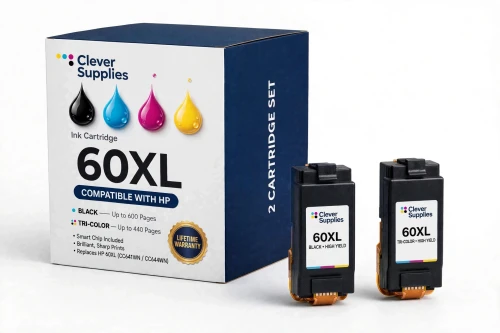
Read this card against the one beneath it and the family’s whole argument is on the table. The standard pair costs $6.00 less and delivers 675 fewer rated pages — the saving is real and the trade is poor for anyone who prints more than occasionally. The genuine comparison is starker still. HP’s US store prices the genuine 60XL black cartridge alone at $80.99, which is $25.52 more than this complete two-cartridge box; HP’s genuine standard pair totals $71.98 for roughly a third of this box’s pages. A full compatible XL change for less than one genuine XL cartridge is the bargain this family is built around.
Shop the 60XL Set of 2 →THE OTHER SEVEN LISTINGS
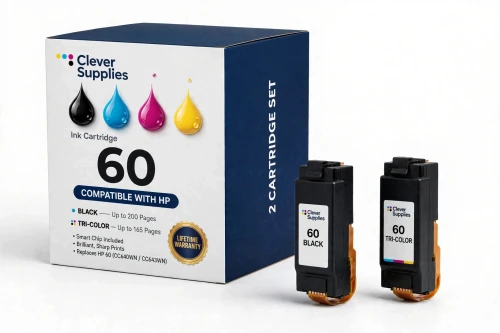
The complete standard change, and the honest runner-up. Its two singles cost $25.49 apiece — perfect parity — so the pair sums to $50.98 and the box keeps $1.51 of it. It suits a printer that wakes up a few times a month; a busier machine will spend the $6.00 difference on the XL pair many times over in pages.
Shop the 60 Set of 2 →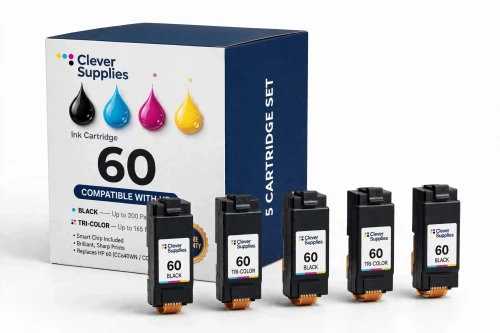
Three blacks against two tri-colors mirrors how these printers actually drink — documents empty the black station well ahead of the colors. The $15.02 saving against $127.45 of singles is the standard row’s largest, and the box keeps a full spare change on the shelf after the first swap.
Shop the 60 Set of 5 →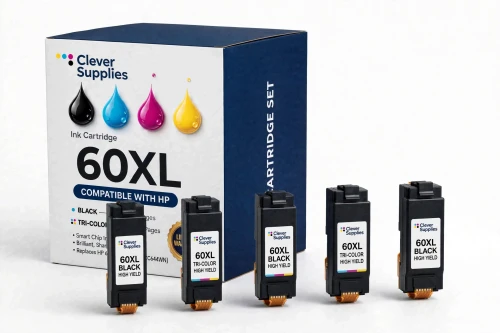
The deepest box on the shelf and, per page, the cheapest: 4.70¢ blended undercuts even the flagship pair. Three XL blacks and two XL tri-colors cover roughly two and a half full changes, and the $15.02 saving against $140.95 of XL singles matches the standard volume box’s figure to the cent.
Shop the 60XL Set of 5 →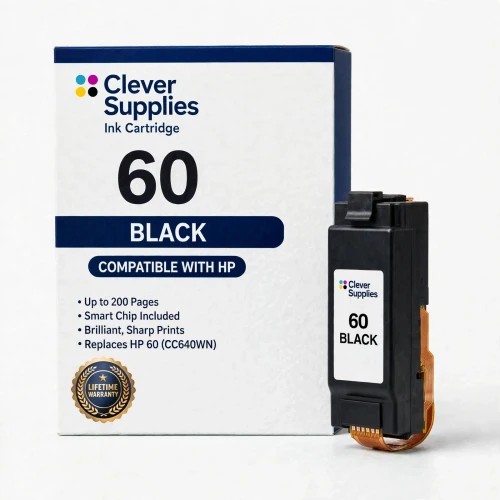
The standard black, priced at exact parity with its tri-color partner — an unusual courtesy in ink pricing, where color usually carries the premium. HP’s genuine version of this cartridge is $31.99. Bought alone it tops up a printer whose color side still has life; bought with the tri-color it is simply the pair at $1.51 more.
Shop the 60 Black Single →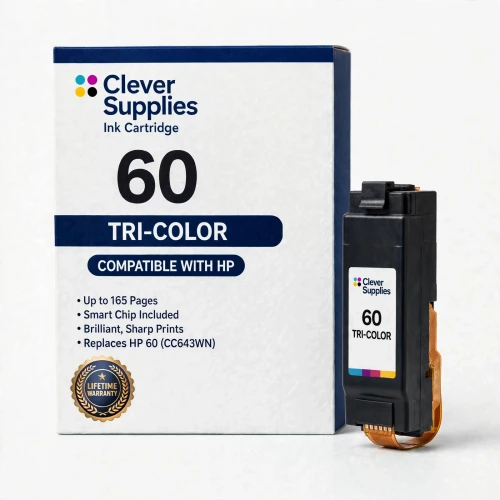
All three colors in one body — cyan, magenta and yellow sharing a single cartridge, which is why its 165-page rating is the family’s smallest and its per-page rate the highest. The same $25.49 as the black single, against $39.99 for HP’s genuine tri-color. When one color inside runs dry, the whole cartridge is the replacement; that is the platform’s design, not a defect.
Shop the 60 Tri-color Single →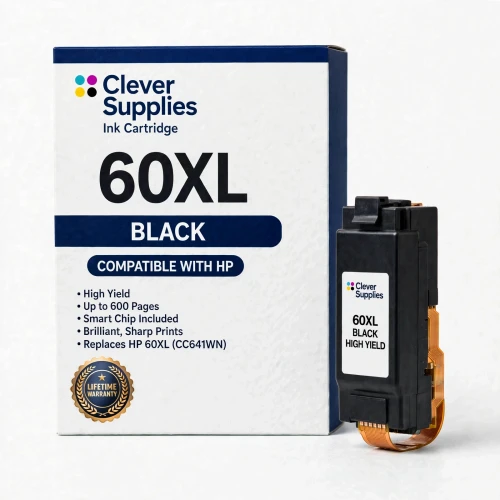
The single most lopsided upgrade on this page: $1.50 beyond the standard black buys three times the rated pages and cuts the black page from 12.75¢ to 4.50¢. HP’s genuine XL black is $80.99 — almost exactly three times this cartridge’s price for the same roughly 600 pages.
Shop the 60XL Black Single →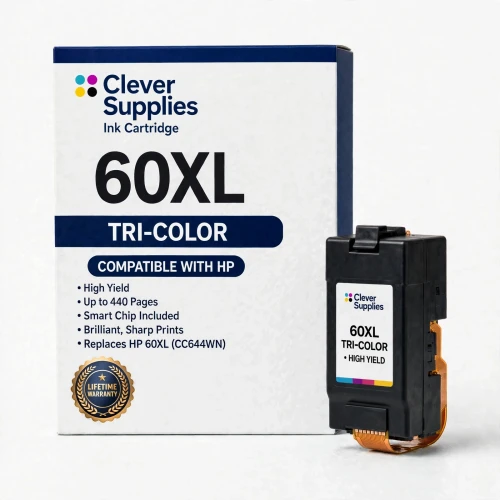
The XL step on the color side costs more than on the black side — $4.50 over the standard tri-color — and returns about two and two-thirds times the pages for it, bringing the color page down from 15.45¢ to 6.82¢. It is the dearest single on the shelf and still the second-cheapest color page the family offers.
Shop the 60XL Tri-color Single →Two features of this shelf deserve naming outright. There are no duplicate listings to untangle — each of the eight configurations exists exactly once — and there is no tier trap either: both tiers fit every printer on the roster, so the choice between them is purely about how much ink you want in the box, never about whether it will fit.
All eight listings side by side
No fit column appears, because fit does not divide this family: all eight rows serve the same 32 printers named further down, in either tier. A set’s page total adds the ratings of the cartridges inside it, and its blended rate divides its price by that total.
| Offer | Price | Contents | Cost per page | Saving against singles |
|---|---|---|---|---|
| 60XL Set of 2 — the flagship | $55.47 | 1 XL black, 1 XL tri-color · ~1,040 pages | 5.33¢ blended | SAVE $1.51 |
| 60 Set of 2 | $49.47 | 1 black, 1 tri-color · ~365 pages | 13.55¢ blended | SAVE $1.51 |
| 60 Set of 5 | $112.43 | 3 black, 2 tri-color · ~930 pages | 12.09¢ blended | SAVE $15.02 |
| 60XL Set of 5 | $125.93 | 3 XL black, 2 XL tri-color · ~2,680 pages | 4.70¢ blended | SAVE $15.02 |
| 60 Black Single (CC640WN) | $25.49 | 1 pigment black · ~200 pages | 12.75¢ | Bought one at a time |
| 60 Tri-color Single (CC643WN) | $25.49 | 1 dye tri-color · ~165 pages | 15.45¢ | Bought one at a time |
| 60XL Black Single (CC641WN) | $26.99 | 1 pigment black · ~600 pages | 4.50¢ | Bought one at a time |
| 60XL Tri-color Single (CC644WN) | $29.99 | 1 dye tri-color · ~440 pages | 6.82¢ | Bought one at a time |
Two patterns stand out. The price column barely moves between tiers — the dearest single costs $4.50 more than the cheapest — while the rate column collapses: every XL row beats every standard row by a wide margin, because the ratings multiply while the prices only inch. And the two Sets of 2 carry the identical $1.51 saving, a coincidence of the parity pricing: on both rows, the box discount is the same small courtesy, and the real difference is the pages.
The XL arithmetic, and what HP charges for the same pages
Run the numbers on a concrete stack of paper. Two thousand black pages bought as XL black singles cost about $90; the same two thousand bought as standard black singles cost about $255. On the color side, a thousand tri-color pages run about $68 in the XL cartridge against about $155 in the standard. The XL Set of 5 blends both stations to 4.70¢, so a mixed 2,680-page run — the box’s full rating — is the cheapest way to print anything in this family. The standard tier’s only winning scenario is a printer that prints so rarely that a cartridge’s pages outlast its years; for any machine in regular use, the XL premium is recovered within the first cartridge.
HP’s genuine shelf performs the same division at very different prices. The genuine standard black is $31.99 and the genuine standard tri-color $39.99 — $71.98 for a 365-page change, about 19.72¢ a page, which is more per page than every compatible row on this page including the standard singles. HP’s own standard 2-pack, code N9H63FN, is $68.99, still $19.52 above this store’s standard pair. And the genuine 60XL black stands alone at $80.99: about 13.50¢ a page, roughly three times the compatible XL black’s price and rate alike. No genuine price for the 60XL tri-color is quoted here, because none could be retrieved from HP’s US store — the comparison on the color side rests on the standard figures above. One caution applies to every genuine figure printed: HP’s store was running a promotion when they were read, and they may sit higher once it ends.
So the tier question answers itself twice over. Within this store, the XL costs a few dollars more per box and returns multiples of the pages. Against the genuine shelf, even the standard compatible pair undercuts HP’s standard pair by $22.51 while the XL pair delivers nearly three times the pages for $16.51 less than HP’s standard two. What remains is choosing the box size, and the which-to-buy section below takes that up by printer habit.
Ratings everyone agrees on, and the printhead inside every cartridge
This family’s figures need no arbitration. The listings’ descriptive text, their structured yield fields and HP’s current cartridge pages all publish the same four numbers: roughly 200 pages for the standard black, 165 for the standard tri-color, 600 for the XL black and 440 for the XL tri-color. HP measures them under ISO/IEC 24711, tested in the Deskjet D2560 printer with continuous printing, so the ratings are averages across a standard test run rather than a promise for any one household — heavy coverage will land below them, light text above. The ink split is consistent on both sides too: the black is pigment-based, the formulation that keeps document text crisp, and the tri-color is dye-based, the formulation photo paper prefers.
On what a new printer starts with, this guide prints no reduced starter figure, because HP publishes none for this platform. HP’s own box-contents lists for these machines name the plain retail cartridges — an HP 60 Black Ink Cartridge and an HP 60 Tri-color Ink Cartridge — with no introductory or setup designation attached, and no smaller in-box rating appears anywhere in HP’s materials for the family. What can honestly be said stops there: the first change a new owner buys is a normal buying decision between the two tiers, on the same figures as every later one.
The platform’s defining mechanical fact deserves its own plain statement: the printhead is part of the cartridge. There is no separate printhead to buy for these printers, no imaging unit and no collection part — the store stocks none because none exists as a supply. Fitting a cartridge therefore renews the printhead along with the ink, which carries a practical consequence owners of newer platforms do not get: a printhead that clogs or wears is cured by the cartridge change itself, not by a service part. Both slots must be filled for the printer to run, as the listings note — a two-cartridge machine prints with the pair or not at all.
The 32 printers that run on HP 60
The roster spans three of HP’s home lines of the period — the DeskJet workhorses, the ENVY all-in-ones and the PhotoSmart photo printers — 32 model categories in this store, every one of them visible, and the store’s list matches HP’s own compatibility list model for model. There is no tier restriction to track: per HP and the listings alike, the standard 60 and the 60XL fit every model below interchangeably, at both stations.
The eighteen DeskJets: the DeskJet D1660, DeskJet D2530, DeskJet D2545, DeskJet D2560, DeskJet D2660, DeskJet D2680 and DeskJet D5560; and the F-series — the DeskJet F2430, DeskJet F2440, DeskJet F2480, DeskJet F4210, DeskJet F4235, DeskJet F4240, DeskJet F4280, DeskJet F4435, DeskJet F4440, DeskJet F4480 and DeskJet F4580.
The five ENVY models: the ENVY 100, ENVY 110, ENVY 111, ENVY 114 and ENVY 120. The nine PhotoSmarts: the PhotoSmart C4635, PhotoSmart C4640, PhotoSmart C4650, PhotoSmart C4680, PhotoSmart C4740, PhotoSmart C4750, PhotoSmart C4780, PhotoSmart C4795 and the PhotoSmart D110A.
One boundary of the roster matters more than any name on it. Machines that look like close relatives — the OfficeJet 4500 and the OfficeJet J4500 and J4680 — are not on HP’s compatibility list for this family at all; those printers take the HP 901, a different cartridge, and the FAQ below takes the confusion up directly. If the model on your printer’s badge is not among the 32 above, match by cartridge code instead: CC640WN, CC643WN, CC641WN or CC644WN on the cartridge coming out settles the question.
The chip question on a platform older than blocking
All eight listings state the same chip position in their specification fields: “Yes — new compatible chip.” In their text they add what that means in practice — the chip reports ink levels to the printer, and it is a newly built chip, not a refilled original shell carrying a reset one. Nothing has to be transferred from an empty cartridge. If a printer shows a recognition warning, the listings’ own remedy is the first step: reseat the cartridge and restart the machine, with the lifetime warranty behind any cartridge that still will not register.
HP’s side, reported at the strength HP itself gives it: this printer generation predates HP’s dynamic security program and its HP+ system entirely, and HP’s current pages for these four cartridges carry no firmware-blocking language — their cartridge technology language concerns verifying that an original HP cartridge is in use, which is authentication wording, not a blocking regime. No chip guide covers the HP 60 codes, so none is linked here; the listings’ statement above is the whole of the position.
Each listing in this family states a lifetime warranty in its own fields — a cartridge that fails is replaced or refunded, without a time limit.
Ordered the standard tier when the XL was the better fit? Send it back free any time inside the first year.
Tier and fit questions get a human answer from our team, 9 AM–5 PM CST, Monday to Friday.
Stock ships from Illinois, Pennsylvania, Georgia or California — whichever warehouse is nearest the delivery address.
Choosing between the standard pair and the XL pair
- The regular household printer: the 60XL Set of 2 at $55.47. Both slots refilled at 5.33¢ a page — the default choice this family’s pricing points to.
- The printer that barely prints: the standard Set of 2 at $49.47. If a change lasts a year or more, the $6.00 saved today outweighs pages you may never use.
- Steady volume, documents first: the 60XL Set of 5 at $125.93. Its 4.70¢ blended rate is the cheapest page in the family, and its three-to-two black weighting matches real consumption.
- Only one side has run out: that side’s XL single — $26.99 for black, $29.99 for tri-color. The standard singles make sense as top-ups only when the other cartridge is standard too and nearly new.
- Stocking a standard-tier machine room: the standard Set of 5 at $112.43 keeps two full spare changes plus a black in reserve, with the standard row’s largest saving.
Questions the two-cartridge platform raises
Should I buy the 60 or the 60XL?
On these prices, the XL for almost everyone. The XL black costs $1.50 more than the standard black and is rated at three times the pages; the XL tri-color costs $4.50 more for about two and two-thirds times the pages. Both tiers fit every printer on the roster, so nothing but print volume decides it: a machine that prints weekly belongs on XL, and only a genuinely occasional printer comes out ahead on the standard pair’s lower shelf price.
Is the HP 60 the same cartridge as the HP 901?
No — and the confusion is understandable, because the printers resemble each other and some genuine listings elsewhere claim the 60 also fits the OfficeJet 4500, J4500 and J4680. HP’s own compatibility lists for the 60 do not include any OfficeJet: those machines take the HP 901. Every listing in this family carries the same correction in its own FAQ. If your printer is an OfficeJet of that era, the 901 is your cartridge and nothing on this page will fit it.
Which printers use HP 60 and 60XL cartridges?
Thirty-two models in this store’s catalog: eighteen DeskJets from the D1660 to the F4580, the ENVY 100, 110, 111, 114 and 120, and nine PhotoSmarts from the C4635 to the D110A. The store’s roster matches HP’s compatibility list model for model, and every one of the 32 accepts both tiers at both stations. The cartridge code on the unit you remove — CC640WN, CC643WN, CC641WN or CC644WN — is the surest confirmation.
Why do all three colors live in one cartridge?
That is the two-cartridge design this platform was built on: one pigment black for text, one dye tri-color holding cyan, magenta and yellow together. The trade-off is structural — when a single color inside the tri-color runs dry, the cartridge as a whole is due for replacement, even if the other two colors remain. It is also why the tri-color’s rating, about 165 pages standard and 440 in XL, is the figure to watch on a photo-heavy machine.
Does changing the cartridge really renew the printhead?
Yes. On this platform the printhead is built into each cartridge rather than mounted in the printer, so every cartridge you fit brings a fresh printhead with it. No separate printhead exists as a supply for these models — there is nothing else to buy, and a worn or clogged head is fixed by the change itself. Both slots do need to be filled for the printer to run.
What if my printer does not recognize a cartridge?
Start with the remedy the listings themselves give: take the cartridge out, seat it again firmly, and restart the printer. These cartridges are newly built with a new compatible chip that reports ink levels — not refilled shells with reset chips — and this platform predates HP’s firmware-blocking programs. A cartridge that still refuses to register after a reseat and restart is covered by the lifetime warranty.
Disclosure — November 16, 2026. Prices were read from the live product pages on November 16, 2026. Every product in this family carries a single listed price; no markdown framing applies, and each saving figure measures a set against the same cartridges bought as singles here. Yields are the ratings the listings, their specification fields and HP’s current cartridge pages all publish for the four codes — standard black ~200 pages, standard tri-color ~165, XL black ~600, XL tri-color ~440 — measured by HP under ISO/IEC 24711 in the Deskjet D2560 printer. Genuine HP figures printed here are only the ones retrieved from HP’s US store, all shown in stock: the standard black (CC640WN) at $31.99, the standard tri-color (CC643WN) at $39.99, the XL black (CC641WN) at $80.99 and the standard 2-pack (N9H63FN) at $68.99; they were read while HP’s store was running a promotion and may rise. No genuine price is printed for the XL tri-color (CC644WN), because none was retrieved from that source. The roster follows the store’s 32 model categories, all visible, matching HP’s compatibility list model for model; HP publishes no reduced introductory rating for this platform, so no starter figure is printed. The eight listings are each carded once; the family has no duplicate listings. Every cartridge is covered by a lifetime warranty with 1-year free returns, as its listing states.