




Three small machines anchor this family: the LaserJet M209dw printer and the LaserJet MFP M234dw and M234sdw multifunctions. All three draw on the same pair of black cartridges — the 134A (W1340A), rated at about 1,100 pages, and the 134X (W1340X), rated at about 2,400 — and HP draws no line between them: either cartridge goes into any of the three printers, so the only real decision is how many pages to buy at a time. The store stocks both tiers in identical pack ladders — a single, a 2-pack and a 4-pack in each — six configurations in all, and every price on this page is the sale price the checkout charges. One wrinkle is worth flagging before the shelf, because it is this family’s alone: the two tiers do not argue equally. The 134X is rated at 2,400 pages by its specification field, by its description prose and by HP, in perfect agreement. The 134A’s own field and HP both say 1,100, yet its prose says 1,150 — a number HP declares for this platform’s regional sibling codes, not for the W1340A. This guide divides by 1,100 and 2,400 throughout, and sets the 1,150 out below as a defect on the product pages rather than a rating.
Run a LaserJet M209dw, a LaserJet MFP M234dw or its M234sdw sibling and you can stop checking compatibility after this sentence: both cartridges below fit your machine, full stop. What remains is arithmetic. The 134X single costs $2.61 more than the 134A single and returns roughly 1,300 extra rated pages for it, which is why the shelf leads with the 134X 2-pack at $55.57 — two high-yield cartridges, about 4,800 rated pages, 1.16¢ a page. Every offer carded here is a Clever Supplies compatible; the store carries no genuine HP cartridge for this family, so where HP’s prices appear they are labeled as HP’s and serve only as a yardstick. And when you budget pages, budget on 1,100 for the standard cartridge and 2,400 for the high-yield — the figures in the listings’ own specification fields and in HP’s declarations — rather than the 1,150 the standard tier’s prose prefers.
Six boxes, two ladders that mirror each other
Twenty-four listings carry this family’s codes, and eighteen of them are the same six offers wearing printer names: each configuration is re-listed once per model, with the printer’s identity carried only in the SKU and the price and stock identical to the card that stands for it. Set those aside and the shelf is unusually tidy — the standard cartridge in single, 2-pack and 4-pack form, the high-yield in exactly the same three shapes, nothing else in either tier. Each configuration is carded once, at the sale price verified for it. A SAVE badge, where a pack wears one, is sale-price arithmetic inside its own tier: the pack’s price subtracted from what its cartridges cost bought one at a time. The flagship opens the shelf, the rest of the high-yield line follows, and the standard line closes it.
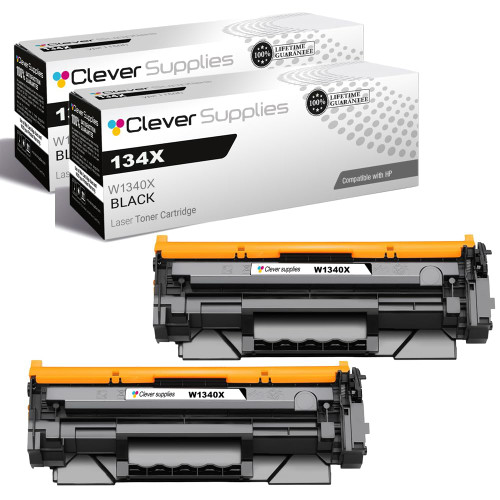
There is no genuine pair to weigh it against: HP sells the W1340X one at a time at $104.99, so two genuine cartridges come to $209.98. This box delivers the same two cartridges’ worth of rated pages — about 4,800 — for $55.57, which is $154.41 less. The shape suits these machines: one cartridge in the printer, its twin sealed in a drawer, on desktops that count their printing in hundreds of pages a week.
Shop the 134X 2-Pack →THE OTHER HIGH-YIELD BOXES — ONE SMALLER, ONE DEEPER
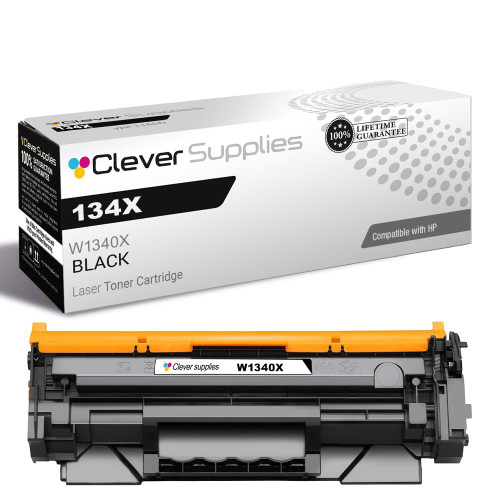
The cheapest step up in the family: $2.61 over the standard single buys about 1,300 additional rated pages. Against HP’s genuine W1340X at $104.99, this single sits $69.17 lower.
Shop the 134X Single →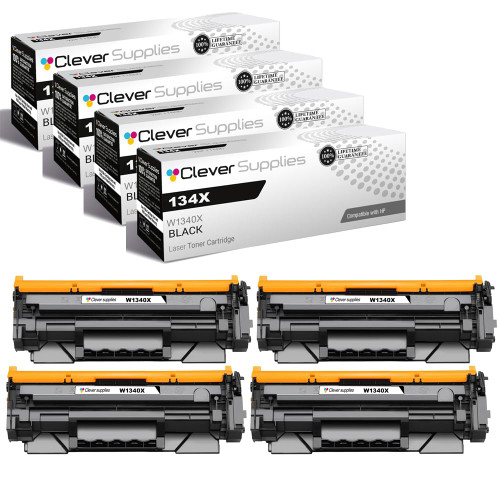
Cartridges at $23.76 apiece and the shelf’s lowest rate per page. Stock for a small cluster of these printers drawing on one shared drawer.
Shop the 134X 4-Pack →THE STANDARD LINE — THE SAME THREE SHAPES, A SHORTER RATING
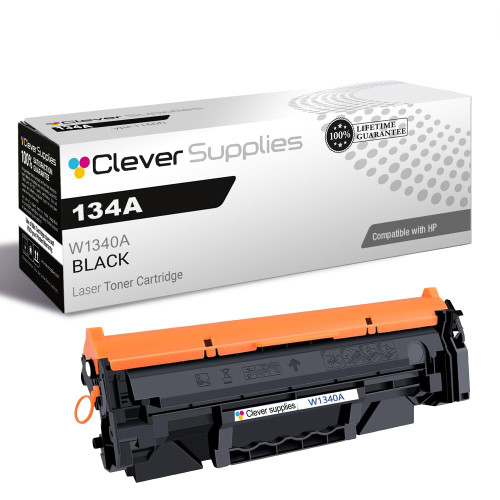
The smallest order in the family, and still a clear step up from the roughly 700-page setup cartridge the printer shipped with. HP’s genuine W1340A is $64.99, so this single runs $31.78 under it.
Shop the 134A Single →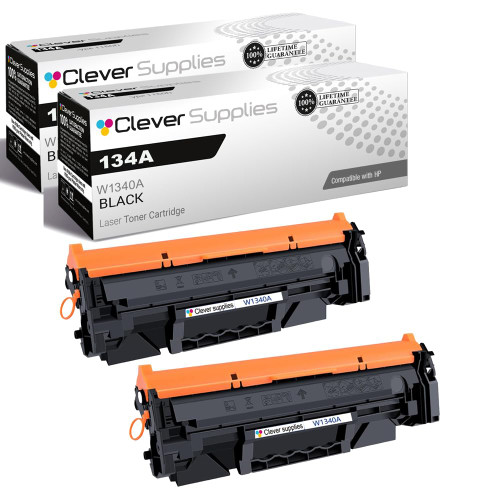
Cartridges at $25.18 apiece. The standard tier’s natural shape for a machine that prints lightly: one at work, one waiting, and no money tied up in high-yield pages that light use may not reach for a year.
Shop the 134A 2-Pack →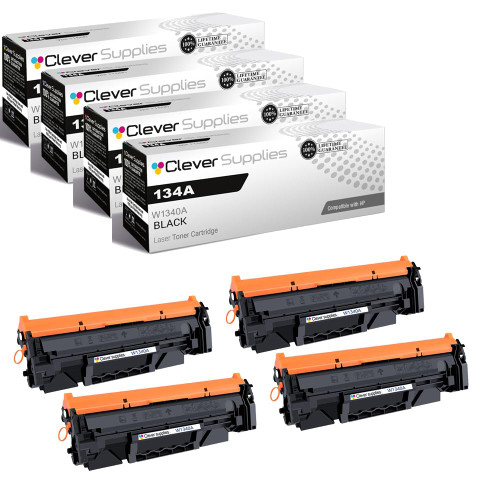
Cartridges at $21.16 apiece — the standard tier’s best rate. Note the count: four cartridges at the field rating give about 4,400 pages, whatever the listing’s own 4,600-page prose total says.
Shop the 134A 4-Pack →Every configuration, priced by the page
Each row takes a box’s sale price and divides it by the rated pages inside — 1,100 pages per 134A cartridge, 2,400 per 134X, taken from the listings’ own yield fields. Cheapest page first. Because the ladders mirror each other, every box size appears twice, once per tier, which makes the tier gap easy to read at a glance; the fit column, meanwhile, never changes, because both cartridges fit all three machines.
| Box | Price at checkout | Rated pages in the box | Per-page cost | Fits |
|---|---|---|---|---|
| 134X 4-Pack | $95.05 | 4 cartridges · ~9,600 pages | 0.99¢ | All three store models |
| 134X 2-Pack — the flagship | $55.57 | 2 cartridges · ~4,800 pages | 1.16¢ | All three store models |
| 134X Single | $35.82 | 1 cartridge · ~2,400 pages | 1.49¢ | All three store models |
| 134A 4-Pack | $84.62 | 4 cartridges · ~4,400 pages | 1.92¢ | All three store models |
| 134A 2-Pack | $50.35 | 2 cartridges · ~2,200 pages | 2.29¢ | All three store models |
| 134A Single | $33.21 | 1 cartridge · ~1,100 pages | 3.02¢ | All three store models |
Read down a tier and the pattern is gentle: deeper boxes shave the rate a little at a time, the high-yield line easing from 1.49¢ to 0.99¢, the standard line from 3.02¢ to 1.92¢. Read across the tiers and the drop is a step, not a slope — the priciest 134X page on the table, the single’s 1.49¢, still undercuts the cheapest 134A page, the 4-pack’s 1.92¢. So the cartridge choice outweighs the box choice here: pick the tier by how much you print, then let the pack size follow the space in the drawer.
Three printers on the shelf, a longer HP list behind them
On fit, HP’s specification pages are unambiguous: each printer on this platform lists the same two replacements, in the same words — “HP 134A Black LaserJet Toner Cartridge, W1340A (~1100), HP 134X Black LaserJet Toner Cartridge, W1340X (~2400)” — so no model is reserved for one tier or shut out of the other. This store keeps a category for three of those machines, and all three take every cartridge on this page: the LaserJet M209dw, the LaserJet MFP M234dw and the LaserJet MFP M234sdw. Each name links to that model’s category page here. The store keeps no family category for this cartridge, so those three models are the entire linked roster.
Two qualifications ride along with that short list, pulling in opposite directions. The first widens it: HP’s published compatibility for these codes runs to at least sixteen models — the M211d and M211dw printers, the MFP M233dw, M233sdn and M233sdw, the M235 line and the M236 line among them. The listings’ habit of calling the store’s three models “the complete list of models this code fits,” or saying the cartridge serves them “and no other LaserJets,” describes this store’s shelves, not the cartridge’s reach; an owner of one of the wider-list models is holding a machine HP documents for these codes, even though this store stocks no category for it. The second qualification narrows it back, deliberately: the “e” variants in HP’s span — the M209dwe, M234dwe and M234sdwe — are HP+ machines, and HP+ membership terms limit those printers to original HP toner alone. No compatible on this page is offered for one.
Owners shopping beyond this store may also meet sibling codes for the same printers: HP sells this platform as the 135A/135X in some regions, the 136A/136X in others and the 137A/137X in China and India, and HP’s yield form for the platform notes that the W1340A and the W1350A are one and the same physical cartridge. The regional codes carry their own declared ratings — the 136 and 137 standard cartridges are the ones rated at 1,150 pages, a figure that matters again in the next section. This store stocks only the North American W1340 codes, so only those are carded and rated here.
One tier argues with itself — by fifty pages
Half of this family’s yield record is beyond dispute. The 134X reads 2,400 pages in its Page Yield field, in its description prose and in HP’s declaration, each an approximate average under ISO/IEC 19752, and its pack totals multiply out cleanly on that figure. The 134A is where the record splits. Its Page Yield field reads 1,100 pages — precisely what HP declares for the W1340A — but its prose works with 1,150 instead wherever a number has a job to do: a FAQ asks “How long should 1,150 pages last at home?,” the 2-pack’s cartridges are “each rated at 1,150 pages,” and the 4-pack promises “a combined pool of about 4,600 rated pages” where the field figure gives 4,400. Strangest of all, the same descriptions contradict themselves in their own cross-reference paragraph, which states the W1340A at “(1,100 pages)” — the field figure — a few screens away from the 1,150 the FAQs are using. The 1,150 is not an invented number: it is HP’s declared yield for this platform’s regional sibling cartridges, the W1360A and W1370A. It is a genuine HP rating attached to the wrong code, and this guide rates the W1340A at 1,100 — the figure the store itself specifies and HP itself declares for the cartridge actually being sold. The overstatement is 50 pages, about 4.5 percent; small, but it is never used here as a rating.
The reason the fifty pages matter is that the prose’s arithmetic leans on the inflated figure and on list prices at the same time. The standard 2-pack’s page is the clearest case: it prices the pair at its $57.90 list figure, derives $28.95 a cartridge, and spreads that across 1,150 pages to reach “roughly two and a half cents” a page. Checkout actually charges $50.35 for that pair — $25.18 a cartridge — and at the field rating the honest rate is 2.29¢. Two errors, one in the price and one in the yield, stacked into a single plausible-sounding number. Every rate in this guide is built the opposite way, from the sale price and the field yield, and the note at the foot of the page itemizes the listings’ figures against the real ones.
Against the shelf stand HP’s genuine prices, sourced from HP’s US store and marked as HP’s at each appearance: the genuine W1340A at $64.99, which works out to 5.91¢ a page at its rating, and the genuine W1340X at $104.99, or 4.37¢. HP sells neither cartridge in a multi-pack — both are singles-only at HP — so the packs above have no genuine twin to be measured against, and none is implied. On the singles the gaps are plain: the compatible 134A single runs $31.78 under its genuine counterpart, the compatible 134X single $69.17 under, and the flagship pair $154.41 less than two genuine high-yield singles bought together.
The drum rides inside the cartridge — and the first one is a short one
There is no separate imaging unit to budget for on the M209 and M234 platform. The W1340A and W1340X are all-in-one cartridges — toner and imaging drum in a single housing — and the listings say so in their own words: “the imaging drum is built into the cartridge itself.” Every swap therefore renews the drum surface along with the toner, drum life is already inside each rating and price above, and HP’s genuine supply list for these machines runs to exactly two entries — W1340A and W1340X, both of them this cartridge. The fuser kit sits on the printer’s service schedule rather than its consumables shelf, and this store does not stock it.
The cartridge already inside a new printer is a reduced one. HP’s specification pages list the box contents as an “HP Black LaserJet Toner Cartridge (~700 pages),” with a footnote giving the in-box yield as about 700 black pages under ISO/IEC 19752 across the roster. So whichever tier you choose first, the replacement outlasts the original by a visible margin — the standard cartridge carries over half again the in-box rating, the high-yield more than three times it. The 134X is never the cartridge in the box: HP’s own footnote reserves it as an extra, “High-yield cartridges are not included in printer purchase; purchase separately.”
Chips: not a word on the listings, a full warning on the spec sheet
Search all twenty-four descriptions in this family for the chip question and you will find nothing — the words chip, firmware and dynamic occur zero times between them. No listing claims a chip, and none mentions one. HP’s specification pages for these same printers carry the dynamic-security notice in full, and it is worth reading as HP prints it: “This printer is intended to work only with cartridges that have a new or reused HP chip, and it uses dynamic security measures to block cartridges using a non-HP chip.” HP adds that periodic firmware updates will maintain the effectiveness of those measures, blocking cartridges that previously worked. A buyer who read only the product pages would never know the mechanism exists.
The statement that can be made is the store’s standing position for its compatibles, given as the store’s own — these listings provide no wording of their own to quote. Its supplier fits a current-generation chip in every cartridge; installation is plug-and-play, and nothing has to be carried over from the spent unit. The limit this series always prints applies unchanged: no promise is made about firmware HP has yet to release. The cover that stands behind every cartridge on the shelf follows, in the terms the listings themselves state.
What stands behind each box
Matching the box to the workload
Answers for the M209 and M234 owner
1,100. That is the figure in the listing’s own Page Yield field, and it is exactly the yield HP declares for the W1340A under ISO/IEC 19752. The 1,150 in the prose is a real HP number pinned to the wrong cartridge — it is HP’s declared yield for this platform’s regional sibling codes, the W1360A and W1370A — and the same product page gives itself away: its cross-reference paragraph states the W1340A at 1,100 pages. The high-yield tier needs no arbitration; field, prose and HP all read 2,400 for the 134X. This guide rates both cartridges by the field figures; the prose number is recorded as a defect in the note at the foot of this page.
Either one. No tier fence exists on this platform: HP’s specification pages list the W1340A and the W1340X side by side as the replacements for every machine in the line, so a LaserJet M209dw on a home desk and a LaserJet MFP M234sdw in a small office take the high-yield cartridge just as readily as the standard one. Choose by volume: the 134X carries about 2,400 rated pages to the 134A’s 1,100, at under half the standard tier’s per-page cost.
By HP’s record, yes — its published compatibility for these codes spans at least sixteen models, including the M211 printers and the MFP M233, M235 and M236 lines. This store stocks categories and listings for three models only, so those three are the models linked and carded here; when the listings call the three “the complete list of models this code fits,” they are describing this store’s shelves, and HP’s own statement runs wider. One slice of that wider span is held back deliberately: the “e” variants are HP+ machines, limited by the program to original HP toner, and this guide offers nothing for them.
No. Toner and imaging drum are built into the same unit here, so the drum’s life is priced into the cartridge’s rating, and every change renews the print surface together with the toner. HP’s genuine supply list for the M209 and M234 machines runs to two entries — W1340A and W1340X — and both entries are the toner cartridge itself; no drum is sold for this platform, here or by HP.
A setup cartridge rated at about 700 pages, per HP’s own box-contents line for the platform. Because that first unit is a shortened measure, its replacement lasts visibly longer — over half again for the standard 134A, more than three times over for the 134X, which never ships in the box and is always bought separately. Let the page count that first cartridge gives you settle the tier question: a machine that emptied it within a month belongs on the high-yield tier.
Regional names for this same cartridge platform. HP sells the line as the 134A/134X in North America, the 135A/135X in a second region group, the 136A/136X in a third and the 137A/137X in China and India, and HP’s yield form for the platform treats the W1340A and the W1350A as one and the same physical cartridge. The regional codes carry their own declared ratings — the 136 and 137 standard cartridges are declared at 1,150 pages, which is where the figure in this family’s product prose comes from. This store stocks nothing under the regional codes, so they carry no cards here; its W1340A and W1340X listings are rated at HP’s North American figures, 1,100 and 2,400.
Price and disclosure note: Every price in this guide is a sale price, read live from the store’s catalog on November 17, 2026 and confirmed a second time on each listing’s own storefront page, title-matched in both places. A higher list price stands behind every sale price; should a promotion lapse, the figure on the product page governs. SAVE badges are sale-basis arithmetic from end to end — a pack is measured against the same cartridges bought one by one inside its own tier, at sale prices. Standard tier: the 2-pack’s $16.07 badge is the gap between its $50.35 price and $66.42 of singles; the 4-pack’s $48.22 is the gap against $132.84. High-yield tier: $16.07 against $71.64 of singles for the 2-pack, $48.23 against $143.28 for the 4-pack. HP’s figures are HP’s own, checked the same day and labeled as HP’s wherever they appear — the W1340A at $64.99, confirmed in the offer data carried on its HP US store product page, and the W1340X at $104.99, HP’s US store price as carried in HP’s own syndicated product feed; that product page’s price block was not exposed to this check, so the high-yield figure is printed on the feed’s basis and labeled accordingly. HP sells both cartridges singly only, so no genuine multi-pack exists to compare against; where a pack is set beside HP above, it is set against that many genuine singles, and the text says so. Yields rest on one split, stated in full: the Page Yield fields read 1,100 pages for the 134A and 2,400 for the 134X, the same figures HP declares under ISO/IEC 19752, and every rate here divides by them; a pack’s page total is its cartridges’ ratings added together, and its per-page rate is its price divided by that total. (One footnote deserves a line of its own: HP’s cartridge pages print the yield basis as “ISO/IEC 19798” — HP’s own misprint; its yield reporting forms give ISO/IEC 19752, the basis used here.) Fit is taken from HP’s specification pages, which list both cartridges as replacements for every model in the line. Measured against that record, the store’s own surfaces depart from it in the following respects.
First, the standard tier’s description prose inflates its yield: 1,150 pages per 134A cartridge against the field’s and HP’s 1,100, in all twelve standard listings, and the figure propagates into all twenty-four descriptions through the high-yield listings’ cross-references to the sibling tier. The inflation does work in the prose — a FAQ headed “How long should 1,150 pages last at home?,” a 4-pack total of “about 4,600 rated pages” where the field basis gives 4,400 — while the same descriptions’ cross-reference paragraph states the W1340A at “(1,100 pages),” so the prose contradicts itself on a single page. The 1,150 figure is HP’s declared yield for the platform’s regional sibling codes W1360A and W1370A, attached here to the wrong code. Second, About and FAQ prose prices at list throughout, and builds its per-page arithmetic on those list prices: the standard single at $38.19 where checkout charges $33.21; the standard 2-pack at “$57.90, so each W1340A inside it costs $28.95” and “roughly two and a half cents” a page — a sentence wrong twice over — a list price spread across an inflated yield — where checkout and the field rating give $50.35, $25.18 a cartridge and 2.29¢; the standard 4-pack at $97.31 against $84.62; the high-yield single at $41.19 against $35.82; its 2-pack at “$63.91… each W1340X effectively costs about $31.96… roughly 1.3 cents per page” against $55.57, $27.79 and 1.16¢; its 4-pack at “$109.31… about $27.33 per W1340X… about 1.1 cents per rated page” against $95.05, $23.76 and 0.99¢. Third, the standard batch’s introductory boilerplate calls the compatible cartridge “This genuine toner” — in all twelve standard listings, including the three carded here — the one word a compatible listing must not wear; the high-yield batch’s introduction does not carry the phrase. Fourth, fit prose closes the roster in absolute terms: “the complete list of models this code fits,” “and no other LaserJets,” “Compatibility runs to exactly three machines” — where HP’s published compatibility spans at least sixteen models including the M211 and the M233, M235 and M236 lines; the three models named are the ones this store stocks categories and listings for. The single slice of HP’s wider span this guide holds back is the HP+ “e” variants, limited by that program to original HP toner. Fifth, the two 2-pack SKUs are misspelled in the store’s own system — CS-HP-134A-2Balck and CS-HP-134X-2Balck, “Balck” where “Black” belongs — on the pair of configurations buyers most often reorder by code, the flagship among them; the single and 4-pack SKUs carry no such error. Sixth, a pack’s Page Yield field is indistinguishable from a single’s — “Black: 1100” and “Black: 2400,” with nothing to say whether the number belongs to one cartridge or to the whole box — so a buyer comparing fields alone cannot tell the two apart. Seventh, every description in the family prints a cross-reference to Canon’s Cartridge 071 and 071H, with Canon ratings of 1,200 and 2,500 pages; that equivalence was not verified against Canon’s own sources in this pass, so it is recorded here as an unverified store claim — it is not printed in this guide as established fit, and its figures are used in none of this guide’s arithmetic.
Six cards stand above, one for each unique configuration across the two genuine tiers. The eighteen listings not carded are the duplicates: each configuration re-listed once per printer name, the printer’s identity living only in the SKU, at prices and stock identical to the canonical listing it mirrors; none is carded, and none is linked. The chip section records this family’s silence on chips — no description mentions a chip, firmware or dynamic security in any form, on a platform whose printer pages print HP’s dynamic-security notice in full — and states the store’s standing supplier position there as the store’s own, bounded as always: nothing is promised about firmware still to come. The in-box figure comes from HP’s specification pages for the platform. Every offer carries the cover its own listing states: a 1-year warranty, 1-year free returns, weekday support between 9 AM and 5 PM Central, and inventory held in Illinois, Pennsylvania, Georgia and California.