




Twenty of Brother's workgroup printers drink from the same toner shelf, yet they do not all change drums the same way. Thirteen of them take the DR920 — the imaging unit the toner cartridge rides in — while the other seven take a different drum entirely, one that exists only as a genuine part. This page is for the thirteen: which models they are, the three pack sizes the drum is sold in, what each one costs per thousand pages, and how to be certain the part you need is a drum at all.
The DR920 serves thirteen printers in Brother's TN920 workgroup family — the HL-L5210, HL-L6210 and HL-L6310 lines, the DCP-L5510DN and five MFC models. A compatible single costs $32.28; the only other ways to buy it are a 2-pack at $48.47 and a 4-pack at $80.87, because this ladder has exactly three rungs and no 3-pack or 5-pack exists. The remaining seven platform models take the DR925, for which no compatible unit is sold anywhere in this store. Brother's genuine DR920 is listed here at $320.79 but stands at zero stock, so for now the compatible shelf below is the one that can actually ship.
The roster divides here: thirteen printers take the DR920, seven take the DR925
Brother's toner pages for this platform — the TN920, TN920XL and TN920XXL pages — name the identical twenty models, which invites the assumption that one drum covers the whole family. Brother's drum pages say otherwise. They divide the twenty into two camps that share nothing: thirteen models assigned to the DR920, and seven assigned to the DR925. The two drums are not interchangeable, a DR920 will not fit a DR925 printer, and no adapter or setting changes that. The thirteen this page serves are:
DCP series: DCP-L5510DN
HL series: HL-L5210DN · HL-L5210DW · HL-L5210DWT · HL-L6210DW · HL-L6210DWT · HL-L6217DW · HL-L6310DW
MFC series: MFC-L5710DN · MFC-L5710DW · MFC-L5717DW · MFC-L5915DW · MFC-L6810DW
Do not try to sort the two camps by name, because one model defeats the pattern. The MFC-L5915DW, linked above, belongs to this drum — Brother places it on the DR920 roster in so many words. Across the line sit five models whose names end in the same 15: the HL-L5215DW, HL-L6415DW, HL-L6415DWT, MFC-L5715DW and MFC-L6915DW, together with the pair of EX machines, HL-EX415DW and MFC-EX915DW. Those seven take the DR925. If your printer is one of them, be plain about where you stand: this store sells no compatible DR925 at all, so there is nothing on this page to put in your cart — its only DR925 is Brother's genuine unit at $260.68, and that listing is out of stock on the day this page was written.
One piece of Brother framing needs untangling before any prices, because it flatters the other drum. The DR925 is headlined at 75,000 pages and the DR920 at 45,000, which reads like a difference in stamina. It is a difference in counting. Brother rates the DR920 at 45,000 pages when jobs average one page and 75,000 when they average three; the DR925 carries the identical pair of numbers, simply headlined from the other end. Put both on the same basis and they are rated exactly alike — so choose your drum by fit, never by the bigger headline.
A note on sources, stated once and plainly: this store's own DR920 listings name all twenty platform printers in their fit text — the seven DR925 machines included — and sit filed under those models' pages too, which makes the two drums look interchangeable when they are not. This guide follows Brother's rosters instead: the thirteen linked above, and the seven named in prose for direction only, linked nowhere.
The drum shelf has three rungs: a single, a pair, and a box of four
The yardstick for the whole shelf is the single bought on its own at $32.28: two of them ring up $64.56 and four ring up $129.12, and every figure called a saving further down is a pack measured against those totals. The ladder stops at four: this store stocks no 3-pack and no 5-pack of the DR920 in any form, so nobody should go hunting for rungs that do not exist. One labeling wrinkle first, because it misleads people in this family: all three listings carry the words “Toner Cartridge” in their store titles, while the box in fact holds a drum unit — the 45,000-page rating printed on them is a drum's rating, not a cartridge's. The cards below call the part what it is.
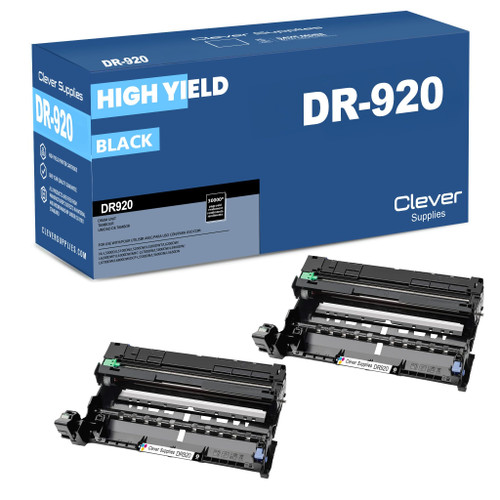
A drum change is a rare event in this family — one unit is rated to outlast roughly fifteen standard toner cartridges — and it tends to announce itself mid-job, on the day a printer can least afford to sit idle waiting for a delivery. The pair is built for that moment: the drum you need now, and its successor already in the cupboard at the lowest per-unit price most owners will ever use. If a single machine is all you run, stop at this rung. The 4-pack below only begins to earn its keep when several of the thirteen printers draw on one supply shelf.
Shop the 2-Pack →
The reference point for every figure on this page, at about $0.72 per thousand pages. The honest choice for a first drum change on a machine near retirement, or when exactly one unit is wanted and no stock behind it.
Shop the Single →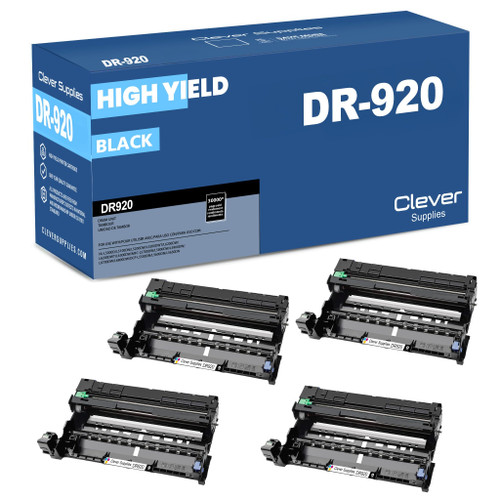
$20.22 per drum and about $0.45 per thousand pages — the floor of this ladder. Four drums is fleet arithmetic, and this is also the only offer here that clears the $49 free-shipping line on its own.
Shop the 4-Pack →Three offers, one yardstick: what a thousand pages of drum cost
Each row is the same DR920 carrying the same Brother rating; only the count in the box, and with it the per-unit price, changes. All per-thousand figures are worked out on Brother's 45,000-page rating at one page per job — the basis the store's own listings print — so the rows can be compared without a footnote doing quiet work.
| Offer | Pack price | Per drum | Cost per 1,000 pages | Against buying singles |
|---|---|---|---|---|
| 2-Pack — this page's pick | $48.47 | $24.24 | $0.54 | SAVE $16.09 |
| Single | $32.28 | $32.28 | $0.72 | The baseline |
| 4-Pack | $80.87 | $20.22 | $0.45 | SAVE $48.25 |
| Genuine Brother DR920, single (reference) | $320.79 | $320.79 | $7.13 | Out of stock today — Brother's own price is $273.49 |
Read the steps rather than the totals. Moving from one drum to two takes about a quarter off the per-thousand cost; moving from two to four takes roughly another sixth. Below that there is nothing — the ladder genuinely ends at the 4-pack — so the real decision is between convenience now, the balanced pair, and depth for a fleet.
Fading print is a toner story; repeating marks are a drum story
A cartridge running dry and a drum wearing out write in different hands, and the sheet in front of you usually says which one is talking. Cartridge trouble fades: density washes out across the page, one edge goes pale, the machine begins asking for toner, and output improves for a while if the cartridge comes out and is rocked gently from side to side. Drum trouble repeats: the same spot, nick or short line marching down sheet after sheet at fixed intervals, a gray haze settled behind text that used to sit on clean white, banding that looks stamped rather than smudged. The diagnostic that costs nothing is the swap test — fit a toner cartridge you know is good and print the same page again. Whatever the fresh cartridge cures was the cartridge. Whatever survives it, character for character, lives on the drum's surface, and no second cartridge will cure it.
The printer keeps its own ledger as well. Drum pages and toner pages are tallied separately on these models, and a Replace Drum message points at the unit priced on this page, not at the cartridge clicked into it. At Brother's ratings a single drum covers about fifteen TN920 cartridges, roughly seven and a half TN920XL, about four TN920XXL or around two and a half TN920UXXL — the per-job habits of a real office move those ratios around, but the scale of them explains why the drum warning tends to arrive years into a machine's life, long after toner swaps have become unremarkable routine.
Fitting the unit is not quite the end of the job. These machines remember the old drum's page total, and that memory has to be cleared from the front panel once the replacement goes in — Brother publishes the steps for each model — or the display will go on mourning a drum that is already in the recycling. Clear the drum tally and nothing else; the toner runs on its own count, untouched by a drum change. And never clear the tally merely to silence a warning on a drum you have left installed: the counter will believe you, the surface will not heal, and the repeating marks will keep arriving on schedule.
Drum and toner in one box: the sixteen sets standing behind this platform
When a drum warning and an empty cartridge arrive in the same month, this store also sells matched sets — a drum packaged with toner. Sixteen of them stand behind this platform: for each of the four toner tiers there is a drum with a single cartridge, a drum with two, a drum with three, and a two-drum, two-cartridge box. The one-drum-one-cartridge shape is priced at $52.39 with a TN920 cartridge, $53.33 with an XL, $54.43 with an XXL and $67.87 with a UXXL; the two-drum shapes run $88.71, $90.58, $92.79 and $119.67 by tier, and the deepest set — a drum with three UXXL cartridges — stands at $139.07. The full set shelf is compared where it belongs, in the Best Brother TN920 Toner guide, and no savings figures for the sets appear on this page. Two fit notes do belong here. First, a set is only as wide as its drum: whatever the toner half of the box fits, the set serves the thirteen DR920 printers and no others. Second, the top tier narrows further — TN920UXXL cartridges fit just twelve of the platform's models, and only five of those take this drum: HL-L6210DW, HL-L6210DWT, HL-L6310DW, MFC-L5915DW and MFC-L6810DW. The four UXXL sets serve those five machines, whatever their listings claim.
The genuine drum: priced above Brother's own shelf, and not orderable today
Brother's genuine DR920 stands in this store's listings at $320.79, and two plain facts travel with that number wherever it is quoted. First, Brother USA's own storefront sells the identical drum for $273.49 — the genuine part costs $47.30 more here than from its maker, a comparison this page prints instead of burying. Second, the listing cannot be ordered today at all: its stock count stands at zero and its product page reports the drum unavailable. The eight genuine toner-and-drum bundles built on this family are in the same position — priced, listed, and at zero stock — and a ninth genuine bundle has been switched off entirely. Nothing on the genuine side of this family is a purchase anyone can complete right now.
So read $320.79 as a reference figure, as this page does. Against the compatible single at $32.28 carrying the same Brother-published rating of about 45,000 pages, it is just under ten times the price. If genuine stock returns, what the premium buys is Brother's own part under the manufacturer's warranty, returnable within 30 days — set against this store's one-year warranty and one-year return window on the compatible drums carded above. A service agreement that specifies genuine parts can make that the right money on a day when it can actually be spent. Until then, the orderable drum shelf for these thirteen printers is the compatible one — and the genuine DR925 serving the platform's other seven printers, listed at $260.68 with no Brother price published to measure it against, is out of stock today as well.
Chips: a silent family, reported as one
Begin with what a drum is: the surface the image forms on. It holds no toner, tracks no level and has nothing for a chip to report, so this guide makes no chip claim for the DR920 — and, unusually, neither does anything else in the family. The word “chip” does not appear even once across all thirty product descriptions in this family, compatible and genuine alike; there is no fitted-chip statement anywhere to repeat or lean on. The one chip-adjacent sentence that can be put on the record comes from Brother itself, from its published support answers, and it is carried the same way across this store's Brother guides: “Brother firmware updates do not block the use of third-party ink and toner cartridges in our machines.” This page adds no recognition promise and no firmware forecast to it, because for this family nothing further has been established.
The terms standing behind the compatible shelf
Five confirmations before this drum goes in the cart
The questions this drum tends to raise
It depends which 15. The MFC-L5915DW takes the DR920 — Brother lists it on this drum's roster outright. The HL-L5215DW, HL-L6415DW, HL-L6415DWT, MFC-L5715DW and MFC-L6915DW all take the DR925, and so do the HL-EX415DW and MFC-EX915DW. The suffix looks like a family marker and behaves like a coin toss, so check the full model name against the thirteen linked at the top of this page rather than guessing from the ending.
No. The two drums carry the same published rating — about 45,000 pages at one page per job and 75,000 at three pages per job. Brother headlines the DR920 from the first of those figures and the DR925 from the second, which makes the DR925 look like the marathon runner of the pair. On a like-for-like basis there is nothing between them; the DR925 is simply the drum shaped for the platform's other seven printers.
No — that model is one of the seven DR925 machines, and the two drums are not interchangeable. This store stocks no compatible DR925; its only DR925 is Brother's genuine unit at $260.68, itself out of stock today. What this page will not do is steer you toward a DR920 for that printer, whatever a listing's fit text suggests.
Because the store does not stock one — nor a 5-pack. The DR920 is sold as a single, a 2-pack and a 4-pack, full stop. If four drums are what you need, the arithmetic favors the four-box anyway: two 2-packs come to $96.94 against the 4-pack's $80.87 for the same four units.
Because its stock count is zero: the listing is priced but not buyable today, and every genuine bundle in this family is in the same state. Worth knowing alongside that: Brother USA's own price for the drum is $273.49, so the figure here is not even the cheapest genuine route on a day when genuine stock returns. The compatible drums above are in stock, and they are the shelf this page can actually sell you.
Almost always, the counter reset. The machine does not watch the drum itself — it watches a page tally, and that tally still belongs to the old unit until you reset it from the front panel, by the steps Brother documents for your model. Reset the drum's tally alone; the toner keeps a tally of its own, and it should be left exactly as it stands.