




What Toner Does the Brother MFC-L2750DW Use?
Posted by Clever Supplies on Nov 11th 2026
Quick answer: The Brother MFC-L2750DW uses Brother TN730 standard-yield black toner (about 1,200 pages) or Brother TN760 high-yield black toner (about 3,000 pages), and a separate Brother DR730 drum unit rated at about 12,000 pages. One toner slot, one drum underneath it, two very different replacement intervals.
Start With the Feeder, Because That's Why You Bought This One
Most models in this family scan a two-sided document the slow way: scan the front, pull the sheet back, scan the back. The MFC-L2750DW is the exception. Its 50-sheet document feeder captures both sides in a single pass, which makes it the family's genuine document-workflow machine — the one offices buy to digitize files, not just to print them.
Add the 2.7-inch color touchscreen with create-your-own shortcuts, print-from and scan-to cloud services straight from the panel, NFC touch-to-connect for phones, and print speeds up to 36 pages per minute, and the picture is clear: this is the top step of the TN730/TN760 generation. None of that changes the supplies — but it does change how fast an office moves through them, which is why the yield conversation below matters more here than on any sibling.
Yields and Running Cost
| Supply | Rated yield | Our compatible price | Cost per page |
|---|---|---|---|
| TN730 (standard toner) | ~1,200 pages | Listed with the TN760 cartridge (see note) | Not quoted — see note |
| TN760 (high-yield toner) | ~3,000 pages | $25.26 | About 0.8 cents |
| DR730 (drum unit) | ~12,000 pages | $28.55 | About 0.2 cents |
Prices verified on our product pages, November 2, 2026. Why is one cell empty? Because the TN730-named listing is sold at the TN760's $25.26. A standard-yield cost per page computed from a high-yield price would mislead in the TN730's disfavor, so we leave the gap visible.
Now the practical reading. An office that scans and prints all day will empty the roughly 700-page starter cartridge in short order, and a 1,200-page TN730 not long after. The TN760, at about 0.8 cents per page in compatible form, is the cartridge this printer was effectively designed around. The drum's 12,000 pages, meanwhile, will carry a typical small office well past the two-year mark.
Toner and Drum: The Two-Part System, Briefly
Brother keeps the powder and the imaging surface in separate units on this platform. The toner cartridge holds what becomes the image; the DR730 drum is the surface that transfers it to paper, and it sits in the machine through roughly four TN760 cartridges. When output goes pale everywhere, suspect toner. When defects repeat down the page at regular spacing — dots, lines, a grey wash — suspect the drum. Replacing by symptom rather than by guess is the cheapest habit an owner of this machine can learn.
One more starter fact: the cartridge in the box is rated around 700 pages. It is a welcome gift, not a benchmark, and its early retirement says nothing about the printer's appetite.
Replacing the Cartridge
1. Leave the power on, open the front cover, and draw out the drum-and-toner assembly. 2. Press the green lock lever and remove the used cartridge from the drum frame. 3. Unpack the new cartridge, rock it gently from side to side several times, and remove its protective cover. 4. Push the cartridge into the drum frame until it locks. 5. Slide the drum's green corona-cleaning tab fully across and back to its arrow, slide the assembly into the machine, and close the cover.
If a fresh cartridge triggers a "not recognized" message or the toner gauge refuses to move, follow the steps in our TN760 recognition and reset guide before concluding anything is defective.
The Drum Day, and the Set That Softens It
When the DR730 finally reaches the end of its 12,000-page rating, you will need a toner decision at the same moment more often than not — drums rarely expire the week after a cartridge change. That coincidence is what the TN760 + DR730 set exists for: $37.73 for the pair on November 2, 2026, against $53.81 bought as singles, a saving of about $16, in a single delivery. Heavier scan-and-print offices can look at the drum-with-two-toners and the two-drum, two-toner sets beside it.
The counterweight stays on the record: with a young drum, that set is a shelf ornament. Buy the lone TN760, and let the drum partnership age naturally.
Frequently Asked Questions
What does "single-pass duplex scanning" actually save me? Time, in proportion to your paperwork. A 20-page two-sided contract is captured in one feeder run instead of two passes with a re-feed in the middle. For an office digitizing files daily, it is the feature that justifies this model over its siblings.
Can I make a shortcut on the touchscreen for my usual scan job? Yes. The 2.7-inch color touchscreen lets you store your most-used copy, scan and fax routines as one-touch shortcuts, including scan-to destinations in popular cloud services.
How does NFC printing work on this model? Hold a compatible phone near the machine's NFC mark and the connection is made for that job — no network hunting, no password typing. It is a guest-friendly way to print from a handset that is not a regular network user.
Does the MFC-L2750DW take the same drum as the cheaper models? Yes — the DR730 serves the entire family, from the entry printers up to this one. Its rating is about 12,000 pages regardless of which machine it sits in.
Why did my first cartridge run out so quickly? Because it was the roughly 700-page starter. Your first full cartridge — TN730 or TN760 — will last noticeably longer, and the machine's appetite will look normal from then on.
 brother tn760 tn760 toner cartridge black
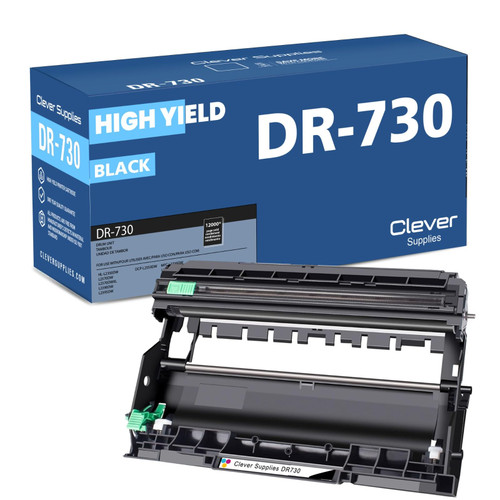 brother dr730 dr730 toner cartridge black
 brother tn760 tn760 tn730 toner cartridge black
 brother tn760 dr730 black drum and toner set
Key takeaways
- The top cartridge here is rated at 3,000 pages — fewer swaps, lower cost per page.
- Lowest cost per page in this family: ~0.8¢ with the highest-yield cartridge.
- Buying the toner + drum set instead of the parts separately saves $16.
Other Printers That Use TN730, TN760 and DR730
The flagship shares its supplies with every model below. If your Brother is one of these, the yields, costs and replacement guidance in this article carry over unchanged: