




Begin with the name, because the name points the wrong way. The cartridge sold on this page is called the SP 201HA, yet no US machine that accepts it wears a 201 badge. Ricoh USA's own price list enters part 407258 under three Aficio SP 213 printers — the SP 213Nw, the SP 213SFNw and the SP 213SNw — so if your machine says 213, you are in the right place and the cartridge's name is simply inherited from its cartridge family. Three more facts frame everything below. Ricoh listed the genuine cartridge at $82 in its July 2016 US price list, a dated figure we quote with its date attached. The savings printed on our product pages were calculated from list prices rather than checkout prices, so each one is rebuilt here from the prices the till actually charges. And when we counted in November 2026, every listing on this shelf showed zero recorded stock while remaining open to orders — a state we describe exactly as we found it, further down.
The short answer: the 2-pack at $50.53 is the order most owners should place — $25.27 per cartridge against $33.30 for a single, $16.07 saved, and a price that crosses the $49 free-shipping threshold by itself, if only by $1.53. Anyone feeding the machine steadily belongs in the 4-pack at $84.98, where each cartridge falls to $21.25. The single at $33.30 remains the trial size, and it is the only box of the three that cannot reach free shipping alone.
A single black all-in-one cartridge — toner and drum in one unit, rated at 2,600 pages under ISO/IEC 19752 — serves all three Aficio SP 213 models. We sell it three ways: a single at $33.30, a 2-pack at $50.53 and a 4-pack at $84.98. Most buyers should take the 407258 2-pack: one cartridge working, one sealed in reserve, free shipping on its own, and $16.07 kept against buying the pair one at a time.
The printers say 213 — the cartridge answers to 201
Ricoh's SP 213 trio is a compact Wi-Fi desktop line built around one shared engine. The Aficio SP 213Nw prints only. The Aficio SP 213SNw adds copying and scanning, and the Aficio SP 213SFNw adds fax on top of that. Features differ; the toner bay does not. Each model has a category of its own in this store, and every box below is filed under all three of them — whichever badge your machine carries, this page is its shelf.
Why, then, does the cartridge carry a 201 name? Because Ricoh names this cartridge for its cartridge family, not for the machines on the US price list. That list — Ricoh USA's Equipment Suggested Retail Price List of July 2016 — contains no SP 201 machine sections at all; it documents part 407258 in the consumables tables of exactly the three SP 213 models above, in three separate sections that agree word for word. A shopper hunting for an "SP 201 printer cartridge" and an SP 213 owner hunting for toner are looking for the same box. Judge fit by the model name on the printer, never by the number in the cartridge's name.
One stocked code, the upper of two tiers
The cartridge is an all-in-one unit: toner and drum travel together inside a single housing, so a swap renews both at once and there is no separate drum to price, track or replace on its own schedule. Ricoh rates it at 2,600 pages and footnotes that rating with its measurement standard — ISO/IEC 19752 — in each of the three machine sections of the July 2016 list. Our listings print the identical 2,600 figure. One small wording correction is worth making: a listing answer describes the rating as assuming "about 5% coverage," which is a looser label than the one Ricoh actually declares. The number agrees; the basis is the ISO standard, and that is the basis every per-page cost in this guide is divided from.
| Cartridge code | Color | Ricoh rated yield | Declared basis |
|---|---|---|---|
| 407258 (SP 201HA) | Black | 2,600 pages | ISO/IEC 19752 (Ricoh USA, July 2016 list) |
Behind this cartridge sits a second tier that this store does not sell. Ricoh documents a standard-yield sibling, the SP 201LA (407259), rated at 1,500 pages and listed at $64.99 in the same three sections of the same price list. Both tiers fit the same three machines — they are shorter- and longer-life versions of one supply — but a search of this store returns no 407259 listing at all, so the HA cartridge on this page is the only rung of the ladder we stock. None of our product pages mentions the LA tier; a buyer holding one should know the two are different cartridges at different ratings, not two names for one box.
The cartridge your machine arrived with is a third data point, and the same Ricoh document supplies it: each SP 213 ships with a starter all-in-one cartridge yielding approximately 700 pages. Set against the 2,600-page replacement, the first swap multiplies a cartridge's working life by roughly 3.7 — the single largest jump most owners of this platform will ever notice, and the reason the starter's early exit should not be read as the machine's normal appetite.
Ricoh's own price for the genuine cartridge is a matter of record: $82, printed identically in all three machine sections of the July 2016 SRP list. Treat it as what it is — the manufacturer's list price from 2016, quoted here with its provenance because it is genuinely Ricoh's figure, not a current street price; Ricoh's US store publishes no live price for this cartridge today. Against that dated $82, our compatible single sells at $33.30.
Three boxes, priced at the checkout
Anchor on the single at $33.30, because both packs are discounts measured from it. Bought in pairs the cartridge costs $25.27; bought in fours, $21.25. Followed through to cost per rated page, the sequence descends from about 1.28 cents for a cartridge bought alone to roughly 0.97 cents inside the 2-pack and about 0.82 cents inside the 4-pack. The boxes hold the same sealed unit in different counts, so nothing about print quality separates them — the decision is purely how far ahead you want to buy.
| Box | Checkout price | Cost per cartridge | Against buying singles | Suits |
|---|---|---|---|---|
| 407258 black 2-pack THE DEFAULT ORDER | $50.53 | $25.27 | Saves $16.07 vs two singles | One machine in regular use — a cartridge fitted and a sealed spare behind it. |
| 407258 black 4-pack | $84.98 | $21.25 | Saves $48.22 vs four singles | A busier desk, or more than one SP 213 drawing on the same drawer. |
| 407258 black single | $33.30 | $33.30 | — | A first trial of the compatible, or a machine that prints only now and then. |
Shipping turns on a whisker here: the 2-pack clears the $49 free-shipping line on its own by just $1.53 — the slimmest solo clearance on any shelf in this guide series — and the 4-pack clears it by $35.98. The single, at $33.30, is the only box that misses, falling $15.70 short.
One more line belongs under this table, and it is not about price. When we read the catalog in November 2026, the recorded stock against every listing in this family — all three boxes — stood at zero, even though the listings remain visible and open to orders. The section on the stock record below sets out exactly what that does and does not mean; we flag it here so nobody meets it first at the checkout.
The three boxes, one by one
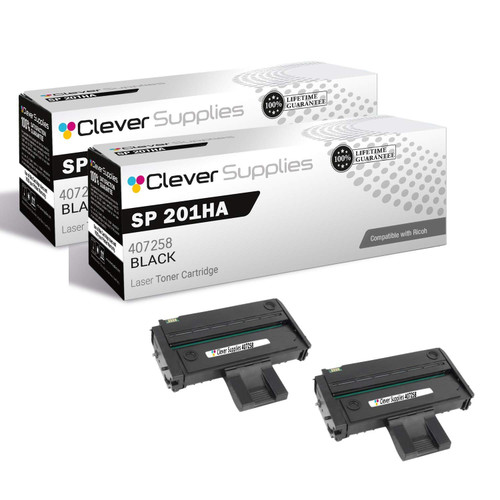
Small desktop machines tend to live at the edge of someone's attention until the morning they print pale. The 2-pack is built against that morning: fit one cartridge, keep the second sealed beside the machine, and let fitting the spare be the signal to reorder. At $25.27 a unit the arrangement also undercuts the two-single route by $16.07, and the box slips over the free-shipping line without help from anything else in the basket.
View the 2-Pack →
The single earns its place two ways. It is the audition: one cartridge, run against your own documents, before any pack asks for your confidence. And it is the honest size for a machine that prints a few pages a week, where a 4-pack would outlast the printer's welcome. Order it knowing the shipping position — alone in the basket it does not reach the free-shipping line, so either let it ride with something else or accept the 2-pack's spare as the better arithmetic.
View the Black Single →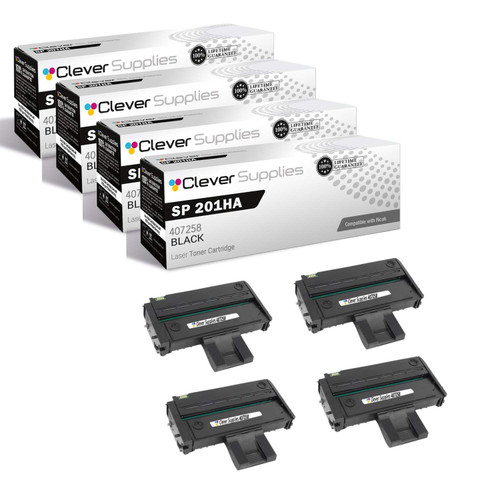
The 4-pack suits the machine that works for a living — a reception desk, a small accounts office, a home worker printing daily — or a drawer shared by two or three SP 213s. Four cartridges at the shelf's lowest unit price, each sealed until its turn, and the $48.22 held back against four single orders would cover a fifth cartridge bought singly with money left over.
View the 4-Pack →Putting the order together
A worked example: four cartridges, three ways of buying them
Suppose you want four cartridges in the drawer. Bought one at a time they cost 4 × $33.30 = $133.20. Bought as two 2-packs at $50.53, the same four cartridges cost $101.06. Bought as a single 4-pack they cost $84.98. The 4-pack therefore keeps $48.22 against the singles route and $16.08 against the doubled 2-packs — on a one-cartridge shelf, the pack choice is the whole discount.
Why the product pages quote larger savings than this guide
Every savings figure on this family's product pages was subtracted from list prices, and it is worth being precise about the nature of the error, because the arithmetic itself is clean. The 2-pack's page sets two singles at $76.60 — twice the $38.30 list price — against the pack's $58.11 list price, and reports $18.49 saved at $29.06 a cartridge, with per-page costs falling from about 1.47 cents to about 1.12. Each of those sums re-adds correctly; they are simply computed from prices nobody is charged. At checkout the same comparison reads $66.60 against $50.53: $16.07 saved, $25.27 a cartridge, about 0.97 cents a page. The 4-pack's page claims $55.47 saved at $24.43 a cartridge and roughly 0.94 cents a page; the checkout figures are $48.22, $21.25 and about 0.82 cents. Even the single's own text prices it at $38.30 in its closing lines and derives about 1.47 cents a page, where the till charges $33.30 and the honest rate is about 1.28 cents. The packs really are cheaper than singles — by the amounts in this guide, not the larger ones on their pages.
One single, three listings
Search this store for the 407258 and the single cartridge appears three times. Alongside the canonical listing there is a twin whose address ends in "-1" and a second twin whose product name drops the space from the cartridge's name, spelling it SP201HA. All three publish the same price, the same specification and near-identical text, and the cartridge that arrives is the same whichever of the three a buyer orders from. The shelf therefore holds three distinct boxes, not five; this guide cards the canonical single once and links to no other version of it.
The stock record reads zero — what that means, and what it does not
At our November 2026 count, the inventory recorded against all five listings in this family — the three boxes carded here and both duplicate singles — stood at zero units, while every listing remained visible, marked available and open to orders. We report that exactly as recorded, and we are careful about its limits: a catalog count of zero does not by itself prove a warehouse shelf is empty, and it equally does not entitle us to promise the opposite. What can be said is that the recorded figure sits awkwardly against some of the listings' own prose — one duplicate single's closing paragraph assures readers the cartridge is always kept on hand, and the 4-pack's text describes it as stocked for heavy use — and where copy and count disagree, the count is the part we are willing to stand behind. The practical reading is simple: these boxes remain orderable, but if your machine is already printing pale and timing matters, talk to us before you order — support runs Monday to Friday, 9 AM to 5 PM CST — rather than assuming a box leaves the same day.
Running the SP 213 day to day
The chip arrives current
Every cartridge we sell for this platform leaves our supplier carrying its newest updated chip, and in our hands that supply has behaved exactly as it should: the printer takes the unit the moment it seats, the level gauge reads normally, and we have never had to transplant a chip from an empty cartridge to make one work. One caveat applies to every compatible from every seller, and we would rather state it than skip it: firmware Ricoh may issue in the future could, in principle, alter a machine's attitude to third-party toner, and no retailer can warrant against software that does not yet exist. Behind the cartridge as it ships stand the fitted chip, a one-year warranty and one-year returns.
The first replacement is the long one
Calibrate your expectations against the right baseline. The cartridge an SP 213 leaves the factory with is a starter unit of roughly 700 pages, so the first 407258 you fit should deliver close to four times the printing — about 3.7 times, on Ricoh's own figures — before it asks for a successor. An owner who judged this platform's running costs by the starter's short life has been judging it by its smallest cartridge. Because the unit is all-in-one, that first swap also renews the drum along with the toner: there is no separate drum counter ticking away behind the toner gauge, and nothing else on a schedule of its own to budget for.
Reading the 2,600-page rating honestly
The 2,600 figure is a declared yield under ISO/IEC 19752, which means it was measured on that standard's test pages, not harvested from any one office's habits. Treat it as the yardstick it is: the fair basis for comparing this cartridge against its standard-yield sibling and for the per-page arithmetic above. Your own count will move with your documents — letters and invoices sit close to test conditions, while dense forms, shaded panels and graphics spend toner faster, on genuine and compatible cartridges alike. The life your first full cartridge actually gives you, on your own work, is the soundest basis for timing the order after it.
The 407258 pre-order checklist
Answers for SP 213Nw, SP 213SFNw and SP 213SNw owners
Because Ricoh names the cartridge for its cartridge family rather than for the printers on its US list. Ricoh USA's July 2016 price list has no SP 201 machine sections; it documents part 407258 — the All-In-One Black Print Cartridge SP 201HA — in the consumables tables of the SP 213Nw, the SP 213SNw and the SP 213SFNw, identically in all three. The name on the cartridge and the badge on the machine come from two different naming schemes, and the pairing is Ricoh's own. If your machine is one of the three SP 213 models, this is its cartridge.
$82, according to Ricoh USA's Equipment Suggested Retail Price List of July 2016, where the figure appears in the sections for all three SP 213 machines. Two qualifications travel with it: it is a 2016 list price, from when the platform was current, and Ricoh's US store publishes no live price for the cartridge today, so $82 is a documented historical figure rather than a quote you could act on now. For the comparison that can be acted on, our compatible single sells at $33.30.
Both subtractions are accurate — they start from different prices. The product page worked at list: two singles at the $38.30 list price total $76.60, set against the pack's $58.11 list price. At the sale prices the checkout charges, two singles cost $66.60 and the pack costs $50.53, which saves $16.07 and prices each cartridge at $25.27. To the listings' credit, every figure in this family re-adds correctly at list; the basis is the only thing out of date. When a saving is what settles a purchase, redo it from the two prices on the screen in front of you.
Both packs. Free shipping begins at $49: the 4-pack clears it with room to spare at $84.98, and the 2-pack clears it by the narrowest margin on any shelf in this series — $50.53 against a $49 line leaves $1.53 of headroom. The single is the only box that misses, at $33.30, falling $15.70 short; it needs a companion item in the same order, or the step up to the 2-pack, whose spare most owners end up glad of.
Substantially longer, on Ricoh's own numbers. Each SP 213 ships with a starter all-in-one cartridge yielding approximately 700 pages; the replacement on this page is rated at 2,600 pages under ISO/IEC 19752 — roughly 3.7 starters' worth of printing from one unit, under similar coverage. The starter's short life is a property of the starter, not of the machine, and the first full cartridge is the one to judge the platform's running costs by.
The listings remain visible and open to orders, and this guide links them as it finds them. But we will not dress the record up: when we counted in November 2026, the inventory recorded against every listing in this family was zero units. A zero in a catalog can lag a warehouse, and it can also mean exactly what it says; from the catalog alone we cannot tell you which, so we promise neither immediate dispatch nor a wait we cannot measure. If your machine is down and the timing is critical, contact support — Monday to Friday, 9 AM to 5 PM CST — before ordering, and we will tell you what we know.