




Whole machine due at once: the four-color set at $268.48 — it undercuts its own contents by $48.24 and pools the platform’s cheapest page. A single color gone: that color’s cartridge at $82.73. Black gone: the CB380A single at $68.53. The one listing to approach carefully is the CM6030F-named set at $275.64: it costs more than the flagship, and its page contradicts itself about which black cartridge it contains — the panel beside the flagship explains, and the disclosure records it. Every price on this page is a sale price read from the product’s own listing; the listings themselves argue in list prices, which are set aside here. One absence to budget around from the start: this platform’s imaging drums are separate parts, four of them, and the store stocks none — the drum section below has their codes.
The set that restocks everything
A badge on this page certifies exactly one comparison, made at sale prices: a box against the same cartridges bought singly. One box earns it. The four singles total $316.72; the set is $268.48, and the $48.24 difference is printed beside its price rather than rounded into a slogan. The word on the box deserves the opposite treatment. The listing calls itself “Premium Quality”, and its own first answer dismantles the phrase — the label, it says, marks a product line, not a surcharge, not a different yield, not different cartridges. This guide takes the listing at its word: the flagship leads on arithmetic and completeness, and the premium in its name is worth exactly what its own page says it is worth.
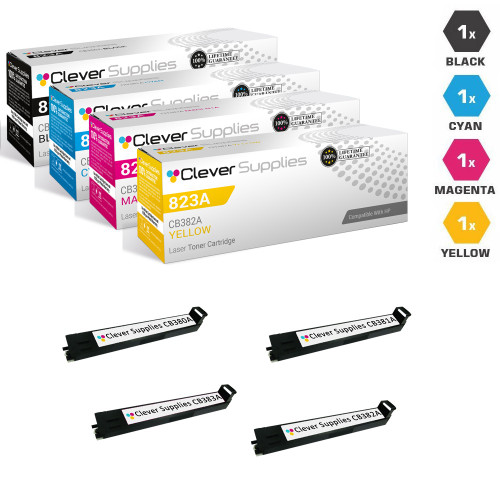
The box carries the platform’s full row in HP’s sequence: CB380A black, CB381A cyan, CB382A yellow, CB383A magenta. Fitting follows the routine these machines were built for — the used cartridge comes out, its replacement goes in — with each unit arriving with the supplier’s current chip revision fitted, so no component is transferred from the cartridge being retired. What a set cannot renew is the imaging side: the drums on this platform are four separate parts with lives of their own, and no toner order touches them. Their section is further down.
Buying one bay at a time
Departmental machines rarely empty in unison, and each cartridge on this platform is an independent supply with its own slot — the economical order is usually the single that ran out. Black is the platform’s hardest-worked cartridge and its shortest-lived: 16,500 rated pages against 21,000 for every color, an inversion of the usual arrangement that HP’s figures state plainly and the listings’ fields repeat. The black card comes first; the three colors follow as equals — identical price, identical rating, differing only in the bay they fill.

Black’s shorter rating is a fact of the platform, not a defect of this listing: the same 16,500 appears in HP’s data, the listing’s field and its text. Offices that print mostly documents will cycle blacks noticeably faster than colors here, and a spare black on the shelf is the stock-up this platform actually rewards — there is no black bundle in the store, so a spare means a second single.
Shop the 823A Black →The practical consequence is a monitoring habit, not a purchasing trick. On a document-heavy machine the black gauge falls first and keeps falling first; colors are the long intervals between orders. Judge the set by its pooled 79,500 pages when the whole machine is due, and judge each single by its own rating when one bay runs dry — the two judgments are both printed on this page, in the table below.
THE 824A COLOR SINGLES — $82.73 EACH · 21,000 PAGES EACH
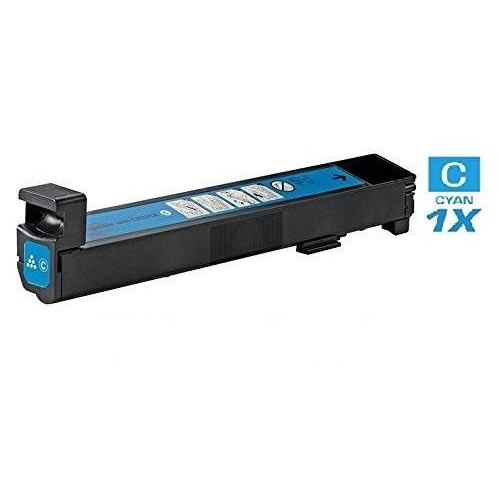
Skies, water and corporate blues are built from this bay; when they go pale while reds still print strong, cyan is the cartridge that has run down.
Shop the 824A Cyan →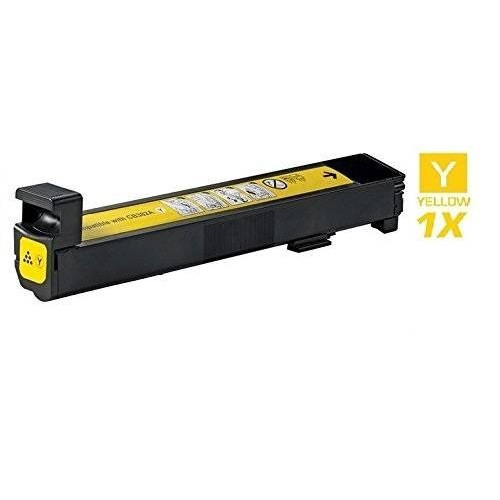
The quietest failure on the platform — warm tones cool and highlights flatten long before any warning. CB382A is the yellow; the 3-code is magenta.
Shop the 824A Yellow →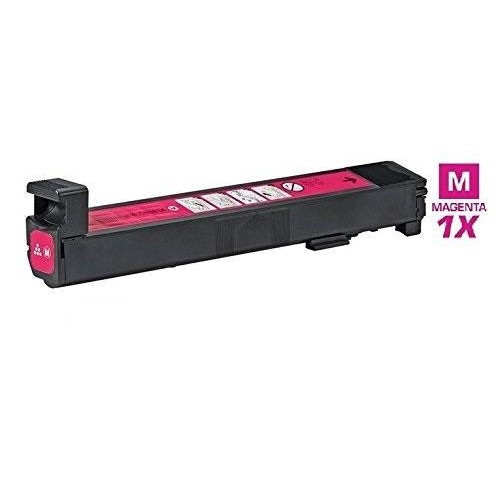
Reds drift orange and skin tones go waxy as this bay fades. The magenta single renews it alone, at the same price and rating as its siblings.
Five products, one pricing basis
Each row divides the sale price on the product’s own page by its rated pages; the set’s figure is marked pooled because its pages are spread across four cartridges. The disputed CM6030F set gets no row — a comparison table is the wrong place for a box whose contents are in question — and its two possible figures are handled in the notes. Cheapest first:
| Configuration | Sale price | Rated pages | Cost per page | Printer fit |
|---|---|---|---|---|
| 823A-824A 4-Color Set — the flagship | $268.48 | 4 cartridges · ~79,500 pages | 0.338¢ pooled | All 10 models |
| 824A Cyan Single | $82.73 | 1 cartridge · ~21,000 pages | 0.394¢ | All 10 models |
| 824A Yellow Single | $82.73 | 1 cartridge · ~21,000 pages | 0.394¢ | All 10 models |
| 824A Magenta Single | $82.73 | 1 cartridge · ~21,000 pages | 0.394¢ | All 10 models |
| 823A Black Single | $68.53 | 1 cartridge · ~16,500 pages | 0.415¢ | All 10 models |
A full-color page on this platform stacks the black’s 0.415¢ with three color rates of 0.394¢ — about 1.60¢ at the coverage the ratings assume. Treat that as the ceiling the test basis implies; ordinary office pages carry a fraction of the color the basis supposes, and cost proportionally less.
The absent row, priced both ways: the CM6030F-named set at $275.64 pools to 0.347¢ if its black is the CB380A its answers describe, or 0.334¢ if its black is the CB390A its fields describe. The second figure would nose ahead of the flagship’s 0.338¢ — which is precisely why it is not tabled: a lead that depends on a cartridge the same page elsewhere denies is not a lead this guide will print as fact. Either way the set costs $7.16 more than the flagship for, on the undisputed reading, the identical contents.
No genuine row appears because there is no genuine price to print: HP’s US store lists none of the four codes, so the comparison this platform allows is among the store’s own listings — and on sale prices, the set above wins it.
Ten machines on one roster
HP’s compatibility for these four codes names ten machines, and every cartridge on this page serves all ten. The printers: Color LaserJet CP6015, CP6015de, CP6015dn, CP6015n, CP6015x and CP6015xh. The multifunctions: CM6030, CM6030f, CM6040 and CM6040f. The store files the family under its combined HP 823A-824A category.
A buyer reading only the listings’ opening lines would never learn the second half of that roster. Every single and both family-named sets introduce themselves as cartridges for the CP6015 printers alone; the multifunction machines surface only deep in the same pages’ question-and-answer sections, which name them correctly. The pages thus undersell their own fit — the reverse of the usual catalog sin — and this guide follows the fuller, correct account: all ten models, for every product carded.
The store’s category tree tells a busier story than HP’s roster: sixteen model categories for ten machines, including five near-duplicate variants of the multifunction names and one category for a “CM6049F” that appears nowhere in HP’s compatibility for this platform — evidently a garbled CM6040f. None of those extra names adds a machine; the roster above is the whole of it.
ISO ratings — and colors that outlast the black
These cartridges belong to the ISO era: their ratings are declared under ISO/IEC 19798, the standardized yield test, and the listings’ own footnote says so. HP declares about 16,500 pages for the black and about 21,000 for each color. In this family the three tellings agree — the spec field on each listing, the listing’s prose and HP’s published data return the same two numbers for every code — so the arithmetic on this page runs on them without adjustment or apology.
The inversion deserves a second look because it reverses shopping instinct. On most platforms black is the marathon cartridge; here each color outrates it by 4,500 pages. The platform is a color-first departmental engine, and HP simply rated it that way. The practical consequence lands in the buying advice below: black is the bay to watch and the spare to hold, colors are the long intervals between orders. A complete renewal pools about 79,500 rated pages — a sizing figure for the order, not a promise that any single bay will print them.
Separate drums — four of them, none sold here
Unlike the all-in-one platforms elsewhere in this catalog, these machines keep imaging apart from toner. Each color station has its own drum: CB384A for black, CB385A for cyan, CB386A for yellow and CB387A for magenta — all of them 824A parts in HP’s index, each rated by HP at about 35,000 pages. A worn drum announces itself differently from an empty cartridge: fading or background shading that a fresh cartridge does not cure, in the one color whose drum has aged. The store’s position is stated without dressing: it stocks no drum for this platform today, so the codes are printed here for planning and ordering elsewhere, unlinked, because no product page exists to link to.
The toner cartridges ask nothing of the buyer on the chip front. Each ships with the supplier’s latest chip revision already fitted — the practice across this store’s compatible range, backed by a selling record with no chip failure reported to date. Seat the cartridge and the machine takes it, level reporting intact; nothing is salvaged from the spent unit. The assurance carries its boundary in the open: it describes cartridges as supplied now and the record behind them, and it cannot bind firmware HP has not yet written — no seller can honestly promise that, and this page does not.
Warranty, returns and support
One set of terms covers the set and the four singles alike, so it is stated once, here.
Choosing by what ran out
Questions from CP6015 and CM6030/CM6040 owners
Because HP split the naming across one engine. 823A is a single black cartridge, CB380A; 824A is the color row — CB381A, CB382A, CB383A — together with the platform’s four drums. Every complete restock mixes the names, so a guide honoring the boundary would leave each name holding half a shelf. The store’s own filing reaches the same conclusion: its only family category for these cartridges is the combined 823A-824A.
By its own page’s account, no. The flagship listing’s first answer explains that the phrase labels a product line — not a surcharge, not a different yield, not different contents — and the identical set sits in the catalog under a plainer name at the identical price, currently switched off. The set leads this page for its arithmetic: $48.24 under its contents bought singly. The label contributes nothing, and this guide prices it accordingly.
Because its page gives two incompatible accounts of its black cartridge. The name, part-number field and yield field say CB390A — HP’s 825A black, the multifunction line’s alternative black, rated 19,500 pages. The listing’s own contents and code-check answers say the black is CB380A, rated 16,500. One box cannot hold both, and the store sells no 825A single against which to test the claim. Held out of the cards, it is recorded in full beside the flagship and in the disclosure; the flagship offers the verified contents for $7.16 less.
CB382A is yellow; CB383A is magenta. HP’s index fixes the color order across the row — CB381A cyan, CB382A yellow, CB383A magenta — and the store’s listing names and color fields agree. Where a set’s part-number field recites the codes out of order (both sets here list magenta before yellow), the label on the cartridge coming out is the authority.
Because HP rated this platform that way. It is a color-first departmental engine, and its published figures — repeated identically in the listings’ fields and text — give every color a 4,500-page edge over the black. The practical reading: black empties first in document-heavy offices, and it is the bay to monitor and to spare.
No — this platform keeps them apart. Four separate 824A drums, CB384A through CB387A, one per color station, each rated by HP at about 35,000 pages, handle imaging while the cartridges supply toner. The store stocks no drum for these machines, so a drum replacement has to be sourced by its code elsewhere; the toner listings, to their credit, nowhere claim otherwise.
Twelve months of each, counted from delivery: a year of warranty cover and a year of returns at no cost, on the terms each product page sets out. Support is staffed on weekdays between 9 AM and 5 PM Central, and orders leave from the Illinois, Pennsylvania, Georgia and California warehouses.
Price and disclosure note: Prices here are the sale figures on each carded product’s own page, re-read on November 18, 2026 as this guide was prepared; should a figure move afterwards, the product page is the authority. Sale is used deliberately. In their own text the listings argue from list prices — $308.75 for either family-named set, $78.81 for the black single, $95.14 for each color single, $316.99 for the CM6030F-named set — sums checkout does not charge on the listings that can be checked out, with their per-page claims built on those sums. One SAVE badge appears, and it means one thing: the $48.24 between the flagship set’s sale price and the sale-price total of its four cartridges. Yields are HP’s declared ratings under ISO/IEC 19798 — about 16,500 pages for the black, 21,000 per color — and fields, prose and HP agree on them for all four codes; totals spanning several cartridges are labeled pooled wherever they appear. No genuine price is printed because none can be: HP’s US store carries no page for any of these codes. Fit follows HP’s published roster of ten models — six CP6015 printers and the CM6030, CM6030f, CM6040 and CM6040f. The catalog’s own disorder follows, item by item.
First, the disputed set: the CM6030F-named listing’s name, part-number field, introduction and yield field sell a CB390A black at 19,500 pages while its contents and code-check answers sell a CB380A at 16,500 — the only trace of HP’s 825A anywhere in this store, and an unresolved one; it is held out of the cards for exactly that reason. Second, the switched-off CM6030f set carries the same contamination in mirror image: its yield field reads 19,500 for the black against its own answer’s 16,500, and its part-number field contains its own stock code instead of the cartridge codes. Third, money is argued at list throughout, as noted above. Fourth, the set is duplicated: two listings carry it at identical prices with identical stock figures — the same eleven units counted on both — and the twin left visible is the one named “Premium Quality”, a label its own text disowns; the plain-named twin is the one switched off. Fifth, fit is under-named in every introduction: the CP6015 printers alone are claimed up front, with the four multifunction models appearing only in the same pages’ answers. Sixth, the category tree outruns the roster — sixteen model categories for ten machines, five of them near-duplicate variants of the multifunction names, and one, “CM6049F”, for a model HP never made; the series page above the tree currently returns a server error, and this guide does not link it. Seventh, filing gaps run the other way for the two problem listings: the disputed set sits under only three categories, missing the family category its own fit list would suggest, and the switched-off set is filed under a single invisible housekeeping category, outside the HP tree entirely. Eighth, the platform’s shadow pricing: the identical four cartridges are buyable today under six listings named for printer models at $309.52 — $41.04 above the flagship, pooling to about 0.389¢ a page — while ten further model-named listings sit switched off at $223.91, $44.57 below it; the flagship’s cheapest-page standing on this page is measured against buyable offers, and it holds. Ninth, stock figures echo across the platform — 34 on the black single, the switched-off set and all ten dark model-named sets; 11 on both set twins and most of the live model-named ones — the same units counted many times over. Minor artifacts: six of the eight descriptions open with a stray HTML fragment, and both sets’ part-number fields recite the color codes out of HP’s order. Recorded as not defects: no production or prompt text leaks into any description in the family; no toner text claims a built-in drum, and one description states the separate-drum arrangement correctly; warranty wording is consistent at one year throughout, with no lifetime claim anywhere.
Five cards are this platform’s orderable shelf as the guide judges it — the set and the four singles, each shown once — with the disputed set, the duplicate and the switched-off set accounted for in prose rather than presented as choices. The roster stops where HP stops: ten models, two family names, one engine. Ratings are HP’s declared figures, neither padded nor trimmed, and the drums are named with their absence attached: four separate parts, none stocked here. Chip claims carry their limit in the same breath — the current revision ships fitted, the record to date is clean, and firmware not yet written is promised against by nobody. Underneath stand the family’s own terms: twelve months of warranty, twelve months of free returns, support staffed on weekdays between 9 AM and 5 PM Central, and orders leaving warehouses in Illinois, Pennsylvania, Georgia and California.