




Two slots are the whole machine. Every printer in this family — thirteen ENVY models — runs on one black cartridge and one tri-color cartridge, and HP’s entire catalogue for the platform is three cartridges long: the 68 black, the 68 tri-color, and the 68e EvoMore black, a doubled-capacity version of the black alone. No high-yield color cartridge exists, from HP or from anyone, so the family’s one real decision sits in the black slot. This store stocks all three singles and builds four sets around them — a pair and a five-pack in each black — seven listings, each carded once in what follows. One comparison deserves stating before any card: HP’s genuine standard singles are $26.99 apiece, which is less than the compatible standard singles priced below, so no value claim is made for the standard tier on this page. The shelf’s case is built one tier up, where the compatible 68e black costs $44.99 against HP’s $53.99 and prints its page for less than either genuine black does.
Start with the 68e Set of 2 at $83.97: it refills both slots with 440 rated pages at a 19.08¢ blended rate, and the step up from the standard Set of 2 at $79.47 is exactly $4.50 — the price of swapping the standard black for its doubled EvoMore version, nothing else in the box changes. That same $4.50 step is the family’s whole story told once: the 68e black holds 320 pages against the standard black’s 160, so its page costs 14.06¢ against 25.31¢, the cheapest single-cartridge rate here. The standard singles sit at exact parity, $40.49 for the black and $40.49 for the tri-color — and here the page owes the reader a plain fact rather than a pitch: HP’s genuine standard singles are $26.99 each, below both, so anyone shopping the standard tier alone should know HP’s own shelf undercuts this one. Where this store pulls ahead is the tier HP prices at $53.99 and could not supply on the day checked — the compatible 68e black is $44.99. Bulk buyers land on the 68e Set of 5, whose 16.99¢ blended rate is the lowest on the page.
Four sets, three singles, two slots
The seven cards below are the complete shelf, ordered the way the decision usually unfolds. The 68e pair leads because the doubled black is where this family rewards a buyer; the standard pair follows with the contrast printed on its card; the two five-packs come next for households that would rather stock a shelf than watch ink levels; and the three singles close the page in tier order. Because the store lists the standard and 68e sets under identical product names, every set card here names the black cartridge inside the box — look for code 7FP22TN wherever the doubled black is the point. Prices on the cards are the prices on the product pages — no listing in this family is marked down from a higher figure — and a box’s saving badge is always reckoned against the same cartridges bought singly from this store.
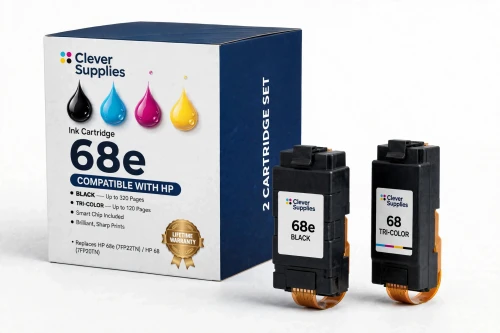
Inside are precisely the 68e black single and the tri-color single carded further down, which total $85.48 bought separately; the box keeps $1.51 of that. Judged against HP’s shelf, the pair holds its own in a way the standard pair cannot: HP’s genuine standard combo costs $53.99 but carries only the standard black’s 160 pages, while this box’s blended rate works out level with that combo’s per-page cost and delivers 440 pages before either slot runs dry. For a printer due both cartridges, this is the purchase the rest of the page is measured against.
Shop the 68e Set of 2 →THE OTHER SIX LISTINGS
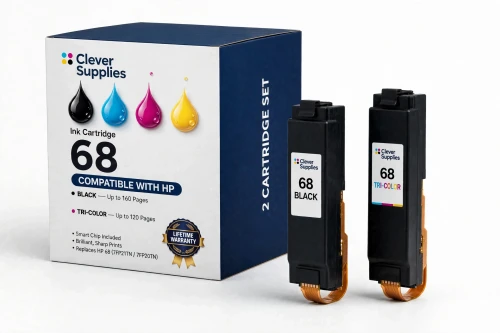
The standard pair — the 7FP21TN black beside the same tri-color the flagship carries. It is $4.50 cheaper at the till and 160 pages shorter in the black slot, which is why its blended page costs 28.38¢ against the 68e pair’s 19.08¢. Buyers weighing it against HP’s own shelf should know the genuine version of this exact pair is a $53.99 combo at HP’s US store; this box’s $1.51 saving is measured against this site’s singles, and on the standard tier that is the only contest it wins.
Shop the 68 Set of 2 →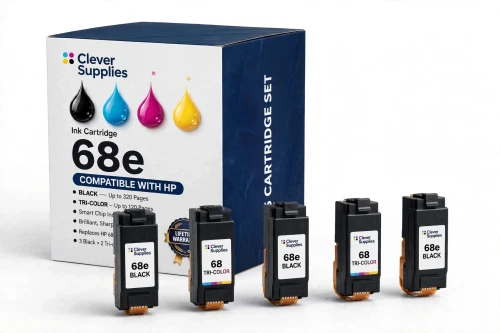
The bulk box, weighted the way these printers actually consume: three blacks against two tri-colors, with every black the doubled 7FP22TN. As singles the five cartridges total $215.95, so the box holds back $12.02 — the largest saving on the page — and its 1,200 pages blend out cheaper than anything else here. Three full black changes and two color changes sit in one carton.
Shop the 68e Set of 5 →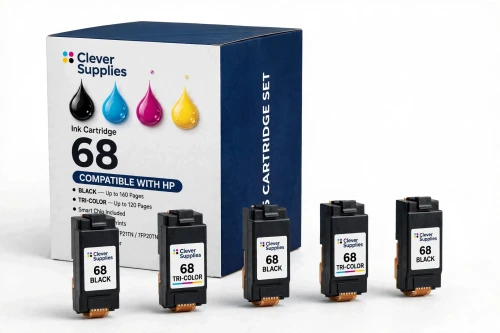
The same 3-plus-2 shape built on the standard black — three 7FP21TN cartridges and two tri-colors. It undercuts its own singles by $7.52 and sits $9.00 below the 68e five-pack above, but the arithmetic runs the familiar direction: 720 pages against 1,200, and a blended page at 27.07¢ against 16.99¢. Stocking up in the standard tier buys convenience, not a rate.
Shop the 68 Set of 5 →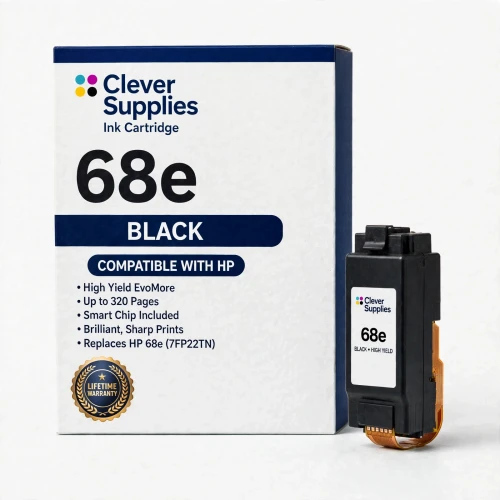
The single this family is really about. For $4.50 over the standard black it carries twice the ink, and its 14.06¢ page is the cheapest any single cartridge here prints — below even HP’s genuine black at either tier, which works out to about 16.9¢. HP’s own 68e single is $53.99 and showed as out of stock at HP’s US store when this page was checked; this one is $9.00 less.
Shop the 68e Black Single →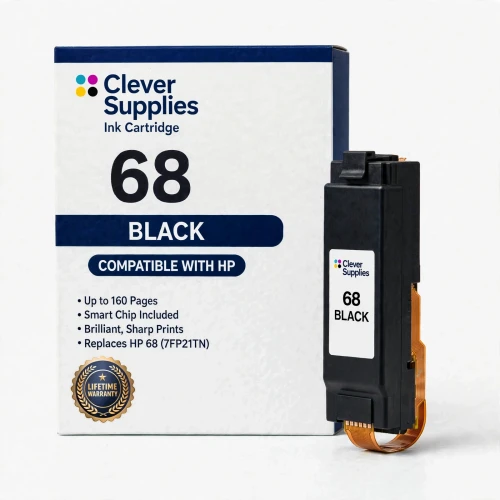
The standard black, priced at exact parity with the tri-color beside it — one entry figure for either slot. Its role is the low-commitment refill for a printer that prints occasionally, and the page states its limits plainly: at 25.31¢ its page is the dearest black page here, and HP’s genuine version of this same cartridge is $26.99, less than this compatible one. On any machine in regular use, the 68e above is the better black.
Shop the 68 Black Single →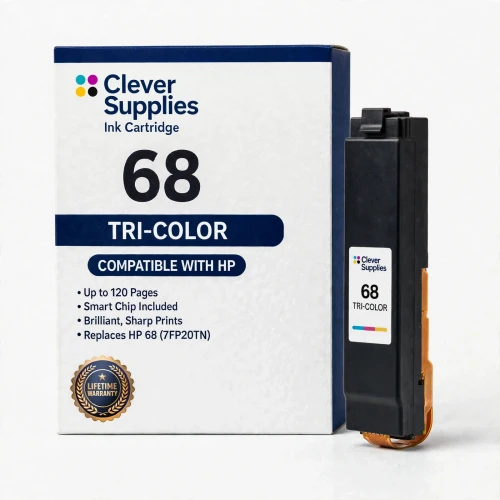
The family’s only color cartridge, in the only size that exists — HP makes no high-yield tri-color for this platform, so there is no larger color tank to step up to and no tier decision to make at this slot. Cyan, magenta and yellow ride together in the one cartridge, rated about 120 pages as a unit. It shares the standard black’s $40.49 price exactly, and the same honest note applies: HP’s genuine tri-color is $26.99.
Shop the 68 Tri-color Single →Step back and the shelf’s shape is unusually tidy. HP’s line for this platform is three cartridges, and all three are here — nothing a buyer could want at the single level is missing, and nothing has been invented to pad the page. The four sets are this store’s own compositions built from those three cartridges, two shapes in two blacks. The one asymmetry runs through everything: capacity can be doubled at the black slot and nowhere else, so every pricing question in the family reduces to how much black the machine drinks.
All seven listings side by side
Fit earns no column of its own: all seven offers run in the identical thirteen printers named further down, so nothing in the table is fenced off from any machine. A set’s page figure adds up the ratings of the cartridges inside it, and dividing the carton’s price by that figure gives the blended rate printed beside it.
| Offer | Price | What the box holds | Cost per page | Saving vs singles |
|---|---|---|---|---|
| 68e Set of 2 — the flagship | $83.97 | 1 68e black, 1 tri-color · ~440 pages | 19.08¢ blended | SAVE $1.51 |
| 68 Set of 2 | $79.47 | 1 standard black, 1 tri-color · ~280 pages | 28.38¢ blended | SAVE $1.51 |
| 68e Set of 5 | $203.93 | 3 68e black, 2 tri-color · ~1,200 pages | 16.99¢ blended | SAVE $12.02 |
| 68 Set of 5 | $194.93 | 3 standard black, 2 tri-color · ~720 pages | 27.07¢ blended | SAVE $7.52 |
| 68e EvoMore Black Single (7FP22TN) | $44.99 | 1 pigment black · ~320 pages | 14.06¢ | Bought one at a time |
| 68 Black Single (7FP21TN) | $40.49 | 1 pigment black · ~160 pages | 25.31¢ | Bought one at a time |
| 68 Tri-color Single (7FP20TN) | $40.49 | 1 dye-based tri-color · ~120 pages | 33.74¢ | Bought one at a time |
Read the two Set of 2 rows against each other and the family’s economics fit in a single glance: identical savings, identical tri-color, and a $4.50 gap that buys 160 extra black pages and pulls the blended rate down by more than nine cents. The bottom row is the other fixed point — the tri-color page, at 33.74¢, is the most expensive page on the page, and no tier, set or bundle anywhere in the family brings it down, because the color cartridge exists in exactly one size.
Where the per-page advantage actually sits
Print 320 black pages both ways and the tier question answers itself. The 68e does it with a single cartridge at $44.99. The standard black needs two cartridges to reach the same page count — $80.98 in total — because each one runs dry at roughly 160 pages. The 68e prints its page for 14.06¢, the standard for 25.31¢ — a little over half. The $4.50 premium is recovered inside the first cartridge, and every black page after that is bought at the lower rate. The sets inherit the same shape: the 68e pair blends to 19.08¢ against the standard pair’s 28.38¢, and the 68e five-pack’s 16.99¢ is the cheapest blended figure in the family.
The comparison against HP’s own shelf cuts both ways, and this page prints both directions. On the standard tier, HP is cheaper: its genuine black and tri-color singles are $26.99 apiece — a black page of about 16.9¢ and a tri-color page of about 22.5¢, both below the compatible standard singles’ 25.31¢ and 33.74¢ — and HP’s genuine combo of the standard pair is $53.99, well under this store’s $79.47 standard set. No wording on this page claims otherwise. One tier up the direction reverses: HP prices the genuine 68e black at exactly double its standard black, $53.99, and that cartridge showed as out of stock at HP’s US store when checked, while the compatible 68e here is $44.99 and prints its page for 14.06¢ against the genuine figure’s 16.9¢. HP’s per-page rate for black is the same at both of its tiers; the compatible shelf’s drops as the tier rises, and crosses under HP’s at the 68e.
One figure no purchase on this page improves: the tri-color page. At 33.74¢ from the compatible single it is the family’s most expensive page, and because HP never built a larger color cartridge for this platform, there is no high-yield color rate to graduate to — the sets dilute it with cheaper black pages, but the color cartridge itself is bought at one size and one rate. Households printing mostly photographs and color documents should weigh that honestly; households printing mostly text will find the 68e black does nearly all the work.
Short ratings, a smaller setup pair, and a printhead in every cartridge
Yields need no referee here. Listing prose, the listings’ own specification fields and HP’s published data all give the same three numbers: roughly 160 pages for the standard black, 120 for the tri-color and 320 for the 68e black, each of them HP’s ISO/IEC 24711 result from testing in the ENVY 6100 series. Those are the figures every rate on this page stands on. Ink typing is settled the same way — pigment-based ink in both black cartridges, dye-based ink in the tri-color — in the listings’ fields, their answers and HP’s specifications alike. These are small cartridges by any measure, built for home machines; the ratings are short because the tanks are, and the 68e’s doubling is the family’s only answer to that.
What a new machine starts on is rated below the retail pair. These ENVY models ship with an HP 68 Setup black and an HP 68 Setup tri-color in the box, and HP’s documentation for the line rates that setup pair at roughly 120 pages black and 75 tri-color — so the first replacement arrives sooner than the retail figures above would suggest, and when it does, the choice between the standard black and the 68e is a normal buying decision rather than an upgrade path. No retail cartridges are included in the box beyond that setup pair.
The hardware arrangement is the cartridge-with-head design, and on this platform it works in the owner’s favor. The printhead is built into each cartridge body — HP’s specification counts two print heads, one in the black and one in the tri-color — so every cartridge change installs a fresh head along with the ink. There is no separate printhead part to buy, no other routine consumable on the platform, and nothing further for this store to stock: a clogged or worn head is cured by the next cartridge, not by a parts order.
Thirteen ENVY models, one cartridge family
The roster is a single HP line — the ENVY home all-in-ones — in thirteen models, and this store keeps a category for every one of them. HP states compatibility for the family at series level, covering the ENVY 6110, 6150 and 6550 series; the thirteen below are the US models inside those series, the plain-numbered ones being retailer variants of the same machines as their “e” twins. Fit needs no chart: every cartridge on this page, standard or 68e, runs in all thirteen models, and the two blacks interchange freely — a 68e black beside a standard tri-color is exactly what the flagship set above contains.
The thirteen: the ENVY 6110e; the ENVY 6152, ENVY 6152e, ENVY 6155, ENVY 6155e, ENVY 6165 and ENVY 6165e; and the ENVY 6552, ENVY 6552e, ENVY 6555, ENVY 6555e, ENVY 6558 and ENVY 6558e. If the model badge is hidden, the outgoing cartridge’s code settles the question: 7FP20TN, 7FP21TN or 7FP22TN means this family.
One regional note: the 68 badge is global but its part numbers carry a regional suffix — the codes on this page end in TN, the Americas version, while the same cartridges ship in other regions under TA-suffix codes. A cartridge carrying a TA code is the same family from another market’s shelf; the listings here are the TN versions.
A new chip in every cartridge, and two boundaries HP sets
The chip entry is identical across all seven listings’ specification fields: “Yes — new compatible chip.” The guidance that travels with it does not vary either — the printer checks the cartridge’s chip, HP firmware updates can change what is accepted, and if a future update ever blocks a cartridge, the lifetime warranty these listings carry covers the buyer. Unlike the oldest families in this wave, this one’s listings disclose the platform’s boundaries themselves rather than leaving them unsaid.
The first boundary is HP+. These are HP+ enabled printers: a machine set up with HP+ at first use is committed to original HP cartridges for the life of the printer, and no compatible cartridge — this store’s or anyone’s — changes that. Owners who did not take the HP+ path at setup are under no such lock, and for them these cartridges install and print as normal. Which of the two situations a given printer is in was decided at its setup, so it is worth knowing before ordering rather than after.
The second boundary is dynamic security. HP equips this platform with it, and HP’s own statement of the rule is that these printers are intended to work only with cartridges that have new or reused HP electronic circuitry, using dynamic security measures to block cartridges using modified or non-HP circuitry. That is HP’s position, printed here as HP states it; the listings’ answer to it is the new compatible chip recorded above plus the warranty cover. No chip page on this site covers the 7FP2x codes, so this section links nowhere.
All seven listings promise a lifetime warranty in their specification fields — a cartridge that fails in service, or one a firmware update leaves blocked, comes back for replacement or refund under it.
Each listing allows a full year for returns — send any cartridge on this page back within its first twelve months, free of charge and for any reason.
Help with fit, tier choice or a cartridge the printer is arguing with is available from the support team on weekdays, 9 AM to 5 PM Central.
Orders leave from four US warehouses — Illinois, Pennsylvania, Georgia and California — with the one nearest the delivery address handling the shipment.
Choosing between the standard pair and the doubled black
- The regular restock: the 68e Set of 2 at $83.97. Both slots refilled, 440 rated pages, a 19.08¢ blended rate — the purchase the rest of the shelf is priced against.
- The stocked shelf: the 68e Set of 5 at $203.93. Three doubled blacks and two tri-colors, 1,200 pages at the family’s lowest blended rate of 16.99¢, and the page’s largest saving at $12.02.
- Black empties on its own: the 68e black single at $44.99. It prints the cheapest single-cartridge page here, 14.06¢, and costs $9.00 less than HP’s own version of the same cartridge.
- The lowest ticket for a full change: the standard Set of 2 at $79.47 — chosen with open eyes. On the standard tier HP’s genuine singles, $26.99 each, undercut this store’s compatible standard singles, so this box suits a buyer already ordering from this shelf; the compatible range earns its advantage in the 68e tier above it.
- The color slot is calling: the tri-color single at $40.49. It is the only color cartridge the family has, in the only size made — when the printer asks for color, this is the whole decision.
What buyers ask about the 68 family
Is there an HP 68XL, or a high-yield tri-color?
No. HP’s line for this platform is exactly three cartridges — the 68 black, the 68 tri-color and the 68e EvoMore black — and the high-yield badge exists on the black alone. No 68XL of any kind appears in HP’s catalogue, and no larger color cartridge exists to buy from any source. The tri-color comes in one size, rated about 120 pages; the family’s only capacity step is the black, where the 68e doubles the standard cartridge’s 160 pages to about 320.
How do I tell the standard sets from the 68e sets?
By the black cartridge inside the box. The store lists both versions of each set under the same product name, so the name alone will not tell you — the code will: a set built on 7FP21TN holds the standard black, and a set built on 7FP22TN holds the 68e EvoMore black. The 68e versions cost $4.50 more as a pair and $9.00 more as a five-pack, and their page counts give them away as well — 440 and 1,200 pages against 280 and 720. Every set card on this page names the black inside it for exactly this reason.
Can I mix a 68e black with a standard tri-color?
Yes — the two slots are independent, and the tiers mix freely in all thirteen roster printers. A 68e black beside a standard tri-color is not an improvisation; it is precisely the contents of the 68e Set of 2 carded at the top of this page. The reverse question has no equivalent at the color slot, because the tri-color exists in a single version that pairs with either black.
What does HP+ mean for these cartridges?
It depends on a choice made when the printer was first set up. These ENVY models are HP+ enabled: an owner who chose HP+ at setup committed that printer to original HP cartridges for its life, and compatible cartridges will not run in it. An owner who set the same model up without HP+ is under no such commitment, and these cartridges install and print normally. The platform also carries HP’s dynamic security, under which firmware updates can change what the printer accepts — the listings answer that with a new compatible chip in every cartridge and lifetime warranty cover if an update ever blocks one.
Is the HP 68 the same cartridge as the HP 67?
No. The 67 and 68 families serve look-alike generations of ENVY printers and are not interchangeable — a cartridge from one will not run in a printer built for the other, and HP’s compatibility data keeps the two apart. The generations sit side by side in plenty of homes, so match the code stamped on the cartridge coming out — 7FP20TN, 7FP21TN or 7FP22TN for this family — before ordering.
Is the printhead replaced when I change a cartridge?
Yes. On this platform the printhead is built into each cartridge — one in the black, one in the tri-color — so every cartridge change renews the head for that slot along with the ink. There is no separate printhead to order and no other routine consumable on these printers; a print-quality problem traced to a worn or clogged head is fixed by the next cartridge, not by a parts purchase.
Disclosure — November 16, 2026. Every price on this page was read off the live product pages on November 16, 2026. No listing in this family is priced with a markdown, so a saving figure here is nothing more than a box’s price set against what its contents cost bought one at a time on this site. Yield figures are those printed by the listings, recorded in their specification fields and published by HP — about 160 pages for the standard black, about 120 for the tri-color and about 320 for the 68e black — HP’s figures being its ISO/IEC 24711 results from the ENVY 6100 series. Ink typing is stated as HP specifies it: pigment-based in the blacks, dye-based in the tri-color. The genuine figures quoted for comparison come from HP’s US store on the same day: the standard black and tri-color singles at $26.99 each, the genuine standard two-pack combo (6L6S2TN) at $53.99, and the genuine 68e black at $53.99, which showed as out of stock there when checked. On the standard tier those genuine singles are priced below this store’s compatible standard singles, and this page says so wherever the comparison is made; the compatible shelf’s price advantage is confined to the 68e tier. No genuine 68e combo-pack price could be retrieved from HP’s US store, so none is quoted. Setup yields are stated from HP’s documentation for this ENVY line — a setup pair rated about 120 pages black and 75 tri-color ships in the box. The roster comes from this store’s thirteen ENVY categories, all of them visible, which sit inside the series HP names for these cartridges. The part numbers on this page carry the Americas TN suffix; the same cartridges ship in other regions under TA-suffix codes. Each cartridge carries the cover its own listing states: a lifetime warranty, with returns free throughout the first year.