




Restock the whole machine with the four-color set. At $263.09 it renews every bay with roughly 97,000 rated pages, lands at 0.271¢ per pooled page, and costs $48.24 less than the identical cartridges bought one at a time — and $1,894.87 less than the four genuine HP singles. Where only the black bay is fading, the black 2-pack at $144.88 is the sharpest buy on the page: 56,000 pages at 0.259¢ each. Single bays are topped up singly — $80.48 for black and $76.95 for each color. Read the figures on this page as sale prices throughout: each listing also carries a higher list price, and the listings’ own text does its sums from those list figures, which no buyer actually pays. One box resists exact description — the five-cartridge set at $327.49 names four codes for five cartridges and never identifies the duplicate, so its card prints no page total and no saving.
Start with the sets
The family holds eight products, and the eight cards on this page cover them, each product appearing once with its own photograph, the sale price from its own page, and its own order link. A SAVE badge appears only where a box costs less than its contents bought one cartridge at a time; three boxes clear that bar, and each badge states the exact amount. First comes the complete set, because an MFP that prints, copies and scans all day tends to run its bays down together; beside it sits the set that renews the colors alone, for machines whose black cartridge has plenty of life left in it.

A multifunction machine earns its keep in mixed work — copies at the glass, scans to email, long print runs between — and its four bays age in rough step, which is the moment this box is priced for: one purchase, every bay fresh, the family’s best pooled figure for a mixed set. Inside it, each cartridge carries its chip from the supplier — the latest generation, fitted before the box was sealed — so installation is the plain exchange the machine expects: the spent cartridge lifts out, its replacement seats, and no chip is carried across from the old unit. The contents are not married to one machine, either: an office running two of these MFPs can divide a set between them, bay by bay.

Singles, a black pair, and a five-cartridge box
Below the sets, the shelf finishes with four single cartridges and two more boxes. The color singles could hardly be simpler: cyan, yellow and magenta each cost $76.95 and each is rated at the same 23,000 pages, so choosing among them is purely a matter of which bay is empty. Black is the family’s outlier in the buyer’s favor — the priciest single at $80.48, yet rated 5,000 pages higher than the colors, which hands it a lower per-page figure than any of them. Before ordering by the digits alone, fix the code order in mind: the row runs black, cyan, yellow, magenta, meaning CF472X is the yellow and CF473X the magenta — HP’s assignment, proven on HP’s own product pages, and not the rainbow sequence the numbers invite you to assume.
THE FOUR SINGLES — BLACK $80.48, EACH COLOR $76.95

On a machine that copies and prints documents all day, this is the bay that turns over first, and it is also the strongest single on the shelf: 28,000 rated pages bring its cost to 0.287¢ a page, below every color single. Set against the genuine CF470X at $450.99 in HP’s store, it is the family’s widest dollar gap on a single cartridge.
Shop the 657X Black →
The code ending in 1 opens the color run. Identical in price and rating to its two color siblings, it asks for no deliberation at all: when the MFP names the cyan bay, this is the cartridge that answers it.
Shop the 657X Cyan →
Yellow sits on the code ending in 2 — HP places it ahead of magenta in this row, however the rainbow runs. Order by the code-and-color pairing printed here and on the cartridge you remove, not by the position the color occupies in the spectrum.
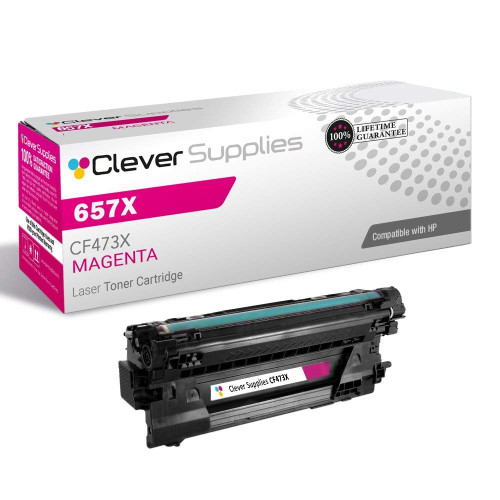
Magenta takes the final code, CF473X, while sitting third in the machine’s own color order. Replaced on its own, it restores reds and skin tones without disturbing three bays that still hold pages.
Shop the 657X Magenta →TWO BOXES REMAIN — THE BLACK PAIR AND THE FIVE-CARTRIDGE SET

Nothing on this page beats it for plain economy: two CF470X cartridges priced $16.08 under the cost of the same pair bought separately, which lands at 0.259¢ per rated page — under every set on the shelf. A document-heavy workgroup will burn through black long before its colors, and this box answers that pattern directly, with the second cartridge already on hand when the first gives out.
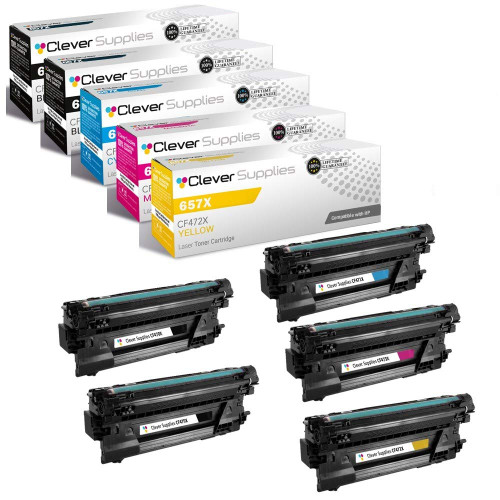
This is the one card on the page that comes with a warning label. The box holds five cartridges, but the listing behind it names just the row’s four codes and stays silent on which of them is present twice; its copy casts the extra unit as a spare against the first bay to fail, without saying what that unit is. With the contents short of exact, no page total and no saving appear here — each would swing on the unknown fifth cartridge. If knowing precisely what ships matters, the four-color set plus one single of your chosen code assembles the same idea with every cartridge identified.
Shop the 657X 5-Color Set →The whole row on one price basis
Every row below follows the same recipe: take the price on the product’s own page — the sale price — and divide it by the pages the box is rated for, 28,000 for a black cartridge and 23,000 for a color. Set rows are marked pooled, since their totals add several bays together; pricing a whole box that way is the honest comparison between boxes, while the cost of one printed page is a different sum, taken up in the notes beneath the table. A single row carries no per-page figure, for the reason stated on its card. Rows run cheapest first.
| Configuration | Sale price | Rated pages | Cost per page | Printer fit |
|---|---|---|---|---|
| 657X Black 2-Pack | $144.88 | 2 cartridges · ~56,000 pages | 0.259¢ | All 4 models |
| 657X 4-Color Set — the flagship | $263.09 | 4 cartridges · ~97,000 pages | 0.271¢ pooled | All 4 models |
| 657X Black Single | $80.48 | 1 cartridge · ~28,000 pages | 0.287¢ | All 4 models |
| 657X 3-Color Set | $198.69 | 3 cartridges · ~69,000 pages | 0.288¢ pooled | All 4 models |
| 657X Cyan Single | $76.95 | 1 cartridge · ~23,000 pages | 0.335¢ | All 4 models |
| 657X Yellow Single | $76.95 | 1 cartridge · ~23,000 pages | 0.335¢ | All 4 models |
| 657X Magenta Single | $76.95 | 1 cartridge · ~23,000 pages | 0.335¢ | All 4 models |
| 657X 5-Color Set | $327.49 | 5 cartridges · the fifth is never identified | Not printed — its card explains why | All 4 models |
Keep two different questions apart when reading these rows. The pooled column prices boxes, and on that measure the black pair wins: black is at once the highest-rated cartridge and, per page, the cheapest to run, so two of them undercut every mixed box. A single printed page asks something else — a full-color page pulls from all four bays simultaneously, so its toner cost is the four single rates added together: 0.287¢ of black plus 0.335¢ in each color, roughly 1.29¢ in all, at the coverage the ratings presume. Ordinary office pages use a fraction of that color, so read the sum as the ceiling the ratings imply, not as a running meter.
The genuine comparison needs no pooling, because HP’s US store offers this row as singles and nothing else: CF470X black at $450.99 and CF471X, CF472X and CF473X at $568.99 apiece, $2,157.96 for the four. Cartridge for cartridge, genuine black runs to roughly five and a half times what the compatible single costs, and a genuine color to roughly seven and a half times. Put differently, the flagship set’s $263.09 would not cover even one genuine black cartridge at HP’s price, with $187.90 still owing.
Four MFPs take this row — and nothing else does
HP publishes this row’s compatibility at series level, under the Color LaserJet Enterprise M681 and Color LaserJet Enterprise M682 names, and the machines standing under those two series are exactly four: the M681dh, the M681f, the Flow model M681z and the Flow model M682z. Each model name above links to the category this store keeps for it. All four 657X codes are accepted by all four machines; no model takes the black while refusing a color, and no code is reserved for the Flow variants. One correction to the listings’ own wording belongs here: their text parades “M681” and “M682” as though they were printers in their own right. They are series names. The roster is the four models just named, and fit on this page is claimed for those four and no others.
Within the roster, the owner decides how cartridges are grouped. Nothing obliges a set to be installed as a set: one cartridge can go in today and its box-mates next quarter, a fresh black can sit beside three aging colors, and a set bought for one MFP can be split across two machines on the same floor. A set here is a pricing device, nothing more — the machine never checks that its cartridges arrived together.
Two boundary statements close the fit question. First, the neighboring row: the single-function branch of this same Enterprise generation — the M652 and M653 printers — runs on the 656X cartridges, CF460X through CF463X, and the two rows refuse each other in both directions. A 657X cartridge will not serve an M652 or M653, and a 656X cartridge will not serve these MFPs, however adjacent the codes look. Second, the tier below this one: a standard-capacity line for the M681 and M682 platform does exist — it is the 655A row, CF450A through CF453A, shared across the whole generation, printers and MFPs alike, and it is the row these MFPs ship with. What does not exist is a standard cartridge carrying a 657 code, so there is no 657A shelf to miss: the eight boxes carded here are the complete 657X row, sitting one capacity step above that standard row. Where a code on a cartridge and a code in a listing ever disagree, trust the cartridge.
One rating per code, agreed everywhere
Yield sections in this program usually exist to referee a disagreement. Here there is none to referee. HP declares roughly 28,000 pages for the CF470X black and roughly 23,000 for each of the three colors, each color’s figure being HP’s composite average across cyan, yellow and magenta, measured on the ISO/IEC 19798 basis. The listings’ spec fields print those same numbers, and — the part that cannot be taken for granted in this catalog — so does their descriptive prose. Field, text and manufacturer tell one story, so every division on this page uses 28,000 and 23,000 without adjustment or apology. Pack totals follow directly: 56,000 pages across the black pair, 69,000 across the three-color set, about 97,000 in the flagship. The five-cartridge set is the exception: with its fifth cartridge unidentified, no total is printed for it at all — a bracketed guess is not a rating.
How those ratings play out on a working machine depends on the work. Black’s 5,000-page advantage is genuine but modest beside the difference in how the bays are drained: a unit living on copied forms and text-heavy print will cycle black noticeably faster than its colors, while a marketing team proofing color all day can reverse the order entirely. The ratings assume the standard’s test pages, not any office’s documents, so treat them as the common yardstick the prices above were divided by — which is all a comparison needs them to be.
Chips and managed MFPs
Machines of this class rarely live alone: they sit on managed fleets, take scheduled firmware, and report their supply levels to whoever administers them, which makes the cartridge chip a working part rather than a formality. The position for every cartridge carded here is the supplier’s standing one across this store’s compatible range — every unit carries, from the moment it is sealed, the newest chip generation the supplier fits, and Clever Supplies’ record on the cartridges it sells shows no chip problem reported to date. The swap itself stays mechanical: out comes the spent cartridge, in goes its replacement, and at no point is a chip lifted from the old unit and moved to the new one.
That position has an edge, and it should be visible: it covers the cartridges as they are supplied now and the record accumulated so far. Protection against firmware HP has yet to release is not something any seller can truthfully include in the price, and none is included here. The family’s listings are themselves silent on chips and firmware, so the store’s settled position is set out on this page — the place buyers actually look — rather than left unasked.
Warranty, returns and support
One set of terms backs the whole family — the flagship set and a lone color single alike — so the terms are stated once, here, rather than repeated beneath every card.
Choosing the box
Questions from M681 and M682 owners
Not under a 657 code — but the platform does have a standard row, and it is worth knowing before you buy. HP never made a CF470A-series standard cartridge, so no standard-yield 657 exists; the standard tier for these MFPs is the 655A family, CF450A through CF453A — the row shared with the M652 and M653 printers, and the cartridges an M681 or M682 ships with. A 655A black is rated at roughly 12,500 pages and each color at roughly 10,500, against 28,000 and 23,000 here: the 657X row is the high-yield step above that standard row, and the eight boxes on this page are that row complete. (Wording about an “HP 657A” cartridge turns up on some regional HP pages, but no such code exists — it is a yield-footnote naming artifact; the standard row travels under the 655A name.)
CF472X is yellow; CF473X is magenta. HP’s own product pages fix that pairing, and the store’s names fall in line with it. Read the row in full — CF470X black, CF471X cyan, CF472X yellow, CF473X magenta — and the trap is visible: the colors follow cyan-yellow-magenta order, not rainbow order. When you order, work from the pairings printed on the cards above, and when the new box lands, compare its code against the code on the cartridge coming out.
The listing never identifies it, so neither does this page. Five cartridges go into the box; the name and copy between them mention only the row’s four codes, CF470X through CF473X, and no page in this store states which code turns up twice — the fifth is described only as a spare held against whichever bay empties first. That gap is exactly why the set’s card shows no page total and no SAVE badge: each figure would change with the identity of the extra cartridge. Buyers who need the spare named should build it themselves — the four-color set, plus one single of the code they expect to run down soonest.
No. Those single-function printers take the 656X row — CF460X through CF463X — and the two rows do not cross-fit in either direction: a 656X cartridge is just as wrong for an M681 or M682 as a 657X cartridge is for the printers. The machines are close relatives and the codes are near neighbors; the cartridges are not interchangeable.
They are not — they are the two series names HP files these machines under. The actual models are four: the M681dh, the M681f, the M681z and the M682z, and every code in this row fits every one of them. The listings’ habit of listing the series names alongside the models makes their fit lines read as six printers where four exist; the fit claims themselves are true at series level, and this guide’s roster names the four real machines.
Twelve months apiece. Warranty cover runs for a year from delivery, and a return made within that year costs the buyer nothing — the terms are the ones printed on the family’s own product pages. A person staffs support on weekdays between 9 AM and 5 PM Central, and parcels are dispatched from warehouses in Illinois, Pennsylvania, Georgia and California.
Price and disclosure note: The prices printed above are sale prices, lifted from each carded product’s own page in the live catalog and re-checked there on November 18, 2026; if a figure moves after that date, the product page governs. Sale prices carry every calculation in this guide, because the listings’ own prose works from list prices instead — numbers higher than anything a buyer is charged. What a SAVE badge certifies is narrow: the gap between a set’s price and the total of its contents bought singly, again at sale prices. The badges here are $48.24 on the four-color set, $32.16 on the three-color set and $16.08 on the black 2-pack. The five-cartridge set carries no badge, since nobody can say exactly what is inside it, and an exact subtraction needs exact contents. Yields are HP’s declared ratings — roughly 28,000 pages for CF470X black and 23,000 per color, the color number being HP’s ISO/IEC 19798 composite average — and the listings repeat those figures in field and prose alike; set totals are flagged as pooled wherever printed, since no real page drains four bays in lockstep. Genuine comparisons use HP’s own US store, which sells this row only as singles: CF470X at $450.99, the three colors at $568.99 apiece, $2,157.96 for a set of four bought that way — prices read from HP’s product pages on November 18, 2026, with each cartridge available to buy. Fit claims rest on HP’s published compatibility: the M681dh, M681f, M681z and M682z, all four codes in all four models. The departures from that tidy picture, all of them in the store’s catalog rather than in HP’s data, are catalogued below.
First, the prose prices at list. The answers on the product pages that talk money quote list figures — $92.55 for black, $88.49 per color, $166.61 for the pair, $228.49, $302.55 and $376.61 for the three sets — although the till charges the lower sale price, and the per-page costs quoted beside them are divided out of those list figures, overstating what printing actually costs a buyer. Second, the big sets misreport their own yields: on both the four-color and five-cartridge sets, the yield field reads “Black: 23000”, parking the color rating in the black slot when the black cartridge is rated 28,000, and no color yield line appears on either set at all; the arithmetic in this guide runs on the true per-code ratings. Third, the five-cartridge set cannot be inventoried from its listing: four codes are named for five cartridges, nothing anywhere states the repeat, and the copy presents the extra cartridge as a spare for the first bay to empty without naming it — hence no pooled total and no badge on its card. Fourth, series are dressed as models: the shared introduction and several answers place “M681” and “M682” in the fit list as if each were a machine alongside the M681dh, M681f, M681z and M682z. The underlying fit claims hold at series level; the roster nonetheless numbers four models, and four is what this guide prints. Fifth, the stock column reads zero on four of the eight listings — the cyan single, the three-color set, the four-color set and the five-cartridge set — while all four remain visible and orderable, and no listing in the family records a single sale; accordingly, nothing on this page asserts anything about availability or popularity. Sixth, a space sits inside every SKU in the family (“CS-HP 657X-BK” and its siblings): cosmetic, uniform across the eight, noted for the record. Seventh, browsing by family is impossible: the store keeps no “HP 657X” category, so the eight products file under brand, color series and the model and series categories alone — and none of the eight carries custom fields, the yield figures living instead in each product’s spec strip.
The shelf above is the 657X row entire: eight cards, eight products, nothing held back — this census family contains no duplicates to collapse and no contested listing to exclude, and the row carries a single tier of its own; the standard tier beneath it is the separate 655A family, with a guide of its own. No fit claim reaches past HP’s four models, and no yield is printed above or below the figures HP declares and the listings echo. On chips, the standing assurance and its standing edge: cartridges arrive fitted with the newest chip generation and the record shows no chip trouble to date, and there the promise ends — nothing here underwrites firmware that does not yet exist. Under every card sit the terms the listings themselves publish: twelve months of warranty, twelve months of free returns, a person answering Monday to Friday, 9 AM to 5 PM Central, and dispatch from the Illinois, Pennsylvania, Georgia and California warehouses.