




Most toner families ask the black cartridge to do the heavy lifting. This enterprise family reverses the arrangement. The Color LaserJet Enterprise CP5525 and M750 printers run on four cartridges — CE270A black, CE271A cyan, CE272A yellow, CE273A magenta, every one of them badged 650A — and it is the colors that carry the longer rating: about 15,000 pages apiece against the black’s 13,500. HP never issued a high-yield version of any of them, so the badge is 650A at all four stations and there is no second tier to sort out. Nine offers make up the entire shelf: four sets, the four singles, and a single two-black pack. The numbers need no referee, because the listings and HP’s own published data land on exactly the same yields. What this page works through is the money: the price of each box, the price of each printed page, and how far beneath HP’s $2,235.96 total for the same four genuine singles this shelf manages to sit.
The four-color set at $256.95 is the natural place to begin: it comes in $48.22 under the four singles purchased one at a time and spreads its price across 58,500 rated pages, which works out to 0.44¢ a page. If the black still has life in it, the tri-color set at $196.19 renews the color side alone and saves $32.14. Color singles are priced in lockstep at $76.11; the black single stands a fraction higher at $76.84, and the two-black pack at $137.61 is as far as the black ladder goes — no three-pack or five-pack exists for this family. Two larger sets carry honest cautions instead of savings badges, because their listings never spell out exactly which cartridges double up. Set against all of this, HP’s genuine singles — $378.99 for the black and $618.99 for each color — total $2,235.96 for one complete change.
Nine offers, one tier, two sets with fine print
The order below runs from the full change down to the spare black: the four-color set first, then the colors-only set, the two bigger boxes whose contents are only partly described, the four singles in code order, and the two-black pack last. Where a listing states its composition cartridge by cartridge, the saving is printed and measured; where it does not, the card says so and no saving is claimed. Ratings throughout are the agreed pair — roughly 13,500 pages from the CE270A black and roughly 15,000 from each color — the same figures in the store’s listings and in HP’s test data.
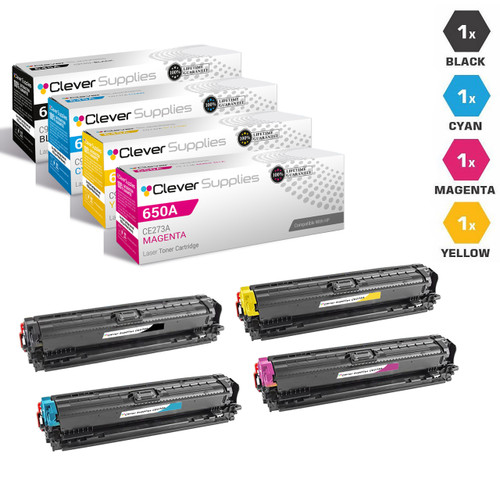
Hold it up against the genuine route and the platform’s economics are stark: HP’s four singles come to $2,235.96, so this single carton covers the identical four stations, at the identical ratings, for roughly a ninth of that bill.
Shop the 4-Color Set →THE REMAINING EIGHT OFFERS
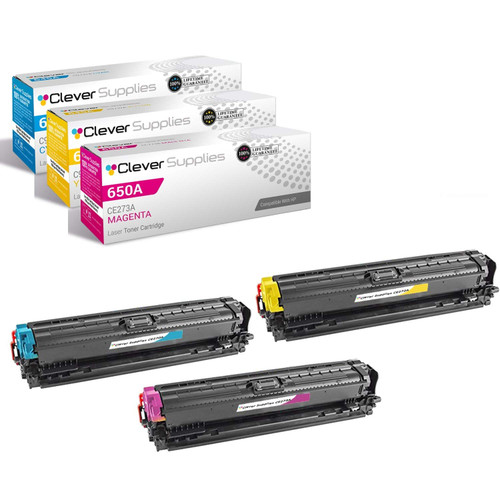
The color side renewed on its own, for machines whose black cartridge still has thousands of pages in hand. Its listing states the three contents outright, and bundling them trims $32.14 off the three singles while holding the color page at 0.44¢.
Shop the Tri-Color Set →
A five-cartridge box at $63.54 a cartridge — the cheapest per-unit price among the sets. The caution: its own listing says one code is doubled without naming which, and points to the carton label for the exact contents, so this guide prints no saving and no per-page rate for it. Check the label when the box arrives.
Shop the 5-Color Set →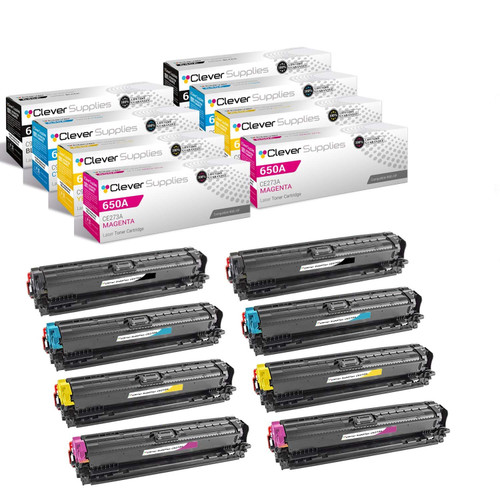
The deepest stock-up box on the shelf, at $62.23 a cartridge. The same honesty rule applies: the listing confirms eight cartridges drawn from the four codes but never enumerates how many of each, deferring to the carton label — so no saving and no per-page figure is claimed here either.
Shop the 8-Color Set →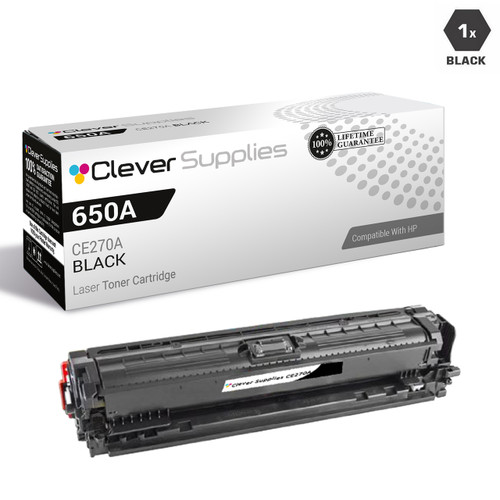
The black unit the two-pack is built from. Unusually for a toner family, it is rated below its color siblings — 13,500 pages against their 15,000 — and priced a touch above them, $76.84 against $76.11, which makes its page the shelf’s dearest at 0.57¢.
Shop the Black Single →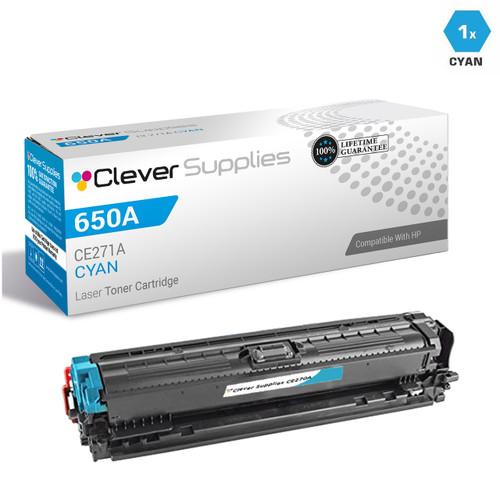
Cyan carries the price all three colors share — $76.11, identical to the tags on yellow and magenta. Put it beside HP’s $618.99 genuine cyan and the compatible-versus-genuine gap is wider here than at any other station on the shelf.
Shop the Cyan Single →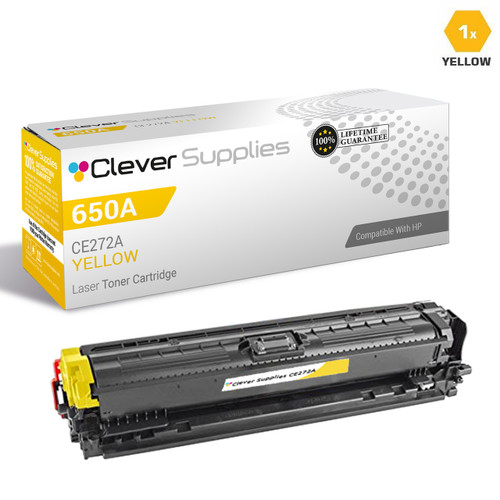
Yellow asks $76.11 and returns roughly 15,000 rated pages, precisely the bargain its two color neighbors offer. From a budgeting chair the three color stations might as well be one station: identical money out, identical pages back.
Shop the Yellow Single →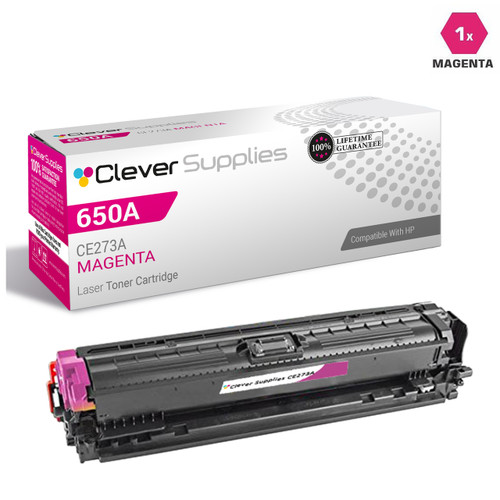
Magenta rounds out the color row at the same $76.11, where HP’s genuine version asks $618.99. No matter which color the control panel names, the replacement invoice reads the same and the rated coverage matches too.
Shop the Magenta Single →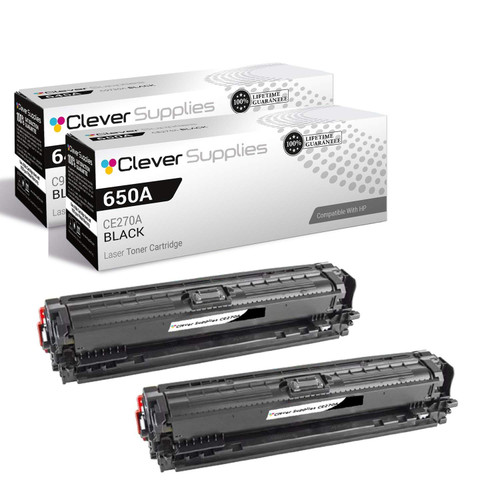
One black goes into the machine and its twin waits in the cupboard: bought together they undercut two singles by $16.07 and pull the black page down from 0.57¢ to 0.51¢. It is also where the black ladder ends — this family offers no three-pack or five-pack above it.
Shop the 2 Black Pack →Nine offers is the whole shelf, and its shape deserves a second look: the colors outlast the black by 1,500 rated pages apiece, yet cost a fraction less. That inversion is simply how HP rated this platform — the color figure is a composite rating for the three color cartridges tested together — and the store’s pricing follows it rather than fighting it. What the shelf does not contain matters too: no high-yield tier, no three-black or five-black pack, no colors-only box larger than the tri-color set.
Every price quoted here is a sale price — the amount the checkout actually charges. That basis is worth stating plainly in this family, because the product texts themselves often mention the higher list prices along the way; the closing note explains how each figure on this page was arrived at.
All nine offers, one table
Nine rows carry the entire family. Treat the ratings as planning numbers from the standard test method rather than promises: a page soaked in color burns through a cartridge sooner than a page of light text. A box’s page total adds up the ratings of the cartridges inside it, and its rate divides the sale price by that total. Two rows deliberately show no rate and no saving — their listings never itemize the contents closely enough to support either figure. No fit column is needed, since every row serves the same six printers named further down.
| Offer | Sale price | Box contents | Cost per page | Saving vs singles |
|---|---|---|---|---|
| 650A 4-Color Set — the flagship | $256.95 | Black, cyan, yellow and magenta, one each · ~58,500 pages | 0.44¢ blended | SAVE $48.22 |
| 650A Tri-Color Set | $196.19 | Cyan, yellow and magenta, one each · ~45,000 pages | 0.44¢ | SAVE $32.14 |
| 650A 5-Color Set | $317.72 | 5 cartridges across the four codes — doubled cartridge not identified | Not quoted | Not stated in full |
| 650A 8-Color Set | $497.82 | 8 cartridges across the four codes — count per code not itemized | Not quoted | Not stated in full |
| 650A Black Single (CE270A) | $76.84 | 1 black · ~13,500 pages | 0.57¢ | Bought one at a time |
| 650A Cyan Single (CE271A) | $76.11 | 1 cyan · ~15,000 pages | 0.51¢ | Bought one at a time |
| 650A Yellow Single (CE272A) | $76.11 | 1 yellow · ~15,000 pages | 0.51¢ | Bought one at a time |
| 650A Magenta Single (CE273A) | $76.11 | 1 magenta · ~15,000 pages | 0.51¢ | Bought one at a time |
| 650A 2 Black Pack | $137.61 | 2 black · ~27,000 pages | 0.51¢ | SAVE $16.07 |
Read down the rate column and the family’s odd shape shows itself: the lone black single, at 0.57¢, is the most expensive page on the page, while the colors sit at 0.51¢ and the two stated sets blend to 0.44¢. The two blank rows are not missing data — they are the honest consequence of listings that decline to itemize their own contents.
The page arithmetic — and HP’s version of it
Begin with color, because color is where this platform’s volume lives. A color page bought as singles runs 0.51¢; the tri-color set and the four-color set both bring it to 0.44¢ blended. Black runs slightly dearer: 0.57¢ from the single, 0.51¢ from the two-pack. In round terms, 10,000 color pages cost about $51 in singles or about $44 through a set; 10,000 black pages cost about $57 in singles or about $51 from the two-pack.
HP’s genuine shelf performs the same division at a different altitude entirely. The genuine black is $378.99 for the same rated 13,500 pages — about 2.81¢ a page. Each genuine color is $618.99 for 15,000 pages — about 4.13¢. So a genuine color page costs roughly eight times its compatible counterpart, and a genuine black page roughly five times. The comparison here is built from HP’s four singles, which is how HP’s US store presents this family.
Enterprise machines print at enterprise volumes, so scale the gap up. A hundred thousand color pages run about $440 through the four-color set against roughly $4,130 on genuine singles; a hundred thousand black pages run about $510 from the two-pack against roughly $2,810 genuine. On a platform built for departmental duty cycles, that difference is not a per-cartridge curiosity — it is the machine’s whole running-cost story, repeated at every single change.
Ratings everyone agrees on — with the colors in front
No tie-breaking is required on this page. The CE270A black is rated at roughly 13,500 pages and each color at roughly 15,000 under ISO/IEC 19798 — identically in the listings’ descriptive prose, in their structured yield fields, in HP’s ISO test report for the family and on HP’s current product pages. With no dissenting figure anywhere in the family, each rate above stands on the store’s numbers and the manufacturer’s simultaneously. One convention is worth understanding: the 15,000-page color figure is a composite rating, measured with the three color cartridges working together, which is how HP has always published yields for this generation.
On starter cartridges, this guide prints no figure, because none could be established. HP’s box-contents lists for these printers name one print cartridge of each color, with no “introductory” qualifier and no reduced rating attached — unlike platforms where HP publishes a smaller in-box yield. So no starter number is claimed here in either direction; what can be said is only that HP attaches no reduced introductory rating to this platform.
Genuine pricing is quotable in full for this family: all four 650A cartridges remain listed and in stock at HP’s US store — the black at $378.99 and each color at $618.99, $2,235.96 for a complete set of singles. No genuine multipack price is quoted on this page, because none was established from HP’s US store.
Budget-holders should also know about the platform’s one further consumable, which this store does not carry. Alongside the four cartridges, these printers use a toner collection unit — HP’s CE980A, rated at roughly 150,000 pages — which gathers waste toner and is replaced on its own long cycle. It is an HP part to source when the printer calls for it, not a cartridge decision, and it leaves the day-to-day running cost of the nine offers above untouched. There is no separate drum to plan for: the user-replaceable supplies for this platform are the four cartridges and that collection unit.
Six enterprise printers, one shared shelf
HP fields this family under two enterprise lines: the CP5525 printers, launched in 2010, and the M750 series that followed in 2012. Three equipment levels stand in each line — the networked base model, the duplex dn, and the fully fitted xh. Every one of the six accepts all four cartridges; no model is restricted to any subset of the family. (HP’s own documentation labels the CP5525 line the “CP5520 series” — that is the series name on the user guide, not a separate set of models.)
The CP5525 line: the Color LaserJet CP5525n, Color LaserJet CP5525dn and Color LaserJet CP5525xh. The M750 line: the Color LaserJet Enterprise M750n, Color LaserJet Enterprise M750dn and Color LaserJet Enterprise M750xh.
Any of those six names on the front panel means the nine offers above belong to that machine — every one of them. And should the panel be out of sight, the code printed on the cartridge coming out answers the question by itself: CE270A, CE271A, CE272A or CE273A belongs to this family alone.
Chips: a topic neither side brings up
Search all thirty-three listings in this family — titles and body text included — and the word “chip” never appears. On the subject of cartridge electronics the listings are simply silent, in both directions at once, so there is no claim from the store side for this guide to relay — and none will be invented to fill the space.
HP’s side is quiet for a chronological reason: the CP5525 line dates from 2010, before HP’s dynamic-security program existed, and HP’s current pages for these four cartridges carry no dynamic-security language. What a buyer can actually lean on is written down in the band that follows: twelve months of warranty on every cartridge here, with returns free across the same twelve months.
What stands behind every cartridge here
Choosing by the way the machine is used
Questions the CP5525 and M750 platform raises
No. HP produced this family in a single tier only — the four 650A cartridges are the complete lineup, and no CE270X-through-CE273X range exists at HP or anywhere in this store. The published ratings are simply the ratings: roughly 13,500 pages for black and 15,000 for each color.
Six, per HP: the Color LaserJet CP5525n, CP5525dn and CP5525xh, and the Color LaserJet Enterprise M750n, M750dn and M750xh. Each of the four cartridges fits each of the six models — there are no model-specific carve-outs. HP’s own documentation calls the CP5525 line the “CP5520 series” — a series label, not additional models.
Because that is how HP rated the platform. The black’s published yield is about 13,500 pages, while each color carries a composite rating of about 15,000 pages under ISO/IEC 19798 — the three color cartridges measured working together. The store’s listings publish the same two figures, so the inversion appears in both sources, not just one.
The listings do not fully say, and this guide does not guess. The five-cartridge set’s own text states that one code is doubled without naming which; the eight-cartridge set confirms eight cartridges drawn from the four codes without itemizing the count per code. Both listings point to the carton label for the exact contents — which is why neither box carries a saving or a per-page rate on this page.
No separate drum appears in HP’s supplies list for this platform — the user-replaceable supplies are the four print cartridges plus one further item, the CE980A toner collection unit, rated at roughly 150,000 pages. This store does not stock the collection unit; when the printer calls for one, it is an HP part to source.
Nothing whatsoever — the word does not appear in a single listing in this family, in either direction. The platform dates from 2010, before HP’s dynamic-security program, and HP’s current pages for these cartridges carry no dynamic-security language. What stands behind a purchase here is the store’s written cover: a year of warranty, with returns free for that same year.
The store’s compatible-cartridge terms apply: twelve months of warranty cover, free returns for the whole of that year, and weekday support between 9 AM and 5 PM Central to arrange the exchange. Keep the packaging until the replacement cartridge is in and printing properly.