




In July 2026 HP folded this family into a combined HP 63/65 line — and quietly left one cartridge behind. HP’s own transition table carries the 65 black, the standard 65 tri-color and the 65XL black across to the new badge, but it contains no row at all for the 65XL tri-color, because the combined line sells no high-yield color cartridge. For the owners of the 31 AMP, DeskJet and ENVY printers listed further down, that omission matters: the compatible 65XL tri-color on this shelf, rated near 300 pages, is now the only XL tri-color that exists for their machines in any badge, genuine or compatible. The shelf itself is short. HP’s classic 65 range ran to four singles — a standard and an XL cartridge at each of the two stations — and this store stocks the XL pair only: the two XL singles and two sets built out of them, every one newly manufactured rather than refilled, each with its printhead built in and a new compatible chip fitted. On black, the merger costs a 65 owner nothing, since the combined XL black carries the same roughly 300-page rating as the cartridge sold here. Color is where the ground moved, and the merger section below lays out precisely how.
The Set of 2 at $49.47 is the natural first purchase: one box restocks both stations at the full XL ratings, 600 rated pages at 8.25¢ a page blended, and it holds back $4.51 of the $53.98 the same pair costs as singles. Heavier households should look at the Set of 5 — $119.93 for 1,500 rated pages, the shelf’s deepest saving at $13.52 and its cheapest blended rate at 8.00¢. Measured against the genuine cartridges HP sells for these printers today, the black side is straightforward: the compatible XL black is $25.49 against $46.99 for HP’s combined 63/65XL black, which HP’s US store could not supply on the day these prices were checked. The tri-color needs one honest sentence. HP’s successor tri-color sticker, $26.99, sits $1.50 below the $28.49 asked here — and that cartridge prints roughly 100 pages against roughly 300, which is 26.99¢ a page against 9.50¢. This guide claims the cheaper page for the tri-color, never the cheaper box. No genuine price for the classic N9K codes could be read on HP’s US store at all, so none is printed anywhere on this page.
Four listings, every one of them XL
The Set of 2 leads because it answers the whole restock in a single box: both stations, both at the XL rating, nothing left outstanding. The Set of 5 comes next for homes that empty the black station far faster than the color one, and the two singles close the shelf for the one-station top-up. What arrives is newly made — each cartridge is produced to the specification of the HP part it replaces, the black to N9K04AN and the tri-color to N9K03AN, rather than being an original shell emptied and filled again; the listings say so in as many words, and the chip in each cartridge is new. Every price on the cards is the listing’s own, one per product, and a set’s saving badge always measures the box against the identical cartridges bought singly on this page.
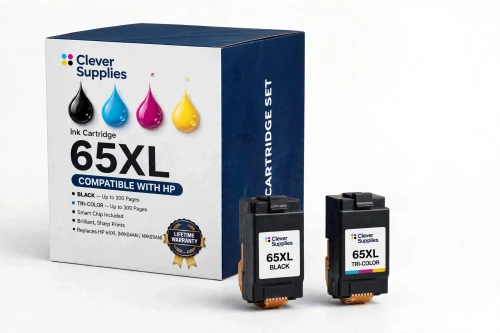
Most two-cartridge printers announce both empty cartridges within a few weeks of each other, and this box is built for that moment. It carries the XL rating at both stations — two and a half times the standard black’s pages and three times the standard tri-color’s — so the next change sits proportionally further away. The $4.51 saved against the singles is real but modest; the larger saving is the one the cost-per-page section measures against the genuine cartridges HP currently sells for these machines.
Shop the 65XL Set of 2 →THE OTHER THREE LISTINGS
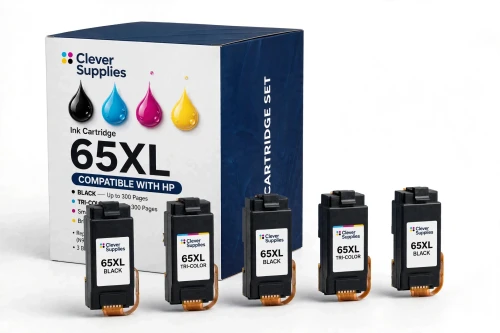
Three black cartridges to two tri-color ones follows the way these printers actually consume: documents drain the black station long before the colors fade. The same five cartridges bought one by one total $133.45, so the box keeps $13.52 — the biggest saving on the shelf — and after the first complete change there is still a spare black and a spare tri-color in the drawer.
Shop the 65XL Set of 5 →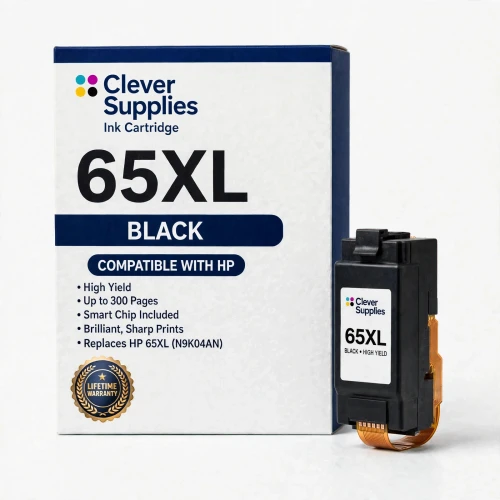
Text and paperwork keep the black station busiest on this platform, and this is its economical form: two and a half times the standard black’s rating, at $21.50 less than HP’s successor XL black at $46.99 — a genuine cartridge HP’s US store showed as unavailable on the day these prices were read. When black runs out first, this is the cartridge to reach for.
Shop the 65XL Black Single →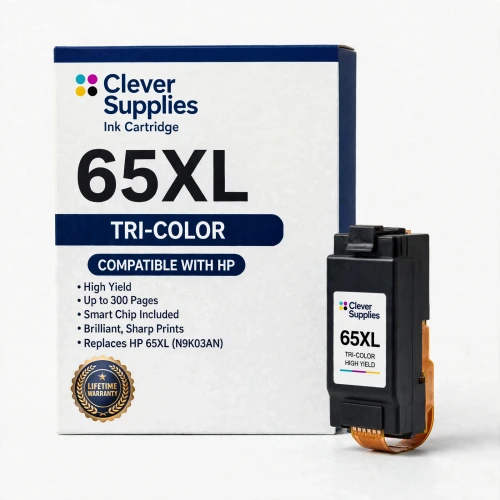
Cyan, magenta and yellow ride in a single body and are changed as one when the first color gives out. Since HP merged its lines, no genuine XL tri-color exists for these printers at all — HP’s successor color cartridge is a standard-yield part, $26.99 for roughly 100 pages. This cartridge costs $1.50 more and prints about three times as many pages; the cost-per-page section shows the arithmetic in full.
Shop the 65XL Tri-color Single →Two things about the shelf itself are worth stating plainly. No listing appears twice — the four are four distinct configurations — and there is no standard-tier compatible anywhere in the catalog to muddy the choice: a shopper who wants the smaller cartridges will find them only as genuine HP products, and the standard tier’s ratings are covered in the yield section below.
Two cartridges, four ways to buy them
Compatibility needs no column of its own: it is the same down the whole table, because every row fits the same 31 printers named further down — and so does HP’s unstocked standard tier. For the sets, the page count adds the ratings of the cartridges inside the box, and the blended rate divides the box price by that total.
| Offer | Price | Contents | Cost per page | Saving against singles |
|---|---|---|---|---|
| 65XL Set of 2 — the flagship | $49.47 | 1 XL black, 1 XL tri-color · ~600 pages | 8.25¢ blended | SAVE $4.51 |
| 65XL Set of 5 | $119.93 | 3 XL black, 2 XL tri-color · ~1,500 pages | 8.00¢ blended | SAVE $13.52 |
| 65XL Black Single (N9K04AN) | $25.49 | 1 pigment black · ~300 pages | 8.50¢ | Bought one at a time |
| 65XL Tri-color Single (N9K03AN) | $28.49 | 1 dye tri-color · ~300 pages | 9.50¢ | Bought one at a time |
The unusual row pairing is the two singles: both are rated at the same 300 pages, so on this platform neither slot is the weak link it is in most two-cartridge families. The tri-color still costs $3.00 more for its 300 pages — one body dividing its capacity three ways is dearer to fill than one that carries black alone — and the sets then do their one job: their discount pulls the blended rate below the 9.00¢ the same pages average when bought as singles.
Cost per page — and the one genuine sticker that undercuts this shelf
Start with the shelf’s own numbers. A thousand black pages bought as XL singles run about $85.00; a thousand tri-color pages, about $95.00. Mixed across both stations, the Set of 5 blends to 8.00¢ a page and the Set of 2 to 8.25¢ — the two cheapest mixed rates available to these printers — while the black single’s 8.50¢ is the lowest rate any one cartridge here achieves.
The genuine comparison now runs through HP’s combined 63/65 line, because that is what HP’s US store sells for these printers. Its XL black is $46.99 for roughly 300 pages — 15.66¢ a page, against $25.49 and 8.50¢ here — and its two-cartridge combo is $72.99 for roughly 400 blended pages, 18.25¢ a page, against the Set of 2’s $49.47 for 600. On the day these figures were read, HP’s store showed both of those black-side products as out of stock; the successor tri-color was the one genuine cartridge of the three that could actually be ordered. No price for any classic N9K code could be read on HP’s US store, so this guide quotes none and builds no comparison on reseller figures.
Then the exception, printed as plainly as the savings. That successor tri-color costs $26.99 — $1.50 less than the $28.49 compatible XL tri-color on this shelf. Judged on the sticker alone, the genuine cartridge is the cheaper color cartridge, and nothing on this page pretends otherwise. What the sticker buys is roughly 100 pages: 26.99¢ for every page it prints, against 9.50¢ from a cartridge rated at roughly 300. So the honest claim for the tri-color is the page, not the box — about a third of the genuine cost for every color page, from the only XL tri-color these printers can still take. A household that prints color a handful of times a year may reasonably prefer the smaller genuine cartridge; any busier pattern reverses the arithmetic quickly.
The same 300 at both stations — and a starter pair that is not short-filled
Here, too, the two sides of the counter agree. Each listing’s specification field, its descriptive text and HP’s published rating for the code all land on the same figure: roughly 300 pages for the XL black (N9K04AN) and roughly 300 for the XL tri-color (N9K03AN), measured under ISO/IEC 24711 with HP’s collateral naming the DeskJet 3700 series as the test platform. Ratings are standardized-test averages — photo-heavy printing will finish a cartridge sooner, light text work later — and every rate quoted on this page rests on those shared figures.
The unstocked standard tier shows what the XL step buys. HP rates the standard black (N9K02AN) at roughly 120 pages and the standard tri-color (N9K01AN) at roughly 100, so the XL black carries two and a half times its counterpart’s output and the XL tri-color three times its own. Both tiers fit the same 31 printers; the difference is capacity against sticker, never compatibility. Only the XL tier exists in compatible form, which is why this guide is built on it — and, as the merger section explains, the XL tri-color now exists in no other form at all.
A new printer on this platform does not start life on short-filled cartridges. HP’s own support answer for the ENVY 5055 rates the setup pair in the box at the full standard figures — roughly 120 pages black and 100 tri-color — so there is no reduced starter yield to warn about here; the ratings in the table above govern from the first retail change onward. Those setup cartridges are marked Instant Ink Ready, and the platform is one HP lists as eligible for its Instant Ink program with genuine cartridges; no listing on this shelf claims Instant Ink compatibility for a compatible cartridge, and this guide makes no such claim either.
The mechanics take one short paragraph. There is no printhead unit living inside the printer to wear out: the printhead is built into each cartridge, so fitting a new cartridge renews the printing surface along with the ink. Nothing else is consumed by these models — no separate printhead, drum or maintenance part exists for the family — which is part of why the whole supply question reduces to the two slots.
The 31 printers that run on HP 65
This roster can be stated without hedging: the compatibility list HP publishes on its own US cartridge pages and the models filed in this store’s catalog are the same 31 names, with nothing added on either side and nothing missing. Each model below has its own visible category, the listings’ count of 31 verified printers is exact, and fit never narrows inside the roster — every cartridge in the classic line, standard and XL alike, fits every model, and so do both cartridges on this shelf.
The AMP group — HP’s printer-and-speaker line, filed under the store’s DeskJet series: the AMP 100, AMP 105, AMP 120, AMP 125 and AMP 130.
The DeskJet group: the DeskJet 2622, DeskJet 2624, DeskJet 2625, DeskJet 2628, DeskJet 2635, DeskJet 2636, DeskJet 2640, DeskJet 2652, DeskJet 2655, DeskJet 2680, DeskJet 3720, DeskJet 3722, DeskJet 3752, DeskJet 3755, DeskJet 3758 and DeskJet 3772.
The ENVY group: the ENVY 5010, ENVY 5012, ENVY 5014, ENVY 5020, ENVY 5030, ENVY 5032, ENVY 5034, ENVY 5052, ENVY 5055 and ENVY 5070.
Two boundaries close the roster. The first is the badge boundary the merger section takes up next: before 2026, HP 63 and HP 65 were separate printer groups whose cartridges never interchanged, and a leftover standalone 63 cartridge still does not fit any printer above — only the new combined 63/65 cartridges cross over. The second is regional. HP badges this same platform 65 in North America and in Asia Pacific outside India, China and Indonesia, 304 in Western Europe, and 123 across the Middle East, Africa, Latin America and the CIS; a printer sold under one badge expects that badge’s cartridges. If the badge is ever in doubt, the code printed on the cartridge coming out of the machine settles it.
The 63/65 merger, from the 65 side — and the chip in each cartridge
In July 2026 HP merged the standalone 63 and 65 lines into a single HP 63/65 range. HP’s explainer for the change — published July 28, 2026 and updated that November — maps the old cartridges across in a transition table: HP 65 Black becomes HP 63/65 Black, HP 65 Tri-Color becomes HP 63/65 Tri-Color, and HP 65XL Black becomes HP 63/65XL Black. Read the table closely and one line is missing: there is no HP 65XL Tri-Color row, because the combined range contains no XL tri-color for it to map to. HP’s phase-out answer names only the legacy 63 as being retired, and its bottom line is that “if your printer used HP 63 or HP 65, just buy HP 63/65 from now on.” The successor shelf on HP’s US store is three products deep — a tri-color, an XL black and a combo of the two — and although the transition table names a standard 63/65 Black, no standard black single is actually sold there. The full merger story, told from the 63 side, sits in our HP 63 guide; what follows is only what changes for a 65 owner.
On black, nothing changes. The combined 63/65XL black is rated at roughly 300 pages, exactly the standalone 65XL black’s rating — the yield cut the merger imposed on 63 owners, whose XL black fell from 430 pages to 300, simply does not exist on this side of the merger. The entire 65-side loss sits in the tri-color slot: the standalone 65XL tri-color’s roughly 300 pages has no combined successor, and the only genuine color cartridge HP now sells for these printers is the standard-yield 63/65 at roughly 100. Two practical consequences follow. Leftover standalone 65 cartridges keep working in 65 printers — HP promises the same printer compatibility, and no new hardware is involved — while a leftover standalone 63 cartridge still does not fit a 65 printer, because the crossover exists only in the new combined cartridges. And the compatible 65XL tri-color on this shelf is, by HP’s own table, the only XL tri-color left for these 31 printers in any badge.
The supply itself is the straightforward kind. These cartridges are new manufacture: the listings describe a cartridge built to the specification of the HP part it replaces — the black single’s own words are that it is “not a refilled original shell with a reset chip” — and every listing’s specification field records the chip the same way: “Yes — new compatible chip.” The chip is fitted before the cartridge reaches you, it reports ink levels to the printer so the low-ink warnings keep working, and nothing has to be moved across from the cartridge coming out.
One more platform fact, stated at exactly the strength the evidence supports. These AMP, DeskJet and ENVY series predate HP’s later cartridge programs: there are no “e” variants in the roster and no HP+ activation exists on this platform, and no HP source checked for this guide names these series among its dynamic-security-enabled printers. That is a statement about the platform’s age, not a promise about firmware that has not been written yet. Should a printer ever question a cartridge, the listings’ remedy is to acknowledge the on-screen message, reseat the cartridge until it clicks and restart the printer, wiping the gold chip contacts with a dry lint-free cloth if the warning persists — and a cartridge that still will not register is covered by the lifetime warranty set out below.
All four listings record a lifetime warranty in their fields, and their own text extends it to recognition failures, leaks and print-quality defects alike: the cartridge is replaced or refunded.
The returns field on every listing allows a full year at no cost — comfortably longer than a first set of XL cartridges takes to work through in most homes.
Fit questions, merger questions and cartridge warnings are answered by our own team on weekdays, 9 AM to 5 PM Central.
Orders leave from four warehouses — Illinois, Pennsylvania, Georgia and California — with the nearest one to the delivery address handling each order.
Matching the box to the household
- Both stations are running dry: the Set of 2 at $49.47 — the complete XL refill at 8.25¢ a page blended, and $23.52 under HP’s genuine combo, which carries 200 fewer rated pages.
- A printer that works hard: the Set of 5 at $119.93. Its three-to-two mix tracks real consumption, its $13.52 saving is the largest here, and its 8.00¢ blended rate is the cheapest mixed running available to these printers.
- Only the black station is empty: the 65XL black single at $25.49 — 8.50¢ a page, the cheapest single page on the shelf, and $21.50 below HP’s successor XL black.
- Only color has run out: the 65XL tri-color single at $28.49 — roughly 300 rated pages, and the only XL tri-color these printers can still take from any maker.
- Color printing is a rarity in your house: HP’s successor tri-color at $26.99 is $1.50 cheaper per box and may honestly be the better buy — it prints roughly 100 pages, so the case rests entirely on how little color you use.
- You still hold standalone HP 65 cartridges: keep using them. They fit these printers exactly as they always did; it is leftover standalone 63 cartridges that do not cross over.
Questions the merger and the XL-only shelf raise
What happened to HP 65?
HP merged it. In July 2026 the standalone 63 and 65 lines became a single HP 63/65 range, and HP’s transition table for the change carries no 65XL tri-color across — the combined line sells no high-yield color cartridge. The combined XL black matches the old 65XL black at roughly 300 pages, so black lost nothing; color lost its XL tier entirely. The merger section above works through the detail, and our HP 63 guide tells the same story from the other side.
Will an HP 63 cartridge fit my 65 printer?
A standalone 63 cartridge will not. Before the merger, 63 and 65 were separate printer groups with separate cartridges, and that boundary survived it: the only cartridges that serve both groups are the new combined 63/65 ones. A leftover standalone 65 cartridge, by contrast, still fits and prints exactly as it did before July 2026 — the merger changed what HP sells, not what your printer accepts.
Isn’t HP’s own tri-color cheaper than yours?
Per box, yes — and this guide says so rather than working around it. HP’s successor 63/65 tri-color is $26.99 against $28.49 here. Per page the comparison reverses completely: the genuine cartridge is rated at roughly 100 pages, which is 26.99¢ a page, while the cartridge on this shelf is rated at roughly 300, which is 9.50¢. It is also, since the merger, the only XL tri-color made for these printers at all. Buy the genuine box if your color printing is rare; buy pages if it is not.
Why is there no standard HP 65 cartridge on this shelf?
Because no compatible standard-tier listing exists in this catalog. HP’s classic line had four singles — the standard black (N9K02AN, roughly 120 pages) and tri-color (N9K01AN, roughly 100) beside the XL pair — and the compatible supply here covers the XL pair only, as singles and inside both sets. Both tiers fit the same 31 printers, so the narrowing costs nothing in fit. It is worth noting that HP’s successor line has narrowed the same way: no standard black single is sold on its US store either.
Are these cartridges new, or refilled?
New. Each cartridge is manufactured to the specification of the HP part it replaces — the listings state outright that it is not a refilled original shell with a reset chip — and it arrives with a new compatible chip that reports ink levels to the printer. Nothing is carried over from the cartridge coming out, and there is no empty core to send back.
Which printers use HP 65XL ink?
Thirty-one models in this store’s catalog: the five AMP printers (100 through 130), sixteen DeskJet models across the 2600 and 3700 groups, and ten ENVY 5000-series models from the 5010 to the 5070. Both XL cartridges fit all thirty-one, and so does HP’s standard tier — no model in the roster is restricted to one size. The roster is not a sample: HP’s own US compatibility list for these cartridges names the same 31 printers, model for model.
Do these cartridges work with Instant Ink?
No claim of that kind is made for them, here or in the listings. The platform itself is one HP lists as eligible for Instant Ink, and the setup cartridges that ship with these printers are Instant Ink Ready — but that program runs on HP’s own program cartridges. A household enrolled in Instant Ink should stay with HP’s supply for as long as it remains enrolled.
What if my printer does not recognize a cartridge?
Follow the listings’ own remedy first: acknowledge the on-screen message, take the cartridge out and reseat it until it clicks, then restart the printer; if the warning persists, wipe the gold chip contacts with a dry lint-free cloth and install it again. A cartridge that still refuses to register falls under the lifetime warranty every listing in this family carries — the listings name recognition failures expressly — and is replaced or refunded.
Disclosure — November 16, 2026. Prices were read from each product’s live page on November 16, 2026, each one checked against the title of the listing it belongs to. One listed price per product applies throughout; this family carries no promotional or markdown pricing, and a set’s saving is always the gap between the box and the identical cartridges bought as singles on this site. Yields for the stocked codes are the figures the listings print, their fields record and HP publishes — the same numbers from all three sources: XL black roughly 300 pages, XL tri-color roughly 300, under ISO/IEC 24711, HP’s collateral naming the DeskJet 3700 series as the test platform. The unstocked standard tier’s figures are HP’s alone: roughly 120 pages black (N9K02AN) and roughly 100 tri-color (N9K01AN, the datasheet figure; HP’s own store listing shows roughly 110 for that code, and the lower figure is the one used wherever this page needs one). No genuine price for any classic N9K code could be read on HP’s US store on that date, so none appears here and no comparison rests on reseller pricing. The genuine comparison is HP’s successor line, read on HP’s US store the same day: 63/65 Tri-color (B7RT2AN) $26.99 at roughly 100 pages, the one successor product HP could supply that day; 63/65XL Black (B7RT5AN) $46.99 at roughly 300 pages, shown as out of stock; 63/65 Combo (B87FDAN) $72.99 at roughly 400 blended pages, shown as out of stock. The tri-color comparison is reported as found: the genuine successor’s sticker is the lower one, its cost per page the higher one by nearly three times, and no cheaper-than-genuine claim is made for that cartridge on price. The merger facts come from HP’s own explainer (published July 28, 2026; updated November 5, 2026) and its transition table, which contains no 65XL tri-color row; HP’s store copy describes the combined XL as one cartridge with the same printer compatibility. Setup ratings are HP’s published figures for the ENVY 5055 — roughly 120 pages black and 100 tri-color, the full standard ratings. The roster is this store’s 31 visible model categories, and it matches HP’s US compatibility list for these cartridges model for model; regional variants named only in third-party lists, with no store category and no HP US naming, are excluded. The platform’s other regional badges are 304 (Western Europe) and 123 (Middle East, Africa, Latin America and CIS); no fit is claimed for printers sold under them. The supply is new-manufacture compatible — built to the HP part’s specification, not a refilled original shell — as the listings describe it. No Instant Ink compatibility is claimed for any cartridge on this shelf. The four listings are each carded once, and each carries the lifetime warranty and 1-year free returns its listing’s fields state.