




Forty-nine printers, two cartridge slots, and a family its own maker has just retired — that is the landscape here. The HP 61 platform powered a generation of home DeskJets, ENVY all-in-ones and small OfficeJets between 2010 and 2014, and every one of those machines runs the same simple arrangement: a pigment black cartridge beside a tri-color cartridge holding cyan, magenta and yellow together, with the printhead built into each cartridge so a swap also renews the printhead. HP sold the pair in two sizes, the standard 61 (CH561WN black, CH562WN tri-color) and the 61XL (CH563WN black, CH564WN tri-color), and this store mirrors that line exactly — all four singles plus two sets built from the XL tier, six listings, no duplicates and no invented tiers. Two facts shape the buying decision. The XL step is nearly free: stepping up from the standard black to the XL black adds $1.50 and more than doubles the rated pages. And in 2026 HP declared the classic codes end of life, replacing them in its own store with new-code successors — which makes the genuine comparison on this page a comparison against those successors, at their higher prices.
Begin with the pair. The 61XL Set of 2 at $53.97 refills both slots with 730 rated pages at 7.39¢ a page blended, and keeps $4.51 of the $58.48 its two cartridges cost bought singly. Bigger households should look straight at the 61XL Set of 5: $134.93 buys 1,890 rated pages, works out to the family’s cheapest page at 7.14¢ blended, and leaves a spare black after two full changes. The tier gap is small enough to state in one breath — the XL black is $28.49 against the standard black’s $26.99, and the XL tri-color is $29.99 against $26.99, while the ratings jump from 190 and 165 pages to 430 and 300. The standard singles hold one pricing courtesy worth noting: black and tri-color sit at perfect parity, $26.99 apiece, so color is not the expensive slot on the standard row. Genuine context closes the argument: HP no longer sells the classic codes in its US store, and their 2026 successors cost more at every station — $49.99 for the high-yield black alone, against $28.49 here.
A two-slot platform with a six-listing shelf
Six cards cover the whole family, and their order follows the family’s own logic. The XL Set of 2 leads because a two-cartridge printer is refilled as a pair, and the XL pair is where the value concentrates — the premiums over standard are the price of a coffee split across hundreds of extra pages. The Set of 5 follows as the volume option, then the two XL singles for one-sided top-ups, and the two standard singles close the shelf for machines that print rarely or already run a standard cartridge on the other side. Every price below is simply the product’s listed price — nothing in this family is marked down from anything higher — and each set’s saving is figured against the identical cartridges purchased singly on this page.
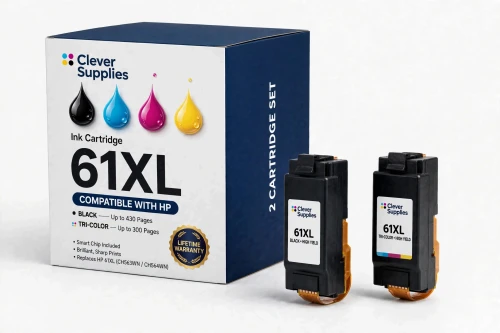
Judge this box against the genuine shelf and the family’s story tells itself. HP’s own store no longer lists the classic 61 codes at all; the successor combo that replaced them, code C0PA6AN, is $101.99 — $48.02 more than this box — and its two cartridges are rated at about 560 pages combined, some 170 fewer than the pair inside this set. Even HP’s successor high-yield black on its own, at $49.99, comes within four dollars of this complete two-cartridge refill. For any roster printer in regular use, this is the default order.
Shop the 61XL Set of 2 →THE OTHER FIVE LISTINGS
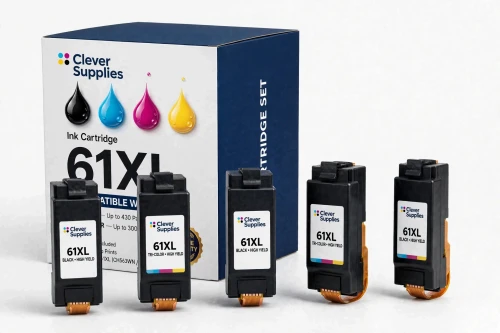
Three blacks against two tri-colors follows the way these printers actually consume — documents drain the black slot long before the colors fade. The box covers two complete changes and leaves a black in reserve, and its $10.52 saving against $145.45 of singles is the largest on the shelf. Per page it undercuts even the flagship pair.
Shop the 61XL Set of 5 →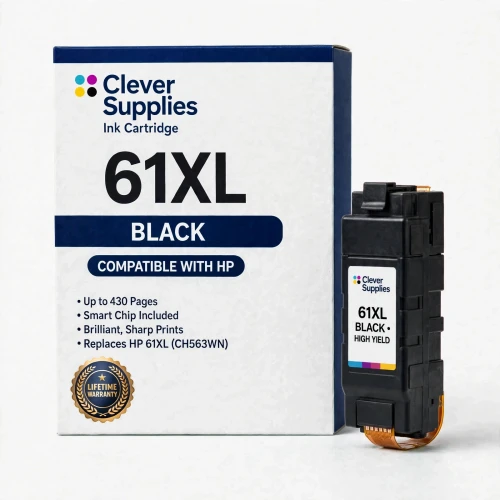
The easiest upgrade decision in the family: $1.50 beyond the standard black buys a cartridge rated at 430 pages instead of 190, and cuts the black page from 14.21¢ to 6.63¢. HP’s successor to this cartridge, the new-code high-yield black, is $49.99 in HP’s store — $21.50 more, for a lower 360-page rating.
Shop the 61XL Black Single →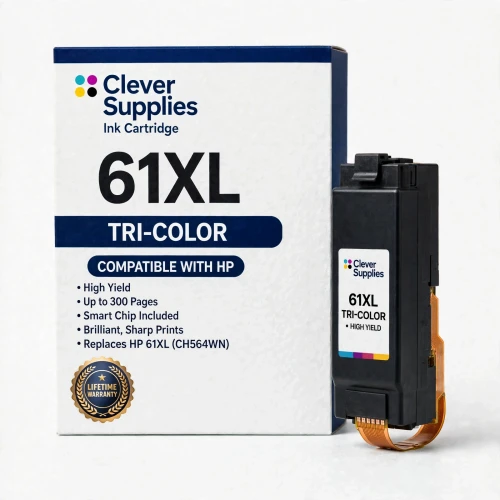
The color-side step costs $3.00 over the standard tri-color and returns 300 rated pages against 165. It is the shelf’s dearest single and still far under the genuine successor: HP’s one new tri-color, which now covers both classic tri-color codes, is $52.99.
Shop the 61XL Tri-color Single →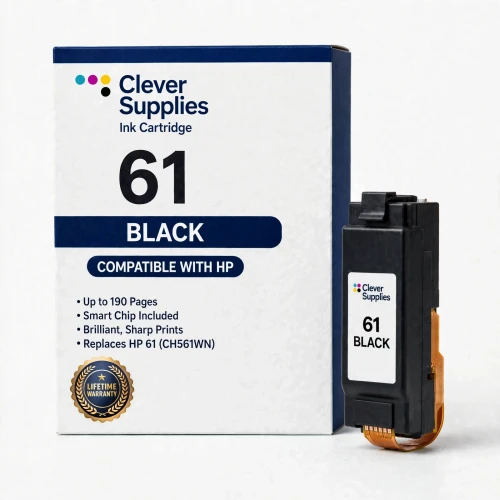
The standard black — the same cartridge these printers shipped with in the box — priced at exact parity with the standard tri-color beside it. It suits a machine that prints a few pages a month, or a top-up alongside a tri-color that still has life; anything busier outgrows its 190 pages quickly.
Shop the 61 Black Single →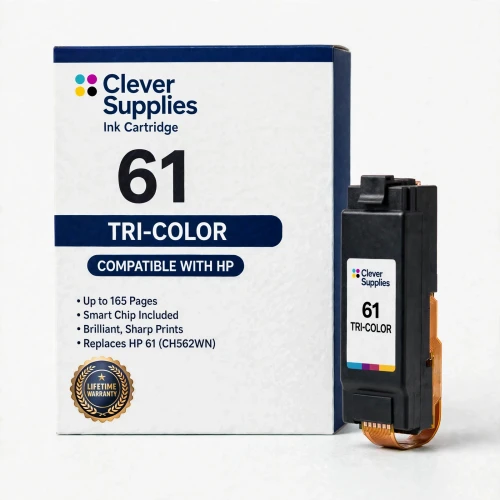
Cyan, magenta and yellow share one body here, and the same $26.99 as the black single — parity that flatters the color slot for once. The rating is the family’s smallest, and the design carries its known trade — the cartridge is spent when its first color is, even if the other two still hold ink.
Shop the 61 Tri-color Single →Two absences on this shelf are worth stating plainly, because shoppers look for both. There are no standard-tier sets — HP’s classic pairings existed, but this store boxes its sets from the XL tier only — and there are no black multi-packs. What the shelf does have, it has exactly once: six configurations, six listings, nothing duplicated under a second name.
All six listings side by side
Fit earns no column here because it divides nothing: every row serves the same 49 printers named further down, and both tiers fit every one of them. For a set, the page figure is the sum of its cartridges’ ratings, and the blended rate is its price divided by that sum.
| Offer | Price | Contents | Cost per page | Saving against singles |
|---|---|---|---|---|
| 61XL Set of 2 — the flagship | $53.97 | 1 XL black, 1 XL tri-color · ~730 pages | 7.39¢ blended | SAVE $4.51 |
| 61XL Set of 5 | $134.93 | 3 XL black, 2 XL tri-color · ~1,890 pages | 7.14¢ blended | SAVE $10.52 |
| 61XL Black Single (CH563WN) | $28.49 | 1 pigment black · ~430 pages | 6.63¢ | Bought one at a time |
| 61XL Tri-color Single (CH564WN) | $29.99 | 1 dye tri-color · ~300 pages | 10.00¢ | Bought one at a time |
| 61 Black Single (CH561WN) | $26.99 | 1 pigment black · ~190 pages | 14.21¢ | Bought one at a time |
| 61 Tri-color Single (CH562WN) | $26.99 | 1 dye tri-color · ~165 pages | 16.36¢ | Bought one at a time |
Read the price column and the rate column together and they tell opposite stories. Prices bunch tightly — the dearest single costs $3.00 more than the cheapest — while rates spread wide, because the XL ratings more than double on a few extra dollars. The oddity at the bottom is real: the XL black single, at 6.63¢, prints a cheaper page than either set’s blend, since the tri-color’s rate pulls every blend upward. Black-only printing belongs on that single; mixed printing belongs in the sets.
What the XL step buys, and what HP’s successors charge
Put the tiers against a fixed stack of pages. Take a thousand black pages: bought as XL black singles they cost about $66, bought as standard black singles about $142. Do the same on the color side and a thousand tri-color pages come to roughly $100 from the XL cartridge, against roughly $164 from the standard. The premiums that buy those gaps are $1.50 and $3.00 a cartridge — recovered well inside the first XL cartridge’s extra pages. The standard tier keeps exactly one honest use case: a printer that prints so seldom that a cartridge’s rated pages would take years to spend, where the lower shelf price matters more than the rate.
The genuine side of this family changed shape in 2026, and this page reports it as it now stands. HP’s official word is that all four classic configurations — both standard cartridges and both XL cartridges — are end of life, and HP’s US store no longer sells them: no genuine price for a classic code exists to print here. What HP sells instead, for the same printers, is a refreshed line under new codes. Its high-yield black, C0PA4AN, is $49.99 and rated at about 360 pages — roughly 13.89¢ a page, more than double the compatible XL black’s rate, for fewer pages. Its tri-color, C0PA5AN, is $52.99 at about 200 pages, and it now succeeds both classic tri-color codes at once. The successor combo of the two is $101.99, against $53.97 for this store’s XL pair with the higher combined rating.
So the comparison resolves cleanly at every station. Inside this store, the XL tier costs a little more per box and returns far more per page. Against HP’s current genuine line, every compatible cartridge on this page undercuts its successor — by $21.50 on the black, by $23.00 on the tri-color, and by $48.02 on the pair — while carrying equal or better ratings. The remaining choice is only box size, and the which-to-buy section below settles it by printing habit.
The ratings this page uses, the ones HP moved, and the printhead in every cartridge
Every figure in the cards and table above comes from the listings themselves — their descriptive text and their specification fields agree on all six products: the standard black at about 190 pages, the standard tri-color at 165, the XL black at 430 and the XL tri-color at 300. HP’s own numbers for these codes have not stood still, and honesty requires the footnotes. When these printers launched, HP’s datasheets rated the XL pair higher — about 480 pages for the black and 330 for the tri-color. HP’s current pages for the classic standard codes quote lower figures, roughly 170 and 150 pages, while the XL pair is still quoted at 430 and 300. This guide does its arithmetic on the listings’ figures throughout, as it does for every compatible family; treat all of them as planning averages rather than guarantees, since coverage per page moves real output well above or below any rating. The ink split is consistent everywhere: pigment black for documents, dye tri-color for color and photos.
What a new printer starts with needs no separate starter math, because HP publishes none for this platform. The box contents HP lists for these machines — the DeskJet 2540’s datasheet is representative — name the ordinary retail pair: an HP 61 Black Ink Cartridge and an HP 61 Tri-color Ink Cartridge, with no setup designation and no reduced in-box rating. The first replacement decision is therefore the same decision as every later one, between the standard pair and the XL pair on the figures above.
The mechanical fact that defines this platform: the printhead is part of the cartridge. HP’s datasheets describe a two-cartridge system and nothing more — no separate printhead and no collection unit exists as a supply for these printers, so there is nothing else to stock or to buy. Each cartridge you fit brings a fresh printhead with it, which is why a clogged or worn head on one of these machines is cured by the cartridge change itself rather than by a service part.
The 49 printers that run on HP 61
The roster crosses three of HP’s home and small-office lines of the period — the DeskJet range, the ENVY all-in-ones and the OfficeJet models — 49 model categories, all of them visible in this store’s catalog, matching the count the listings themselves claim. Fit is universal in both directions: the XL cartridges are the same shell with more ink inside, so every model below accepts the standard 61 and the 61XL interchangeably, in either slot, with no per-model exceptions to track.
The thirty-four DeskJets: the DeskJet 1000, DeskJet 1010, DeskJet 1012, DeskJet 1050, DeskJet 1051, DeskJet 1055, DeskJet 1056, DeskJet 1510, DeskJet 1512 and DeskJet 1514; the DeskJet 2050, DeskJet 2510, DeskJet 2512, DeskJet 2514, DeskJet 2540, DeskJet 2541, DeskJet 2542, DeskJet 2543, DeskJet 2544, DeskJet 2546, DeskJet 2547, DeskJet 2548 and DeskJet 2549; and the DeskJet 3000, DeskJet 3050, DeskJet 3050A, DeskJet 3051A, DeskJet 3052A, DeskJet 3054, DeskJet 3054A, DeskJet 3056A, DeskJet 3510, DeskJet 3511 and DeskJet 3512.
The ten ENVY models: the ENVY 4500, ENVY 4501, ENVY 4502, ENVY 4504, ENVY 4505, ENVY 5530, ENVY 5531, ENVY 5532, ENVY 5534 and ENVY 5535. The five OfficeJets: the OfficeJet 2620, OfficeJet 2621, OfficeJet 4630, OfficeJet 4632 and OfficeJet 4635.
One further name belongs in this section precisely because it is not linked: HP’s own compatibility statement for the standard black also names the DeskJet 2000 series (J210). This store carries no category for that model and files no products under it, so it is named here in plain text only. For every printer, linked or not, the surest check is the code on the cartridge coming out — CH561WN, CH562WN, CH563WN or CH564WN settles the question on the spot.
The chip question on a platform that predates blocking
The specification fields of all six listings give the same chip answer: “Yes — new compatible chip.” These are newly built cartridges carrying the latest compatible chip, made to fit and report ink levels without anything being transferred from the cartridge you remove — plug-and-play, in the plain sense. As with every compatible cartridge, no promise is made about future firmware; what can be said is that the question barely arises on this platform.
The reason is the printers’ age. These machines were sold between 2010 and 2014, before HP’s dynamic security program and before the HP+ system existed, and HP has published no cartridge-blocking firmware language for them — the listings carry no firmware warnings because there is none to carry. HP’s current published word on this family is its 2026 end-of-life explainer, a change of catalog rather than of printer behavior. No chip guide exists for the 61 codes, so none is linked; the listings’ statement above stands as the whole position, with the lifetime warranty behind any cartridge that refuses to register.
The warranty field on every one of the six listings reads the same: lifetime cover, under which a failed cartridge is replaced or refunded however long you have owned it.
Bought the standard tier and later wished for the XL? Returns are free for a full year from the order.
Tier questions, fit questions and registration problems are answered by a person on weekdays, between 9 in the morning and 5 in the afternoon Central time.
Four warehouses — Illinois, Pennsylvania, Georgia and California — hold the stock, and the one nearest your delivery address sends the order.
Choosing the box by how the printer actually works
- The ordinary household machine: the 61XL Set of 2 at $53.97. Both slots refilled at 7.39¢ a page blended — the order this family’s pricing is arranged around.
- The busy home office: the 61XL Set of 5 at $134.93. The cheapest page in the family at 7.14¢ blended, two full changes plus a spare black, and the shelf’s largest saving.
- Documents, almost no color: the 61XL black single at $28.49. At 6.63¢ it is the cheapest single-station page here, and it beats both sets’ blends for black-only work.
- One slot empty, the other healthy: that slot’s XL single — $28.49 for black, $29.99 for tri-color. The standard singles earn their place only beside a standard cartridge that is nearly new.
- The printer that wakes a few times a month: the standard singles at $26.99 apiece. When a change lasts a year, the lower shelf price beats pages that may never be printed.
Questions this family now raises
Should I buy the 61 or the 61XL?
The XL, for almost every machine. The black step costs $1.50 and more than doubles the rating, from 190 pages to 430; the tri-color step costs $3.00 and lifts 165 pages to 300. Both tiers fit all 49 printers on the roster, so volume alone decides: a printer in weekly use belongs on XL, and only a genuinely occasional machine comes out ahead on the standard pair’s lower price.
Has HP discontinued the HP 61?
The classic codes, yes. In 2026 HP declared all four classic configurations end of life and stopped selling them in its US store, replacing them with a refreshed line under new codes: the C0PA4AN high-yield black at $49.99, the C0PA5AN tri-color at $52.99 — one cartridge now succeeding both classic tri-colors — and the C0PA6AN combo at $101.99. The printers themselves are unaffected and need no new hardware. The compatible cartridges on this page keep the classic codes your printer was built around, at prices below every successor.
Which printers use HP 61 and 61XL cartridges?
Forty-nine models in this store’s catalog: thirty-four DeskJets from the 1000 to the 3512, the ENVY 4500 through 4505 and 5530 through 5535, and the OfficeJet 2620, 2621, 4630, 4632 and 4635. HP’s own statement for the standard black also names the DeskJet 2000 series (J210), which this store carries no category for. Every model on the roster takes both tiers in both slots; the code printed on the cartridge you take out — CH561WN, CH562WN, CH563WN or CH564WN — settles it beyond argument.
Why do all three colors live in one cartridge?
Because the platform was designed around two cartridges and no more: a pigment black devoted to text, and a single dye cartridge in which cyan, magenta and yellow share one body. The compromise is built in — the tri-color is finished when its first color empties, however much of the other two is left — so its rating, roughly 165 pages in standard form and 300 as an XL, is the number a photo-printing household should plan around.
Does changing the cartridge really renew the printhead?
Yes — the head is not a printer part on this platform at all. It is manufactured into the cartridge, so each replacement arrives with a new head already fitted. There is no standalone printhead to order for these models, and a head that has clogged or worn out is put right by the swap itself.
Is the HP 61 the same as the HP 301, 122 or 802?
They are HP’s regional counterparts of this family — 301 for Western Europe, 122 for Africa, the Middle East, Latin America and the CIS, and 802 for China, India and Indonesia — sold under different cartridge numbers for those markets. This store stocks the North American 61 line only, and nothing on this page should be read as fitting a printer built around the regional numbers; match the code on your cartridge instead.
Disclosure — November 16, 2026. Prices and ratings were taken from the live product pages on the date above. Each of the six products carries one listed price and no markdown framing; a set’s saving is the difference between its price and the same cartridges bought singly in this store. All page arithmetic uses the yields in the listings and their fields — standard black ~190 pages, standard tri-color ~165, XL black ~430, XL tri-color ~300. HP has published different numbers for these codes at other times (launch datasheets put the XL pair near 480 and 330; its present classic-code pages put the standard pair near 170 and 150 and keep the XL pair at 430 and 300), and those variants are reported in the yields section rather than used. Genuine prices shown are for the 2026 successor line only — C0PA4AN at $49.99, C0PA5AN at $52.99, C0PA6AN at $101.99, each read from HP’s US store and shown in stock — because HP no longer sells the classic codes there, having declared all four end of life in 2026; no classic-code genuine price could be retrieved from that source, so none appears. The roster is this store’s 49 visible model categories; the DeskJet 2000 series (J210), which HP’s compatibility statement for the standard black also names, has no category here and is mentioned in prose only. No reduced in-box rating is published by HP for this platform, so no starter figure appears. Each of the six listings is carded exactly once, and the family has no duplicates. Warranty and returns follow each listing’s fields: lifetime warranty, 1-year free returns.