




Four cartridges are the whole of this family. HP’s 307A range for the Color LaserJet Professional CP5225 printers — the A3 color machines sold as the CP5225, CP5225n and CP5225dn — consists of a black rated near 7,000 pages and three colors rated near 7,300 apiece, and HP never added a high-yield variant at any of the four positions. The shelf below holds twelve ways to buy them: five sets, four singles and three packs of black, every one on sale as this page is written. Two of the sets arrive with a question mark over part of their contents, and those two are flagged as such wherever they appear. One pleasant surprise needs no flag at all: a brand-new CP5225 leaves the factory carrying full-size cartridges, so the ratings quoted here are the ones the machine starts on, not numbers it graduates to later.
The buying shortlist runs like this. The four-color set at $247.06 is the default order: one cartridge per station, $48.24 less than the same four bought singly, and a blended 0.85¢ across its 28,900 rated pages. Color-heavy shops get the shelf’s lowest claimed rate from the six-color set at 0.83¢; black-heavy shops walk the black packs down to 0.87¢. Singles hold a small surprise — the black costs $73.57 against $73.91 for each color, yet the colors carry the higher rating, so a color page (1.01¢) undercuts a black one (1.05¢). Two large sets, the five-color and the eight-color, are priced on this page without a claimed saving, because their listings never quite say what is inside; both are flagged in place.
Sets first, then the singles, then black by the pack
The twelve offers are laid out in buying order: the five multi-color sets lead, the four singles follow in code order — black, cyan, yellow, magenta — and three packs of the black cartridge close the shelf. Ratings printed on the cards are the family’s ISO figures: roughly 7,000 pages from the black and roughly 7,300 from each color. Two set cards carry an explanation where a savings badge would normally sit; their listings leave a piece of the contents undescribed, and each card names the missing piece.
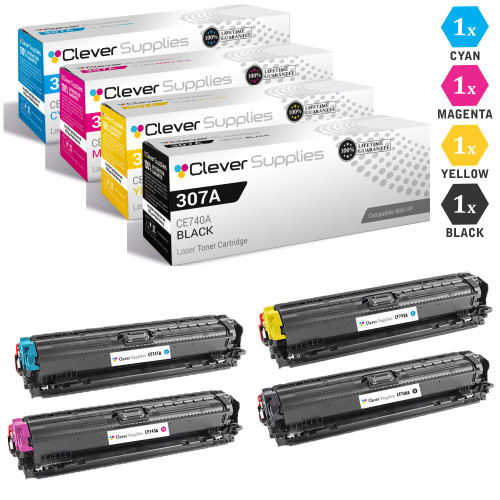
Set it against HP’s own counter: the genuine black cartridge alone lists at $231.99 in HP’s US store — about fifteen dollars less than this entire set — and the genuine cyan and magenta list at $407.99 each, more than the set costs outright. HP sells no genuine four-pack for this family, so a like-for-like genuine restock means four separate cartridges at four separate prices.
Shop the 4-Color Set →THE REMAINING ELEVEN OFFERS
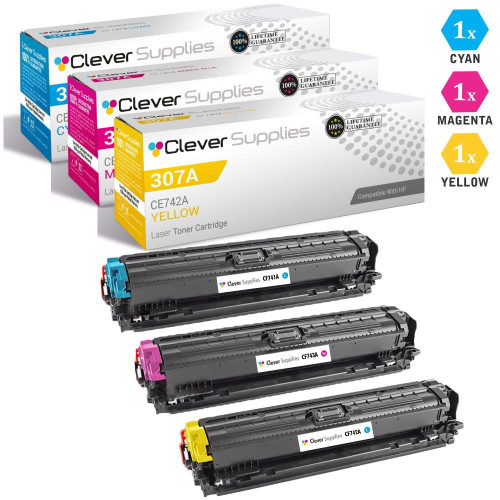
The three colors without a black, for a machine whose black cartridge still has life in it. Buying the trio together trims $32.16 off the three singles and brings the color page down from 1.01¢ to 0.87¢.
Shop the Tri-Color Set →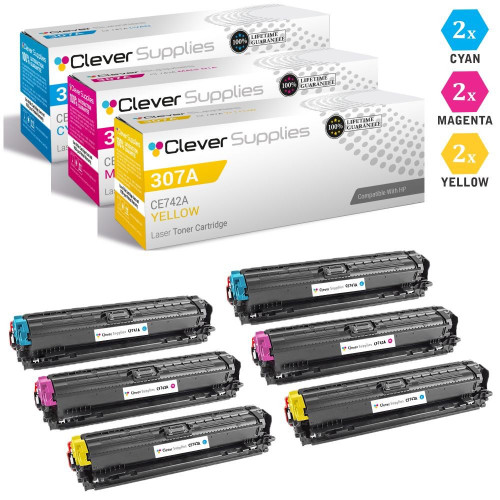
A double round of the colors for printers that live in color. Its listing counts the contents out explicitly — two of each color, black deliberately excluded — and the math follows: the lowest claimed per-page rate anywhere on this shelf.
Shop the 6 Color Set →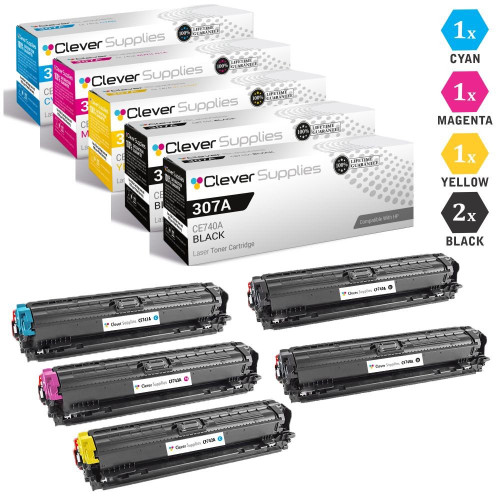
Every station is covered and a fifth cartridge rides along, but no line of the listing identifies the extra one. Until it does, the price is printed on its own — this guide attaches neither a saving nor a per-page rate to an unsettled contents list.
Shop the 5 Color Set →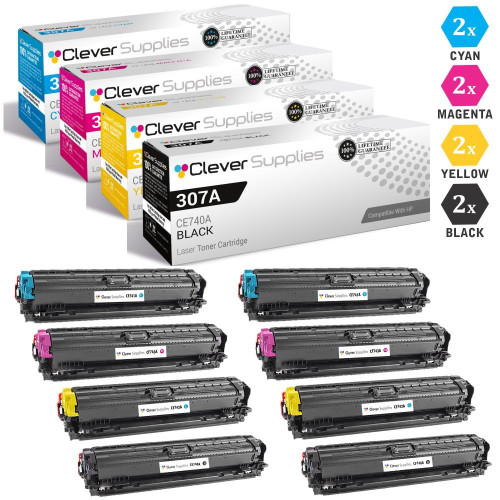
The deepest stock-up box in the family confirms eight cartridges across the four part numbers, then leaves the division between them to the carton label. Two of each is the natural guess, and a guess is all it is — so the price stands here without claims beside it.
Shop the 8 Color Set →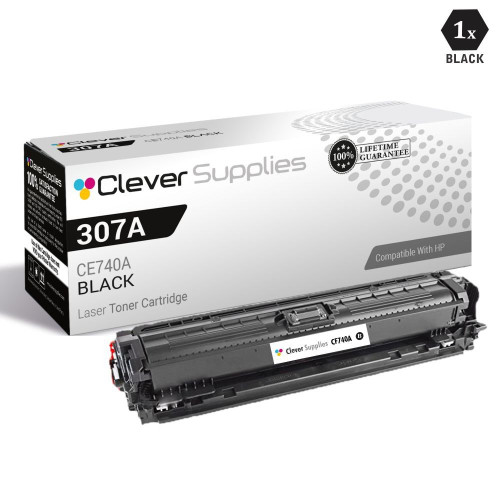
The black sold on its own — and, unusually, the cheapest single on the shelf, undercutting each color by thirty-four cents despite its lower page rating. It is also the cartridge the three black packs below are built from.
Shop the Black Single →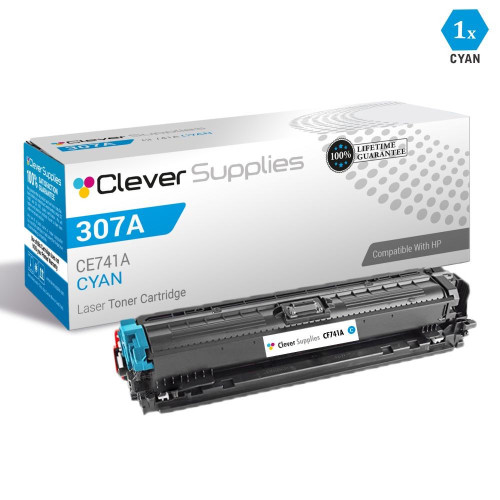
A single cyan for the station the printer is calling for. The three colors share one price and one rating, so a lone color page costs the same whichever station runs dry.
Shop the Cyan Single →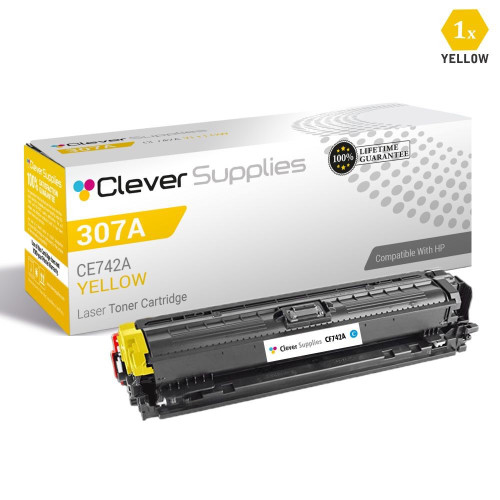
Yellow by itself, at the same $73.91 and the same ~7,300-page rating as its two color neighbors — no station in this row is priced above another.
Shop the Yellow Single →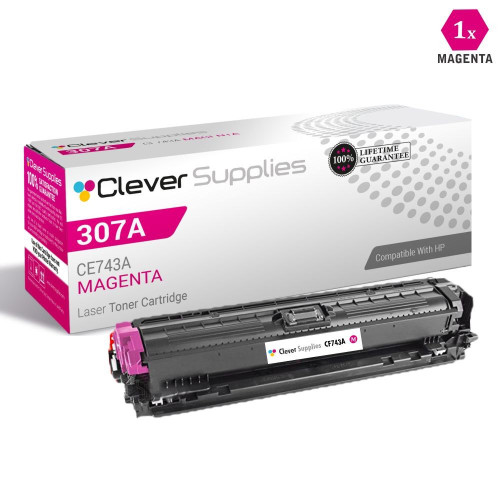
The magenta cartridge sold singly. Note the shelf’s small inversion: at 1.01¢ a page it is a shade cheaper to run than the black, because its rating is the higher of the two.
Shop the Magenta Single →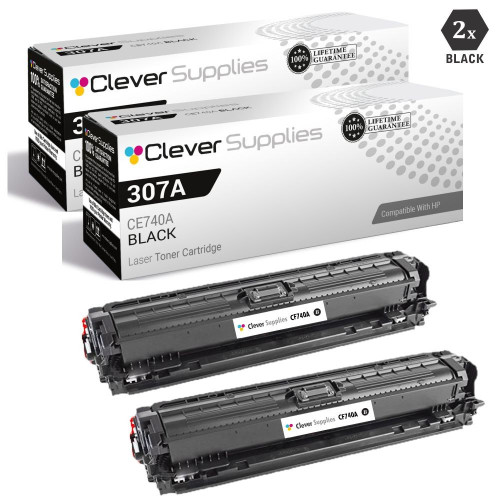
One black in the machine and one on the shelf: the pair saves $16.09 against two singles and pulls the black page down from 1.05¢ to 0.94¢.
Shop the 2 Black Pack →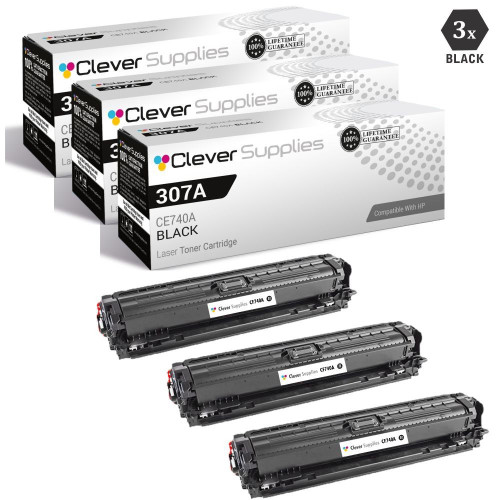
Three blacks in a single carton, $32.17 below the three singles — the middle rung of the black ladder, at 0.90¢ a page.
Shop the 3 Black Pack →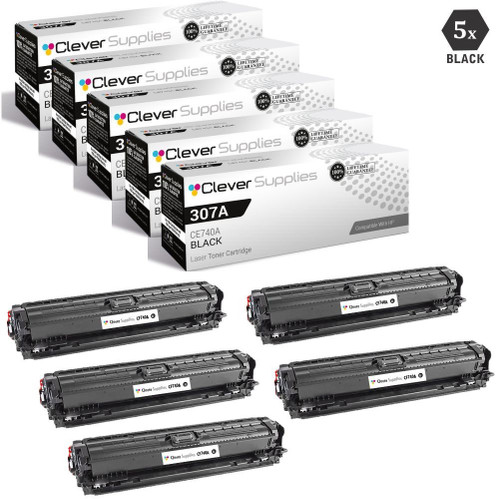
The heaviest black-only box the family offers: five cartridges, $64.33 under the five singles, and the cheapest black page the black ladder reaches at 0.87¢.
Shop the 5 Black Pack →Two cards above wear an explanation instead of a badge, and the reason deserves one plain sentence: a saving can only be measured against a known contents list, and the five-color set never names its fifth cartridge while the eight-color set never counts its eight by code. Both boxes are priced and carded like everything else — what is withheld is the claim, not the product.
Every calculation on this page begins from sale prices, the sums a buyer actually pays at checkout. Some product pages run their percentages from the higher list prices instead, so a figure quoted there can read differently from its counterpart here; the closing note records the basis behind each number on this page.
All twelve offers, one table
Ratings are test-standard averages, so read them as planning figures: heavy coverage shortens a cartridge’s life, light coverage stretches it. A multi-cartridge box’s page total is its cartridges’ ratings added together, and its rate is the sale price divided by that total. There is no compatibility column because there is nothing to compare — all twelve rows fit all three printers named further down.
| Offer | Sale price | What is in the box | Cost per page | Saving vs singles |
|---|---|---|---|---|
| 307A 4-Color Set — the flagship | $247.06 | Black, cyan, yellow and magenta, one each · ~28,900 pages | 0.85¢ blended | SAVE $48.24 |
| 307A Tri-Color Set | $189.57 | Cyan, yellow and magenta · ~21,900 pages | 0.87¢ | SAVE $32.16 |
| 307A 6 Color Set — colors only | $363.06 | Two each of the three colors, no black · ~43,800 pages | 0.83¢ | SAVE $80.40 |
| 307A 5 Color Set | $304.54 | Five cartridges spanning the four codes; the fifth is not identified | Not claimed | Not claimed |
| 307A 8 Color Set | $478.04 | Eight cartridges spanning the four codes; counts per code not given | Not claimed | Not claimed |
| 307A Black Single (CE740A) | $73.57 | 1 black · ~7,000 pages | 1.05¢ | Bought one at a time |
| 307A Cyan Single (CE741A) | $73.91 | 1 cyan · ~7,300 pages | 1.01¢ | Bought one at a time |
| 307A Yellow Single (CE742A) | $73.91 | 1 yellow · ~7,300 pages | 1.01¢ | Bought one at a time |
| 307A Magenta Single (CE743A) | $73.91 | 1 magenta · ~7,300 pages | 1.01¢ | Bought one at a time |
| 307A 2 Black Pack | $131.05 | 2 black · ~14,000 pages | 0.94¢ | SAVE $16.09 |
| 307A 3 Black Pack | $188.54 | 3 black · ~21,000 pages | 0.90¢ | SAVE $32.17 |
| 307A 5 Black Pack | $303.52 | 5 black · ~35,000 pages | 0.87¢ | SAVE $64.33 |
The two “Not claimed” rows are deliberate. Neither the five-color set nor the eight-color set publishes a complete contents list, and without one, no honest saving or rate exists to print. Every other row can be re-derived from the singles on the shelf: pick a box, add up its cartridges bought singly, and the badge figure is the difference.
The cost of a page, row by row
Begin with the oddity: a black page costs more than a color page in this family. The black single works out to 1.05¢, each color single to 1.01¢ — the colors are priced a few cents higher per cartridge but rated 300 pages higher, and the rating wins. The black packs then do what packs do: 0.94¢ in the two-pack, 0.90¢ in the three-pack, 0.87¢ in the five-pack. Color bought in boxes drops further — 0.87¢ from the tri-color set and 0.83¢ from the six-color set, the cheapest claimed rate on the page. Blended across a full change of all four stations, the flagship set lands at 0.85¢.
Translated into a month: 3,000 black pages cost about $31.50 in singles, about $27 in the three-black pack and about $26 from the five-black pack. Two thousand color pages cost about $20.20 as singles, about $17.40 from the tri-color set and about $16.60 from the six-color set. The lesson of the shelf is plain — in this family the savings sit in the multi-cartridge boxes, never in choosing one single over another.
Ratings both sides agree on — and a full-size start
HP measures this family under ISO/IEC 19798 and publishes about 7,000 pages for the CE740A black and about 7,300 for each color, the three colors declared together as a composite figure. Unusually, there is no second set of numbers to reconcile: every listing on the shelf states those same ratings, so the wholesaler’s figures and the manufacturer’s figures are one and the same, and every rate in this guide is built on them. Treat them as averages all the same — the standard assumes ordinary business pages, and dense A3 graphics will pull a cartridge below its rating just as light memos push one past it.
New-machine buyers get a better deal here than most platforms offer. HP’s datasheet for the CP5225 series lists the box contents as preinstalled cartridges at the full ratings — black at about 7,000 pages, colors at about 7,300 — rather than the reduced introductory units many printers ship with. The first replacement therefore falls due on the same schedule as every later one, and the per-page figures above describe the machine’s running costs from its first day.
For scale, HP’s US store prices the genuine cartridges at $231.99 for the black and $407.99 apiece for the cyan and the magenta, all shown in stock; no genuine multipack is offered for the family. A genuine restock of all four stations means buying the singles one by one — against which the compatible four-color set at $247.06 costs about fifteen dollars more than HP’s black cartridge alone.
One maintenance item simply does not exist here. HP builds this platform on an all-in-one cartridge architecture — toner and imaging drum sealed into the same unit — so each cartridge change renews the drum as well, and no separate drum is made, stocked or priced for these printers.
Three printers, all A3, all on the same four cartridges
HP’s datasheet draws the roster tightly: the CP5225 series is its A3 color line, and it contains exactly three models. All four cartridges fit all three machines — HP attaches no restriction by model or station, because there is only the one tier to restrict.
The three: the Color LaserJet CP5225, the Color LaserJet CP5225n and the Color LaserJet CP5225dn — the plain model, the networked model, and the networked model with automatic two-sided printing.
If a machine in front of you wears one of those three names, the shelf above is its shelf. And if the nameplate is out of reach, the cartridge coming out of the printer settles the question: a code from CE740A through CE743A belongs to this family and no other.
Chips: one sentence in the newer listings, silence in the rest
Five of the twelve listings — the older generation — never mention a chip in any form. The other seven share a single sentence cataloging what their cartridges are built from: brand-new parts throughout, running from the OPC drum and wiper blades to, among the remaining internals, a smart chip. Read it for what it is — a statement about components. It promises nothing about recognition, and it says nothing about firmware in either direction.
HP’s own material is no more expansive. Its cartridge page for this 2010-era platform carries no dynamic-security wording at all; the only security it mentions is the anti-counterfeit seal on genuine packaging. So this guide claims nothing in either direction — neither that a chip guarantees acceptance nor that one is required — and points instead to the written cover standing behind every cartridge sold here.
The cover behind the cartridges
Matching the box to the workload
Questions the CP5225 platform raises
No. HP’s range for this platform stops at the four standard cartridges — CE740A black and the CE741A, CE742A and CE743A colors. No high-yield variant exists in HP’s lineup, and none is stocked here, so every cartridge on this page is a 307A whatever the box size.
Full-size ones. HP’s datasheet lists the preinstalled cartridges at the full retail ratings — about 7,000 pages for the black and about 7,300 for each color — so a new machine runs its first cartridges as long as any it will ever take.
Because a saving is a comparison against a known contents list, and two listings do not provide one: the five-color set never identifies which cartridge it doubles, and the eight-color set never divides its eight among the four codes. Both are priced and carded above; the claims wait until the contents are settled.
No. The platform uses all-in-one cartridges with the imaging drum built into each unit, so fitting a fresh cartridge renews the drum in the same motion. There is no drum to buy, price or schedule for these printers.
That is simply how the shelf is priced: $73.57 for the black against $73.91 for each color. The colors also carry the higher rating — about 7,300 pages against the black’s 7,000 — so a color page works out cheaper too, 1.01¢ against 1.05¢. This guide prints the figures as it finds them.
The seven newer listings say their cartridges are built with new parts including a smart chip; the five older ones do not raise the subject. HP publishes no dynamic-security language for this platform, and nothing here claims more than the listings claim — the protection a buyer can rely on is the year’s warranty and the year’s free returns.
Three: the Color LaserJet CP5225, CP5225n and CP5225dn. HP’s datasheet names those models for the platform, and all four cartridges fit each of them without restriction.
The store’s compatible-range terms apply: a year of warranty cover and free returns across the same year. Weekday support, 9 AM to 5 PM Central, handles the arrangement — hold on to the carton until the replacement has printed cleanly.