




The 148 family feeds HP's current small-office monochrome line — the LaserJet Pro 4001 printers and MFP 4101 multifunctions that replaced the long-running M404/M428 series. Two cartridges fit every one of them, and the choice between them is mostly arithmetic. But this is also a family where HP's chip rules genuinely matter, so this guide covers the yield math, the pack ladder, and — in HP's own words — the firmware behavior that decides whether any given cartridge is accepted at all.
The short answer: for most offices the 148X single at $60.78 is the buy — $8.88 more than the standard cartridge, with roughly three times the rated pages. The 148A single at $51.90 is the lower up-front price for genuinely light printing.
Both cartridges fit all five US models in this family. The standard-yield 148A (W1480A) is rated by HP at about 2,900 pages and costs $51.90 here. The high-yield 148X (W1480X) is rated at about 9,500 pages and costs $60.78 — so for $8.88 more, the rated output roughly triples and the toner cost falls from about 1.79¢ to about 0.64¢ per page. Unless your printer sits idle for weeks at a time, the 148X is the rational default; the packs below cut the per-page cost further still.
The 5-second decision
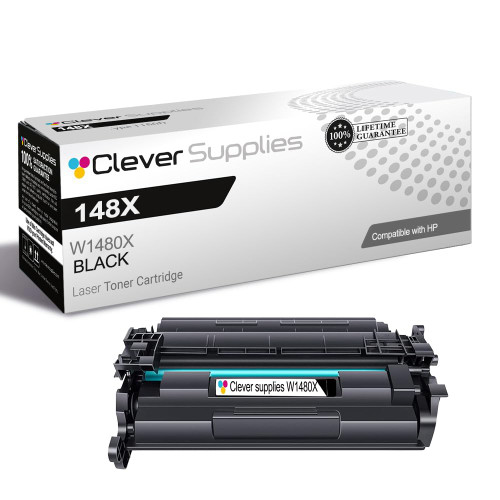
The price gap between the two cartridges is $8.88; the yield gap is about 6,600 pages. On any printer that works most weeks, that trade is not close — the high-yield cartridge pays for its small premium within its first few hundred pages and then keeps printing long after a 148A would have run dry.
View the 148X Single →
There is one honest case for the standard cartridge: a printer that genuinely prints a few dozen pages a month, where the lower bill today matters more than the cost per page. Even then, 2,900 rated pages is a long runway — this is the same capacity HP loads into the printer at the factory.
View the 148A Single →The short verdict
This family's economics turn on a lopsided pair of numbers. The standard cartridge is rated at about 2,900 pages; the high-yield at about 9,500 — roughly three and a quarter times the output — yet on our shelf the two singles differ by less than nine dollars. That is why the 148X wins almost every realistic comparison here: about 0.64¢ per page against about 1.79¢, before packs widen the gap further. The 148X 4-pack brings the cartridge price down to $48.72 and the running cost to about 0.51¢ per page.
Set against HP's own prices, the context sharpens. HP lists the genuine 148A at $140.99 and the genuine 148X at $281.99 — about 4.86¢ and 2.97¢ per rated page respectively. Our compatible 148X single is $221.21 below the genuine cartridge it replaces, at the same HP-rated yield. The remaining questions in this family are not about price at all; they are about the chip rules covered further down this page, which deserve a careful read before any purchase — ours included.
This guide is built from listed prices, HP's rated yields, and Clever Supplies policies. It is not presented as a laboratory test or a roundup of customer ratings, and we do not add review counts or stars that are not part of the buying facts.
Every HP 148 option, side by side
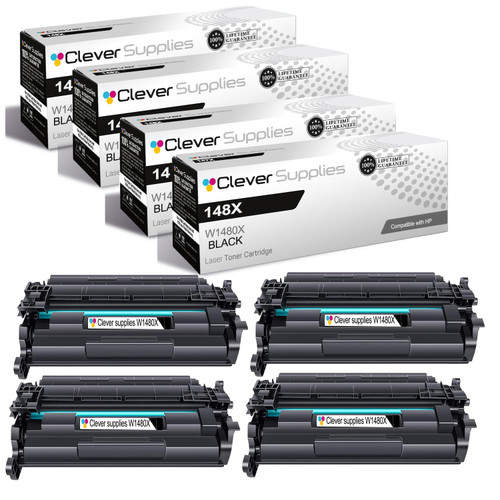
Six ways to buy for this family — two cartridge sizes, each as a single, a 2-pack, and a 4-pack. Pack savings are measured against the same cartridge bought as singles.


Best HP 148 picks by priority
Best overall: the 148X single
For a single printer in a working office, the 148X single is where the family's math points. HP rates these printers for 750 to 4,000 pages a month, and at that pace a 2,900-page cartridge can be a quarterly errand while a 9,500-page cartridge stretches across most of a year. One purchase, one swap, and a per-page cost less than half the standard cartridge's.
Best for steady volume: the 148X packs
If the printer feeds a small team, buy ahead. The 2-pack drops each cartridge to $52.74, and the 4-pack to $48.72 — about 0.51¢ per page, the cheapest printing this family offers. A sealed spare on the shelf also turns the next empty cartridge into a two-minute swap instead of a delivery wait.
Best on a tight budget today: the 148A single
When the printer is a home-office machine that prints in bursts — invoices one week, nothing the next — the 148A single at $51.90 is a reasonable way to spend less now. Toner does not dry out between quiet spells, so even a lightly used cartridge keeps its rated life; just know the per-page cost is the highest on this page.
HP 148 options compared
| Option | Price checked | HP-rated yield | Why choose it |
|---|---|---|---|
| 148X 4-pack BEST VALUE | $194.89 | 9,500 pages each | About 0.51¢ per page; saves $48.23 against four 148X singles. |
| 148X single | $60.78 | 9,500 pages | The default buy for most offices; about 0.64¢ per page. |
| 148X 2-pack | $105.48 | 9,500 pages each | $52.74 per cartridge; saves $16.08 and keeps a spare sealed. |
| 148A single | $51.90 | 2,900 pages | The lowest up-front price; about 1.79¢ per page for light printing. |
| 148A 2-pack | $87.72 | 2,900 pages each | $43.86 per cartridge; saves $16.08 against two singles. |
| 148A 4-pack | $159.37 | 2,900 pages each | About 1.37¢ per page; saves $48.23 against four singles. |
| Genuine HP 148X (price context) | $281.99 | 9,500 pages | HP's own cartridge at HP's store price; $221.21 above the compatible for the same rated yield. |
| Genuine HP 148A (price context) | $140.99 | 2,900 pages | HP's standard cartridge at HP's list price; $89.09 above the compatible. |
Rated yields are HP's ISO/IEC 19752 figures for the W1480A and W1480X. Real output varies with page coverage, document type, printer settings, and how the printer is used. Genuine prices are HP's own store and list prices, checked November 2026.
The chip question: this family's real decision
Every printer in the 4001/4101 series is what HP calls a dynamic security printer. HP's own wording, printed on its product pages for these models, is direct:
Read that the way a buyer should. Whether a compatible cartridge runs in this family is decided by the chip it carries and the printer's firmware — not by the toner inside it. Accordingly, compatible 148 cartridges are sold across the market in two distinct forms: cartridges supplied with a chip fitted, and cartridges supplied without a chip, which only work after a chip is transferred from another cartridge the printer accepts. The two forms are not interchangeable, and a listing that never says which form it sells leaves its most important question unanswered.
The routine that protects you, whichever cartridge you choose:
No separate drum to buy — it is inside every cartridge
Some printer families split their imaging parts — a toner cartridge on one replacement clock and a separate drum unit on another, as Brother's two-part systems do. The 148 family is not built that way. In HP's own words, these are "all-in-one toner cartridges which include both toner and the imaging drum," and HP's replacement list for the 4001/4101 contains toner cartridges and nothing else. There is no drum part number to order, no drum counter to reset, and no second consumable to budget for.
The practical consequence is a simpler diagnosis at the end of a cartridge's life. When output starts to fade, streak, or spot near the end of a cartridge, the worn part is inside that cartridge, and fitting a fresh one replaces the drum surface along with the toner. The same symptom on a nearly new cartridge points somewhere else — paper path, settings, or the cartridge itself — and is a warranty conversation, not a parts order.
One more detail in the buyer's favor: these printers leave the factory with a preinstalled cartridge rated at the full ~2,900 pages — the same capacity as a retail 148A. There is no low-yield starter cartridge to burn through before the first real purchase, so the first replacement decision is the one this page is about.
What the printer's messages actually mean
The 4001/4101 panel and its embedded web page report supply problems in a handful of wordings. Here is what each one is really telling you, and the move that matches it:
Which printers use HP 148 toner?
Both cartridges fit the full US lineup of HP's 2022 monochrome refresh: the LaserJet Pro 4001n, LaserJet Pro 4001dn and LaserJet Pro 4001dw printers, and the LaserJet Pro MFP 4101fdn and LaserJet Pro MFP 4101fdw multifunctions. The MFP models add scan, copy and fax around the same print engine, so the cartridge decision is identical across all five — pick by yield and pack, not by model.
A naming caution while shopping: the older LaserJet 4101 from the early 2000s is an unrelated machine that shares only a number. If a listing or category page shows a printer that looks nothing like the current compact Pro design, you are looking at the wrong 4101.
The cost-per-page picture
The arithmetic is the cartridge price divided by HP's rated yield for that cartridge. The 148X single: $60.78 ÷ 9,500 ≈ 0.64¢. The 148A single: $51.90 ÷ 2,900 ≈ 1.79¢. HP's genuine cartridges at HP's prices: $281.99 ÷ 9,500 ≈ 2.97¢ for the 148X, and $140.99 ÷ 2,900 ≈ 4.86¢ for the 148A. Packs push our figures lower — the 148X 4-pack works out near 0.51¢ — because the per-cartridge price falls while the rated yield stays the same.
Treat these as comparison figures, not promises about your printer. Rated yields assume the ISO test pattern; dense contracts, graphics-heavy pages and frequent short jobs all move real output. What the ratings do reliably is rank the options — and in this family the ranking is not close: high-yield first, packs second, standard yield last.
Swapping a 148 cartridge
The exchange is the standard top-loading LaserJet routine and takes about two minutes, with no tools. Lift the top cover with the printer on, pull the old cartridge straight up and out, and set it aside for recycling. Rock the new cartridge gently from side to side a few times to settle the toner, strip off its packing materials and sealing tape, then lower it into the bay and push until it seats fully. Close the cover and let the printer finish its start-up cycle before printing.
Because the drum is part of the cartridge, there is nothing else to inspect, clean by schedule, or replace during the swap — the fresh cartridge brings a fresh imaging surface with it. To check the level afterwards, open the printer's supply status from its control panel or embedded web page; after fitting any cartridge in this family, keep the first supply-status screen in mind — if a message other than a normal ready state appears, the decoder above tells you what it means and what to send us.
Before you order: the 60-second checklist
HP 148 toner questions, answered
The 148X, in almost every case. HP rates it at about 9,500 pages against the 148A's 2,900, and here the price difference is only $8.88 ($60.78 against $51.90), which puts the cost per page at roughly 0.64¢ against 1.79¢. The 148A makes sense when the printer is used lightly and the lower bill today is the priority.
No. HP describes these as all-in-one cartridges that include both the toner and the imaging drum, and its replacement list for these printers contains cartridges only. Every cartridge change renews the drum with it — there is no drum to order, track, or reset in this family.
No — and it is worth checking before anything else. The HP+ models (4001ne, 4001dne, 4001dwe, MFP 4101fdne, MFP 4101fdwe) are configured to accept only genuine HP toner. The standard models — 4001n, 4001dn, 4001dw, MFP 4101fdn and MFP 4101fdw — are the ones this guide covers.
It depends on the cartridge's chip and your printer's firmware — that is the honest answer for this family, and HP's own dynamic-security statement (quoted in full above) explains why. Compatible 148 cartridges are sold both with a chip fitted and without one, so confirm the form before you buy; and if a block message ever appears, photograph it with the firmware version and bring both to the seller. Every cartridge linked from this page carries our 1-year warranty and 1-year free returns.
HP's ratings — about 2,900 pages for the 148A and 9,500 for the 148X — are measured on the ISO/IEC 19752 test pattern. Heavy coverage, dense documents and lots of very short jobs reduce real-world output; light text documents can exceed the rating. Use the ratings to compare cartridges, which is what they are for, rather than as a page-count guarantee.
No. HP specs the preinstalled inbox cartridge at the full ~2,900 pages, the same rating as a retail 148A. Your first replacement purchase is a normal buying decision, not an early penalty for buying the printer.
Judge by the price at checkout on the product page. Guides like this one are refreshed on a schedule, while store pricing moves with stock and promotions; the product page is the live source, and the disclosure below records when this page's figures were checked.