




Most owners meet this part through a message on the printer’s screen — Replace Drum — and a good number of them go shopping for toner first. The DR730 is not toner. It is the drum unit: the imaging frame that the toner cartridge slots into, the part that lays each page’s image onto the paper. Brother built one drum for the entire TN730 / TN760 / TN770 platform, so the same unit serves twelve different printers, and it outlasts roughly four high-yield toner cartridges before its turn comes round again. This page covers that drum on its own terms — the three ways this store sells it, what each one costs per thousand pages, and one fact worth knowing before checkout: the genuine Brother drum is currently out of stock here.
The short answer: for most owners the DR730 2-pack at $41.02 is the buy — two drum units, roughly 24,000 rated pages between them, priced $16.08 below two singles bought apart. The single at $28.55 suits a machine that prints lightly and may not outlive one drum. The 4-pack at $65.97 pulls the drum’s cost down to $1.37 per thousand pages for printers in daily service.
Begin with the words on the screen. A drum message calls for a drum — no toner cartridge, however fresh, will clear it, because the two parts age on separate clocks. If your printer belongs to the twelve models named below, the DR730 is its drum, full stop: the same unit fits the machine that sips TN730 cartridges and the one that runs TN770. From there the decision is arithmetic. One drum at $28.55 handles the immediate warning; the 2-pack at $41.02 banks a spare against the next one; the 4-pack at $65.97 is the fleet answer. Buyers set on the genuine Brother box should read the genuine section before planning around it — that drum is out of stock in this store at the time of writing.
Twelve printers turn on this one drum
Brother’s supply pages for this platform name the same twelve machines against the drum and against every toner tier: the DCP-L2550DW; the HL-L2350DW, HL-L2370DW, HL-L2370DW XL, HL-L2390DW and HL-L2395DW; and the MFC-L2690DW, MFC-L2710DW, MFC-L2717DW, MFC-L2730DW, MFC-L2750DW and MFC-L2750DW XL. Eleven of the twelve link to their category pages; the MFC-L2730DW stands in plain text because this store has no category page for it — the drum fits it all the same, and any listing below can be ordered for it.
One confusion deserves settling at the top, because it sends buyers to the wrong page. The TN770 toner — the platform’s super-high-yield tier — fits only four of these machines, and owners of the other eight sometimes conclude their printer is a lesser variant that takes different hardware throughout. That ceiling applies to the toner tier and nothing else. The drum underneath never changes: all twelve models, from the smallest HL to the XL multifunctions, run the identical DR730, whichever toner size their firmware allows.
Two footnotes on names, so the list above can be trusted as written. Brother’s own DR730 product page names only nine of the twelve in its summary line, leaving out three MFC models that its platform pages include — this guide follows the platform roster of twelve. And the compatible listings’ own text adds one further name, the HL-L2325DW, which appears on none of Brother’s supply pages for this platform; it is not counted as a roster model here, and no link is offered for it.
The drum shelf: one unit, a pair, or a box of four
One naming trap has to be cleared before the cards, because it misleads real buyers: in this store, every compatible DR730 listing carries the words “Toner Cartridge” in its product title, although the part inside the box is a drum unit. The cards below label each offer as what it actually is. On price, the ladder is easy to hold in the head — a single drum costs $28.55, so two singles rung up separately come to $57.10 and four to $114.20. Both pack prices are judged against those two sums, and against nothing else.

A drum is not a part owners replace often — at Brother’s rating, one unit carries a home printer through years of ordinary work — and that rarity is exactly what makes the pair sensible. The warning always seems to land mid-job, on a deadline, with no spare in the building. Holding the second drum costs $12.47 more than the single today and removes that scramble entirely, while the per-drum price falls by more than eight dollars. For a machine expected to stay in service, this is where the shelf’s value sits, which is why the pair leads the page.
Shop the 2-Pack →
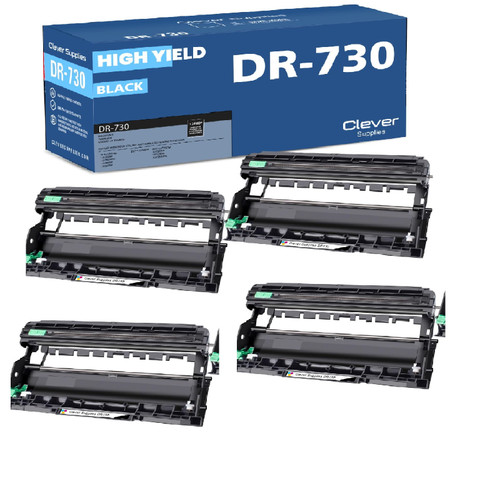
The unit itself does not change from box to box — same drum, same rating, same fit across the twelve models. What changes is how far ahead the purchase reaches. A lightly used MFC in a home office can take the better part of a decade to wear out one drum, and for that machine a shelf of spares is money parked in cardboard. A shared workgroup printer chewing through toner cartridges every few weeks lives at the other end of the scale: at that pace a drum is a yearly event, and the four-pack’s $1.37 per thousand pages is the cheapest way to keep it one.
The listings’ own yield figures need no correction here, which is worth saying out loud. Each states the drum at 12,000 pages — Brother’s number, unembellished — and the pack totals printed on the multi-drum listings, 24,000 and 48,000, are honest multiples of it. The figures on this page are therefore the listings’ own numbers, checked against Brother rather than adjusted.
Three ways to buy the same drum, side by side
Because one drum design covers the whole platform, the table needs no compatibility column — every row fits every model named above. What it can usefully compare is reach: how many rated pages each box holds, and what a thousand of those pages cost at each quantity.
| Offer | What is in the box | Rated drum life | Price | Cost per 1,000 pages | Measured against singles |
|---|---|---|---|---|---|
| DR730 2-pack | Two DR730 drum units | About 24,000 pages in total | $41.02 | About $1.71 | SAVE $16.08 vs two singles |
| DR730 4-pack | Four DR730 drum units | About 48,000 pages in total | $65.97 | About $1.37 | SAVE $48.23 vs four singles |
| DR730 single | One DR730 drum unit | About 12,000 pages | $28.55 | About $2.38 | — |
No genuine row appears in this table, and that absence is a stock report rather than an editorial choice: the genuine Brother drum is listed in this store but cannot currently be bought, so no buyable price exists to set beside these three. Its situation is covered in the genuine section below.
Drum or toner? Reading what the printer is asking for
The two consumables in these machines live nested together, which is where the confusion starts. The toner cartridge — a TN730, TN760 or TN770 — holds the powder and clips into the DR730 drum unit; the drum is the frame that carries it and transfers the image to the page. They are replaced on entirely separate schedules. Toner runs out in the low thousands of pages; the drum keeps turning through roughly four TN760 cartridges, or about ten TN730s, before its surface wears to the point where print quality fades and the machine calls for a new one.
The practical test is which name the printer uses. A toner-low or toner-empty warning is answered with a cartridge, and swapping the drum at that moment buys nothing. A Replace Drum message — or prints that come out streaked and faint even with a fresh, genuine-quality cartridge installed — points at the drum. Owners sometimes burn through two toner cartridges chasing a drum problem, because a worn drum makes good toner print badly; if a new cartridge did not restore the page, the drum is the next suspect, not another cartridge.
One habit completes the job when the drum does get swapped: afterward, reset the drum counter through the printer’s settings, so the machine starts counting the new unit’s life from zero. The counter is the drum’s odometer — fitting a fresh drum without resetting it leaves the printer measuring the old unit’s mileage, and the Replace Drum warning will return far sooner than the hardware deserves. The mirror-image mistake is just as common: resetting the drum counter during a routine toner change, which tells the printer a worn drum is new again and hides a real replacement until quality gives out.
Sets that pair this drum with toner live on the toner side
This store also sells the DR730 bundled with toner, in four set shapes: one TN760 cartridge with one drum, two TN760 with one drum, three TN760 with one drum, and two of each. They exist because a drum change and a toner purchase often land in the same month, and a single box answers both. No compatible set pairs the drum with the standard TN730 cartridge — every bundle on the shelf is built around the high-yield TN760.
Those sets are deliberately not priced on this page. Half of every bundle is toner, and toner pricing — the cartridges on their own, the packs, and the sets measured against their parts — is the subject of the Best Brother TN760 Toner Cartridges guide, where two of the sets are already carded and compared. Keeping the figures in one place means the two guides cannot drift into quoting different numbers for the same box; this page stays with the drum alone, which is the part its readers came to replace.
The genuine DR730, and why it is not on the shelf above
Buyers whose rule is genuine-only deserve the position stated without decoration. This store does list a genuine Brother DR730, correctly titled as a drum unit, at a shelf price of $86.49 — a figure that would sit well below Brother USA’s own $129.49 for the same part. But the listing’s stock count is zero, its page reports the item as currently unavailable, and there is no way to complete a purchase against it today. A price nobody can pay is not an offer, which is why the genuine drum appears in this section as information rather than in the cards above as a choice.
While the standalone genuine drum is out of stock, genuine Brother stock of this drum does exist in the building — inside the store’s genuine toner-and-drum bundles, which are on the shelf at the time of writing. The least expensive of them, at $200.75, is currently the only route by which a genuine DR730 can be bought here at all, and it arrives with toner the buyer may not need. Anyone weighing that route should also know the terms that travel with genuine parts in this store: the manufacturer’s warranty stands behind them, and the returns window on genuine items runs 30 days, rather than the full year the compatibles below carry.
Chips belong to the toner conversation, not this one
Search the text of the three drum listings carded on this page and the word “chip” never appears. That silence is accurate rather than evasive: on this platform the recognition electronics ride with the toner cartridge, while the drum unit is the mechanical imaging part underneath it. This guide therefore makes no chip claim of any kind for the DR730 — no fitted chip, no recognition behavior, no gauge promise — because the part itself carries none to claim.
The reassurance that can honestly be offered is Brother’s own published position on third-party supplies, stated in its support answers: “Brother firmware updates do not block the use of third-party ink and toner cartridges in our machines.” Everything else on this page rests on the same verifiable footing — Brother’s twelve-model platform roster, Brother’s approximate drum-yield wording, and shelf prices read on the date shown at the top.
Five DR730 checks to run before checkout
Answers for owners facing a drum change
The drum. It is the imaging unit that the toner cartridge — TN730, TN760 or TN770 — clips into, and it is replaced on its own much longer schedule. When a printer message names the drum, it is this unit it wants, whatever toner happens to be installed at the time.
Yes. The TN770’s four-model limit is a ceiling on the toner tier only. The DR730 serves all twelve models on the platform, including the eight that top out at the TN760 — a machine’s toner ceiling says nothing about its drum, because the whole platform shares the one design.
Brother rates the DR730 at approximately 12,000 pages, and publishes that figure as an approximation that may vary by type of use — heavier, denser printing wears the surface faster than light office text. In the platform’s own terms, expect one drum to outlast about four TN760 cartridges or ten TN730 cartridges before the machine asks for the next one.
Because its shelf is empty. The genuine listing stands at $86.49 with a stock count of zero, and its page reports the item as currently unavailable; Brother USA, by contrast, sells the same drum at $129.49 with stock on hand. Inside this store, a genuine DR730 can presently be had only as part of a genuine toner-and-drum bundle, the least expensive of which is $200.75.
Because this store has no category page for that model, and this guide links only to pages that exist. The omission is in the store’s catalog, not in the fit: Brother’s platform roster includes the MFC-L2730DW among the twelve, the DR730 is its drum, and any of the listings above can be ordered for it.
The three compatible offers carry this store’s own terms — a one-year warranty and a full year to return a compatible item that turns out wrong for your machine. Genuine Brother parts, when they are in stock, carry the manufacturer’s warranty instead, with a 30-day returns window. Orders ship from whichever of the four warehouses — Illinois, Pennsylvania, Georgia or California — is nearest, and the support desk is staffed on weekdays from 9 AM to 5 PM Central.