




Start with a disappearance. Brother no longer keeps a product page for this drum: look the DR500 up on the maker’s site today and the trail ends at an empty address, so the part now survives on documentation rather than on a live listing — chiefly the platform service manual, whose specification table grants one drum a life expectancy of 20,000 pages. The printers, though, are still out there: fifteen monochrome models from the early 2000s, spanning two engine generations, every one of them imaging through this single unit. This store’s compatible shelf holds exactly two ways to buy it — a 2-pack and a 4-pack, no single at any price — and both listings argue their value from list prices that checkout will never charge. The pages ahead price both boxes from the register instead, rebuild the printer list from Brother’s own cartridge pages, and set the genuine drum’s $233.87 down plainly, with no manufacturer price left anywhere to measure it against.
The short version runs like this. A lone compatible DR500 drum is not for sale here; the shelf opens at a pair. The 2-pack costs $81.64 — $40.82 per drum — and wears the flagship badge for no grander reason than being the smallest purchase available. The 4-pack costs $147.21, drops the unit price to $36.80, and undercuts two separate 2-packs ($163.28) by $16.07 — the only comparison this family honestly supports, since no single exists to anchor a saving. Brother itself has walked away from the drum’s product page, so its genuine price cannot be read anywhere; the genuine unit stocked here stands at $233.87 on its own. Carry two cautions into the details: both packs compute their advertised per-drum costs from list prices rather than selling prices, and both are titled as toner cartridges while containing imaging drums and no toner at all — a point each pack’s own text concedes. The cards below name each box for what it actually holds.
A two-box shelf for a drum Brother no longer lists
Reconstructing this platform takes a small act of archaeology. The drum’s own page at Brother is gone, so its printer list has to be rebuilt from the cartridge pages that survive, and its rating read out of the service manual Brother published for these machines. The store’s shelf, by contrast, could not be simpler to survey: three drum listings in total, the two compatible packs below and one genuine single, with no duplicates, no toner-and-drum bundles and no fourth offer hiding anywhere. What cannot be bought is one drum on its own — the pair is the floor, covering the change a machine needs now and the next one after it, and the foursome is the ceiling, sized for a shelf feeding several of the fifteen models.
Both packs also arrive mislabeled. Their titles call them toner cartridges and their specification tables file them under “Laser Cartridge”, yet each pack’s own description states the truth plainly — imaging drums only, no toner included — and their help sections deal in drum matters alone: service life, counter warnings, the swap itself. The genuine entry, notably, is filed correctly as a drum unit. Throughout this guide the contents outrank the labels: the offers below are called drums, because drums are what the boxes contain.

A drum purchase on a machine of this age is a considered one — the symptom has shown itself, in repeating marks or a gray wash that fresh toner cannot cure, and the fix should not need repeating for years. The pair answers that pattern exactly: install one drum today, keep the second boxed against the day the counter calls again, years from now. Homes and small offices will find the pair sufficient; a storeroom supplying several platform machines should look at the 4-pack below, which wins on unit price.
Shop the Drum 2-Pack →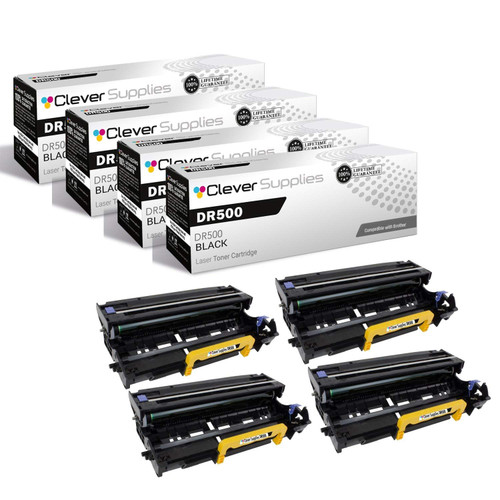
Four drums at the family’s floor price. Each unit works out to $36.80 — $1.84 per thousand rated pages, near 0.18¢ a page — undercutting the pair’s per-drum rate by $4.02 and beating the same four drums assembled from two separate pairs. Their lives add up to roughly 80,000 pages of imaging, drawn down one drum at a time across the years, and the $147.21 total carries free shipping on its own.
Shop the 4-Pack →Every way to buy the DR500, set out in one table
The per-drum column divides by one drum, never by the box: each unit figure uses the same 20,000 pages Brother’s specification assigns a single drum. The final column adds the lives inside a box together — read it as a stocking figure, not a rating any one drum carries.
| Offer | Box price | Cost per drum | Per 1,000 rated pages | What you get |
|---|---|---|---|---|
| Drum 2-pack (flagship) | $81.64 | $40.82 | $2.04 | A pair of drums — ≈40,000 pages of imaging in total |
| Drum 4-pack | $147.21 | $36.80 | $1.84 | Four drums — ≈80,000 pages of imaging in total |
| Genuine Brother DR500 (reference) | $233.87 | $233.87 | $11.69 | A single genuine drum — Brother publishes no price of its own for it today |
So the compatible choice reduces to pack size. Pairs price the drum at $40.82; fours bring it to $36.80, and $147.21 buys four outright against the $163.28 that two 2-packs would cost — the same hardware, $16.07 apart. Nothing beyond the foursome is stocked. The genuine row answers to different economics entirely; its section below explains why its price stands without a manufacturer’s figure beside it.
The packs price themselves off the list column
Read the cost talk on either pack’s page and a pattern emerges: the arithmetic runs on list prices, the pre-discount column, as though those were the sums a buyer hands over. The pair’s coverage answer concludes, “At $93.89 for the two, the per-drum cost is $46.95”, and its About section repeats the $46.95 per drum as the pack’s working figure. The foursome’s cost answer is built the same way from the first line — “The pack is $169.29 for four drums, so each drum works out to $42.32” — and its About section restates $42.32 per drum in turn.
The register tells a different story. The pair checks out at $81.64, which is $40.82 per drum — not $46.95. The foursome checks out at $147.21, which is $36.80 per drum — not $42.32, and not measured against a pair at $46.95 either. Every per-drum number in the listings’ cost talk is a list-price ghost: it describes a transaction nobody will actually make, and any budget built on it inherits the padding. (The genuine listing, to its credit, keeps the two columns apart and labels its list figure as a list figure.)
One set of books governs this page: selling prices everywhere outside this section, and the list numbers quoted above confined to these paragraphs, where the correction belongs.
Fifteen printers, rebuilt from Brother’s cartridge pages
Brother publishes no DR500 page today, so no drum roster exists to copy. What survives are the cartridge pages: the TN560’s compatibility list names fifteen machines, and since every one of them images through this drum, those fifteen are the platform. They fall into two generations, and the grouping matters — the first takes either cartridge, the second takes the high-yield only. Each name below links to its category inside this store.
First generation — TN530 or TN560: DCP-8020 · DCP-8025D · HL-5040 · HL-5050 · HL-5050LT · HL-5070n · MFC-8420 · MFC-8820D · MFC-8820DN
Later generation — TN560 only: HL-1650 · HL-1650N · HL-1650N Plus · HL-1670n · HL-1850 · HL-1870n
Two cartridges feed these machines, both rated the old way, by coverage rather than by a laboratory standard. Brother’s standard TN530 carries the footnote “‡Yields approx. 3,300 pages @ 5% coverage on Letter size paper” and fits only the first nine machines listed above. Its high-yield TN560 counterpart reads “‡Yields approx. 6,500 pages @ 5% coverage on Letter size paper” and fits all fifteen — it is the sole tier the later generation accepts (Brother spells that generation’s networked Plus model HL-1650NPLUS). The drum wears no test-standard badge either: its 20,000-page figure is a platform specification from Brother’s service documentation, expressed on the same coverage-era footing. Measured against drum life, one drum outlasts about six TN530 cartridges, or roughly three TN560s.
Toner buying on this platform has a hard edge the drum shelf does not: this store stocks no compatible TN530 or TN560 at all. Both cartridges exist here only as genuine Brother listings — the TN530 at $107.37 and the TN560 at $143.29 — named for context and deliberately not linked, since the offers this guide stands behind are the compatible drums. Brother’s cartridge pages do remain readable, and they currently price the TN560 at $143.29 and show the TN530 at a $106.79 list figure with an $84.79 promotional price — quoted as Brother-page context, nothing more. The family’s one code category gathers the platform under the TN560 code category; no DR500 or TN530 code category exists. And there is no TN500 cartridge: the 500 in this family’s name belongs to the drum alone, so a search for a TN500 is a search for a part Brother never made.
One filing caution closes the list. The store shelves these drums under more model categories than Brother’s fifteen — tray and network variants among them — and variant names surface in the listings’ own fit talk as well. This page links Brother’s fifteen and no others; a model a listing names but Brother’s cartridge pages do not is a claim this guide neither repeats nor relies on.
Reading the page: drum wear versus an empty cartridge
Let the printed sheet arbitrate before any menu does. A tiring drum leaves physical evidence: the same flaw returning at regular intervals down successive pages, a streak that runs the sheet’s length and survives a cartridge change, a gray fog settling behind text that used to come out clean. An exhausted cartridge leaves no evidence at all — the print simply grows paler, evenly, until a fresh cartridge brings the density back in full. The machines keep separate tallies for the two supplies, so when the drum-life warning is the one showing, toner is not the answer to it.
Stocking follows from the proportions. Twenty thousand pages of drum life spans about six standard cartridges or three high-yield ones, and at the modest daily volumes these surviving machines typically see, a single drum change can cover years of work. A one-printer office is well served by the pair — one drum earning its keep, one waiting. Keep the 4-pack for sites where several of the fifteen draw on a shared shelf.
The genuine drum: $233.87, with no maker price beside it
Ordinarily this section sets the store’s genuine price against the manufacturer’s. Here that comparison cannot honestly be made: Brother has deleted the DR500’s product page, and with it any official shelf price — no readable Brother source states what the maker charges for this drum today. So the genuine unit in this catalog stands at $233.87 unaccompanied. Neither a premium nor a discount against a maker figure can be claimed for it, and none is. What can be said is concrete enough: it is a single genuine drum, titled and filed correctly as a drum unit, its own text keeps its $350.81 list price labeled as a list price, and spread over the rated life its cost works out to $11.69 per thousand pages — about 1.17¢ a page.
Whoever pays it buys the manufacturer’s own part and the shelter of the manufacturer’s warranty; a genuine item can also be returned to this store within thirty days of purchase. Against it, the compatible packs sit at $40.82 or $36.80 per drum — and that gap between this store’s own shelves, rather than any comparison with a vanished page, is the honest frame for the choice.
Chips: nothing in this family claims one
Search all five listings on this platform — the two packs, the genuine drum, both genuine cartridges — for a chip mention or a recognition promise and the search comes back empty; no specification field makes room for one either. The silence is structural rather than coy. A drum supplies the photosensitive surface the image forms on; it holds no toner to gauge, passes no level reading to the printer, and gives the electronics nothing to count. This guide therefore makes no recognition claim for the DR500. The one public statement on record is Brother’s, carried here exactly as the maker words it: “Brother firmware updates do not block the use of third-party ink and toner cartridges in our machines.”
The terms that stand behind the two offers
Five checks before a DR500 drum goes in the cart
Asked when the drum light comes on
Around 20,000 pages. Unusually, the figure cannot be quoted from a Brother product page, because Brother no longer publishes one for this drum; it comes from the specifications table of Brother’s service manual for this platform — “Drum unit — Life expectancy: 20,000 pages/drum unit” — and every listing’s specification field agrees with it. Read it as a rated life under standard coverage, the middle of a range that dense coverage and heavy daily use will move around, not as a promise for any individual machine.
Because the displayed prices are the real ones. Checkout charges $81.64 and $147.21, which works out to $40.82 per drum in the pair and $36.80 in the foursome. The bigger numbers threaded through the descriptions are list prices, and arithmetic built on them inherits the padding; the pair’s own coverage answer, for instance, works out $46.95 per drum from the list column. This guide computes every figure from selling prices.
Because the maker has removed it: the address that once hosted the DR500 now returns an empty page, and no successor page carries the part. The cartridge pages for the TN530 and TN560 remain live, which is why this guide’s printer list is rebuilt from them — and why no Brother price for the genuine drum can be quoted anywhere on this page. There is none left to read, and none has been estimated in its place.
No — what arrives is drum units, full stop. The toner wording in both packs’ headlines, and the “laser cartridge” label inside their specification tables, is template inheritance from the toner shelf; each pack’s own description states that its box holds imaging drums only, with no toner included, and their help pages talk only about drum life, drum counters and the 20,000-page rating. The genuine entry gets its label right. Judge each offer by its contents — here, both packs are called drums.
No — the carton holds four separate drums. Each carries the same rating of roughly 20,000 pages and goes into service only when the previous one’s life runs out. The 80,000 figure is what you get by adding four independent service lives end to end; it describes the box’s total stock of imaging, never a single unit’s endurance.
There is none, and there never was. On this platform the 500 number identifies the drum; the cartridges that belong with it are the standard TN530 and the high-yield TN560. Anything sold as a “TN500” wears a code Brother never assigned — the cartridge already inside your machine will be labeled with one of the two real ones.
The drum never changes: one DR500 serves all fifteen machines. What changes is fit and capacity. The TN530, at roughly 3,300 pages, fits only the nine first-generation models; the TN560, at about 6,500 pages, fits all fifteen and is the later generation’s only option. This store stocks both cartridges as genuine listings only — no compatible version of either exists here — and the TN560 listing’s own comparison checks out: two TN530 cartridges give about 6,600 pages for $214.74, against one TN560’s 6,500 pages at $143.29.
The printer is still counting the old drum’s life. These machines track drum usage in an internal counter that fresh hardware alone does not zero; the reset step in Brother’s drum-replacement procedure for your model does, which is why the swap is not finished until it is done. Resetting the counter without changing the drum only silences the message — the worn surface goes on marking every page.