




Fourteen of Brother's compact monochrome printers draw toner from one shared platform, and behind that toner they all lean on a single drum: the DR420, the imaging unit the cartridge clips into. Whichever of the fourteen you own, and whichever toner tier you feed it, the drum question has exactly one answer. This page prices that answer five ways, works out what each pack costs per thousand pages, and helps you confirm the drum is the part your printer is actually asking for.
The DR420 is the only drum Brother makes for the TN420/TN450 platform, and all fourteen printers on that platform use it. A compatible single is $26.52, and the ladder climbs by count alone — a 2-pack at $36.97, then three, four and five units at $47.41, $57.86 and $68.31 — with the per-drum price stepping down at every rung. There is no high-yield drum, no second drum model and no wrong choice of drum hiding in this family; the only real decisions are how many to keep on hand and whether the genuine part, stocked here at $140.33, is worth its premium to you.
Fourteen printers, one drum apiece, no roster argument anywhere
Some Brother platforms divide their printers between two drums and leave owners to work out which side of the line they stand on. This is not one of those platforms. Brother publishes three supply pages for this family — one for the drum, one for each toner tier — and the printer list printed on the DR420 page is the printer list printed on the TN420 page is the printer list printed on the TN450 page: the same fourteen names, in the same order, with nothing added and nothing missing. Every one of them takes the DR420, and the toner decision that sits alongside it is a question of cartridge yield only. The fourteen are:
DCP series: DCP-7060D · DCP-7065DN
HL series: HL-2220 · HL-2230 · HL-2240 · HL-2240D · HL-2270DW · HL-2275DW · HL-2280DW
MFC series: MFC-7240 · MFC-7360N · MFC-7365DN · MFC-7460DN · MFC-7860DW
Set against that rating, the drum is the slow-moving part of the machine. Brother rates the platform's toner cartridges at roughly 1,200 pages for the TN420 and 2,600 for the TN450, both measured under the ISO/IEC 19752 standard, so a single drum at its 12,000-page rating works through about ten standard cartridges or a little over four and a half high-yield ones before its own turn comes. That ratio is why most owners meet this page once every few years rather than once a season.
One honesty note about fit claims, made once: this store's DR420 listings name all fourteen printers above and then keep going, adding overseas variants and shortened name forms, and the listings sit filed under dozens of category pages apiece. The fourteen linked here are the roster Brother itself publishes for the United States, and where a listing's longer list and Brother's list disagree, this guide stays with Brother's.
The same drum, counted five ways: from a single unit to a shelf of five
Every price on this shelf is measured against the single unit bought alone at $26.52. Two singles would total $53.04, three $79.56, four $106.08 and five $132.60 — keep those totals in mind, because each pack below is priced against its own line in that sequence, and the gap between the pack price and the singles total is the whole of the pack argument. Nothing else varies: the drum inside is the same part, carrying the same Brother rating, whichever box it arrives in.
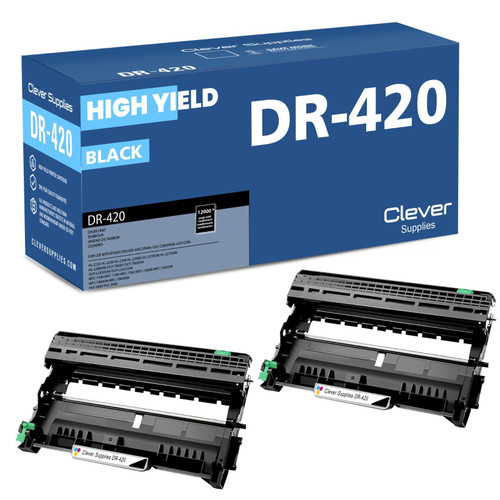
A drum on this platform is a once-in-years purchase, and it rarely fails at a convenient moment — the warning tends to surface in the middle of a print run the office actually needs. The pair answers that pattern directly: fit one drum now, and let its replacement wait in the cupboard instead of in a delivery van. For a single printer, that covers the foreseeable future of the machine. The deeper packs further down earn their place only where several of the fourteen models share one supply shelf, or where whoever orders supplies would rather think about drums once and then not again for a very long time.
Shop the 2-Pack →
The yardstick every other figure on this page is measured against, at about $2.21 per thousand rated pages. The straightforward buy when one printer needs one drum and nobody is stocking a shelf.
Shop the Single →
$15.80 per drum and about $1.32 per thousand pages. Suits two printers on staggered cycles — though note the box stops $1.59 short of the $49 free-shipping line when it travels alone.
Shop the 3-Pack →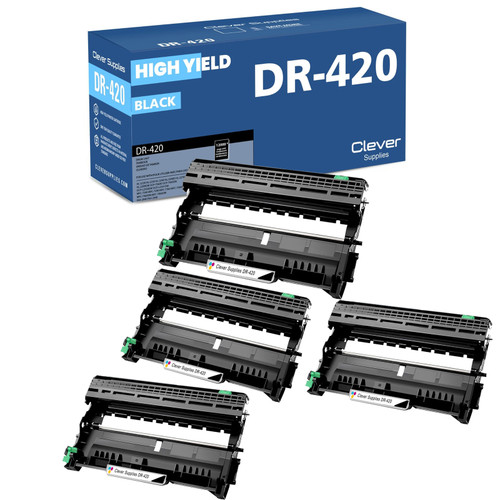
$14.47 per drum and about $1.21 per thousand pages. The first pack on the ladder that clears the $49 free-shipping line entirely on its own.
Shop the 4-Pack →
$13.66 per drum — the bottom step of the ladder, at about $1.14 per thousand pages. Deep stock for a row of machines, and it clears the free-shipping line by itself.
Shop the 5-Pack →A word about how many listings stand behind these five cards, because a search of this store turns up more DR420s than this page shows. The shelf has been listed repeatedly over the years: the single appears four times, the 2-pack three times, and each drum-and-toner set three times — and every copy of an offer is identical to its canonical in both price and stock count, down to the unit. One of the extra singles dresses itself in a “Premium / High Yield” name at the same $26.52; nothing distinct stands behind the name, because a drum has no yield tiers — Brother publishes exactly one rating for this part. Four of the duplicate listings also carry the words “Toner Cartridge” in their titles although the box holds a drum unit; that is flagged here, once, so the cards above can simply call the part a drum. The five carded listings are the same ones this store's TN450 guide already points to, and choosing among duplicates costs a buyer nothing either way.
The ladder on one page: price per drum, price per thousand pages
Every row is the identical DR420 under the identical Brother rating of about 12,000 pages; the only things moving are the count in the box and the per-unit price that comes with it. The last column measures each pack against buying that same number of drums one at a time.
| Offer | Pack price | Per drum | Cost per 1,000 pages | Against buying singles |
|---|---|---|---|---|
| 2-Pack — this page's pick | $36.97 | $18.49 | $1.54 | SAVE $16.07 |
| Single | $26.52 | $26.52 | $2.21 | The baseline |
| 3-Pack | $47.41 | $15.80 | $1.32 | SAVE $32.15 |
| 4-Pack | $57.86 | $14.47 | $1.21 | SAVE $48.22 |
| 5-Pack | $68.31 | $13.66 | $1.14 | SAVE $64.29 |
| Genuine Brother DR420, single (reference) | $140.33 | $140.33 | $11.69 | In stock here — Brother's own store sells it for $104.99 |
Notice where the steps flatten out. The jump from one drum to two does most of the work — the per-thousand figure drops by nearly a third — and each rung after that trims a smaller slice. Past the 2-pack, you are no longer really buying cheaper pages; you are buying fewer orders, fewer deliveries and a shelf that stays stocked. Price those things honestly and the right rung usually names itself.
Reading the page in front of you: which failures belong to the drum
Toner trouble and drum trouble announce themselves differently, and telling them apart before ordering is the cheapest diagnostic in printing. A cartridge that is running dry loses density: print washes pale, one side of the page fades ahead of the other, and taking the cartridge out for a gentle side-to-side rock buys a few more usable pages. A drum that is wearing out leaves marks instead: the same blemish turning up at the same spacing down successive sheets, a light gray film behind text that used to print on clean paper, bands repeated like a pattern rather than smeared like a spill. The test that settles the argument costs nothing — put in a cartridge you trust and print the offending page again. Whatever the fresh cartridge fixes was the cartridge. Whatever it leaves untouched, defect for defect, sits on the drum's surface, and swapping cartridges a second time will leave it there too.
The machine keeps the two supplies on separate counters, which is its own clue. A Replace Drum message is about the unit on this page, never about the cartridge clicked into it, and the drum counter runs on its own long clock — at Brother's ratings, roughly ten TN420 cartridges or four and a half TN450 cartridges pass through a printer in the span of one drum's life. That is why the drum warning so often surprises people: the cartridge has been changed many times since the drum was last thought about, and the two maintenance events have almost nothing to do with each other.
One step after the swap that owners routinely miss: the printer does not detect the new drum by itself. It counts pages against the old unit until someone tells it otherwise, so the drum counter has to be reset from the machine's own menu once the replacement is seated — Brother documents the exact key sequence for each model — or the display will keep reporting a worn drum that is no longer in the building. Reset the drum count only; the toner counter is a separate ledger and should be left exactly as it stands. And resist resetting the count on an old drum just to quiet the message: the counter will fall silent, the surface will not improve, and the repeating marks will go on arriving on their regular spacing.
Drum and toner in one box: the four matched sets on this platform
For the month when the drum warning and the low-toner warning land together, this store also boxes the two supplies as sets. Four shapes exist: a drum with a single TN450 cartridge at $34.03, a drum with two cartridges at $41.54, a drum with three at $49.05, and a two-drum, two-cartridge box at $51.99. All four are built on the TN450, the platform's 2,600-page tier — which is less of a restriction than it looks, because the store sells one physical cartridge under the TN420 and TN450 names at the same $23.59 single price, and the sets simply carry the high-yield name. They fit all fourteen printers on the roster alike, whatever a few of the duplicate set listings leave out of their fit text, and the toner side of this platform — the tiers, the pack ladder and the two-names-one-cartridge question — is compared in full in the Best Brother TN450 Toner guide. No savings arithmetic for the sets appears on this page; the drum ladder above is where this guide does its comparing.
Brother's own drum: on the shelf, in stock, and priced past Brother's counter
Unlike some families in this series, the genuine article here can actually be bought today: Brother's DR420 sits in this store at $140.33 with stock behind it. What also has to be said, in the same breath, is that Brother USA's own storefront sells the identical unit for $104.99 — so the genuine drum costs $35.34 more from this shelf than from its maker, and this page prints that comparison rather than leaving it for you to find. Set against the compatible single at $26.52 carrying the same published 12,000-page rating, the genuine unit runs to about five and a third times the price. The eight genuine toner-and-drum bundles built on this platform are stocked as well, running from $195.41 to $406.29.
What the premium purchases, when it is worth purchasing at all, is provenance: Brother's own part covered by the manufacturer's warranty, with returns closing 30 days after delivery. The compatible shelf above runs on different terms — a one-year warranty and a one-year return window from this store. Offices bound by a service contract that names genuine parts will read those two columns one way; everyone else can weigh a rated-identical drum at a fifth of the price and decide accordingly. Either way, the numbers on the table are the numbers as they stand, on both shelves.
Chips: the listings mutter about one — this guide declines to repeat it
Start from the part itself: a drum is the surface an image is formed on. It contains no toner, reports no level, and gives a chip nothing to measure — which is why this guide makes no chip claim for the DR420. That needs saying actively in this family, because some of the store's own listings gesture the other way. The word “chip” surfaces five times across the family's twenty-one compatible descriptions, and every instance is the same inherited boilerplate: a parts-list line in the carded pack listings themselves that ends with the words “a smart chip,” and, in one listing, a sentence about tracking “ink levels” — on a monochrome laser drum that holds no ink. No listing in the family carries any chip specification, and template text copied from listing to listing is not evidence of a fitted part, so none of it is repeated here as fact. The one statement that can be put on the record belongs to Brother, from its published support answers, and it is the same sentence carried across this store's Brother guides: “Brother firmware updates do not block the use of third-party ink and toner cartridges in our machines.” Beyond that sentence this page promises nothing about recognition and forecasts nothing about firmware, because nothing further has been established for this family.
What stands behind the compatible offers
Five checks to run before a DR420 goes in the cart
Questions owners of this platform ask about the drum
The drum unit — the part this page prices. Drum and toner are separate supplies with separate counters on these machines, and the drum's clock runs far longer: roughly ten TN420 cartridges, or about four and a half TN450 cartridges, pass through the printer during one drum's rated life. A young cartridge sitting in an old drum is the normal state of affairs when the message arrives, not a contradiction.
Brother rates it at about 12,000 pages and attaches a condition in its own wording: drum yield is approximate, and may vary by type of use. Long jobs, heavy coverage and frequent short runs all move the real figure. Note that drums carry no ISO yield standard the way the platform's toner cartridges do — the 12,000 is Brother's published rating with Brother's published caveat, and that is how this page quotes it.
The same drum. That listing and the standard single are the identical part at the identical price, down to the same stock count, and a drum cannot come in a high-yield variant in the first place: Brother publishes one rating for the DR420, and every unit carries it. The shelf lists several offers more than once — singles four times over, the 2-pack three times — and this guide cards one canonical listing per offer, the same ones the TN450 guide points to.
Because that is where the shelf price stands: $140.33 here against $104.99 at Brother USA's own storefront, a gap of $35.34 that this page prints rather than smooths over. What the genuine price covers is Brother's own part under the manufacturer's warranty, with returns closing after 30 days; the compatible drums above carry this store's one-year warranty and one-year returns. Both columns are on the table — the choice between them is a judgment call, not a trap.
Almost certainly the counter reset. These printers judge drum life by a page tally, not by inspecting the unit, and the tally still belongs to the drum you removed until it is cleared from the machine's menu — Brother documents the sequence for each model. Clear the drum tally and only the drum tally; the toner keeps its own count and should be left untouched.
There is very little for firmware to act on: a drum holds no chip, tracks no level and identifies itself in no way — it is a surface, not a supply with electronics. Brother's published support position, quoted in full in the chip section above, is that its firmware updates do not block the use of third-party ink and toner cartridges. This guide makes no chip claim for the DR420 and adds no promise beyond Brother's own sentence.