




Some machines make you learn a whole supplies catalog. The WorkCentre PE16 is not one of them. Xerox built this compact mono laser around a single all-in-one cartridge, the 113R00667, and that one unit carries everything the print engine consumes: the toner, the developer and the photoreceptor drum all live inside the same housing, so a cartridge change renews the entire imaging path at once. The rating is 3,500 pages at 5% area coverage, and there is no second tier hiding behind it — no standard fill and high-capacity fill to compare, no drum sold on a separate line, nothing else on the reorder list. This store sells the cartridge in exactly two cartons, a single and a 4-Pack, and both listings describe the right cartridge with the right yield. What their copy gets wrong is the arithmetic: every saving and per-page figure in it is worked from a base price fifteen percent above what checkout charges. This guide keeps the shelf that simple, states the one-piece design plainly, and rebuilds the money at the sale prices buyers actually pay.
Short answer: the cartridge is the 113R00667, and the only decision is how many to keep on hand. A single costs $38.79 and runs about 1.11¢ a rated page; the 4-Pack costs $106.91, works out to $26.73 a cartridge and about 0.76¢ a page, and keeps a verified $48.25 against four singles bought one at a time. Postage splits the shelf: the single stops $10.21 short of the $49 free-shipping line, while the 4-Pack is the one carton that clears it alone. If your PE16 still seems to eat its first cartridge quickly, that is not a defect — the cartridge the machine shipped with was a 2,000-sheet starter, and every replacement is the full 3,500-sheet fill.
Order by the number on the cartridge you are taking out: if it reads 113R00667, either box on this page replaces it, because the PE16 accepts nothing else. A household or a desk that copies occasionally is served by the single at $38.79, ordered alongside anything else the office needs so the order crosses $49. A machine that faxes and copies every working day belongs on the 4-Pack at $106.91: the unit price falls by nearly a third, the postage question disappears, and three sealed spares wait in the cupboard. There is no third choice to weigh, no drum to add to the cart, and no higher-yield version to hold out for — Xerox never made one for this machine.
The flagship: the Single

This is the carton to buy when the machine prints a few days a week and a spare on the shelf would gather dust. Its own listing argues from the wrong tier — $44.61 a cartridge and about 1.27 cents a page — but checkout charges $38.79, which puts the honest page cost at about 1.11¢. The one caution is postage: at $38.79 the single sits $10.21 below the $49 free-shipping line, so it rewards being paired with the next office order rather than shipped alone. Fitted in minutes through the front of the machine, it is the full 3,500-sheet running fill, noticeably longer-lived than the 2,000-sheet starter the PE16 arrived with.
See the SingleThe rest of the shelf: one more box
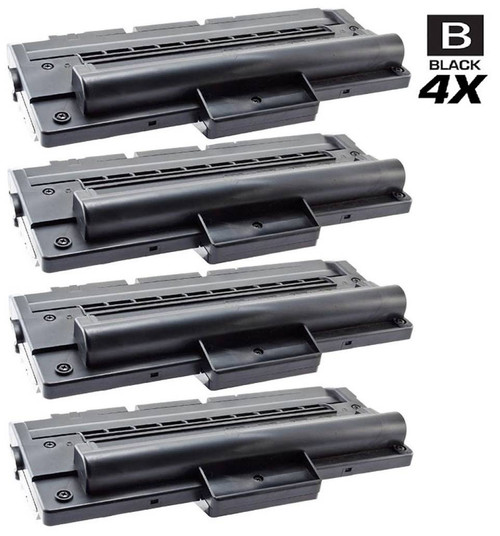
Four singles at the sale price would total $155.16; this pack is $106.91, so the verified saving is $48.25 — not the $55.49 the listing claims from its $122.95 base figure, and not the $30.74 a cartridge or 0.88 cents a page it derives from that figure. At the price checkout charges, each cartridge inside the pack costs $26.73 and the page rate falls to about 0.76¢. The four units are identical, so rotation is simple housekeeping: open one, keep the other three sealed, and work through them first in, first out. For a PE16 anywhere near its recommended monthly volume, this is the economical way to own the machine.
See the 4-PackBoth boxes, priced at what checkout charges
Two rows are the whole comparison, because two boxes are the whole shelf. Every figure below is worked from the sale price; the saving in the last column is measured against singles bought one at a time at the charged single price of $38.79.
| Box | What’s inside | Sale price | Per cartridge | Cost per rated page | Saving vs singles |
|---|---|---|---|---|---|
| Single | 1 × 113R00667 | $38.79 | $38.79 | ≈1.11¢ | — |
| 4-Pack | 4 × 113R00667 | $106.91 | $26.73 | ≈0.76¢ | $48.25 |
One cartridge, one piece: how this platform is built
Most laser printers split their consumables in two. Toner sits in one unit and the imaging drum in another, each with its own rating, its own price and its own moment to fail, and the owner is left tracking two countdowns that never agree. The PE16 was designed the other way. Xerox’s brochure describes the supply as an all-in-one cartridge, toner and photoreceptor together, and the service documentation spells the construction out: the cartridge contains the OPC drum, the developer and the toner components in one unit. The drum your pages are imaged on is not a fixture of the machine. It is part of the cartridge, it arrives fresh with every replacement, and it leaves with the empty.
That single decision shapes everything about owning this machine. There is no drum to order, because none exists as a separate part. There is no drum life to monitor, no drum reset to perform, and no second purchase waiting a few cartridges down the road. When print quality eventually softens near the end of a cartridge — the faint background shading and tired solids that on a two-piece machine send owners shopping for a drum — the remedy here is simply the next cartridge, which renews the imaging surface along with the toner. The user guide’s own maintenance routine makes the same point from the other direction: its drum-cleaning procedure cleans the OPC drum of the cartridge, because the cartridge is where the drum lives.
The rest of the machine’s wear items underline how complete that arrangement is. The feeder rubber, the document roller and the fuser all carry service replacement cycles in Xerox’s documentation, measured in tens of thousands of pages, and all of them are technician parts rather than supplies an owner reorders. For the person standing at the machine, the 113R00667 is the only consumable there is: it loads from the front, it is the single line on the reorder list, and when it is spent the whole imaging path starts over. A received fax, a photocopy and a document sent from a computer all come off the same drum and the same toner supply inside that one unit, which is why this guide spends no space on drum compatibility, drum pricing or drum warnings. On this platform there is nothing to be compatible with.
It also explains the shape of the shelf. A two-piece platform needs a guide that weighs toner against drums and standard fills against high-capacity ones. The PE16 needs none of that scaffolding. One cartridge design, one rating, two carton sizes — the buying question collapses to how far ahead you want to stock, and the sections below take that question and the yield behind it in turn.
The yield, stated the way Xerox states it
The 113R00667 is rated at 3,500 pages at 5% area coverage. That wording is deliberate, and it is Xerox’s own: the PE16 brochure prints the estimate as 3,500 at 5% area coverage, and Xerox’s Commercial Price List effective April 1, 2015 carries the same figure on the cartridge’s line, with 5% in the coverage column. Five percent coverage is the light, text-like page the industry has long used as its yardstick — a typical letter or memo, mostly white space. Pages heavier than that, with dense tables, shaded forms or large solid areas, draw more toner and return fewer pages; pages lighter than that return more. The rating is a measuring stick for comparing cartridges, not a promise about any particular stack of work.
One absence is worth stating plainly, because buyers comparing across brands will notice it. Xerox declares no ISO/IEC yield for this cartridge. That is a documented fact rather than a gap in the research: the same April 2015 price list prints an ISO/IEC standard in the coverage column for other cartridges, and for the 113R00667 it prints only the 5% figure. The platform dates from 2003, before Xerox applied that declaration practice to this class of machine, and its service documentation measures toner life against the older IDC 5% test pattern instead. So the honest comparison basis for this cartridge is the one printed everywhere Xerox mentions it — 3,500 pages at 5% coverage — and this guide uses exactly that basis, no more and no less.
The other yield figure an owner meets is the one that causes the most confusion, and it belongs to the machine’s first cartridge rather than to any replacement. Xerox’s service documentation rates the initial cartridge shipped with the PE16 at 2,000 sheets, against 3,500 sheets for the running cartridge you buy thereafter. A starter fill is a deliberate economy: it gets a new machine working while keeping its shelf price down, and it is spent sooner by design. If your PE16 seemed to run dry surprisingly early in its life, that arithmetic is the explanation, and it will not repeat — every 113R00667 fitted since, including both boxes carded above, is the full 3,500-sheet fill.
Set against the machine’s recommended volume, the rating plans easily. Xerox suggests 500 to 1,500 pages a month for the PE16, within a duty ceiling of 10,000. At 500 pages a month a single cartridge lasts about seven months; at 1,000 a month, about three and a half; at the top of the recommended band, a little over two. A 4-Pack therefore covers roughly eight months of heavy recommended use and well over two years of light use, which is why the pack is a stocking decision rather than a bulk gamble: the cartridges wait sealed, and the platform asks nothing else of you in the meantime.
Which box: the only decision on the shelf
With one cartridge and two cartons, the choice is a forecast about your own habits. Choose the single if the PE16 is a secondary machine — a home desk that copies tax paperwork in April and prints a few letters a month otherwise, or a small office where the main printing happens elsewhere. At that pace a cartridge lasts the better part of a year, a shelf of spares ties up money for no benefit, and the $38.79 single keeps the cost of each replacement as low as a single order can be. Pair it with paper or the next office supply run so the combined order passes $49 and the postage disappears; ordered entirely alone, it stops $10.21 short of that line.
Choose the 4-Pack if the machine works every day. A PE16 that receives faxes, copies forms and prints correspondence at anything near its recommended volume works through a cartridge every two to three months, and at that rhythm the pack’s arithmetic is hard to argue with: $26.73 a cartridge instead of $38.79, about 0.76¢ a page instead of about 1.11¢, and $48.25 kept across the life of the pack. It is also the only carton that ships free standing alone, and it removes the small but real risk of an empty machine on a deadline morning — the next cartridge is already in the building. Storage asks little: keep the spares sealed in their bags, flat, cool and out of direct light, open them one at a time, and take them in the order you bought them.
The genuine cartridge frames the value of both. On Xerox’s Commercial Price List effective April 1, 2015, the genuine 113R00667 was priced at $109.99 — a dated figure, quoted with its date because it belongs to that list and no other. Against it, the compatible single at $38.79 costs a little over a third of the genuine price for the same rated 3,500 pages and the same one-piece design, and the 4-Pack’s $26.73 unit cost is under a quarter. Buyers who keep a PE16 running in 2026 are usually doing so because the machine still earns its place; at these prices, feeding it costs less per month than the paper it prints on.
The machine behind the cartridge
The WorkCentre PE16 is a mono laser multifunction machine from the early 2000s: it prints, copies, scans and faxes from one compact body, at 17 pages per minute on Letter paper and 16 on A4, with output at 600 by 600 dpi. Paper feeds from a 250-sheet main tray with a single-sheet bypass for odd stock, and a 30-sheet automatic document feeder sits on top for copying and faxing multi-page originals. Xerox rates the duty cycle at up to 10,000 pages a month and recommends 500 to 1,500, a band that describes its natural habitat exactly — a small office, a front desk or a home workspace with steady but human-scale paperwork. Connection is of its era: USB and a parallel port, with no network interface, so the PE16 serves the desk it sits on rather than a whole floor.
A word about the name, because the store’s filing differs from the maker’s. Every Xerox document for this machine — brochure, user guide, service manual and price list alike — calls it the WorkCentre PE16, and Xerox’s support site styles the product WorkCentre PE16/i, covering the PE16i variant under the same page. This guide follows Xerox and uses that name throughout; the machine’s own category in this store, where both boxes also live, can be browsed as the WorkCentre PE16 category. The naming matters for one practical reason: searching or ordering by the cartridge code sidesteps every version of the name, which is why the label check below comes first.
Documented background, offered as background only: the PE16’s service manual is shared with the Samsung SCX-4216, and the platform underneath the Xerox badge is Samsung-built, controller and print language included. That kinship explains the machine’s manners but changes nothing about supplies. Xerox assigns the 113R00667 to the PE16, that assignment is what this store sells against, and this guide makes no claim that the cartridge fits the Samsung machine or any other. Order the Xerox code for the Xerox machine, and the shared ancestry stays what it is — an interesting footnote in the service literature.
Living with a one-piece machine, day to day
The one-piece design is easiest to appreciate in the small moments of a working week. A fax arrives overnight, a colleague copies a form at nine, a letter prints at noon, and all three jobs draw on the same cartridge, the same drum surface and the same toner supply. There is no print cartridge for one function and a copy cartridge for another, and no way for one side of the machine to be fresh while the other is worn. When output quality is good, it is good across everything the machine does; when it begins to tire, it tires evenly, and the single remedy — a new cartridge — restores all of it at once.
Judging when that moment has come is a matter of watching the pages rather than a gauge. The PE16 keeps a count of toner use, but Xerox’s documentation is explicit that the machine carries no toner level sensor, so there is no remaining-life percentage to consult and no warning light that measures what is left. The honest signals are the familiar ones: text that prints a shade lighter than it did, solids that lose their depth, copies that come off the glass looking washed at the edges. Those signs arrive gradually over the last stretch of a cartridge’s life, and because the drum is part of the same unit, they never mean a second fault to diagnose. Light print on this platform means the cartridge is nearing its end — it does not mean the machine is.
The swap itself matches the design’s simplicity. The cartridge loads from the front of the machine: open the front cover, lift the spent unit out, rock the replacement gently from side to side so the toner settles evenly through it, seat it until it clicks home, and close the cover. No tools, no alignment routine, no second unit to disturb. The user guide’s drum-cleaning procedure is worth knowing about for the same reason — it runs a cleaning cycle for the drum inside the cartridge, and it is the correct first response to the specks and background shading that a dusty week can leave on copies, long before the cartridge itself is spent.
Owners who plan around the rating rather than the gauge get the calmest service from the machine. Note the date each cartridge goes in, and the first one teaches you your own pace: a desk that fitted a cartridge in January and replaced it in August owns a seven-month rhythm, whatever the rated figures say, and can time a 4-Pack order to land a spare in the cupboard a month before it is needed. On a platform with exactly one consumable, that single habit is the whole of supplies management.
Keeping a 2003 platform supplied in 2026
A machine of the PE16’s vintage survives for practical reasons. It asks little: no network to configure, no account to sign into, no supplies ecosystem to learn. It sits on a desk, answers the phone line, copies the form and prints the letter, and its appetite is one cartridge a few times a year. Owners keep machines like this because replacing them would buy features they do not need at the price of relearning a tool they already know. The risk in keeping older hardware is rarely the machine itself; it is the supply line drying up, or growing so complicated that feeding the printer becomes a chore of its own.
That is where the one-piece, one-code design pays its second dividend, decades after it was drawn. A platform with a single cartridge cannot strand its owner between a toner that is still sold and a drum that is not, and it cannot be orphaned by a tier being discontinued while its sibling lingers. There is one number to remember, one label to check and one shelf to reorder from, and the two boxes on this page are that shelf in full. Stocking a year ahead is a single 4-Pack decision rather than a basket of parts, and the sealed spares ask nothing while they wait — no rotation schedule beyond first in, first out, and no expiry anxiety beyond keeping them cool, flat and out of the sun.
The monthly cost of that arrangement is worth stating in the plainest terms the figures allow. At the top of Xerox’s recommended band, 1,500 pages a month, the 4-Pack’s rate of about 0.76¢ a page puts toner at roughly eleven dollars a month; at a gentler 500 pages, under four. Even the single, at about 1.11¢ a page, keeps a hard-working PE16 fed for well under twenty dollars a month. Few machines of any age run cheaper, and none run simpler: one cartridge, one code, and a choice between buying it one at a time or four at a time.
Before you order: the short checklist
Questions buyers ask about the 113R00667
Which cartridge does my WorkCentre PE16 take?
The 113R00667, rated at 3,500 pages at 5% area coverage. It is the only cartridge Xerox made for the PE16, so there is no version of the machine — including the PE16i covered under Xerox’s WorkCentre PE16/i support naming — that takes anything else. If the label on the cartridge you removed reads 113R00667, both boxes on this page are its replacement.
Is there a high-yield version I should hold out for?
No. Xerox’s price list carries exactly one PE16 cartridge line, and the listings’ own copy agrees that no high-yield variant exists. Some platforms split their range into a standard fill and a larger one; this one never did. The choice on this shelf is purely how many of the same cartridge to buy at once — one, or four at a lower unit price.
Do I need to buy a drum separately?
No, and there is none to buy. The PE16’s cartridge is a one-piece unit holding the toner, the developer and the OPC drum together, so every cartridge change installs a fresh imaging surface along with fresh toner. No store sells a PE16 drum because Xerox never made one as a separate part; the wear items beyond the cartridge are service parts fitted by a technician, not supplies.
Why did my first cartridge run out so much sooner?
Because it was a starter. Xerox’s service documentation rates the initial cartridge shipped with the machine at 2,000 sheets, while the running cartridge is the 3,500-sheet fill. The short first life is built into the platform’s pricing, not a sign of a fault, and it happens once: every replacement 113R00667, single or from the 4-Pack, carries the full rating.
How was the 3,500-page yield measured?
At 5% area coverage — the light, text-like page used as the yardstick in Xerox’s brochure and its April 1, 2015 price list, where the figure appears with 5% in the coverage column. Xerox declares no ISO/IEC yield for this cartridge; the same list prints that standard for other codes, which is how the absence is known. Heavier pages than the yardstick return fewer sheets, lighter pages more.
The platform is Samsung-built. Can I order Samsung cartridges instead?
This guide makes no such claim. The shared service manual documents that the PE16 and the Samsung SCX-4216 rest on the same platform, but supplies follow the badge: Xerox assigns the 113R00667 to the PE16, and that is the cartridge sold here for it. Order by the code on your outgoing Xerox cartridge rather than by the platform’s ancestry.
My copies are coming out light. Is the drum worn out?
On this machine the question answers itself differently than on a two-piece printer: the drum is inside the cartridge, so a tired imaging surface and a low toner supply are the same event with the same cure. Try the user guide’s drum-cleaning cycle first if the pages show specks or background shading. If the print is simply fading evenly, the cartridge is nearing the end of its fill, and replacing it renews the drum along with the toner.
How do I know how much toner is left?
By the pages, not by a gauge. Xerox’s documentation records that the machine counts toner use but carries no level sensor, so there is no percentage readout to trust. Watch the output instead: when text lightens and solids lose depth across print, copy and fax alike, the cartridge is in its last stretch. Keeping one sealed spare — or a 4-Pack in the cupboard — turns that judgment call into a two-minute swap.
How long should I store the spare cartridges from a 4-Pack?
Sealed, flat and patient. Open one cartridge, install it, and leave the other three in their bags, stored flat in a cool place out of direct light. Work through the pack first in, first out, opening the next unit only when the installed one begins to fade. Handled that way, the last cartridge in the pack prints like the first on the day its turn comes.
How this guide was put together
Everything above rests on two bodies of evidence: the store’s own listings, read in full, and Xerox’s published documents for this platform — the PE16 brochure, the Commercial Price List effective April 1, 2015, the service manual and the user guide — which between them settle the one-cartridge range, the 3,500-page rating at 5% area coverage with no ISO/IEC yield declared for this code, the 2,000-sheet starter rating, the one-piece construction with the photoreceptor inside the cartridge, the machine’s speeds and volumes, and the roster under Xerox’s own name, WorkCentre PE16, with the PE16i covered by the support styling WorkCentre PE16/i. The census for this family counts two listings, and no MICR variant exists among them or anywhere in Xerox’s documents for this platform, so there is nothing of that kind to card, link or price here; the two fold into the two boxes carded above, each carded once under its canonical posting. The judgment calls are recorded. First, naming: the guide follows Xerox’s name for the machine throughout and treats the cartridge code as the ordering key. Second, money: every price printed here is the sale price checkout charges, and because the listings compute from a higher base tier, the saving, per-cartridge figures and per-page costs were recalculated from the charged amounts; the one saving on a badge, $48.25 on the 4-Pack, is exact at those prices. Third, the genuine benchmark: the only genuine figure quoted carries its date — $109.99 from the list effective April 1, 2015. Fourth, two silences kept deliberately: no internal service figure beyond the documented starter and running ratings is printed, and no recognition or level-sensing claim of any kind is made, because the platform’s documentation supports none.