




Three tiers on Xerox’s ladder — and only one of them is sold here
Xerox’s Detailed Specifications for this platform (document VC7SS-01CG) lay out three capacity tiers, not the standard-versus-high split the Phaser shelves taught buyers to expect. In fact no standard-capacity tier exists for these machines at all. The full ladder:
| Tier | Black | Cyan | Magenta | Yellow | Yield basis | Sold here? |
|---|---|---|---|---|---|---|
| High Capacity — this guide | 106R03741 — 16,100 pages | 106R03744 — 9,800 pages | 106R03743 — 9,800 pages | 106R03742 — 9,800 pages | ISO/IEC 19798 declared | Yes — the six boxes below |
| Extra-High Capacity | 106R03737 — 23,600 pages | 106R03740 — 16,500 pages | 106R03739 — 16,500 pages | 106R03738 — 16,500 pages | ISO/IEC 19798 declared | No — not stocked |
| Metered | 106R03733 — 22,000 pages | 106R03736 — 15,000 pages | 106R03735 — 15,000 pages | 106R03734 — 15,000 pages | 5% coverage — not ISO-declared | No — Xerox contract channel only |
Read the basis column carefully, because it inverts the pattern of the Phaser families. There, the stocked cartridges rested on a bare 5%-coverage footnote and the declaration was missing. Here the footnote in Xerox’s spec sheet reads, verbatim: “Average standard pages. Declared Yield in accordance with ISO/IEC 19798. Yield will vary based on image, area coverage and print mode.” That declaration covers both the High Capacity tier sold here and the Extra-High tier above it. The one rung measured the looser way — the Metered tier, on a 5%-coverage basis — is the rung nobody can buy off a shelf: Xerox supplies it only under metered contracts. So the figures in this guide are quoted with their declaration attached: black 16,100 pages, each color 9,800.
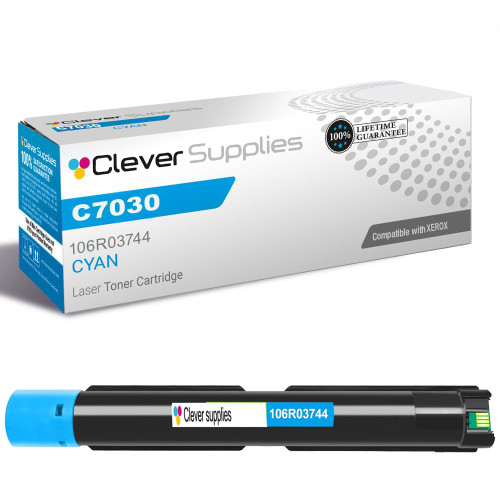
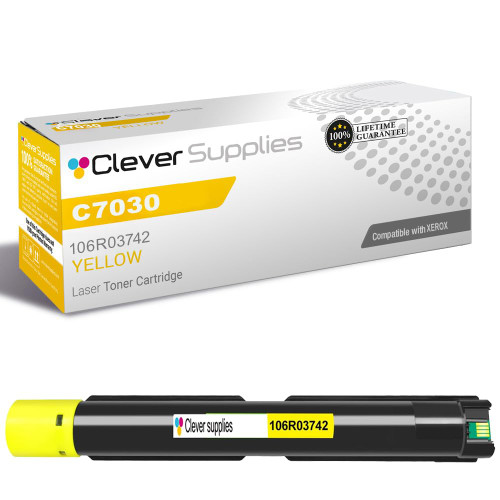
Now the trap in the numbering. The four codes ascend 741, 742, 743, 744, and the colors do not ascend with them: 106R03741 is black, 106R03742 is yellow, 106R03743 is magenta and 106R03744 is cyan. A buyer who assumes the Phaser order — black, cyan, magenta, yellow — and orders “the 742” for a cyan warning will receive a yellow cartridge. Every card below prints the color beside the code, and the safe habit on this platform is to order by the two together.
Two fences deserve a paragraph of their own. The Extra-High and Metered codes above are genuine Xerox tiers for these machines, but this store stocks neither, so nothing in this guide cards or links them. Beyond them, two code ranges circulate that are not tiers of this platform at all: 106R03764–106R03768, sold elsewhere as “standard capacity”, belong to a different and smaller machine, the A4 VersaLink C7000 printer, which shares part of the name and none of the hardware; and 106R03745–106R03752 are regional codes that appear in no Xerox US documentation for the C7020, C7025 or C7030. A cartridge wearing any of those numbers is not a rung missing from the table — it is a different shelf’s stock.
Toner is not the platform’s only consumable, and the two wear parts are worth naming even though this store sells neither. A single drum part, 113R00780, serves all four drum positions, rated by Xerox at about 109,000 pages in the black position and about 87,000 in each color position. The waste toner bottle, 115R00128, is rated at 30,000 pages — the shortest clock in the machine, and the first wear item a busy office will meet. Both are platform context only: no box below contains one, and each is a separate purchase to plan when its turn comes.
Two figures this guide deliberately does not print. The first is a starter yield: Xerox’s spec sheet and user guide state none for the cartridges these machines ship with, and dealer pages found online contradict one another, so there is no verified number to give. The second is a genuine Xerox price. No dated Xerox price list covering this family could be verified, and Xerox no longer sells the cartridge through its own shop, so no genuine figure appears anywhere in this guide.
Exact yields, base-price money, and a saving nobody claimed
Begin with what is right, because on yields this shelf is exemplary. All twenty-four listings claim precisely Xerox’s figures — black 16,100 pages, each color 9,800, the Black 2-Pack 32,200 — with no inflation, no borrowed sibling rating and no contradiction between a listing’s headline and its own spec block. After families whose black yields had to be corrected in two directions at once, a shelf that needs no yield correction at all is worth saying out loud: the page counts on the listings can be trusted as printed.
The money is another matter. Every rate in the copy is computed at the base price, the tier above what checkout charges (the charged price is the base divided by 1.15). The black single advertises “about 0.73 cents per page”, a figure struck from its $118.14 base; at the $102.73 actually charged, the rate is 0.64 cents. The color singles quote “about 0.97 cents per page” from a $95.14 base; charged $82.73, the true rate is 0.84 cents. The Black 2-Pack’s copy is the fullest example, and it deserves quoting whole: “Two single cartridges bought separately would cost $236.28; this pair is $217.79, which saves $18.49 and drops the per-cartridge price to $108.89 … about 0.68 cents per page instead of 0.73.” Every number in that sentence is a base-tier number. At charged prices the two singles cost $205.46, the pair is $189.38, the saving is $16.08, the cartridge is $94.69 and the rate is 0.59 cents a page. The direction of the copy’s claim survives — the pair really is cheaper — but each figure in it is overstated by the same 15 percent.
The flagship makes the opposite mistake: it understates. The 4 Color Set’s copy claims no saving at all, so a reader comparing its $302.68 against four singles has to do the sum unaided. Done at charged prices, the four singles total $350.92 and the set saves $48.24 — the largest saving on the shelf, hiding in a listing that never mentions it. The badge on the set’s card below is this guide’s computation, printed because the set’s contents are fully disclosed in its copy, one cartridge of each of the four codes.
The compatibility copy is as clean as the yields. Every listing names all three models, no listing swaps a color or invents a suffix variant — the platform has none to invent — and no listing carries drum-cartridge boilerplate pasted onto a toner page, a defect that disfigured three earlier Xerox families and simply does not occur here. The listings are also silent in two places where other families’ copy speaks. No ISO claim of any kind appears in them: the ISO/IEC 19798 declaration quoted in this guide comes from Xerox’s own spec-sheet footnote, not from store copy — indeed the only ISO letters anywhere in the twenty-four descriptions hide inside the word “comparison”. And no feed fields support the listings from behind: MPN, GTIN and UPC are blank on all twenty-four, a step beyond the Phaser families, which at least carried UPCs.
Last, the duplication itself — and here the store’s own copy says it best. Twenty-four listings present six boxes, each box posted four times under a short C7030 title and the three model names. The yellow cartridge’s own FAQ concedes the arrangement with a candor the guide is happy to mirror: “It is one and the same product wearing two shop windows … listed both ways. Whichever listing you order from, the box that arrives holds the same compatible yellow cartridge.” Prices and inventory agree across each box’s four postings, so the duplication costs a buyer nothing but reading time — which the six cards below are meant to save.
The full shelf: six boxes, twenty-four listings
Six boxes carry the whole family. Order through the posting carded for each box and the fourfold duplication stops mattering — the same cartridge, at the same price, arrives either way. Figures are November 2026 charged prices, and per-page rates divide by Xerox’s declared yields: black 16,100 pages, each color 9,800.
| Box | Contents | Price charged | Each cartridge | Per rated page | Free shipping on its own? |
|---|---|---|---|---|---|
| 4 Color Set | Black, cyan, magenta and yellow, one apiece | $302.68 | $75.67 avg | ≈0.67¢ blended | Yes — clears by $253.68 |
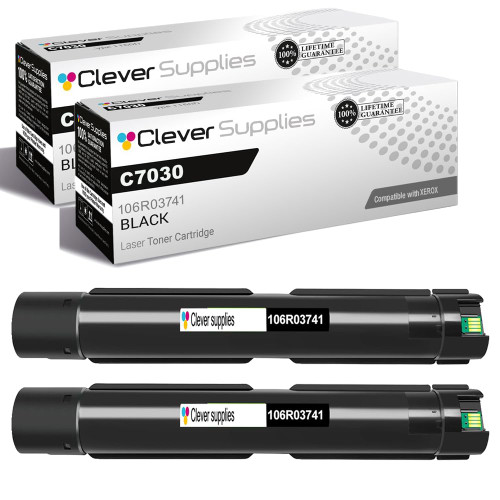
| Black single | 1 × 10⁶R03741 black | $102.73 | $102.73 | ≈0.64¢ | Yes — by $53.73 |
| Cyan single | 1 × 10⁶R03744 cyan | $82.73 | $82.73 | ≈0.84¢ | Yes — by $33.73 |
| Magenta single | 1 × 10⁶R03743 magenta | $82.73 | $82.73 | ≈0.84¢ | Yes — by $33.73 |
| Yellow single | 1 × 10⁶R03742 yellow | $82.73 | $82.73 | ≈0.84¢ | Yes — by $33.73 |
| Black 2-Pack | 2 × 10⁶R03741 black | $189.38 | $94.69 | ≈0.59¢ | Yes — by $140.38 |
Reading the last column: it is the least interesting column this guide series has printed, and that is a compliment. Every box clears the $49 free-shipping line unaided, the cheapest by $33.73, so no order on this shelf is ever shaped by postage. The decisions below are purely about which bays are low and how deep the black stock should run.
Six boxes, each on its own numbers



Picking a box: the restock, the black reserve, or a single warning light
When the supplies screen shows several bays low together, the 4 Color Set is the order: $302.68 against $350.92 for the same four cartridges bought one at a time, with the saving — $48.24 — computed here because the set’s listing never computes it. Four postings sell the box; the CS posting carded above is the audited one, and since prices and stock agree across the four, choosing it is a matter of tidiness rather than money.
Black deserves its own rule, because on a document machine black is the bay that empties on a schedule while the colors empty on occasions. The Black 2-Pack drops the cartridge from $102.73 to $94.69 and the page rate from 0.64 to 0.59 cents, and its real product is continuity: the second cartridge sits sealed beside the machine, so a toner-low warning becomes a two-minute swap instead of a purchase order. Offices that print mostly text and reorder rarely should treat the pair, not the single, as the default black buy. One caution: at ten counted units it is the thinnest-stocked box on the shelf, so the reserve habit is worth starting while it is available.
Singles answer the single warning light — one color fading while the rest hold. All three colors cost the same $82.73 and rate the same 9,800 pages, so the only way to order a color wrong is by its number: yellow is 106R03742, magenta 106R03743, cyan 106R03744. Read the code off the empty cartridge’s label, match it against the card, and the trap closes. Yellow’s forty-six counted units are the deepest stock here; no color is in short supply.
What never enters the decision is postage. On shelves where small boxes fall short of the $49 free-shipping line, order composition gets tactical; here the cheapest box clears the line by $33.73 and the flagship by $253.68, so a lone single costs exactly its sticker and nothing more. Buy the box the machine is asking for, in the quantity the office burns.
Day to day: long toner clocks, and a waste bottle that runs out first
Toner moves slowly on this platform, and planning can move with it. Set Xerox’s recommended volumes against the declared yields: a C7030 working at its full 7,000-page monthly recommendation burns through a black cartridge in a little over two months, while a C7020 at 5,500 pages a month stretches the same cartridge toward a quarter. The colors, at 9,800 pages each, drain in proportion to coverage rather than volume — a reports-and-spreadsheets office may see a year from a color set, while a marketing team printing its own collateral will meet the cyan warning far sooner. Note the page counter at every swap; two or three cycles of your own numbers will tell you more than any rating printed on a box.
The wear parts run on longer clocks, but not equal ones. The waste toner bottle, rated at 30,000 pages, is the first to come due — at recommended volumes, somewhere inside the first year — and it is the item new owners most often fail to anticipate, because no toner box contains one and this store does not sell one. The drum part 113R00780 runs far longer: roughly 109,000 pages in the black position and 87,000 in each color position, which at these volumes is a matter of years, not months. Neither part is carded or linked here; learn where the bottle lives and what its warning looks like before the machine teaches you during a deadline.
Working habits that suit the platform: reorder any color on its warning rather than its empty message — the magenta listing’s advice, and doubly right for cyan, whose empty state pauses color work and holds the queue. Keep the black reserve sealed until the swap, store spares flat in a cool, dry cupboard away from sunlight, and when a cartridge comes out, write its final page count on the carton before it goes: that small archive is what turns Xerox’s declared yields into your office’s measured ones.
The terms behind the six boxes
Each cartridge carded above is a Clever Supplies compatible made for the VersaLink C7020, C7025 and C7030. Coverage runs a year for warranty and a year for free returns; support answers on weekdays between 9 AM and 5 PM CST; shipments leave warehouses in Illinois, Pennsylvania, Georgia and California. Orders reach free shipping at $49 — a threshold every box on this shelf passes by itself, the least expensive by $33.73.
Running a VersaLink C7020, C7025 or C7030 without surprises
Questions VersaLink C7020, C7025 and C7030 buyers ask
Which cartridges fit my machine?
Four High Capacity codes, one per bay: 106R03741 black, 106R03742 yellow, 106R03743 magenta and 106R03744 cyan. The same four serve all three models — C7020, C7025 and C7030 differ only in print speed and duty rating, and their cartridge bays are identical. There are no suffix variants of these machines to match against, so if your printer carries one of the three badges, these are its cartridges.
Why doesn’t the code order follow the colors?
Because Xerox numbered the tier in its own table order, not in the black-cyan-magenta-yellow sequence the Phaser shelves use. Here 106R03742 is yellow and 106R03744 is cyan, with magenta at 106R03743 between them. The listings themselves get the assignment right in every posting; the risk is purely on the buyer’s side, ordering from memory. Read the code off the empty cartridge and match both the number and the color name on the card before ordering.
Are these yields declared under the ISO standard?
Yes. The supplies footnote in Xerox’s Detailed Specifications for this platform states that the yields are “Declared Yield in accordance with ISO/IEC 19798”, and that footnote covers the High Capacity tier sold here and the Extra-High tier above it. The store’s listings never mention the declaration — they simply print the figures, correctly — so the authority for the claim is Xerox’s document, quoted in the codes section above. The platform’s Metered tier is the exception: it is rated on a 5%-coverage basis and is sold only under Xerox contracts.
What about the Extra-High and Metered cartridges?
They are real Xerox tiers for the same machines. Extra-High (106R03737–106R03740) raises black to 23,600 pages and the colors to 16,500, also ISO-declared; Metered (106R03733–106R03736) sits between them on a 5%-coverage basis and moves only through Xerox’s metered supply contracts. This store stocks neither tier, so neither is carded or linked here. If your machine runs under a supplies contract, its cartridges come through that channel; for everyone buying outright, the High Capacity shelf above is the whole market this store offers.
Why do the listings’ per-page figures differ from this guide’s?
Because the listings divide by their base prices and checkout charges less — the charged price is the base divided by 1.15. The Black 2-Pack shows the whole pattern in one sentence: its copy prices two singles at $236.28 and claims a saving of $18.49, where the charged figures are $205.46 of singles and a $16.08 saving. The same 15 percent runs through the singles’ per-page rates — 0.73 cents claimed for black against 0.64 charged, 0.97 claimed for the colors against 0.84. Every rate in this guide is recomputed from the charged price, so the two sets of numbers differ by exactly that tier.
Does the machine need anything besides toner?
Two wear parts, on much longer clocks. One drum part, 113R00780, covers all four drum positions and is rated at roughly 109,000 pages for black and 87,000 for each color. The waste toner bottle, 115R00128, fills at about 30,000 pages and will come due first. This store sells neither part, and no toner set here contains one — a set refreshes toner only. Both are named so their warnings can be planned for rather than met as surprises; when the bottle or a drum calls, it is a separate supply decision of its own.
How this guide was assembled
This guide rests on the store’s own catalogue and on one Xerox document. The catalogue side: twenty-four listings under these four codes, resolving into six physical boxes posted four times apiece — once under a short C7030 title and once under each model’s name — with each box carded once, under the CS posting whose figures were audited. The yellow listing’s FAQ describes that duplication itself. The Xerox side is the Detailed Specifications for the VersaLink C7020/C7025/C7030 (VC7SS-01CG), which supplies the three-tier ladder, the color assignment, the ISO/IEC 19798 footnote, the model speeds and duty ratings, and the drum and waste-bottle ratings. Where the two sources could be checked against each other, the yields agreed exactly, so no yield in this guide corrects a listing. Money is handled the other way: prices are November 2026 charged amounts, and because listing copy reckons from a higher base tier, every saving and per-page rate was recomputed from the charged figure — including the 4 Color Set’s $48.24, which its own listing never claims and which is printed here because the set’s contents are fully disclosed. Two absences are deliberate. No genuine Xerox price is quoted, because no dated list covering this family could be verified and Xerox no longer sells the cartridge directly. And no starter-cartridge yield is printed, because Xerox’s documents state none and the dealer figures found online contradict one another. The drum and the waste bottle appear as platform context only: neither is sold in this family, and nothing in this guide links to them. Stock figures are November 2026 counts; all six boxes carried counted stock, the Black 2-Pack thinnest at ten and the yellow single deepest at forty-six.