




Thirty-four listings serve this small mono platform, and behind them sit just five boxes — every one of them black. The puzzle on this shelf is not the count but the codes. Xerox sells two cartridges for these machines: a Standard Capacity cartridge, 106R02775, rated at 1,500 pages, and a High Capacity cartridge, 106R02777, rated at 3,000. In this store both singles ring up at the same $28.59, so the smaller cartridge costs exactly as much as the one holding twice the toner. Stranger still, a run of the store’s own listings insists the two codes are a single supply wearing two labels — a claim Xerox’s own platform brochure contradicts on its supplies page. This guide prices all five boxes at the figures checkout actually charges and keeps the two tiers separate from the first line to the last.
Short answer: the Black 2-Pack at $41.11 — two high-capacity cartridges, 6,000 rated pages, $16.07 less than the same pair bought as singles. One warning travels with it: at $41.11 the pair stops $7.89 short of free shipping, so let a single ride with it or step up to the 3-Pack. And one rule outranks every other on this shelf: never pay $28.59 for the standard-capacity single while the high-capacity single costs the same $28.59.
When the low-toner warning lands, the order that covers the most ground is the Black 2-Pack at $41.11: two 106R02777 high-capacity cartridges, 6,000 rated pages between them, at $20.56 a cartridge instead of $28.59 — a verified $16.07 kept against two singles. Everything on this shelf turns on one distinction the listings blur. Xerox rates 106R02775 at 1,500 pages and calls it Standard Capacity; it rates 106R02777 at 3,000 pages and calls it High Capacity; both yields are declared under ISO/IEC 19752. The store sells the two singles at one price, $28.59, which makes the standard cartridge the only box here that is never the right buy at list — half the pages for identical money. The packs are all built from the high-capacity cartridge, and every saving in this guide is measured against it.
Four mono machines on one small platform
Xerox aimed this platform at small offices that print in black only: two print-only machines and two multifunction machines, all feeding from the same two cartridges. The Phaser 3052 and Phaser 3260 are the printers; the WorkCentre 3215 and WorkCentre 3225 add copying, scanning, fax and email on top of the same print-engine family. In Xerox’s brochure the configured versions run at up to 29 pages per minute for the 3260 and the 3225 and 27 for the 3215, with a duty cycle of up to 30,000 pages a month across the range.
The nameplates multiply faster than the machines. A Phaser 3260DI and a 3260DNI are the same printer wearing different factory configurations — the suffixes track duplexing and network options, Wi-Fi included on the NI variants — and the WorkCentre 3215NI and 3225DNI follow the same pattern. None of them takes a different cartridge: the bay, the codes and the ratings are shared across every nameplate on the platform, so a buying decision made for one is made for all four.
Thirty-four store listings dress those five boxes in model titles, code titles and pack titles. The high-capacity single alone is posted twelve times; the standard single, by contrast, appears exactly once in the whole catalog, under its own code and no other name. This guide cards one posting per box — the posting whose figures were checked end to end — and leaves the duplicates unlinked.
Two codes, two tiers — whatever the listings say
Xerox’s supplies table for the platform holds two print cartridges, and the difference between them is fill, nothing else: both fit every machine named above, both are black, and one simply carries twice the toner of the other:
| Part number | What Xerox calls it | Rated yield | Sold as |
|---|---|---|---|
| 106R02775 | Standard Capacity Print Cartridge | 1,500 pages | Single only |
| 106R02777 | High Capacity Print Cartridge | 3,000 pages | Single · 2-pack · 3-pack · 4-pack |
| 106R02778 | High Capacity — regional variant | 3,000 pages | Not sold here |
| 106R02782 | Dual Pack — regional variant | 2 × 3,000 pages | Not sold here |
| 101R00474 | Drum Cartridge | Around 10,000 pages | Separate drum family — fenced below |
Both ratings carry a declared test basis. The brochure footnote under the supplies table reads: “Average standard pages. Declared Yield in accordance with ISO/IEC 19752. Yield will vary based on image, area coverage and print mode.” The starter fact matters for the standard code’s existence: each machine leaves the factory with a 1,500-page print cartridge in the bay — the standard-capacity cartridge itself — alongside a drum cartridge rated at 10,000 pages. The 106R02775 is, in effect, the cartridge the machine is born with, sold again as a refill.
A naming practice in this store needs stating plainly, because the rest of the guide depends on it. The CS-series listings print both codes in the box title — “106R02777 106R02775” — and rate the cartridge inside at 3,000 pages. A cartridge rated at 3,000 pages is the high-capacity fill by Xerox’s own table, whatever else is printed beside it, so this guide treats every CS single and pack as the high-capacity cartridge and runs all of their arithmetic at 3,000 pages. The next section takes up what those listings claim about the codes themselves.
One part stands outside the toner shelf entirely. The imaging drum is its own cartridge, 101R00474, rated at roughly 10,000 pages — about three high-capacity toner cartridges per drum — and it wears on its own schedule. The store sells compatible drums in a separate set of listings; this guide names the part and its rating so the two are never confused, and neither cards nor links it.
Where the shelf misleads: a tier denied, and sums at the wrong price
Start with the claim a buyer is most likely to believe, because it is printed in the store’s own answers. The CS listings’ FAQs explain their dual naming by denying the tier split outright. One reads: “The two codes were never two different fills, two different sizes or a standard-versus-high-yield pair — they are two labels for one supply.” Another: “There is no high-yield and standard-yield split hiding behind them — the two codes describe the identical black cartridge.” Xerox’s platform brochure says the opposite in plain table rows: 106R02775, Standard Capacity, 1,500 pages; 106R02777, High Capacity, 3,000 pages. Two fills, two yields, one set of machines. To be exact about what is and is not wrong here: every yield number on this shelf is honest — 1,500 and 3,000 where they belong, pack totals of 6,000, 9,000 and 12,000 all correct. The falsehood is the framing wrapped around correct numbers, and it matters because it talks a buyer out of noticing the next fault.
That fault is the price tag shared by the two singles. The standard single and the high-capacity single both sell for $28.59 — Xerox’s own January 2016 US list priced them $30 apart, at $52.99 and $82.99 — and neither code-named listing’s copy mentions the other code at all. Read the standard cartridge’s page from top to bottom and 106R02777 never appears; read the high-capacity page and 106R02775 is just as absent. A buyer comparing the two postings side by side receives no hint that one of them holds twice the toner of the other at the same money.
The third fault is the one this wave of guides keeps meeting: the listings do their sums at base prices, a rung above the sale prices at the till. The standard single’s copy says it “sells for $32.88 and is rated at up to 1,500 pages, which works out to about 2.19 cents per page”; at the $28.59 charged, the figure is 1.91¢. The 2-Pack is introduced at “$47.28” with each cartridge at “$23.64” and “roughly $18.48 saved”; checkout charges $41.11, the cartridge is $20.56, and the saving is $16.07. The 3-Pack’s copy promises “roughly $20.56 per cartridge — about $36.97 saved” where sale gives $17.88 and $32.14. The 4-Pack’s copy prices four cartridges at “$76.07… roughly $19.02 each”, sets four singles at “$131.52” and concludes the pack “keeps about $55.45”, with a “0.63 cents per page” rate alongside; at sale the pack is $66.15, each cartridge $16.54, four singles $114.36, the kept amount $48.21 and the rate 0.55¢. Every figure in this guide is therefore recomputed from the sale price.
Two catalog curiosities close the account. The 3-Pack exists twice in the older series, once plainly and once wearing a “Premium Quality” banner — and the Premium listing’s own copy gives the game away: “The standard 106R02777 3-pack and this Premium Quality listing are two doors to the same product.” Same cartridges, same count, same price, same stock figure; only the UPC differs. It is carded once here, under the plain listing. Then there is the stock pattern: the family reports 131 singles, 65 2-packs, 43 3-packs and 32 4-packs, the identical figure on every listing of each size across all four listing series — and the arithmetic gives it away, since 65, 43 and 32 are exactly 131 divided by two, three and four and rounded down. Even the standard single, a physically different fill, reports the same 131. The honest reading is one shared pool number propagated across the family rather than four counted shelves; the equally honest corollary is that nothing here is out of stock, and this is the deepest-stocked family in the Xerox wave so far.
Feed-side notes, briefly. MPN and GTIN stand empty on all thirty-four listings, and the UPC is missing from exactly the sixteen CS-series listings while the older series carries one. One CS 2-pack listing wears a misspelled SKU — “CS-Xerox-3052-2Balck” — and the older series’ compatibility copy never names the Phaser 3052 at all, although the store’s own 3052 category holds fourteen of these products; only the CS series names that printer. None of it changes what is in the boxes; all of it is the catalog’s own housekeeping, recorded here and left to it.
The whole shelf: five boxes behind thirty-four listings
The thirty-four listings reduce to the five boxes below. Order from the carded posting for each box; its duplicates charge the same money for the same cartridges. Prices are the November 2026 sale prices, yields are the declared ratings, and the cards after the table carry the November stock figure for each box.
| Box | What’s inside | Sale price | Per cartridge | Cost per rated page | Ships free alone? |
|---|---|---|---|---|---|
| Black 2-Pack | 2 × 10⁶R02777 high-capacity | $41.11 | $20.56 | ≈0.69¢ | No — $7.89 short |
| High-Capacity single | 1 × 10⁶R02777 | $28.59 | $28.59 | ≈0.95¢ | No — $20.41 short |
| Standard single | 1 × 10⁶R02775 | $28.59 | $28.59 | ≈1.91¢ | No — $20.41 short |
| 3-Pack | 3 × 10⁶R02777 high-capacity | $53.63 | $17.88 | ≈0.60¢ | Yes |
| 4-Pack | 4 × 10⁶R02777 high-capacity | $66.15 | $16.54 | ≈0.55¢ | Yes |
Each cost-per-page figure divides the sale price by the declared rating — 3,000 pages for every high-capacity cartridge, 1,500 for the standard. Read the standard single’s row twice: it is the only box whose per-page cost doubles its sibling’s at the identical price. And read the last column before ordering a lone box: no single reaches the $49 free-shipping line, and the flagship 2-Pack misses it too — by $7.89 at sale, and by just $1.72 even at its $47.28 base price. The 3-Pack is the first box on the shelf that ships free by itself.
Five boxes, each on its own arithmetic
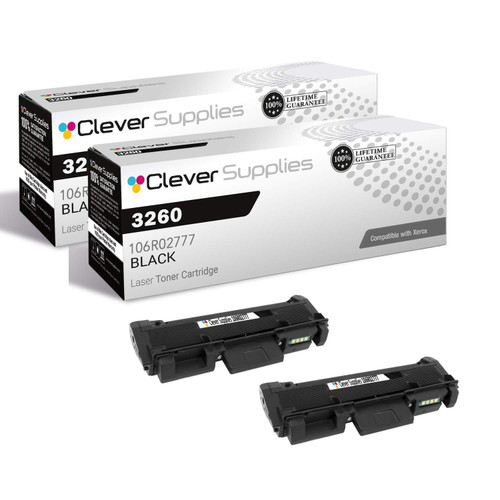
Two high-capacity cartridges in one carton: the standing order for any machine on this platform, since a mono printer with an empty bay prints nothing at all. The listing’s own introduction prices the pair at $47.28 and claims roughly $18.48 saved — base-tier figures; at the $41.11 checkout charges, each cartridge is $20.56 and the verified saving is $16.07. One limit to plan around: $41.11 stops $7.89 short of free shipping on its own. Let any single ride in the same order — $69.70 in total — and the shipping charge disappears.
See the Black 2-Pack
This is the single to buy when only one cartridge is needed: the full 3,000-page fill at the same $28.59 the standard cartridge asks. Its CS listing prints both codes in its title and rates the cartridge at 3,000 pages, which by Xerox’s table makes it the high-capacity supply — the guide treats it as such throughout. Its copy works out “roughly 1.10 cents” per page from the $32.88 base price; at the price charged the rate is 0.95¢. Against Xerox’s January 2016 list price of $82.99 for the genuine 106R02777, the compatible’s arithmetic needs no help. Ordered alone it does not ship free — it stops $20.41 under the line — so it rides best alongside a pack.
See the high-capacity single
The only standard-capacity listing in the family, and the only one of the five boxes with no CS-series counterpart. Nothing about the cartridge is wrong — it is the genuine standard fill, honestly rated at 1,500 pages, and it is the very cartridge a new machine arrives holding. What is wrong is the price beside it: $28.59 buys 1,500 pages here and 3,000 pages one listing over, and this page never mentions the other code, so the comparison is left entirely to the buyer. Its copy derives “about 2.19 cents per page” from the $32.88 base price; at sale the rate is 1.91¢ — exactly double the high-capacity single’s 0.95¢. Buy it only if matching the in-box starter cartridge is itself the goal.
See the standard single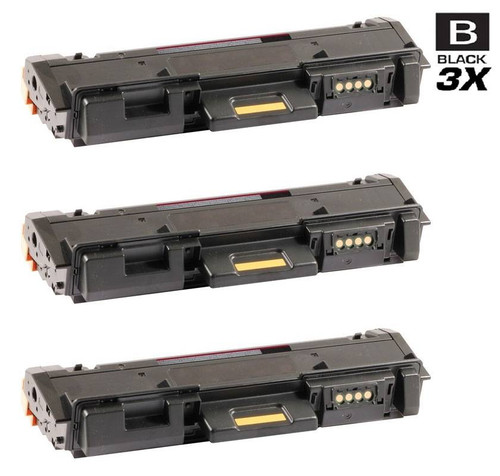
The first box on the shelf that clears the $49 free-shipping line unaided, and the natural step up from the flagship pair for a busier machine. Its copy promises “roughly $20.56 per cartridge — about $36.97 saved” on base-tier arithmetic; at the $53.63 charged, the cartridge is $17.88 and the verified saving $32.14. A twin listing sells this identical box under a “Premium Quality” name at the same price — its own copy calls the two “two doors to the same product” — so the plain posting is the one carded here.
See the 3-Pack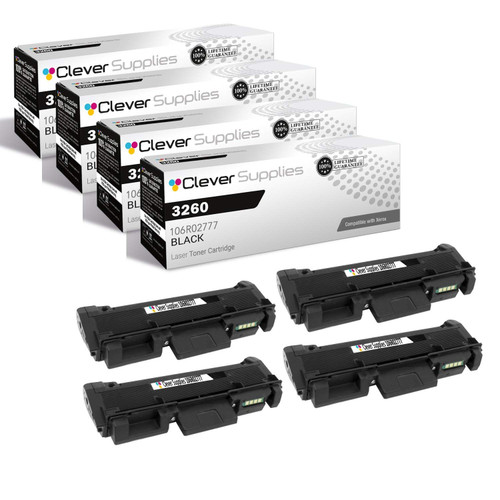
The deep-stock order: a year of ordinary mono printing for a small office in a single carton, at the family’s lowest per-cartridge and per-page figures. The listing’s copy prices the four at “$76.07… roughly $19.02 each”, sets four singles at “$131.52” and credits the pack with keeping “about $55.45” at “0.63 cents per page” — every one of those numbers reckoned at base. At the $66.15 checkout charges: $16.54 a cartridge, $114.36 for the four singles, $48.21 kept, and 0.55¢ a page.
See the 4-PackChoosing among the five: what to order when
The standing order is the flagship pair. A mono machine earns its keep only while it can print, and the 2-Pack’s shape — one cartridge working, one sealed beside the machine — is what keeps a low-toner warning from becoming a stopped office. At $41.11 it also holds the saving that matters at this scale, $16.07 against two singles. Its single weakness is the shipping line: order it with any single in the same basket, or accept the 3-Pack instead, and the weakness is gone.
The single-cartridge rule on this shelf admits no exceptions at current prices. When one cartridge is all you need, the high-capacity 106R02777 at $28.59 is the buy — full stop. The standard 106R02775 costs the same $28.59 for half the rated pages, and its one legitimate errand, replacing like with like when a machine’s starter cartridge dies young, is a niche the packs serve better anyway. If a listing ever prices the standard cartridge meaningfully below the high-capacity one, the comparison reopens; at parity it is not a comparison at all.
Volume decides between the two big packs. The 3-Pack at $53.63 is the cheapest order on the shelf that ships free by itself, and at $17.88 a cartridge it suits a machine that empties a cartridge every month or two. The 4-Pack at $66.15 pushes the cartridge to $16.54 and the page to 0.55¢ — the shelf’s floor on both measures — and asks only for cupboard space in return. Offices running two of these machines should note the pool arithmetic in the section above: the counts behave like one shared stock, so a deep order placed once beats four shallow ones placed in a panic.
Buy from the carded postings. The same five boxes wear thirty-four titles across the catalog — the high-capacity single alone appears under twelve — and the duplicates charge identical money for identical cartridges; the postings carded above are the ones each figure in this guide was checked against.
Day to day: one code to remember, one drum on its own clock
Mono cartridges at these ratings turn over often enough that memory almost works — which is exactly why it should not be trusted. Note the date and the machine’s page-counter reading on each carton as a cartridge goes in, and the closing reading as it comes out. Two or three changes later the notebook holds your office’s real yield per cartridge, measured on your paper and your coverage, and the declared 1,500 and 3,000 become reference points rather than promises. The same log settles which tier you have actually been buying, if a box ever arrives wearing both codes.
Hold one buying rule above the log: the code is the cartridge. 106R02777 on the box means the 3,000-page fill; 106R02775 means 1,500 pages, whatever a listing’s FAQ says about labels. And keep the drum on a separate line of the notebook. Each machine’s imaging drum, 101R00474, is rated at roughly 10,000 pages — about three high-capacity cartridges — and it fades on its own schedule, announcing itself in washed-out pages that a fresh toner cartridge will not cure. No toner box on this shelf includes one.
Spares keep best exactly as they arrive: sealed in their cartons, lying flat, in a cool dry cupboard away from radiators and sunlit shelves. A 4-Pack bought at the shelf’s lowest per-page price only keeps its bargain if the fourth cartridge prints as cleanly as the first, and sealed storage is what guarantees it.
What stands behind the five boxes
Every cartridge carded here is a Clever Supplies compatible built for these four machines. Behind the boxes: a one-year warranty and one-year returns on every compatible, weekday support from 9 AM to 5 PM CST, and stock moving out of four warehouses — Illinois, Pennsylvania, Georgia and California. Shipping runs free from $49; on this shelf the 3-Pack is the cheapest box that gets there on its own, and the flagship pair needs any single beside it to cross the line.
Running a Phaser 3052, 3260 or WorkCentre 3215, 3225 without surprises
Questions buyers ask about this family
Are 106R02775 and 106R02777 the same cartridge?
No — and this needs care, because some listings on this very shelf say they are. Xerox’s platform brochure lists two distinct supplies: 106R02775, Standard Capacity, rated 1,500 pages, and 106R02777, High Capacity, rated 3,000 pages, both declared under ISO/IEC 19752. They fit the same machines and differ only in fill. The store’s CS-series FAQs claim the codes are “two labels for one supply” with no standard-versus-high-yield split; the brochure’s supplies table is the authority, and it shows the split in so many words. The CS boxes themselves are rated 3,000 pages in their own copy, so this guide treats them as the high-capacity cartridge they describe.
Both singles cost $28.59. Which one should I buy?
The high-capacity one, 106R02777 — at price parity there is no trade-off to weigh: same money, same machines, twice the rated pages (3,000 against 1,500, so 0.95¢ a page against 1.91¢). The standard cartridge exists because it is the size Xerox ships inside the machine; on Xerox’s January 2016 US price list the genuine pair stood $30 apart, $52.99 for the standard and $82.99 for the high-capacity. This store prices the compatibles level, and at level prices the standard single’s only errand is matching a starter cartridge exactly.
Why do the stock counts read 131, 65, 43 and 32?
Because they are one number wearing four hats. Every listing of each size reports the identical count — 131 singles, 65 2-packs, 43 3-packs, 32 4-packs — and the pack figures are precisely 131 divided by the pack size, rounded down. Even the standard-capacity single, a different fill entirely, reports 131. Read the counts as a single shared pool propagated across the family rather than four separately counted shelves. The practical news is good either way: nothing in this family is out of stock, and the pool is the deepest in the Xerox wave so far.
Does the Black 2-Pack ship free?
Not by itself. At $41.11 it stops $7.89 short of the $49 free-shipping line — and it would miss even at its $47.28 base price, by $1.72. Two easy fixes: add any single to the same order (2-Pack plus single comes to $69.70 and ships free), or take the 3-Pack at $53.63, the cheapest box on the shelf that clears the line unaided. The 4-Pack at $66.15 clears it too.
Is the “Premium Quality” 3-pack different from the plain one?
No. The Premium listing sells the identical box — same three high-capacity cartridges, same 9,000 rated pages, same $53.63, same stock figure of 43 — and says so in its own copy: “The standard 106R02777 3-pack and this Premium Quality listing are two doors to the same product.” Only the UPC differs. This guide cards the plain listing once; buying either door delivers the same cartridges.
What about the drum — is it in any of these boxes?
No. These machines keep the imaging drum in a separate cartridge, 101R00474, rated at around 10,000 pages — roughly three high-capacity toner cartridges — and each machine ships with one in the box alongside its starter toner. The store sells compatible drums in their own listings, in a separate parts family; no toner single or pack on this shelf includes one, and a toner change never renews it. Fading that survives a fresh toner cartridge is the drum’s way of introducing itself.
How this guide was put together
Two sources underpin this guide: the store’s listings and Xerox’s published documentation for the platform — principally the Phaser 3260 / WorkCentre 3215/3225 brochure (326BR-02UD), whose supplies table fixes the tier map, and Xerox’s January 2016 US price list for the genuine prices. Thirty-four store products answer to these two codes; reduced to physical boxes they are five distinct items, and each is carded once here, under the posting whose figures were verified; duplicate postings are not linked and do not count toward the shelf. All prices are November 2026 sale prices; because the listings reckon from a higher base tier, each saving, per-cartridge figure and cost per page has been worked out afresh from the charged prices. One convention is stated openly: the store’s CS-series boxes carry both codes in their titles and rate their cartridge at 3,000 pages, so this guide treats them as the high-capacity fill and computes their figures at 3,000 — the rating their own copy claims and Xerox’s table assigns to that fill. Genuine Xerox prices appear only with their January 2016 date attached; no current genuine price could be verified, so none is implied. The regional codes 106R02778 and 106R02782 and the drum unit 101R00474 are named as fences only — nothing here sells or links them. The stock figures are a November 2026 count and follow the shared-pool pattern described above; the Phaser 3052’s print speed is not stated anywhere in this guide because no Xerox figure for it could be verified.