




Begin with the Black 2-Pack at $80.45: 11,800 rated pages, $40.23 a cartridge, $16.07 kept against two singles, and free shipping without help from anything else in the basket. Know which rung of the ladder you are standing on before you order. The 106R02720 is the standard tier of three — above it sit a 14,100-page high-capacity cartridge and a 25,300-page extra-high, each under its own code and its own guide. This shelf sells only the standard fill, which is also the fill your machine arrived holding — Xerox packs the full 5,900-page cartridge in the box, not a reduced starter. One warning travels with the single: at $48.26 it falls $0.74 short of free shipping alone, the narrowest miss on any Xerox shelf we have measured. Every price in this guide is the sale price; the listings’ own sums, struck from base prices, are corrected in the open further down.
Two machines, three configurations, and a pair of regional twins
One engine wears two badges. As the Phaser 3610 it is a mono A4 workgroup printer; as the WorkCentre 3615 the same engine gains a scanner and becomes a multifunction machine. Xerox’s brochure for the pair quotes up to 47 pages per minute on Letter paper (45 on A4), a duty cycle of up to 110,000 pages a month, print resolution up to 1200 × 1200 dpi, and paper handling that starts at 700 sheets (150-sheet bypass over a 550-sheet main tray) and grows to 2,350 with three optional feeders. Both machines speak PostScript 3 and PCL.
Xerox’s own configuration list names exactly three machines: the Phaser 3610N, the network printer without automatic two-sided printing; the Phaser 3610DN, which adds the duplex unit; and the WorkCentre 3615DN, the multifunction version with a 60-sheet duplex document feeder on top. The store’s catalogue also speaks of a plain “WorkCentre 3615” and a “Phaser 3610YDN”; neither form appears in the brochure’s configuration table, and what the Y would denote no Xerox document read for this guide explains, so this guide presents the three documented configurations and vouches for no suffix letter by letter. The caution costs nothing at the till: the bay is identical on every form of the machine.
Two of the six nameplates on the listings are not Xerox US models at all but Fuji Xerox’s Asia-Pacific twins of the same hardware. The DocuPrint M455 df is the WorkCentre 3615’s counterpart — Fuji Xerox’s brochure gives it the same 495 × 492 × 549 mm footprint and 21.5 kg weight, in the duplex-and-fax multifunction configuration — and the DocuPrint P455 d is the Phaser 3610’s, at the same 393 × 426 × 315 mm, a duplex printer. Machines sold under those badges take the same cartridge bay, which is why the store lists this cartridge under their names; their store categories are hidden, so they are named here and in the listings but never linked, and Fuji Xerox’s own regional cartridge codes are a separate matter from the code on this page.
The bottom rung of a three-rung ladder
Xerox built three fills for this engine, and the code on the box — not the printer’s nameplate — tells you which one you are holding. The whole map, from the Phaser 3610 / WorkCentre 3615 brochure (36CBR-02EA):
| Part number | What Xerox calls it | Rated yield | Sold as |
|---|---|---|---|
| 106R02720 | Standard Capacity Toner Cartridge | 5,900 pages | Single · 2-pack · 4-pack — this guide |
| 106R02722 | High Capacity Toner Cartridge | 14,100 pages | Its own shelf, under its own guide |
| 106R02731 | Extra-high Capacity Toner Cartridge | 25,300 pages | Its own shelf, under its own guide |
| 113R00773 | Drum Cartridge | 68,000 pages (brochure) — see below | Not sold here — context only |
The footnote under that supplies table is the sentence this guide leans on: “Average standard pages. Declared Yield in accordance with ISO/IEC 19752. Yield will vary based on image, area coverage and print mode.” The 5,900-page figure is therefore a declared yield under the mono toner test standard, not a marketing estimate — and Xerox’s syndicated data for this code independently records the same ISO/IEC 19752 measurement basis. For price scale, Xerox’s US Solutions Providers Price List of January 1, 2016 priced the genuine 106R02720 at $160.99, the high-capacity 106R02722 at $299.99 and the extra-high 106R02731 at $405.99; those are dated list figures, quoted with their date — the compatible single below costs $48.26, under a third of the genuine cartridge’s 2016 list price.
What arrives inside a new machine matters to anyone timing a first refill. The brochure’s what’s-in-the-box list names a toner cartridge of 5,900-page capacity — the full standard cartridge, this guide’s cartridge, not a shortened starter fill. So the first compatible you fit restores exactly the range the machine started with, and a first cartridge that feels short beside the high-capacity tier is simply the ladder working as printed: the step to 14,100 pages belongs to a different code, bought deliberately.
One fence, drawn firmly. The WorkCentre 3655 and 3655i look like close relatives of these machines and do share the drum below, but Xerox assigns them a separate toner ladder of their own — 106R02736, 106R02738 and 106R02740, at 6,100, 14,400 and 25,900 pages — and the 106R02720 is not a 3655 cartridge in Xerox’s map. That family is covered by its own guide. Nothing in this family’s eighteen listings claims otherwise: the number 3655 appears in none of them.
The drum deserves its own paragraph because Xerox disagrees with itself about it. The part is not in doubt: the drum cartridge 113R00773 serves the Phaser 3610, the WorkCentre 3615 and the 3655 line alike, and this store sells no listing for it, so it is context here and carded nowhere. Its rating, though, depends on which Xerox document you open. The 3610/3615 product brochure rates the drum at 68,000 pages; the WorkCentre 3615 Detailed Specifications rate the same part at 85,000 impressions. Both figures are Xerox’s, printed in Xerox’s own documents, and this guide reports both rather than picking a winner: plan on the drum question arising somewhere beyond eleven standard cartridges of toner, and treat either number as the maker’s estimate rather than a promise.
One inflated blurb, and arithmetic done at base throughout
The single wrong yield in this family lives in the oldest listing’s header. That posting’s legacy spec blurb announces a cartridge that “yields approximately 9500 pages” — 3,600 pages beyond Xerox’s declared 5,900, in a blurb that also misspells the machine line as “WorkCenter”. The same listing’s body copy below the blurb says 5,900 throughout, so the page contradicts itself: the blurb is a stale block its newer text never caught up with. Everywhere else the family is exact — the remaining seventeen listings state 5,900 pages and the honest pack multiples, 11,800 and 23,600 — and every rate in this guide divides by Xerox’s figure.
The money, as on so many of this store’s shelves, is worked at a base price a step above the till (the charged price is the base divided by 1.15). The single is “priced at $55.50”, and “At $55.50 against a 5,900-page rating, the arithmetic lands at roughly 0.94 cents per page” — at the $48.26 charged, the rate is about 0.82¢. The 2-Pack’s copy sets two singles at $111.00 against its $92.52, “which saves $18.48 and drops the per-cartridge price to $46.26”, at “roughly 0.78 cents” a page; checkout charges $80.45, which makes the saving $16.07, the cartridge $40.23 and the rate 0.68¢. The 4-Pack totals “Four singles at $55.50 would total $222.00, so the pack saves $55.46”, at a per-cartridge price of “roughly $41.64” and “roughly 0.71 cents” a page; at sale the figures are $144.82, $48.22 kept, $36.21 a cartridge and 0.61¢. The older single’s FAQ repeats the base pack figures, pitching the 2-pack’s cartridge at $46.26 and the 4-pack’s at roughly $41.64. Every figure in this guide is therefore rebuilt from the sale price.
What is absent deserves equal billing. No listing in this family carries drum-cartridge copy pasted onto a toner page — the misdirected boilerplate that disfigured three earlier Xerox families never reached this shelf — and no listing makes any chip claim at all, so this guide adopts none: there is no supplier statement here to rest one on. Pack compositions are stated plainly and are pure multiples of the one cartridge (“There is no assortment and no variety pack involved — the ‘4’ is purely a quantity of the identical cartridge”), with no undisclosed spares or splits to bound. The counted stock is real but formulaic: one pool of thirteen cartridges divided by pack size gives thirteen singles, six 2-packs and three 4-packs, identical under every nameplate, with nothing at zero.
The whole shelf: three boxes behind eighteen listings
Eighteen catalogue titles resolve to three cartons — three quantities of a single cartridge, posted once per printer nameplate. Order through the posting carded for each size and the duplicates stop mattering: every posting of a given size asks the same money for the same contents. All prices are November 2026 sale prices; all yields are Xerox’s declared figures.
| Box | What’s inside | Sale price | Per cartridge | Cost per rated page | Ships free alone? |
|---|---|---|---|---|---|
| Black 2-Pack | 2 × 10⁶R02720 standard | $80.45 | $40.23 | ≈0.68¢ | Yes — the cheapest free box |
| Single | 1 × 10⁶R02720 | $48.26 | $48.26 | ≈0.82¢ | No — misses by $0.74 |
| 4-Pack | 4 × 10⁶R02720 standard | $144.82 | $36.21 | ≈0.61¢ | Yes |
Cost per page divides the sale price by Xerox’s declared rating, and because only one fill is sold here the divisor is 5,900 pages in every row. The last column carries this shelf’s one real trap: the single stops seventy-four cents short of the $49 free-shipping line, so the smallest box is the only one that pays postage on its own.
Three boxes, each with its own arithmetic

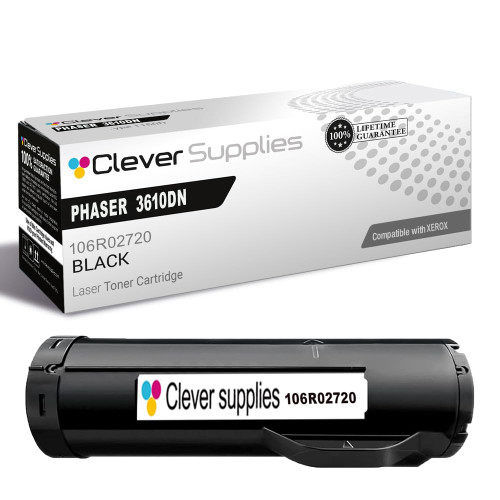

Choosing among the three: volume decides, postage casts one vote
With one fill in three quantities, the choice is mostly about how fast the machine eats cartridges — but postage gets a say exactly once. The single is the only box that does not ship free alone, and it misses by $0.74: close enough to sting, far enough that the postage is real. If a single is all you need, adding anything else to the basket cures the problem; if it travels alone repeatedly, the 2-Pack’s lower per-cartridge price and free carriage overtake it quickly.
At light volume — up to roughly fifteen hundred pages a month — a 5,900-page cartridge lasts about four months, and the standard tier is honestly sized for the work. The single serves the owner who reorders promptly; the 2-Pack serves the owner who would rather hold a sealed spare and think about toner twice a year. There is no economy in stocking deeper at this pace: the $12.05 per-cartridge gap to the 4-Pack does not justify a shelf of ageing cartridges in a quiet office.
In the middle band, fifteen hundred to five thousand pages a month, a cartridge turns over every five or six weeks at the top of the range. Make the 2-Pack the standing order — one fitted, one sealed, reorder when the spare goes in — and the machine never waits on a delivery. Offices running two or three of these machines on the same engine should pool their stock rather than stocking per machine; every configuration and both badges draw on the identical cartridge.
Past five thousand pages a month, buy the 4-Pack and order rarely: 23,600 pages is roughly a quarter’s cover at that pace, at the shelf’s floor price of $36.21 a cartridge. One honest caveat belongs here: sustained heavy volume is what the ladder’s upper rungs were built for. A 14,100-page high-capacity cartridge cuts swap frequency by well over half, and its shelf — not this one — is where that comparison belongs.
Day to day: a full-size first cartridge and a drum on a long clock
Do not expect the rhythm change other platforms teach. Machines that ship with a reduced starter make the second cartridge feel miraculous; this one ships with the full 5,900-page standard cartridge, so cartridge two lasts exactly as long as cartridge one did, and the reorder interval you learn in the first months is the interval you keep. Note the page-counter reading on the carton at each swap anyway — after two or three changes you will know your own yield at your own coverage, which is the only figure that predicts the next order honestly.
The second clock inside the machine belongs to the drum cartridge, 113R00773, and it runs far slower than the toner’s: Xerox’s 3610/3615 brochure rates it at 68,000 pages, the WorkCentre 3615 Detailed Specifications at 85,000 impressions — somewhere between eleven and fourteen standard cartridges either way. This store sells no drum listing, so there is nothing to add to the basket here; when a high-count machine’s print quality fades and a fresh toner cartridge changes nothing, the drum’s age is the next thing to check.
When a cartridge does near its end, the print fades down one side of the page: take the cartridge out, rock it gently side to side to redistribute what toner remains, and finish the job — then fit the spare, because a fade that returns within days means the cartridge is genuinely empty. Keep the spare sealed, flat, cool and dry, and read the code off the spent unit before you reorder: the printer’s name multiplies into half a dozen forms, but 106R02720 never changes.
What stands behind the three boxes
Behind every box carded here stands the same Clever Supplies compatible for the Phaser 3610 and WorkCentre 3615, and the same terms: a one-year warranty, one-year free returns, weekday support between 9 AM and 5 PM CST, and dispatch out of four warehouses — Illinois, Pennsylvania, Georgia and California. Shipping is free from $49 upward; on this shelf both packs qualify by themselves, and the single falls $0.74 short, so a lone cartridge needs a companion item to travel free.
Running a 3610 or 3615 without surprises
Questions buyers ask about the 106R02720
Which cartridge does my Phaser 3610 or WorkCentre 3615 take?
One bay, three fills. Every configuration — 3610N, 3610DN, 3615DN, and the DocuPrint-badged twins — accepts the same three Xerox codes: the standard 106R02720 at 5,900 pages (this guide’s shelf), the high-capacity 106R02722 at 14,100 and the extra-high 106R02731 at 25,300, each sold under its own guide. Read the code off the cartridge you remove; if it says 106R02720, you are in the right place. The WorkCentre 3655 is the exception to keep clear of: a sibling in looks that takes its own code set.
Is the 106R02720 a high-yield cartridge?
No — it is the standard-capacity cartridge, and Xerox’s own data says so: the brochure lists it as “Standard Capacity Toner Cartridge: 5,900 pages”, and Xerox’s syndicated product data records its yield type as Standard. The high-capacity rung is the 106R02722 at 14,100 pages. Nothing on this shelf mislabels the tier: the listings call this cartridge standard or leave the tier unnamed, and the 5,900-page rating is declared under ISO/IEC 19752, so the modest number is at least an honestly measured one.
One listing says this cartridge yields about 9,500 pages. Which figure is right?
Xerox’s figure: 5,900 pages, declared under ISO/IEC 19752. The 9,500-page claim sits in the oldest listing’s legacy header blurb — the same blurb that misspells the machine line “WorkCenter” — and the body copy of that very listing states 5,900 throughout, as do all seventeen other listings in the family. The blurb is a stale block that was never updated; every per-page rate in this guide divides by 5,900.
Does this platform have a separate drum, and how long does it last?
Yes — unlike the toner, the drum is its own part: 113R00773, shared with the WorkCentre 3655 line. This store sells no listing for it, so it appears in this guide as context only. Its rating is the one number Xerox states two ways: the Phaser 3610 / WorkCentre 3615 brochure gives 68,000 pages, while the WorkCentre 3615 Detailed Specifications give 85,000 impressions. Both are Xerox’s own figures from Xerox’s own documents; this guide prints both rather than choosing between its sources. Either way, the drum outlasts somewhere between eleven and fourteen standard toner cartridges.
Will this cartridge fit my DocuPrint M455 df or P455 d?
The machines are Fuji Xerox’s Asia-Pacific twins of this platform — the M455 df matches the WorkCentre 3615 dimension for dimension as its duplex-and-fax multifunction form, and the P455 d matches the Phaser 3610 as its duplex printer form — and the store lists this cartridge under both nameplates for the same bay. Their store categories are hidden, so they are named in copy but linked nowhere, and Fuji Xerox’s own regional cartridge codes for those machines are a separate line from the 106R02720 this shelf sells.
How long will a 2-Pack last me?
Two cartridges, 11,800 rated pages in total. At 1,500 pages a month the pair runs to roughly eight months; at 3,000 a month, about four; at 5,000 a month, a little over two — the tempo at which the 4-Pack’s $36.21 cartridge starts to pay. Treat those as planning figures at the declared rating, nothing more; dense pages burn toner faster, and after a couple of changes your own counter log will give you numbers worth trusting.
How this guide was put together
Two evidence bases support everything above: the store’s own listings, and Xerox’s published documents — above all the Phaser 3610 / WorkCentre 3615 brochure (36CBR-02EA), whose supplies table and ISO/IEC 19752 footnote fix the three-tier ladder, the in-box contents and the drum’s brochure rating, supplemented by the WorkCentre 3615 Detailed Specifications, Fuji Xerox’s brochures for the DocuPrint twins, and Xerox’s US Solutions Providers Price List of January 1, 2016 for genuine pricing. Eighteen store products carry this code, and they reduce to three physical boxes, each posted six times under the platform’s six nameplates; each box is carded once, under the posting whose figures were verified, and no duplicate posting is linked or counted. Eight further listings name this code only as a contrast to the high-capacity cartridge they sell; they belong to that family and are neither carded nor linked here. Prices throughout are November 2026 sale prices, and since the listings reckon from a higher base tier, all savings, per-cartridge figures and per-page costs here were rebuilt from the prices actually charged. Four positions are stated openly. First, the yield: 5,900 pages, declared under ISO/IEC 19752 on Xerox’s own footnote; the single 9,500-page blurb is a stale block contradicted by its own listing and is corrected wherever it matters. Second, the drum: the part number is certain and the rating is not — Xerox’s brochure says 68,000 pages and its detailed specifications say 85,000 impressions, so both are printed with their sources rather than one being silently preferred. Third, the chip: no listing in this family makes a chip claim, so this guide adopts none. Fourth, housekeeping: the flagship posting’s SKU carries a “2Balck” typo, recorded here and left as found; MPN and GTIN stand blank on all eighteen listings, and a UPC survives only on the oldest single. The machines are presented as Xerox documents them — three configurations across two badges, the DocuPrint forms as Fuji Xerox’s dimensional twins, and the store’s extra nameplates named without being vouched for letter by letter. Stock and availability are as read in November 2026.