




One cartridge, fourteen printers, four brand badges. Ricoh's part 402809 is a black all-in-one print cartridge built for the SP 4100 workgroup platform, sold under more names than almost any other in this catalog — seven Ricoh Aficio models, plus the same hardware wearing Gestetner, Lanier and Savin badges. The cartridge itself could hardly be better documented: Ricoh rates it at 15,000 pages under the ISO/IEC 19752 standard, and our listings agree to the page. The faults sit in the paperwork around it. Every saving on this family's product pages was worked out at list prices rather than the sale prices in force now; the question-and-answer text shrinks the fit down to a single model, contradicting the fourteen-model fit line on the very same pages; and the three largest boxes on the ladder record zero stock while staying open for orders. This guide links the full roster, reprices the shelf at checkout, and flags the stock position before you buy.
The short answer: start with the 2-pack at $249.93 — two cartridges at $124.97 apiece instead of $133.01 bought one at a time, one fitted and one sealed in reserve. Deep stock belongs in the 10-pack at $1,185.35, where the unit price bottoms out at $118.54. Every box on the ladder, the single included, clears the $49 free-shipping line by itself, so the only real decision is how deep a reserve you want standing behind the machine.
A single code feeds the entire platform: the 402809 black cartridge is rated at 15,000 pages under ISO/IEC 19752, the figure Ricoh itself publishes, and we sell the identical sealed unit five ways — a single ($133.01), a 2-pack ($249.93), a 3-pack ($366.86), a 5-pack ($600.72) and a 10-pack ($1,185.35). For most workgroups the 402809 2-pack is the right landing spot: $16.09 kept against two singles, a reserve cartridge from the first shipment, and free shipping without a second item in the order.
Fourteen model names sharing one cartridge
The SP 4100 family was Ricoh's workgroup mono line, and it spread widely: networked printers, multifunction variants and a security-hardened edition, all drawing toner from the same bay.Under the Ricoh badge the cartridge serves the Aficio SP 4100N, Aficio SP 4100N-KP, Aficio SP 4100SF, Aficio SP 4100SFL, Aficio SP 4110N, Aficio SP 4110SF and Aficio SP 4310N. Ricoh also sold the identical machines through its sister brands, and — unusually for this catalog — those badge twins have live categories here too: the Gestetner P7031 and P7035, the Lanier LP 131, LP 136 and SP 4310, and the Savin MLP31N and MLP36N. Every box below is filed under all fourteen categories — if any of those names is on your machine's badge, it fits.
Two names in the listings' "also fits" notes deserve a caveat rather than a link. The Lanier LP37n and the Savin MLP37N are named there as further badge variants, but neither has a category or a listing anywhere in this store — they exist in our catalog only as words in that paragraph. Treat them as fit information, stated here in prose: if your machine wears one of those badges, Ricoh's platform documentation puts it on this cartridge, and the boxes below are the ones to order. One filing quirk: the SP 4310 is the Lanier twin, yet its category sits in the Ricoh tree under the name "Aficio SP 4310." The category is live and holds these products, so we link it as filed.
One code, one rating — taken from Ricoh's own sheet
A black-only platform needs no color map, and this one needs no yield detective work either. Ricoh's specifications for the Aficio SP 4100N-KP list exactly one consumable for the platform — "All-in-One Print Cartridge Part #402809 (15,000-page yield)" — footnoted as declared in accordance with ISO/IEC 19752, the international standard for measuring monochrome toner yield. Our listings print 15,000 pages in their fit notes, question sections and descriptions alike: manufacturer, catalog copy and checkout page all carry the same number, on a documented basis. Every per-page cost in this guide is divided out of that rating.
| Cartridge code | Color | Ricoh rated yield | Declared basis |
|---|---|---|---|
| 402809 | Black (all-in-one) | 15,000 pages | ISO/IEC 19752 (Ricoh SP 4100N-KP specifications) |
Two footnotes belong in the open. First, the starter: these machines left the factory with a 6,000-page starter version of this same cartridge, per Ricoh's specification sheet, so the replacement outlasts the unit your printer arrived with by two and a half times. If the first cartridge seemed to run dry quickly, you were measuring the starter fill, not the replacement. Second, the aliases: Ricoh's numbering also sells this identical cartridge as 406997, under the name "Type 120," and in Europe as 407649. Neither code has a single listing in this store — there is no second shelf to wander onto — so the numbers matter only if a cross-reference sends you hunting for them. And keep one neighboring platform out of the arithmetic entirely: the smaller SP 4100L and SP 4100NL take a different, 7,500-page cartridge that we do not stock, and that figure never applies here.
The savings claims on the product pages need the standard correction. Each was struck against list prices — a single at $152.96 — rather than against the prices the register applies. Recomputed at checkout, the 2-pack saves $16.09 rather than the $18.50 its page advertises, at $124.97 a cartridge rather than $143.71; the 10-pack saves $144.75 rather than $166.45. The ladder genuinely descends — its paperwork simply grades every rung against a price nobody is paying, and each rung is corrected in the walk-through below.
The ladder at checkout prices
Anchor the ladder on the single's $133.01, because every pack is a discount measured against it. Two cartridges bring the unit price to $124.97; three, to $122.29; five, to $120.14; ten, to $118.54. In cost per rated page the same descent runs from about 0.89 cents for a cartridge bought alone to roughly 0.79 cents at the top — roughly a tenth shaved off the per-page running cost, earned purely by ordering cartridges in company. Nothing else differs from box to box: each holds the same sealed 402809 unit, so the choice is never about output quality, only about toner depth.
| Box | Checkout price | Cost per cartridge | Against buying singles | Suits |
|---|---|---|---|---|
| 402809 black 2-pack THE DEFAULT ORDER | $249.93 | $124.97 | Saves $16.09 vs two singles | A single machine in daily service: one cartridge running, one sealed in reserve. |
| 402809 black 3-pack | $366.86 | $122.29 | Saves $32.17 vs three singles | A busier lone printer, or a pair of machines pooling one reserve shelf. |
| 402809 black 5-pack | $600.72 | $120.14 | Saves $64.33 vs five singles | Heavier volume across one busy machine or a small fleet. |
| 402809 black 10-pack | $1,185.35 | $118.54 | Saves $144.75 vs ten singles | Several machines drawing on one supply room, or one very heavy printer. |
| 402809 black single | $133.01 | $133.01 | — | Testing a compatible for the first time, or feeding a machine that prints rarely. |
Two honest footnotes. Shipping: every box here passes the $49 free-shipping line alone — the single clears it by $84.01. Stock: the ladder's top three rungs — the 3-pack, 5-pack and 10-pack — remain orderable today even though the catalog shows no units behind any of them; the single (3 units) and the 2-pack (1 unit) held recorded stock when we checked, and neither is deep. If your need is urgent, the stocked rungs are the safer click.
Read as a calendar, the ladder prices itself. A 15,000-page cartridge in a machine printing 2,000 pages a month lasts the better part of eight months, so a 2-pack covers well over a year and a 10-pack runs past six years — longer than most offices should plan toner. At 6,000 pages a month the same cartridge turns over in ten weeks, and the 10-pack becomes a two-year supply for one machine or a shared reserve for several.
Each box on its own merits

Workgroup printers pick their moment badly — output fades halfway through the morning's largest job, never during a quiet spell. This box is the hedge against that day. Fit the first cartridge now and its twin stays sealed in the cupboard, so when the warning comes, the replacement is a walk down the hall rather than a delivery window; swapping it in is also your signal to reorder, which keeps the reserve from ever quite reaching zero. The economics point the same way: at $124.97 a unit, the pair undercuts two separate single orders by $16.09. One caution rides with it — recorded stock behind this box was a single unit when we checked, so it rewards ordering promptly rather than eventually.
View the 2-Pack →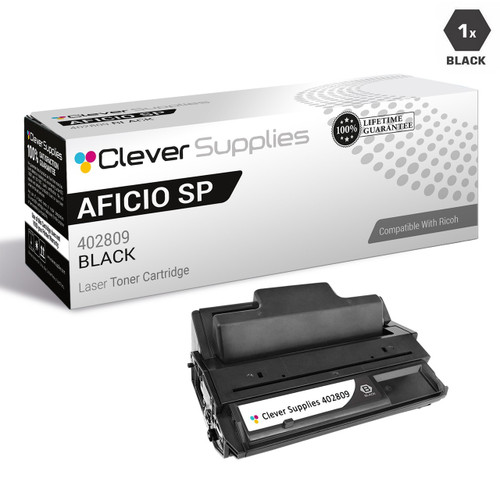
Every other price on this shelf is defined against this one: the packs exist as discounts off $133.01. The single also serves two buyers directly. The cautious one gets a lone cartridge to judge against their own printouts before a pack asks for real money. The light user — a few hundred pages a month — will take years to empty even one of these, and for that desk the larger boxes are inventory in search of a purpose.
View the Black Single →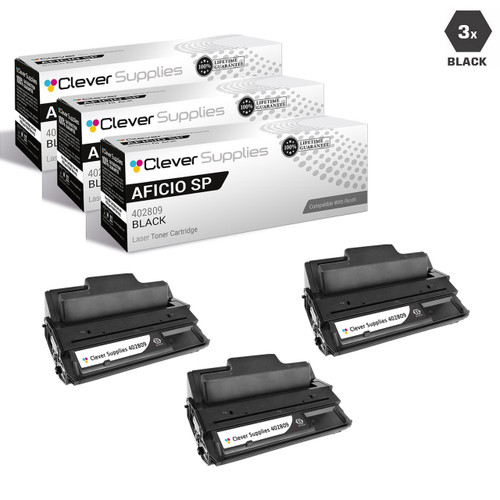
Three is the commitment rung: enough depth that toner drops off the agenda for a long stretch, without the capital the two boxes above it tie up. At $122.29 apiece, the trio keeps a busy single printer supplied for many months; spread across two machines, it covers a fitted cartridge in each with a shared reserve behind them. The caveat is availability rather than value — this listing accepts orders against a stock record of zero, so plan it as replenishment bought ahead, not as the box you reach for mid-outage.
View the 3-Pack →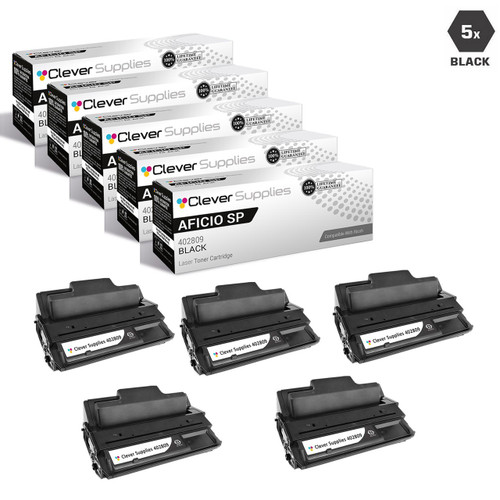
Five cartridges at $120.14 apiece is where the discount stops being a courtesy and starts being a budget line: $64.33 stays in the account against five separate single orders, and 75,000 rated pages arrive in one delivery. For a lone machine that is a very long silence between toner orders; for a small fleet it is a shared reserve that absorbs whichever printer calls first. The stock position matches the 3-pack's — orderable, with nothing recorded behind it at our check — so buy it while the current cartridge is healthy, not after it fades.
View the 5-Pack →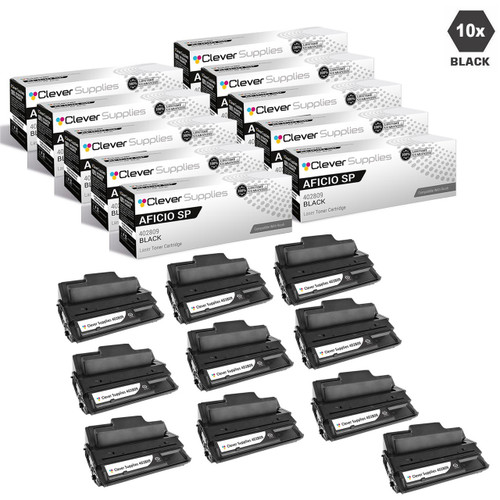
Nothing about this box is complicated: it is the same cartridge, ten deep, at the lowest unit price the family offers. The $144.75 it holds back against ten single orders is the largest single saving on the shelf, and it even undercuts the obvious alternative — two 5-packs reach the same ten cartridges for $16.09 more. Its natural home is a supply room feeding several SP 4100 machines, or the one networked unit whose monthly count runs into the thousands. Like the two rungs beneath it, it stands open for orders against a zero stock record, so place it as a planned replenishment and let the stocked single and 2-pack cover anything urgent.
View the 10-Pack →Assembling the order
A worked example: one reserve shelf of ten
Picture a facilities cupboard serving three SP 4100 machines, with a standing reserve of ten cartridges. Bought one at a time, that stock costs 10 × $133.01 = $1,330.10. Assembled as two 5-packs at $600.72, the same ten come to $1,201.44. Bought as a single 10-pack, they cost $1,185.35. The biggest box therefore keeps $144.75 against the singles route, plus a further $16.09 against the pair of 5-packs — and since this platform carries exactly one cartridge grade, those pack gaps are the only savings mechanism there is to capture.
Why the listings promise bigger savings than the checkout delivers
Every gap between a product page's claims and this guide's figures traces to a single habit: the listings did their subtraction at list prices. Start with the single, whose page works from $152.96 and arrives at "roughly 1.02 cents per page" — at the checkout's $133.01, the honest figure is nearer 0.89 cents. The 2-pack advertises $143.71 a cartridge and $18.50 saved; the register says $124.97 and $16.09. The 3-pack's claimed $36.99 saving becomes $32.17. The 5-pack quotes $73.97 saved and $138.17 a cartridge, where sale prices give $64.33 and $120.14. The 10-pack completes the pattern: $166.45 saved and $136.32 a cartridge on its page, $144.75 and $118.54 once sale prices speak. The packs are worth their prices — their pages simply grade them against a price nobody pays. Trust the version of the sum you can redo from the two figures on the page in front of you; that is the method used everywhere in this guide.
Fourteen machines in the fit line, one in the answers
The strangest defect in this family is a disagreement between two parts of the same product pages. The fit line names fifteen entries — fourteen distinct models once you notice "SP 4310N" is printed twice, with the badge twins listed bare, without their Gestetner, Lanier and Savin prefixes. The question sections then answer as if none of that existed: the cartridge is "built for Ricoh Aficio SP 4100N," it "covers the SP 4100N units only," and owners of anything else are told to check their cartridge code. Ricoh's own specifications settle the argument in favor of the fit line — one cartridge, documented for the platform. This guide follows the fit line and Ricoh, links all fourteen categories, and treats the narrowed answers as a copy error that could talk a third of this platform's owners out of the right cartridge.
Living with the platform
Chips: fitted at the supplier, current revision
Our supplier fits its most recent chip revision before these cartridges are boxed, and in service the result has been uneventful in the best sense: the printer accepts the unit, the level indicator behaves, and output proceeds — chip faults are simply not part of this supply's history with us, and nothing needs to be harvested from the empty cartridge you take out. The one reservation applies industry-wide: Ricoh writes the firmware, and an update issued in the future could alter how a machine treats third-party toner in ways no seller can foresee or honestly insure against. Judge the cartridge as it ships — current chip, twelve months of warranty, twelve months to return it.
Changing a cartridge; keeping spares
Because toner and imaging live in one housing on this platform, replacement is a single front-access job with no separate drum to track: release the spent unit and slide it out, give its successor a slow end-to-end rock so the toner settles level, strip the seal, and push the unit home until it seats. Pack cartridges arrive sealed one by one, so a reserve stays in factory condition until fitted. Keep spares flat, sealed and out of direct sun, work through them oldest first, and a cartridge drawn last from a 10-pack prints no worse for its wait.
Reading the 15,000-page rating honestly
ISO/IEC 19752 measures yield on a standard test page printed continuously, which makes 15,000 a yardstick rather than a forecast. Coverage is what moves your office away from it: correspondence and light memos hew close to the test page, while heavy forms, shaded tables and graphics-rich work draw toner down faster — a tax that falls on genuine cartridges exactly as it falls on compatibles. Your most useful calibration is already behind you: the cartridge these machines shipped with was this identical unit filled to about 6,000 pages, so whatever lifespan it gave under your workload, expect roughly two and a half times that from a full replacement.
The 402809 pre-order checklist
Answers for SP 4100 platform owners
Fourteen models across four badges: the Ricoh Aficio SP 4100N, SP 4100N-KP, SP 4100SF, SP 4100SFL, SP 4110N, SP 4110SF and SP 4310N; the Gestetner P7031 and P7035; the Lanier LP 131, LP 136 and SP 4310; and the Savin MLP31N and MLP36N. That is the roster in the listings' own fit line and in Ricoh's platform documentation. The listings' question sections contradict it by naming the SP 4100N alone — a copy error on those pages. If your model is anywhere in the fourteen, this is your cartridge.
Neither figure is a misprint — they are answers over different price sets. The listing built its claim from list prices: a pair of singles at $152.96 apiece, set against the pack's $287.42 list figure, leaves $18.50 and $143.71 a cartridge. Run the identical subtraction over the prices the checkout charges and the ground shifts: two singles come to $266.02, the pack to $249.93, the saving to $16.09, and the per-cartridge figure to $124.97. Every rung of the ladder carries the same distortion — the 10-pack's headline saving of $166.45 is $144.72 at sale prices. If a discount is going to decide your order, rebuild it from the two figures on the screen in front of you; those are the ones your payment meets.
You can place the order — all three listings are live and set to available. What the catalog cannot show behind them is a single unit: each records an inventory of zero at our check. We print that here because a delivery surprise helps nobody. Two practical routes follow. For an urgent need, stay with the rungs that held stock at checking — the single, with three units recorded, and the 2-pack, with one — or call our support team on a weekday (9 AM–5 PM CST) to have a top rung's position confirmed before you commit. For a planned replenishment, ordering a zero-stock rung is a much smaller gamble, since timing matters less than price.
By a wide margin. Ricoh's specification sheet for this platform gives the factory cartridge a 6,000-page fill — the same all-in-one unit, loaded lighter. A retail replacement carries the full 15,000-page rating in that identical housing, which works out to roughly two and a half starters' worth of printing per cartridge. So if the original seemed to give up early, the explanation sits in the fill it left the factory with, not in the machine's appetite or the cartridge's design.
In this family, yes — every rung qualifies unaided. The threshold is $49, and the shelf's floor price is the single at $133.01, which clears it by $84.01 before anything else joins the order; the packs clear it by hundreds. That is not the pattern across the whole store, which is why the point earns its own answer here: with this platform, pack size can be decided on volume and stock alone, and freight never has to enter the reasoning.
Each cartridge leaves our supplier with the newest chip revision fitted, and in service that has meant exactly what you would hope: the printer recognizes the unit on insertion, the level reporting behaves, and no component needs rescuing from the cartridge you removed. Our history with this supply contains no chip complaints. The honest boundary concerns tomorrow rather than today — Ricoh controls its firmware, and an update that does not yet exist could one day change a machine's response to third-party toner; no seller of compatibles can truthfully promise otherwise. What covers the cartridge in your hands is that fitted chip, a year of warranty, and a year in which to return it.